ESP PORSCHE BOXSTER 2009 2.G Workshop Manual
[x] Cancel search | Manufacturer: PORSCHE, Model Year: 2009, Model line: BOXSTER, Model: PORSCHE BOXSTER 2009 2.GPages: 294, PDF Size: 6.89 MB
Page 239 of 294
Practical Tips, Emergency Service
237
Changing a wheel
Warning!
Risk of serious personal injury or death. The
car may slip off the jack.
f Make sure that no one is in the vehicle when
jacking up and changing a wheel.
f Always place the car on stable supports if work
has to be carried out under the car.
Risk of damage to the brake discs of the
Porsche Ceramic Composite Brake (PCCB).
f Always screw in both assembly aids when changing a wheel.
Note
The tools required for changing a wheel (e.g. jack,
wheel bolt wrench, assembly aids) are not sup-
plied with the car.
Your authorized Porsche dealer will be pleased to
advise you.
1. Apply the handbrake fully and engage 1st gear or PDK selector-lever position P and remove
the ignition key.
2. Switch on the hazard warning lights if neces- sary.
3. Secure the car against rolling away, e.g. by
means of wedges under the wheels on the op-
posite side.
This is particularly important on slopes. 4. Slightly slacken the whee
l bolts of the wheel to
be changed.
5. Lift the car only at the specified jacking points.
6. Raise the car until the wheel lifts off the ground.
Please see the chapter “LIFTING THE VEHICLE
WITH A LIFTING PLATFORM OR GARAGE LIFT”
on Page 242.
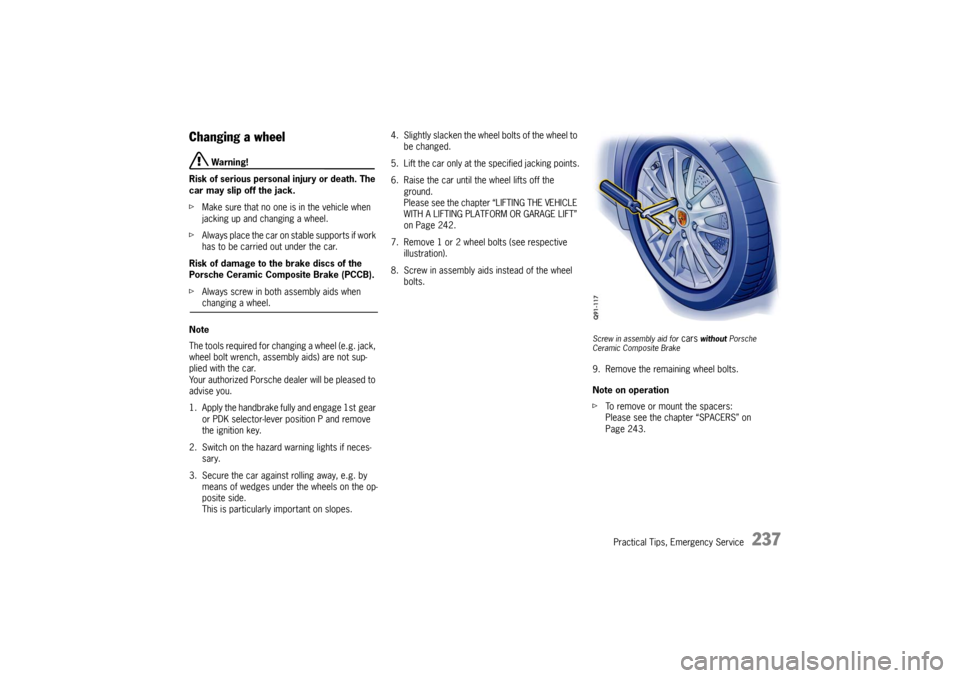
7. Remove 1 or 2 wheel bolts (see respective illustration).
8. Screw in assembly aids instead of the wheel bolts.
Screw in assembly aid for
cars
without Porsche
Ceramic Composite Brake
9. Remove the remaining wheel bolts.
Note on operation
f To remove or mount the spacers:
Please see the chapter “SPACERS” on
Page 243.
Page 242 of 294
240
Practical Tips, Emergency Service
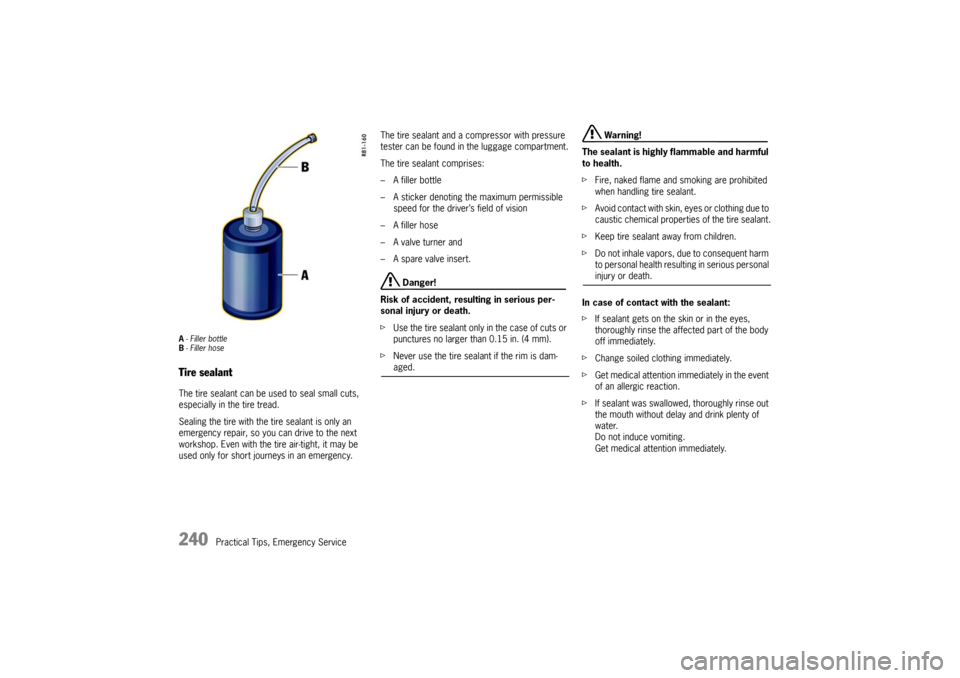
A- Filler bottle
B - Filler hoseTire sealantThe tire sealant can be used to seal small cuts,
especially in the tire tread.
Sealing the tire with the tire sealant is only an
emergency repair, so you can drive to the next
workshop. Even with the tire air-tight, it may be
used only for short journeys in an emergency. The tire sealant and a compressor with pressure
tester can be found in the luggage compartment.
The tire sealant comprises:
– A filler bottle
– A sticker denoting the maximum permissible
speed for the driver’s field of vision
– A filler hose
– A valve turner and
– A spare valve insert.
Danger!
Risk of accident , resulting in serious per-
sonal injury or death.
f Use the tire sealant only in the case of cuts or
punctures no larger than 0.15 in. (4 mm).
f Never use the tire sealant if the rim is dam-aged.
Warning!
The sealant is highly flammable and harmful
to health.
f Fire, naked flame and smoking are prohibited
when handling tire sealant.
f Avoid contact with skin, ey es or clothing due to
caustic chemical properties of the tire sealant.
f Keep tire sealant away from children.
f Do not inhale vapors, due to consequent harm
to personal health resulting in serious personal injury or death.
In case of contact with the sealant:
f If sealant gets on the skin or in the eyes,
thoroughly rinse the affect ed part of the body
off immediately.
f Change soiled clothing immediately.
f Get medical attention immediately in the event
of an allergic reaction.
f If sealant was swallowed, thoroughly rinse out
the mouth without delay an d drink plenty of
water.
Do not induce vomiting.
Get medical attention immediately.
Page 249 of 294
Practical Tips, Emergency Service
247
Replacing fuses In order to prevent damage to the electrical sys-
tem due to short circuits and overloads, the indi-
vidual circuits are protected by fuses.
The fuse box is located in the driver’s footwell.
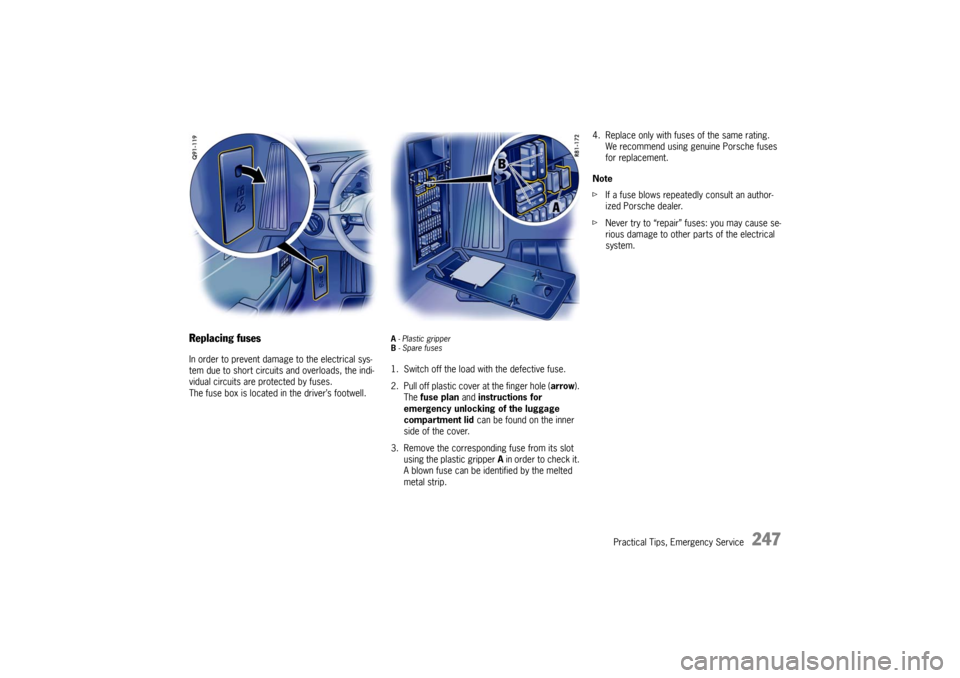
A - Plastic gripper
B - Spare fuses 1. Switch off the load with the defective fuse.
2. Pull off plastic cover at the finger hole (arrow ).
The fuse plan and instructions for
emergency unlocking of the luggage
compartment lid can be found on the inner
side of the cover.
3. Remove the corresponding fuse from its slot using the plastic gripper A in order to check it.
A blown fuse can be ide ntified by the melted
metal strip. 4. Replace only with fuses of the same rating.
We recommend using genuine Porsche fuses
for replacement.
Note
f If a fuse blows repeatedly consult an author-
ized Porsche dealer.
f Never try to “repair” fuses: you may cause se-
rious damage to other pa rts of the electrical
system.
Page 284 of 294

282
Technical Data
Weights
Dimensions BoxsterManual transmissionPorsche Doppelkupplung
Empty weight (depending on equipment) 2943 lbs. to 3153 lbs. 3009 lbs. to 3230 lbs.
1335 kg to 1430 kg 1365 kg to 1465 kg
Maximum gross weight 3605 lbs./1635 kg 3682 lbs./1670 kg
Maximum axle load, front* 1731 lbs./785 kg1731 lbs./785 kg
Maximum axle load, rear* 2017 lbs./915 kg 2017 lbs./915 kg
Boxster S Manual transmissionPorsche Doppelkupplung
Empty weight (depending on equipment) 2987 lbs. to 3175 lbs. 3042 lbs. to 3241 lbs.
1355 kg to 1440 kg 1380 kg to 1470 kg
Maximum gross weight 3627 lbs./1645 kg 3693 lbs./1675 kg
Maximum axle load, front* 1731 lbs./785 kg1731 lbs./785 kg
Maximum axle load, rear* 2072 lbs./940 kg 2072 lbs./940 kg
*The maximum gross weight must not be exceeded. Note: If additional accessories are installed, the useful load will be correspondingly less.
BoxsterBoxster S
Length 172.1 in./4372 mm
172.1 in./4372 mm
Width 70.9 in./1801 mm
70.9 in./1801 mm
Width with door mirrors 76.9 in./1952 mm
76.9 in./1952 mm
Height 50.9 in./1292 mm, with PASM 50.5 in./1282 mm
50.9 in./1294 mm, with PASM 50.6 in./1284 mm
Wheelbase 95.1 in./2415 mm
95.1 in./2415 mm
Ground clearance 4.4 in./112 mm, with PASM 4.1 in./105 mm
4.3 in./109 mm, with PASM 4.0 in./101 mm
Tu r n i n g c i rc l e 36.4 ft./11.1 m
36.4 ft./11.1 m