Spec PORSCHE BOXSTER 2009 2.G Workshop Manual
[x] Cancel search | Manufacturer: PORSCHE, Model Year: 2009, Model line: BOXSTER, Model: PORSCHE BOXSTER 2009 2.GPages: 294, PDF Size: 6.89 MB
Page 235 of 294
Practical Tips, Emergency Service
233
E Maximum Load rating
The maximum load in kilograms and pounds can
be carried by the tire. If you replace tires always
use a tire that has the same maximum load rating
as the factory installed tire.
FRadial
The identification indicates if the tire has radial
structure.
G Term of tubeless or tube tire
Identification for tubeless tires.Speed code letterThe speed code letter indicates the maximum per-
missible speed for the tire.
This code letter is shown on the tire sidewall.Tip on driving
Tires with a maximum speed rating that is lower
than the specified maximum vehicle speed may be
mounted only if they bear an M+S identification on
the tire sidewall.
f
Please note that in addition to the winter tires,
all-season and all-terrain tires are also subject
to speed limits and bear this identification.
Inscription on light alloy wheelsMaintenance note
fProtect the valve inserts against soiling with
valve caps.
Use only plastic valve caps.
Soiled valve inserts can cause a gradual loss
of air.
Note on operation
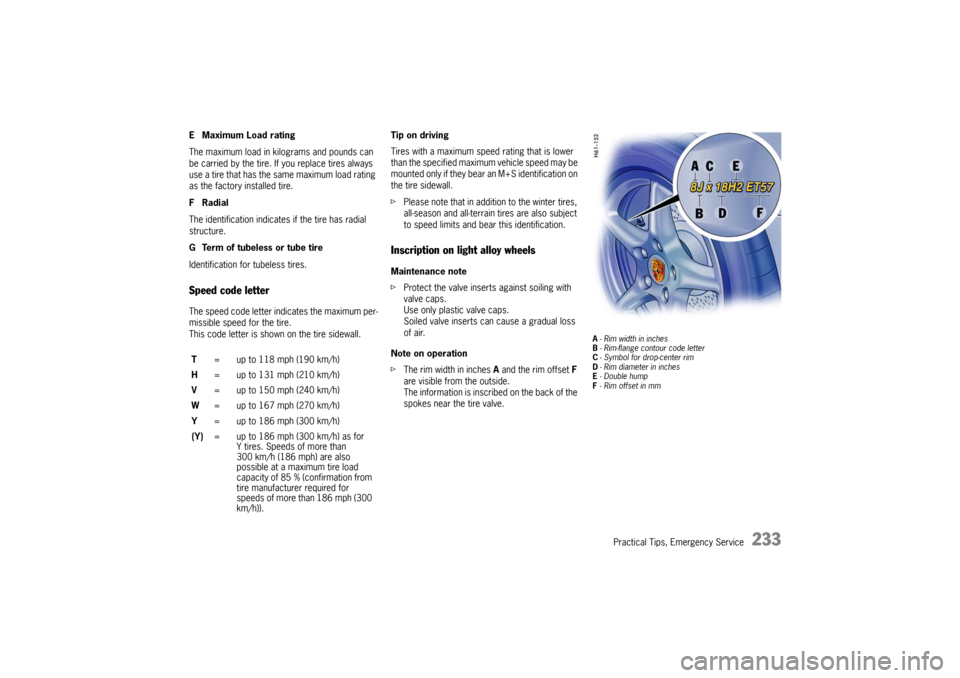
f The rim width in inches A and the rim offset F
are visible from the outside.
The information is inscri bed on the back of the
spokes near the tire valve.
A - Rim width in inches
B - Rim-flange contour code letter
C - Symbol for drop-center rim
D - Rim diameter in inches
E -Double hump
F - Rim offset in mm
T = up to 118 mph (190 km/h)
H = up to 131 mph (210 km/h)
V = up to 150 mph (240 km/h)
W = up to 167 mph (270 km/h)
Y = up to 186 mph (300 km/h)
(Y) = up to 186 mph (300 km/h) as for
Y tires. Speeds of more than
300 km/h (186 mph) are also
possible at a maximum tire load
capacity of 85 % (confirmation from
tire manufacturer required for
speeds of more than 186 mph (300
km/h)).
Page 236 of 294

234
Practical Tips, Emergency Service
Loading InformationDefinitionsThe Curb weight - actual weight of your vehicle -
vehicle weight including standard and optional
equipment, fluids and emergency tools. This
weight does not include passengers and cargo.
The Gross Vehicle Weight is sum of the curb
weight and the weight of passengers and cargo
combined.
The Gross Vehicle Weight Rating is the maxi-
mum total weight of vehicl e, passengers, luggage
and optional equipment.
The Gross Axle Weight Rating is the maximum
load limit for the front or the rear axle. This infor-
mation is located on the safety compliance sticker
located in the driver’s side door jamb.
For determining the compat ibility of the tire and
vehicle load capabilities:
f Please see the chapter “TECHNICAL DATA” on
Page 276.
The load capacity coeffici ent (e.g. “100”) is a min-
imum requirement. The Gross Combined Weight Rating is the
maximum total weight rating of vehicle, passen-
gers and cargo.
The Vehicle Capacity Weight
- Load Limit - is
the maximum total weight limit specified of the
load (passengers and cargo) for the vehicle. This
is the maximum weight of passengers and cargo
that can be loaded into the vehicle. This informa-
tion can be found on the tire pressure plate.
The maximum loaded vehicle weight is the
sum of curb weight, accessory weight, vehicle ca-
pacity weight and production options weight.
The load rating is the maximum load that a tire
is rated to carry for a given inflation pressure.
The maximum load rating is the load rating for
a tire at the maximum permissble inflation pres-
sure.
The cargo capacity is the permissible weight of
cargo, the substracted weight of passengers from
the load limit.
f Never exceed the permissible limits.
Danger!
Risk of loss of control, damage to the vehicle
and serious personal injury or death.
f Never exceed the specified axle loads.
Overloading can shorten the service life of the
tires and car, as well as lead to dangerous
vehicle reactions and long braking distances.
Damage due to overloading is not covered by the vehicle warranty.
Page 239 of 294
Practical Tips, Emergency Service
237
Changing a wheel
Warning!
Risk of serious personal injury or death. The
car may slip off the jack.
f Make sure that no one is in the vehicle when
jacking up and changing a wheel.
f Always place the car on stable supports if work
has to be carried out under the car.
Risk of damage to the brake discs of the
Porsche Ceramic Composite Brake (PCCB).
f Always screw in both assembly aids when changing a wheel.
Note
The tools required for changing a wheel (e.g. jack,
wheel bolt wrench, assembly aids) are not sup-
plied with the car.
Your authorized Porsche dealer will be pleased to
advise you.
1. Apply the handbrake fully and engage 1st gear or PDK selector-lever position P and remove
the ignition key.
2. Switch on the hazard warning lights if neces- sary.
3. Secure the car against rolling away, e.g. by
means of wedges under the wheels on the op-
posite side.
This is particularly important on slopes. 4. Slightly slacken the whee
l bolts of the wheel to
be changed.
5. Lift the car only at the specified jacking points.
6. Raise the car until the wheel lifts off the ground.
Please see the chapter “LIFTING THE VEHICLE
WITH A LIFTING PLATFORM OR GARAGE LIFT”
on Page 242.
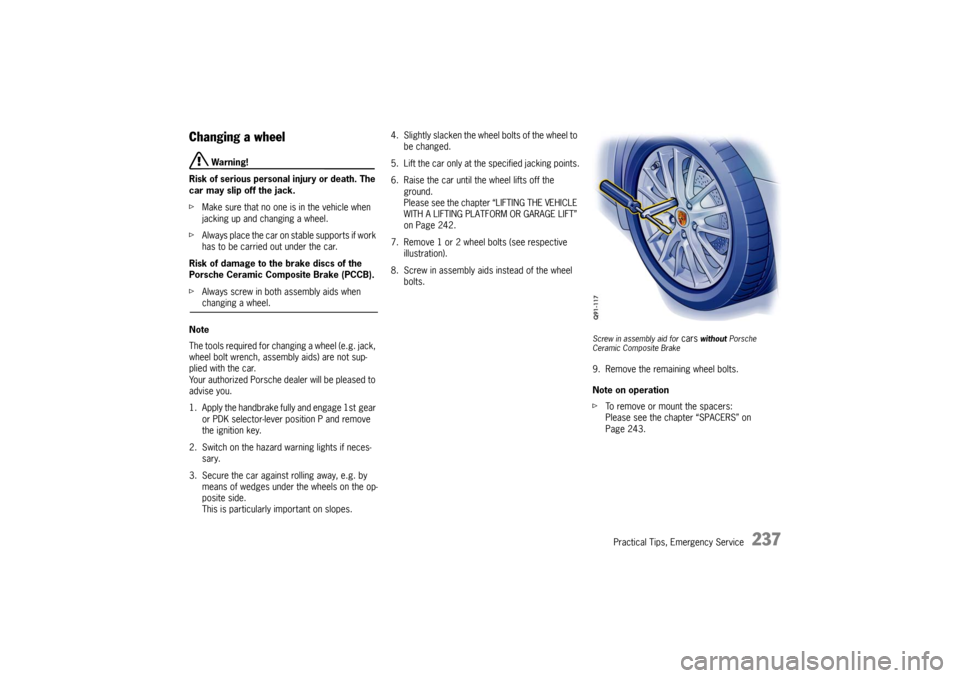
7. Remove 1 or 2 wheel bolts (see respective illustration).
8. Screw in assembly aids instead of the wheel bolts.
Screw in assembly aid for
cars
without Porsche
Ceramic Composite Brake
9. Remove the remaining wheel bolts.
Note on operation
f To remove or mount the spacers:
Please see the chapter “SPACERS” on
Page 243.
Page 241 of 294

Practical Tips, Emergency Service
239
Flat Tire
Warning!
Failure to follow these instructions may result
in serious personal injury to you or to by-
standers.
f If you have a flat tire, move a safe distance off
the road. Turn the emergency flasher on and
use other warning devices to alert other motor-
ists. Set the parking brake.
f Do not park your vehicl e where it may contact
dry grass, brush or other flammable materials.
The hot parts of the exhaust system could set
such materials on fire, thereby causing both
property damage and serious personal injury or death.
A tire sealant and compressor with pressure
tester are located in the luggage compartment.
f Please observe the safety and operating in-
structions on the special sealant bottle with a
special Porsche part number and on the com-
pressor – these are essential. Important note
Sealing the tire with the tire repair kit is only
an emergency repair. Even with the tire air-
tight, it may be used only for short journeys
in an emergency.
The maximum permitted speed is 50 mph
(80 km/h).
f
Do not use commercially available sealant or
tire inflating bottles.
Use only the tire sealant located in the luggage
compartment.
Warning!
Risk of accident, resulting in serious
personal injury or death.
f Have tires replaced by a specialist workshop
as soon as possible.
f Avoid hard acceleration and high cornering speeds.
Page 242 of 294
240
Practical Tips, Emergency Service
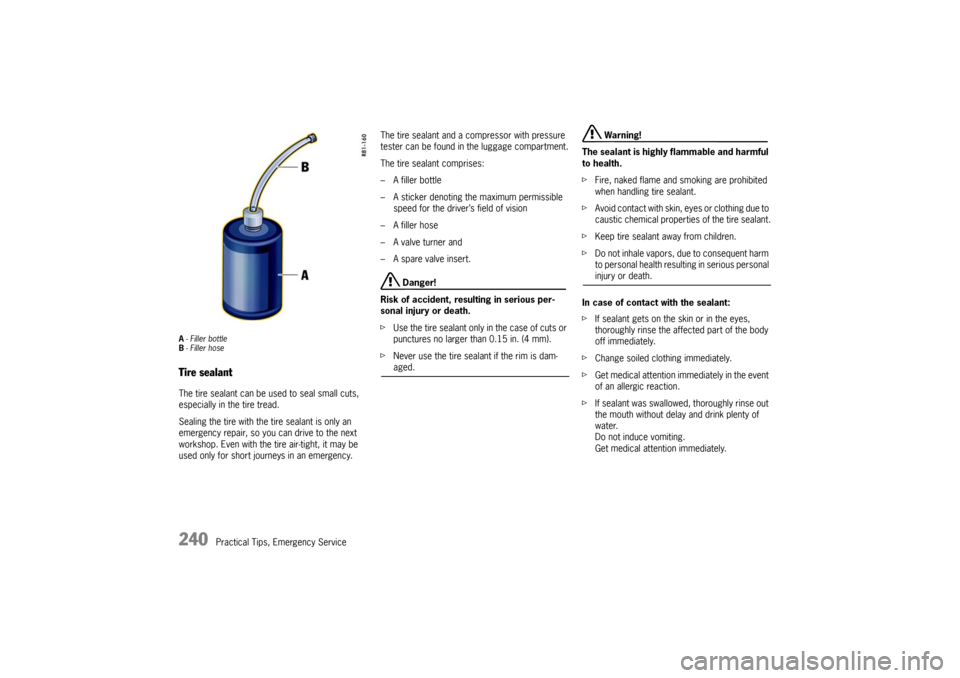
A- Filler bottle
B - Filler hoseTire sealantThe tire sealant can be used to seal small cuts,
especially in the tire tread.
Sealing the tire with the tire sealant is only an
emergency repair, so you can drive to the next
workshop. Even with the tire air-tight, it may be
used only for short journeys in an emergency. The tire sealant and a compressor with pressure
tester can be found in the luggage compartment.
The tire sealant comprises:
– A filler bottle
– A sticker denoting the maximum permissible
speed for the driver’s field of vision
– A filler hose
– A valve turner and
– A spare valve insert.
Danger!
Risk of accident , resulting in serious per-
sonal injury or death.
f Use the tire sealant only in the case of cuts or
punctures no larger than 0.15 in. (4 mm).
f Never use the tire sealant if the rim is dam-aged.
Warning!
The sealant is highly flammable and harmful
to health.
f Fire, naked flame and smoking are prohibited
when handling tire sealant.
f Avoid contact with skin, ey es or clothing due to
caustic chemical properties of the tire sealant.
f Keep tire sealant away from children.
f Do not inhale vapors, due to consequent harm
to personal health resulting in serious personal injury or death.
In case of contact with the sealant:
f If sealant gets on the skin or in the eyes,
thoroughly rinse the affect ed part of the body
off immediately.
f Change soiled clothing immediately.
f Get medical attention immediately in the event
of an allergic reaction.
f If sealant was swallowed, thoroughly rinse out
the mouth without delay an d drink plenty of
water.
Do not induce vomiting.
Get medical attention immediately.
Page 252 of 294

250
Practical Tips, Emergency Service
Battery care fEnsure that battery is securely mounted.
f Keep terminals and connections clean and
properly tightened.
Corrosion can be prevented by coating the ter-
minals and connections with petroleum jelly or
silicone spray.
f Ensure that vent caps ar e securely tightened to
prevent spillage.
Checking the electrolyte fluid level
The acid level should be checked more frequently
by a qualified specialist workshop during the sum-
mer months and in predominantly warm countries. Battery charging
Automotive batteries lose their efficiency when
not in use.
The charge available in your battery can be meas-
ured with a battery hydrometer.
We recommend that the battery voltage be tested
by your authorized Porsche dealer who has the ap-
propriate equipment.
If the car is not driven for prolonged periods, the
battery must be charged at least every 6 weeks.
A discharged battery allows
rapid formation of sul-
fates, leading to premature deterioration of the
plates.
Warning!
Hydrogen gas generated by the battery
could cause an explosion, resulting in
serious personal injury or death.
f Charge battery in a well ventilated area.
f Never charge a frozen battery. It may explode
because of gas trapped in the ice. Allow a fro-
zen battery to thaw out first.
f If you get electrolyte, wh ich is an acid, in your
eyes or on your skin, immediately rinse with
cold water for several minutes and call a doc-tor. Slow battery charging
Your authorized Porsche dealer will be pleased to
advise you about a suitable charger.
1. Always observe the instructions of the charger
manufacturer.
Depending on the type of charger, the battery
may have to be disconnected.
In this case, always disconnect the negative
lead first, and then the positive lead – risk of
short circuit!
Reconnect the leads in reverse order.
2. Before charging, cold batteries must be warmed up indoors.
3. Frozen batteries must be thawed out first before being charged.
4. When charging, ensure that there is adequate ventilation.
5. Connect the charger to the battery. Only plug into the mains and switch the
charger on when it is connected up correctly.
6. Switch on the charger.
7. After charging, switch off the charger first and then disconnect it.
f Please see the chapter “PUTTING VEHICLE
INTO OPERATION” on Page 251.
Page 269 of 294
Practical Tips, Emergency Service
267
Adjusting HeadlightsfPlease see the chapter “LIGHTS, REPLACING
BULBS” on Page 257.
Adjustment
The adjustment is made wi th the vehicle ready to
drive and the fuel tank completely filled.
The driver’s seat must be loaded by a person or a
165 lbs. (75 kg) weight and the tire pressures
must meet the prescribed values.
After being loaded, the car must be rolled a few
meters so that the suspension can settle.
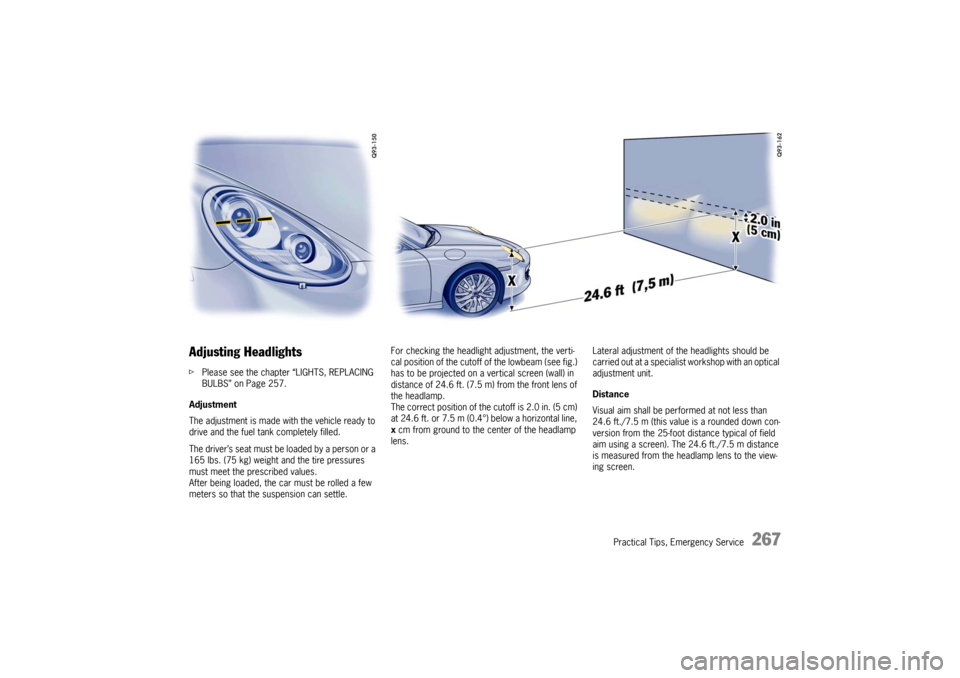
For checking the headlight adjustment, the verti-
cal position of the cutoff of the lowbeam (see fig.)
has to be projected on a ve rtical screen (wall) in
distance of 24.6 ft. (7.5 m) from the front lens of
the headlamp.
The correct position of the cutoff is 2.0 in. (5 cm)
at 24.6 ft. or 7.5 m (0.4 °) below a horizontal line,
x cm from ground to the center of the headlamp
lens. Lateral adjustment of the
headlights should be
carried out at a specialist workshop with an optical
adjustment unit.
Distance
Visual aim shall be perf ormed at not less than
24.6 ft./7.5 m (this value is a rounded down con-
version from the 25-foot distance typical of field
aim using a screen). The 24.6 ft./7.5 m distance
is measured from the headlamp lens to the view-
ing screen.
Page 281 of 294

Technical Data
279
fWhen changing tires or fitting new ones: Please see the chapter “WHEEL BOLTS” on Page 236.
Danger!
Installation of sizes not authorized by
Porsche may have a dangerous effect on
the driving stability and could result in
serious personal injury or death.
f Before mounting new tires, check with yourPorsche dealer about the current release status.
Boxster S Tires Rim Rim offset Track
Summer tires
front 235/40 ZR 18 91Y 8 J x 18 H2 57 mm 58.5 in./1486 mm
rear 265/40 ZR 18 101Y XL 9 J x 18 H2 43 mm 60.2 in./1528 mm
or front 235/35 ZR 19 87Y 8 J x 19 H2 57 mm 58.5 in./1486 mm
rear 265/35 ZR 19 94Y 9.5 J x 19 H2 46 mm 59.9 in./1522 mm
or front 235/35 ZR 19 87Y 8.5 J x 19 H2 55 mm 58.7 in./1490 mm
rear 265/35 ZR 19 94Y 10 J x 19 H2 42 mm 60.2 in./1530 mm
Snow tires front235/40 R 18 91V M+S 8 J x 18 H2 57 mm 58.5 in./1486 mm
rear * 255/40 R 18 95V M+S 9 J x 18 H2 43 mm 60.2 in./1528 mm
The load capacity coefficient (e.g. ”91“) and maximum sp eed code letter (e.g. ”Y“) are minimum requirements.
Tire and rim sizes Extensive tests are performed before specific tires and wheels are approved by Porsche. Your Porsche dealer has information
about approved tires and wheels and is happy to assist you. If aftermarket tires and/or wheels are installed which are not
approved by Porsche, the vehicle’s roadability and handling characteristics might be impaired. Since Porsche has no data on
such combinations, Porsche cannot st and behind the safety or durability of these aftermarket combinations.
Snow chains Can be mounted only on the rear wheels; maximum speed 30 mph/50 km/h. Use only Porsche authorized fine-link
cross-type or edge chains. Snow chain clearance can be guaranteed only with the tire + rim combination marked*
without spacers. Please see the chapter “SPACERS” on Page 243.