Spec PORSCHE BOXSTER 2009 2.G Owner's Guide
[x] Cancel search | Manufacturer: PORSCHE, Model Year: 2009, Model line: BOXSTER, Model: PORSCHE BOXSTER 2009 2.GPages: 294, PDF Size: 6.89 MB
Page 203 of 294

Maintenance, Car Care
201
Always observe the following points:
– Use engine oils approved by Porsche only. This is a precondition for optimum and problem-free
operation of your vehicle.
– Regular oil changes are part of servicing. It is important that the service intervals,
particularly the oil change intervals, are
observed in accordance with the specifications
in the “Maintenance” booklet.
– Oils approved by Porsche can be mixed with each other.
– Porsche engines are designed so that no oil additives may be used.
– A label is located in the engine compartment, which provides you with in formation on suitable
oil for your engine.
Your Porsche partner will be pleased to
advise you.Oil changeThe engine oil has to be changed regularly at the
intervals listed in your Maintenance Schedule .
f Please see the chapter “CAPACITIES” on
Page 281.
We recommend that you have the engine oil
changed at your Porsche dealer, who has the re-
quired oils and the necessary filling equipment.
If you suspect an oil leak in the engine have your
dealer check it out immediately. All current engine oils are compatible with each
other, i.e. when making an oil change it is not nec-
essary to flush the engine if you wish to use a dif-
ferent brand or grade of oil.
Since, however, each brand of oil has a special
composition, you should, if possible, use the
same oil brand if it becomes necessary to top up
between oil changes.
Porsche engines have long intervals between oil
changes. You can make best use of these long oil
change intervals by usin
g multigrade oils since
these are largely independent of seasonal fluctua-
tions in temperature.
If your vehicle is used frequently in stop-and-go
traffic in cold weather, the engine will not always
be properly warmed up.
Condensation from products of combustion may
accumulate in the oil. In this case, it is advisable
to change the oil more fr equently so that your
engine once again has 100% efficient engine oil.
Engine oil performance class Engine oil is not only a lubricant, but also serves
to keep the engine clean, to neutralize the dirt
which penetrates into the engine through combus-
tion and to protect the engine against corrosion.
To perform these functions, the oil is provided with
additives which have been specially developed for
these functions.
The efficiency of an oil is expressed, for example,
by the API, ILSAC or ACEA classifications.
Viscosity Like all liquids, engine oil is viscous when cold,
and thin-bodied when warm. The viscosity of an oil
is expressed by its SAE class. For cold viscosity
(measured at temperatures below 32 °
F/0 °
C) the
SAE class is given as a number and the letter “W”
(as in winter), for hot viscosity (measured at
212 °
F/100 °
C) the SAE class is given only as a
number.
The viscosity of an oil is, therefore, always the
same if it has the same number of an SAE class.
Oils with two viscosities are called multigrade oils;
oils with only one viscosity are termed single-
grade oils.
Single-grade oils can not be used in your engine.
The viscosity of the engine oil for your Porsche
has to be chosen according to the ambient tem-
perature given in the engine oil recommendation
table.
Page 206 of 294

204
Maintenance, Car Care
Fuel Economy Fuel economy will vary depending on where,
when and how you drive, optional equipment
installed, and the general condition of your
car.
A car tuned to specifications and correctly
maintained, will help you to achieve optimal
fuel economy.
fHave your vehicle tuned to specifications.
Air cleaner should be dirt free to allow proper
engine “breathing”.
Battery should be fully charged.
Wheels should be properly aligned.
Tires should be inflated at correct pressure.
f Always monitor your fuel consumption.
f Drive smoothly, avoid abrupt changes in speed
as much as possible.
f Avoid jack rabbit starts and sudden stops.
f Do not drive longer than necessary in the lower
gears. Shifting into a higher gear early without
lugging the engine will help save fuel.
f Prolonged “warm up” idling wastes gas. Start
the vehicle just before you are ready to drive.
Accelerate slowly and smoothly.
f Switch off the engine if stationary for longer
periods. f
Any additional weight carried in the vehicle re-
duces fuel economy. Always keep cargo to a
minimum and remove all unnecessary items.
f Organize your trips to take in several errands
in one trip.
f All electrical accessories contribute to in-
creased fuel consumption.
f Only switch on the air conditioning when neces-
sary.
f Do not drive with the Ro of Transport System
mounted unless you need it.
The EPA estimated mpg. is to be used for
comparison purposes, actual mileage may
be different from the estimated mpg.,
depending on your driving speed, weather
conditions and trip length. Your actual
highway mileage will probably be less than
the estimated mpg.
f Please observe all local and national speed
limits.
Operating your Porsche in other
Countries Government regulations in the United States and
Canada require that automobiles meet specific
emission regulations and safety standards. There-
fore, cars built for the U.S. and Canada differ from
vehicles sold in other countries.
If you plan to take your Porsche outside the conti-
nental limits of the United States or Canada, there
is the possibility that
– unleaded fuel may not be available;
– unleaded fuel may have a considerably lower
octane rating. Excessive engine knock and se-
rious damage to both engine and catalytic con-
verters could result;
– service ma y be inadequa te due to lack of prop- er service facilities, tools or diagnostic equip-
ment;
– replacement parts may not be available or very difficult to get.
Porsche cannot be responsible for the
mechanical damage that could result
because of inadequate fuel, service or parts
availability.
If you purchased your Porsche abroad and want to
bring it back home, be sure to find out about ship-
ping and forwarding requirements, as well as cur-
rent import and customs regulations.
Page 208 of 294
206
Maintenance, Car Care
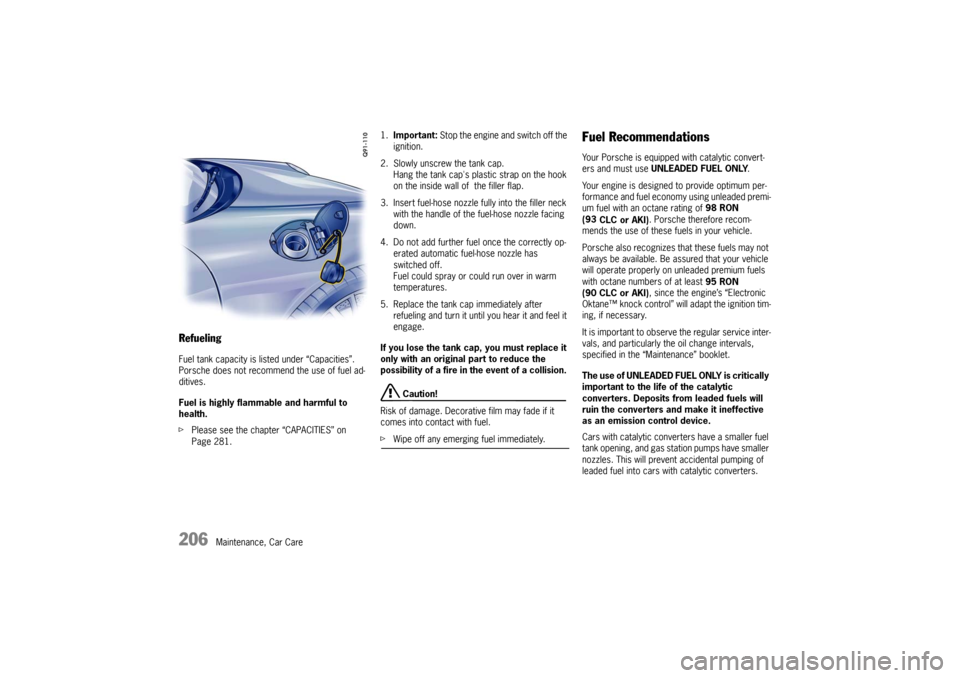
Refueling Fuel tank capacity is listed under “Capacities”.
Porsche does not recommend the use of fuel ad-
ditives.
Fuel is highly flammable and harmful to
health.
fPlease see the chapter “CAPACITIES” on
Page 281. 1.
Important: Stop the engine and switch off the
ignition.
2. Slowly unscrew the tank cap. Hang the tank cap's plastic strap on the hook
on the inside wall of the filler flap.
3. Insert fuel-hose nozzle fully into the filler neck
with the handle of the fuel-hose nozzle facing
down.
4. Do not add further fuel once the correctly op- erated automatic fuel-hose nozzle has
switched off.
Fuel could spray or could run over in warm
temperatures.
5. Replace the tank ca p immediately after
refueling and turn it until you hear it and feel it
engage.
If you lose the tank cap, you must replace it
only with an original part to reduce the
possibility of a fire in the event of a collision.
Caution!
Risk of damage. Decorative film may fade if it
comes into contact with fuel.
f Wipe off any emerging fuel immediately.
Fuel Recommendations Your Porsche is equipped with catalytic convert-
ers and must use UNLEADED FUEL ONLY .
Your engine is designed to provide optimum per-
formance and fuel economy using unleaded premi-
um fuel with an octane rating of 98 RON
(93 CLC or AKI) . Porsche therefore recom-
mends the use of these fuels in your vehicle.
Porsche also recognizes that these fuels may not
always be available. Be assured that your vehicle
will operate properly on unleaded premium fuels
with octane numbers of at least 95 RON
(90 CLC or AKI) , since the engine’s “Electronic
Oktane™ knock control” will adapt the ignition tim-
ing, if necessary.
It is important to observe the regular service inter-
vals, and particularly the oil change intervals,
specified in the “Maintenance” booklet.
The use of UNLEADED FUEL ONLY is critically
important to the life of the catalytic
converters. Deposits from leaded fuels will
ruin the converters and make it ineffective
as an emission control device.
Cars with catalytic converters have a smaller fuel
tank opening, and gas station pumps have smaller
nozzles. This will prevent accidental pumping of
leaded fuel into cars with catalytic converters.
Page 209 of 294

Maintenance, Car Care
207
Unleaded fuels may not be available outside the
continental U.S. and Canada. Therefore, we rec-
ommend you do not take your car to areas or
countries where unleaded fuel may not be availa-
ble. Octane ratings Octane rating indicates a fuel’s ability to resist det-
onation. Therefore, buying the correct octane gas
is important to prevent engine “damage”.
The RON octane rating is based on the research
method. The CLC (U.S. Cost of Living Council oc-
tane rating) or AKI ( anti knock index) octane rating
usually displayed on U.S. fuel pumps is calculated
as research octane numb er plus motor octane
number, divided by 2, that is written as:
The CLC or AKI octane rating is usually lower than
the RON rating:
For example: 95 RON equals 90 CLC or AKI
Fuels containing ethanolDo not use any fuels containing more than 10 per-
cent ethanol by volume.
We recommend, however, to change to a different
fuel or station if any of the following problems oc-
cur with your vehicle:
– Deterioration of driveability and performance.
– Substantially reduced fuel economy.
– Vapor lock and non-start problems, especially at high altitude or at high temperature.
– Engine malfunction or stalling. Portable Fuel Containers
Danger!
Portable fuel containers, full or partially
empty, may leak causing an explosion, or re-
sult in fire in case of an accident.
f Never carry additional fuel in portable contain-ers in your vehicle.
Fuel Evaporation Control Fuel tank venting The evaporation chamber and the carbon canister
prevent fuel from escaping to the atmosphere at
extreme high outside temperatures, when driving
abruptly around curves and when the car is parked
at an incline or in any other nonlevel position. Vapor control system and storage When the fuel tank is filled, vapors are collected in
the evaporation chamber by a vent line leading the
vapors to the carbon canister where they are
stored as long as the engine does not run. Purge system When the engine is running, the fuel vapors from
the canister will be mixed with fresh air from the
ambient air of the canister. This mixture will be
directed to the intake air housing by the tank vent
line, mixed with the intake air and burned during
normal combustion.
RON+MON
2
R+M
2
or
Page 210 of 294

208
Maintenance, Car Care
Emission Control SystemIn the interest of clean air Pollution of our environment has become a prob-
lem that is of increasing concern to all of us. We
urge you to join us in ou r efforts for cleaner air in
controlling the pollutants emitted from the auto-
mobile.
Porsche has developed an emission control sys-
tem that controls or reduces those parts of the
emission that can be harmful to our environment.
Your Porsche is equipped with such a system.
Porsche warrants the Emission Control System in
your new car under the terms and conditions set
forth in the Warranty Booklet.
You, as the owner of the vehicle, have the
responsibility to provide regular maintenance serv-
ice for the vehicle and to keep a record of all main-
tenance work performed. To facilitate record
keeping, have the service performed by author-
ized Porsche dealers. They have Porsche trained
technicians and special tools to provide fast and
efficient service. To assure efficient operation of the Emission
Control System:
f
Have your vehicle maintained properly and in
accordance with the recommendations de-
scribed in your Maintenance Booklet.
Lack of proper maintenance, as well as im-
proper use of the vehicle, will impair the func-
tion of the emission control system and could
lead to damage.
f Do not alter or remove any component of the
emission control system.
f Do not alter or remove any device, such as
heat shields, switches, ignition wires, valves,
etc., which are designed to protect your vehi-
cle’s emission control system.
In addition to serious engine damage, this can
result in a fire if excess raw fuel reaches the
exhaust system.
f Do not continue to operat e your vehicle if you
detect engine misfire or other unusual operat-
ing conditions.
Parking
Warning!
Danger of fire resulting in serious personal
injury or death.
f Do not park or operate the vehicle in areas
where the hot exhaust system may come in
contact with dry grass, br ush, fuel spill or oth-
er flammable material.
f If your car catches on fire for any reason, call
the fire department.
Do not endanger your life by attempting to put out the fire.
Undercoating
Danger!
Danger of fire resulting in serious personal
injury or death.
f Do not apply additional undercoating or rust-
proofing on or near the exhaust manifold,
exhaust pipes, catalytic converters or heat
shields. During driving the substance used for undercoating could overheat and ignite.
Page 213 of 294

Maintenance, Car Care
211
Power Steering
Warning!
Risk of accident resulti ng in serious personal
injury or death.
When the engine is stopped (e.g. when being
towed) or the hydraulic system fails, there is
no assistance for steering.
Therefore, substantially more force will have
to be exerted in order to steer.
f Exercise great care when being towed.
f Have the fault remedied at your nearest autho-rized Porsche dealer.
Note
The flow noise heard at full steering lock is system
related and does not indi cate a defect in the
steering system.
Checking hydraulic fluid f Please see the chapter “EXERCISE EXTREME
CAUTION WHEN WORKING ON YOUR VEHICLE”
on Page 196.
The hydraulic fluid reservoir is located in the engi-
ne compartment.
Regular checking of hydraulic fluid is part of
servicing.
Air Filter A dirty air filter not only reduces engine perform-
ance, but can lead to premature engine wear.
Regular filter replacement is part of the routine
maintenance service.
f In dusty conditions, check the filter element
more frequently and replace if necessary.Combination Filter The fresh air passing through the combination fil-
ter into the passenger co mpartment is virtually
free of dust, pollen, and unpleasant odors.
f If the outside air is polluted by exhaust fumes,
press the circulating-air button.
A dirty filter can be the cause of reduced air flow:
f Have filter replaced by your authorized
Porsche dealer.
Regular filter replacement is part of the routine
maintenance service.
Fluids/Oils for Manual
Transmission and Porsche
Doppelkupplung (PDK)The transmission fluids/oils have to be checked
and changed at the intervals listed in your Mainte-
nance Schedule.
f Please see the chapter “CAPACITIES” on
Page 281.
Do not tow the car or run the engine without fluid/
oil in the transmission. The transmission may be
damaged by even a tiny speck of dirt, only a clean
funnel or spout must be used when adding fluid/
oil.
We recommend that you have the fluids/oils
changed at your Porsche dealer, who has the re-
quired lubricants and the necessary filling equip-
ment.
f If you suspect an oil leak in the transmission,
have your authorized Porsche dealer check it
out immediately.
Page 214 of 294

212
Maintenance, Car Care
Wiper Blades Wiper blades that are in perfect condition are vital
for a clear view.
fReplace the wiper blades twice per year (be-
fore and after the cold season) or whenever
wiper performance deteriorates.
Caution!
Risk of damage if the wiper arm accidentally
falls back on to the window.
f Always hold the wiper arm securely when re-
placing the wiper blade.
Risk of damage if wiper blades that are fro-
zen in place are loosened improperly.
f Thaw the wiper blades before loosening them.
Maintenance note
f Periodically clean the wiper blades with win-
dow cleaner, especially after the vehicle has
been washed in a car wash.
We recommend the Porsche window cleaner. If
they are very dirty (e.g. with insect remains),
they can be cleaned with a sponge or cloth. If the wiper blades rub or squeak, this can be as a
result of the following:
– If the vehicle is washed in an automatic car
wash, wax residues may adhere to the wind-
shield. These wax residues can be removed
only by using window cleaner concentrate.
– The wiper blades may be damaged or worn.
f Replace damaged or worn wiper blades as
soon as possible.
f Please see the chapter “WASHER FLUID” on
Page 210.
f Please contact your authorized Porsche dealer
for further information. Changing windshield wiper blades
f
Please read the separate instructions for fitting
wiper blades as supplied by the manufacturer.
f We recommend that you get your authorized
Porsche dealer to replace the wiper blades.
Caution!
Risk of damage.
If the wiper blades are not changed properly, they
can come loose when the car is moving.
f Check that the wiper blades are seated
securely. The wiper blades must engage properly in the wiper arm.
Page 215 of 294

Maintenance, Car Care
213
Car Care Instructions fPlease see the chapter “EXERCISE EXTREME
CAUTION WHEN WORKING ON YOUR VEHICLE”
on Page 196.
Regular and correct care helps to maintain
the value of your car and is also a
precondition for the New Vehicle Warranty
and the Anti Corrosion Warranty.
Your authorized Porsche dealer has specially
developed car-care products from the
Porsche program available either singly or
as complete car-care sets. They will be
pleased to help you select suitable products.
Whether you use Porsche products or other
commercially available cleaning agents first
make sure of their correct application.
A Porsche that is well-cared for can look like new
for years. It all depends on the amount of care the
owner is willing to give the car.
Warning!
Risk of serious personal injury or damage to
the vehicle or property.
Cleaning agents may be hazardous to your
health.
Most chemical cleaners are concentrates
which require dilution. High concentrations
might cause problems ranging from irritation
to serious injury as we ll as damage to your
vehicle. f
Keep cleaning agents out of reach from chil-
dren.
f Observe all caution labels.
f Always read directions on the container before
using any product. These directions may con-
tain information necessary to avoid personal
injury.
f Do not use fuel, kerosene, naphtha, nail polish
remover or other volatile cleaning fluids. They
may be toxic, flammable or hazardous in other
ways. Only use spot removing fluids in a well
vented area.
f Do not clean the underside of chassis, fend-
ers, wheel covers, etc., without protecting
your hands and arms as you may cut yourself
on sharp-edged metal parts.
Moisture and road salt on brakes may affect brak-
ing efficiency.
f Test the brakes after each vehicle washing.
Decorative film Caution!
Risk of damage due to separation of the
decorative film when cleaning your vehicle with
high-pressure cleaning equipment or steam
cleaners.
f Do not use high-pressure cleaning equipment or steam cleaners for cl eaning decorative film.
High-pressure cleaning units,
steam
cleaners
Warning!
High-pressure cleaning units or steam clea-
ners can damage the following components:
–tires,
– logos, emblems,
– painted surfaces,
– alternator,
– ParkAssist sensors,
– convertible top.
f Please observe the operating instructions from
the unit manufacturer.
f When cleaning with a flat-jet nozzle or the like,
maintain a minimum distance of 20 inches (50
cm).
f Never use high-pressure cleaning units or
steam cleaners with a ro und-jet nozzle. A high-
pressure cleaning unit or steam cleaners with
round nozzle will damage your vehicle.
f The tires are particularly susceptible to dam-
age.
f Do not point the cleaning jet directly at any of the aforementioned components.
Page 217 of 294

Maintenance, Car Care
215
Convertible top
fNever remove snow and ice using a sharp
edged object.
Incorrect care and treatment can damage the con-
vertible top and cause leaks. Any repair work can
be done by your authorized Porsche dealer.
Important note
No folding top is 100% leak proof.
Due to the constant changi ng of loads and strains
to which a car is subject to when driving on roads,
minor wind noise and seepage at joints between
the top, body and doors on convertible tops can-
not be completely sealed in certain areas. There-
fore small leaks are considered normal for these
models. In addition, your convertible top should
not be washed in a car wash. The top may experi-
ence damage by the brushes or may experience
leaks due to the high pressure water streams di-
rected in areas which wo uld not encounter water
in normal driving conditions.
Cleaning
Caution!
Risk of damage due to the cleaning jet of the
high-pressure cleaning equipment or hot wax
treatment.
f Do not clean the convertible top with high-
pressure cleaning equipment.
fDo not use the hot wax treatment. Do not wash the convertibl
e top each time the car
is washed.
It is usually sufficient to spray or wash it with clean
water.
f Brush dust off the convertible top in the direc-
tion of the weave using a soft brush.
f Only if there is heavy dirt, wet the convertible
top with lukewarm water and the Porsche
Wash-Shampoo & convertible-top cleaner, us-
ing a sponge or soft brush, and rub gently.
Rinse Wash-Shampoo & convertible-top clean-
er thoroughly off the convertible top with clean
water.
f After washing it, treat the convertible-top cover
at least once a year with the special Porsche
convertible-top care product.
Do not allow the convertible-top care product
to come into contact with paint or windows. If
it does, remove immediately.
f If there is leakage in the convertible-top cover
or at its seams or folds, the special Porsche
convertible-top care product can be used.
f Please note the information on the container.
f Remove bird droppings immediately since the
acid in them will make the rubber swell and the
convertible top will become leaky.
f Open convertible top only when it is completely
dry, otherwise damp stains and scrub marks
may occur which cannot be removed. f
Try to remove spots from the convertible-top
cover by rubbing carefu lly with a soft rubber
sponge.
Door lock f To prevent the door lock from freezing during
the cold season, the lock cylinder should be
covered during a wash.
f Should the lock freeze, use an ordinary de-icer.
In many cases, a well warmed key can help.
Never use excessive force.PaintTo protect the paint on yo ur vehicle in the best
possible way against mechanical and chemical
damage, you should
– preserve it regularly,
– polish it if necessary,
– remove spots and stains, and
– repair damaged paintwork.
f Do not apply care products containing silicone
to the convertible top and windows.
General information
f Never rub a dusty vehicle with a dry cloth,
because the grains of dirt will damage the
paintwork.
Page 219 of 294

Maintenance, Car Care
217
Note
Door windows feature a water-repellent (hydro-
phobic) coating which prevents soiling of the
windows.
This coating is subject to natural wear and can be
renewed.
fConsult an authorized Porsche dealer.Wiper blades Wiper blades that are in perfect condition are vital
for a clear view.
fPlease see the chapter “WIPER BLADES” on
Page 212.
f Replace the wiper blades twice per year (be-
fore and after the cold season) or whenever
wiper performance deteriorates or the blades
are damaged.
f Periodically clean the wiper blades with
Porsche window cleaner, especially after the
vehicle has been washed in a car wash.
If they are very dirty (e.g. with insect remains),
they can be cleaned with a sponge or cloth.
If the wiper blades rub or squeak, this can be as a
result of the following:
– If the vehicle is washed in an automatic car wash, residues may adhere to the windshield.
These wax residues can be removed only by
using window cleaner concentrate.
– The wiper blades may be damaged or worn. – Replace damaged or worn wiper blades imme-
diately.
f Please see the chapter “WASHER FLUID” on
Page 210.
f Please contact your authorized Porsche dealer
for further information.
Undercoating As it is not possible to ex clude the risk of damage
to this protective coating in day to day driving, it
is advisable to have the underside of the car in-
spected at certain interv als – preferably before
the start of winter and again in spring – and the un-
dercoating restored as necessary.
Your authorized Porsche dealer is familiar with the
bodyseal treatment procedures and has the nec-
essary equipment for applying factory approved
materials. We recommend that you entrust them
with such work and inspections.
Unlike conventional spray oils, undercoating and
rust-proofing compounds based on bitumen or
wax do not attack the so und-proofing materials ap-
plied at the factory.
Warning!
Danger of fire resulting in serious personal
injury or death.
f Do not apply additional undercoating or rust-
proofing on or near the exhaust manifold, ex-
haust pipes, catalytic converters or heat shields. During driving the substance used for
undercoating could overheat and ignite.
f Before applying fresh underseal, carefully
remove any deposits of dirt and grease. Once
it has dried, the new undercoating compound
forms a tough protective coating which
provides efficient rust-proofing of the floor
panels and components.
f Always apply a fresh coating of suitable pre-
servative to unprotected areas after cleaning
the underside of the body, the transmission,
the engine or carrying out repairs to under-
body, engine or transmission components.
Effective rust-proofing is particularly important
during the cold weather seas on. If your car is driv-
en frequently in areas where salt has been spread
on the roads, the whole engine compartment
should be cleaned thoroughly after the winter to
prevent salt from causing any lasting damage. A
full under-body wash should also be performed at
the same time.
Stainless steel exhaust tailpipesStainless steel exhaust tailpipes can discolor due
to soiling, strong heat, and combustion residues.
The original polish can be achieved again using
commercially available metal polishing paste or
metal polish.