Computer PORSCHE CAYMAN 2010 1.G User Guide
[x] Cancel search | Manufacturer: PORSCHE, Model Year: 2010, Model line: CAYMAN, Model: PORSCHE CAYMAN 2010 1.GPages: 284, PDF Size: 5.94 MB
Page 59 of 284

Operation, Safety
57
Brake system warning light
You can check the functionality of the brake
system warning light by switching the ignition to
the "On" position and verifying that the warning
light illuminates.
If the warning lights in the instrument panel and on-
board computer go on while driving, the brake flu-
id level may be too low, or (if the brake pedal travel
has increased) one of the two brake circuits may
have failed.
A greater braking pressure will be required, stop-
ping distances will be longer and the braking be-
havior will change, particularly in curves.
With correctly adjusted brakes, and a correctly
working brake system, the pedal travel to the
point of brake actuation should be 1-3/16 in. to
1-9/16 in. or 30 to 40 mm.
Whenever the brake pedal travel exceeds this dis-
tance, have the brake system checked.
Brake pedal
Warning!
Risk of an accident, re sulting in serious per-
sonal injury or death.
Any obstruction of the brake pedal could
increase the stopping distance.
f Always check the movement of the brake pedal
before driving and make sure that it is not ob-
structed by a floor ma t or any other object.
f Secure the floor mat to prevent it from sliding
into positions that could interfere with the safe
operation of your vehicle.
Your Porsche dealer will be glad to offer you nonskid floor mats of the correct size.
Note
In case one of the two brake circuits fails, in-
creased pedal travel is required to bring your
vehicle to a full stop.
Warning!
To avoid overheating and premature wear of
the brakes:
f Before descending a steep grade, reduce
speed and shift the tran smission into a lower
gear or driving position to control speed.
f Do not “ride the brakes” by resting your foot on
the pedal when not intending to apply brake
pressure.
f Do not hold the pedal down too long or too
often.
This could cause the brakes to get hot and not function properly.
f Please see the chapter “DRIVE-OFF ASSIS-
TANT” on Page 177.
Brake warning light USA
Brake warning light Canada
Page 60 of 284

58
Operation, Safety
Brake booster The brake booster assists braking only when
the engine is running.
When the car is moving while the engine is not run-
ning, or if the brake boos ter is defective, more
pressure on the brake pedal is required to bring
the car to a stop.
If this happens, ABS and PSM will also not oper-
ate.
Moisture or road salt on brakes affects braking.
Brakes will dry after a fe w cautious brake applica-
tions.
Warning!
Risk of an accident, resulting in serious per-
sonal injury or death.
Driving through water may reduce the trac-
tion.
Moisture on brakes from road water, car
wash, or coating of road salt may affect
braking efficiency.
f Cautiously apply brakes to test brakes after ex-posure to road water, etc.
Brake wear Your car has excellent brakes, but they are still
subject to wear. The rate at which they wear de-
pends on how the brakes are used.
f Have the brake system inspected at the
intervals recommended in your Maintenance
Booklet.
Brake system warning light
You can check the functionality of the brake
system warning light by switching the ignition to
the "On" position and verifying that the warning
light illuminates.
If the warning lights in the instrument panel and on-
board computer stay on when the engine is run-
ning or come on while driv ing, the brake pads are
worn excessively.
f Do not continue to operate the vehicle.
Have your authorized Porsche dealer inspect
or replace the brake pads.
Brake pads and brake discsWear on the brake pads and brake discs depends
to a great extent on the driving style and the con-
ditions of use and therefore cannot be expressed
in actual miles on the road.
The high-performance brake system is designed
for optimal braking effect at all speeds and tem-
peratures.
Certain speeds, braking forces and ambient
conditions (such as temperature and humidity)
therefore might cause “brake noises”.
New brake pads or linings
New brake pads and brake discs have to be “bro-
ken in”, and therefore only attain optimal friction
when the car has covered several hundred miles
or km.
The slightly reduced braking ability must be com-
pensated for by pressing the brake pedal harder.
This also applies whenever the brake pads and
brake discs are replaced.
Warning light USA
Warning light Canada
Page 62 of 284

60
Operation, Safety
When the ignition is switched on the ABS warning
light will light up while the system is electronically
interrogated and goes o
ut when the engine is
started if the check is not yet complete.
If the ABS warning lamp fails to go out, this indi-
cates that ABS has been deactivated due to a
fault. If the warning lights in the instrument panel
and on-board computer light up while you are driv-
ing, this indicates that a fault has occurred. In both
cases, normal braking, as in vehicles without ABS,
is still retained.
The ABS system should, however, be examined at
an authorized Porsche dealer immediately to pre-
vent the occurrence of further faults.
f If the ABS system becomes inoperative, take
your vehicle to your authorized Porsche dealer
immediately.
Warning!
Risk of an accident, resulting in serious per-
sonal injury or death.
The control unit of the ABS brake system is
set for standard tire size. If non-standard
tires are installed, the control unit may mis-
interpret the speed of th e vehicle, because of
the variant data it rece ives from the sensors
on the axles.
f Use only tire makes and types tested by Porsche.
Clutch Pedal The clutch pedal must be depressed fully
before the starter will engage.
Warning!
Risk of an accident, resulting in serious per-
sonal injury or death.
f Always check the movement of the clutch ped-
al before driving and make sure that it is not
obstructed by a floor mat or any other object.
f Secure the floor mat to prevent it from sliding
into positions that could interfere with the safe
operation of your vehicle.
Your Porsche dealer will be glad to offer you
nonskid floor mats of the correct size.
To avoid damage to the clutch and transmis-
sion:
f Always depress the clutch pedal fully when
changing gears.
f Do not hold the car on a steep grade with the clutch pedal partially depressed.
Should the free travel of the clutch pedal suddenly
become larger, it could me an a malfunction of the
clutch.
f See your Porsche dealer for correction.
Warning light USA
Warning light Canada
Page 66 of 284

64
Operation, Safety
– The system compensates for undesired lateral
vehicle reactions when the driver releases the
accelerator pedal or brakes when cornering.
This compensation functions up to the
maximum lateral acceleration.
– PSM actively stabilizes the vehicle as required during dynamic driving maneuvers (e.g. rapid
steering movements, during lane changes or
on alternating bends).
– Improved braking stability on bends and on different or varying road surfaces.
– It improves braking function and shortens stopping distance in the event of emergency
braking.
Readiness for operationPSM is switched on automatically every time you
start the engine.
PSM should always be switched on during
“normal” driving.
However, it may be advantageous to switch off
PSM temporarily in exceptional situations, for
example:
– On a loose surface or in deep snow,
– When “rocking” the vehicle free and
– When using snow chains.
Switching off PSMf Press PSM OFF button.
PSM is switched off after a short delay.
The light-emitting diode in the button is lit up.
When the PSM is switched off, the PSM multi-
functional light on the instrument panel is lit
and a message is shown on the on-board
computer.
An acoustic signal also sounds.
Note
When PSM is switched off, the additional braking
functions are deactivated. Automatic reactivation
in emergency situations is linked to the PSM
control. The following functions stabilize the vehicle in
emergency situations, even with PSM switched
off:
– When PSM is off, the vehicle is stabilized as
soon as one of the two front wheels enters the
ABS control range.
– When PSM is off and Sport mode is on, the vehicle is stabilized as soon as both front
wheels enter the ABS control range.
One-sided spinning of the wheels is prevented,
even with PSM switched off.
Switching PSM back onf Press PSM OFF button.
PSM is switched on after a short delay.
The light-emitting diode in the button and the
PSM multifunctional li ght on the instrument
panel go out.
The on-board computer shows a message.
Page 67 of 284

Operation, Safety
65
Sport modeA sportier car set-up is obtained when Sport or
Sport Plus mode is switched on.
PSM interventions are later than in Normal mode;
the vehicle can be maneuverd with greater agility
at its performance limits, without dispensing with
the assistance of PSM in emergency situations.
This helps to achieve optimal lap times, particu-
larly on race circuits and a dry road surface.
– The multifunctional light on the instrument panel lights up for a lamp check when the
ignition is switched on.
– The light indicates a control operation by flashing, including when PSM is switched off
(brake control in the ev ent of one-sided wheel
spin).
– In conjunction with a message on the on-board computer, the light indicates that PSM is
switched off.
An acoustic signal also sounds.
– The light indicates a faul t in conjunction with a
message on the on-board computer.
PSM is out of order. f
Please have the fault remedied at an author-
ized Porsche dealer.
f Please see the chapter “PUTTING VEHICLE
INTO OPERATION” on Page 241.
Towingf Please see the chapter “TOWING” on
Page 259.Checks on test standsBrake tests
Brake tests must be performed only on plate-type
test stands or roller test stands.
The ignition must be switched off.
The following limit values must not be exceeded
on roller test stands:
– Testing speed 5 mph (8 km/h)
– Test duration 20 seconds
Handbrake tests
Handbrake tests on the roller test stand must be
performed only with the ignition switched off .
PSM multifunctional light
Page 68 of 284
66
Operation, Safety
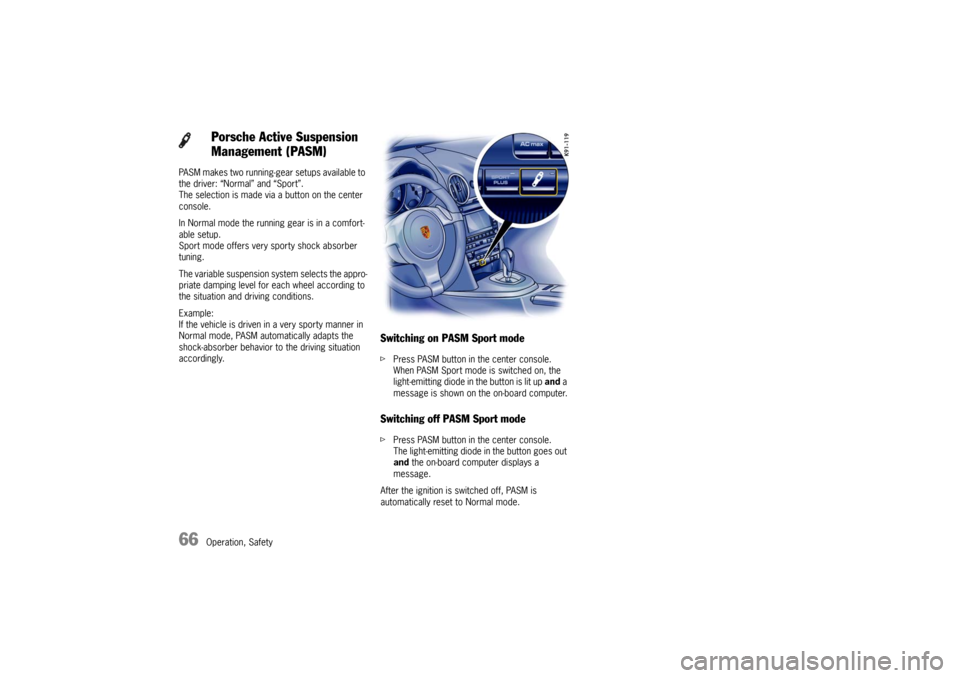
PASM makes two running-gea
r setups available to
the driver: “Normal” and “Sport”.
The selection is made vi a a button on the center
console.
In Normal mode the runnin g gear is in a comfort-
able setup.
Sport mode offers very sporty shock absorber
tuning.
The variable suspension system selects the appro-
priate damping level for each wheel according to
the situation and driving conditions.
Example:
If the vehicle is driven in a very sporty manner in
Normal mode, PASM automatically adapts the
shock-absorber behavior to the driving situation
accordingly.
Switching on PASM Sport modef Press PASM button in the center console.
When PASM Sport mode is switched on, the
light-emitting diode in the button is lit up and a
message is shown on the on-board computer.Switching off PASM Sport modefPress PASM button in the center console.
The light-emitting diode in the button goes out
and the on-board computer displays a
message.
After the ignition is switched off, PASM is
automatically reset to Normal mode.
Porsche Active Suspension
Management (PASM)
Page 69 of 284

Operation, Safety
67
Rear Spoiler The rear spoiler improves driving stability, espe-
cially at higher speeds.
Warning!
Risk of accident, resulting in serious perso-
nal injury or death.
If the spoiler cannot be extended, driving sta-
bility will be adversel y affected by increased
rear axle lift, which could lead to loss of con-
trol.
f Adapt your driving style and speed to the
changed driving conditions.
f Have the fault remedied at an authorized
Porsche dealer.
Risk of injury during manual retraction or
extension of the spoiler with the vehicle
stationary.
f Make sure that no persons or objects are
within the range of movement of the rear
spoiler.
Risk of damage from pushing the vehicle by
the rear spoiler.
f Do not push the vehicle at the rear spoiler.
Automatic control
(automatic mode)The rear spoiler extends at approx. 75 mph
(120 km/h) and retracts again at approx. 50 mph
(80 km/h).
If the automatic control fails, the warning light
lights up.
The warning light in the on-board computer lights
up when the rear spoiler does not extend over
75 mph (120 km/h) or its end position is not
reached.
Manual control
(manual mode)When the ignition is on, the rear spoiler can be
extended and retracted manually using the button
in the center console.
Note
When the rear spoiler is extended manually, the au-
tomatic control does not operate and the rear
spoiler must be manually retracted.
Warning light
Page 74 of 284

72
Operation, Safety
O - Initial position
1 - Ignition on
2 - Start engine
3 - Ignition offIgnition/Starter Switch with
anti-theft Steering LockThe ignition lock has a total of four ignition lock po-
sitions.
The ignition key rebounds to the initial position
from every ignition lock position.
f For your safety, fasten safety belts.
f Please see the chapter “IMMOBILIZER” on
Page 15. f
Please see the chapter “KEY WITH RADIO RE-
MOTE CONTROL” on Page 16.
Before starting the enginefApply the footbrake.
f Manual transmission:
Fully depress the clutch pedal and put the gear-
shift lever into neutral.
The clutch pedal must be depressed fully
before the starte r will engage.
f In vehicles with PDK transmission:
Move PDK selector lever to position P or N.
f Do not press the accelerator pedal.Switch position 0 Initial position
The ignition key cannot be withdrawn when the
ignition is switched on or when the engine has
been started.
To withdraw the ignition key:
f Stop the vehicle.
f In vehicles with PDK transmission:
Move PDK selector lever to position P.
f Switch ignition off.
f Remove ignition key.
Switch position 1 Ignition on
fTurn ignition key to position 1.
Ignition is switched on.
Note on operation
All electrical equipme nt can be switched on.
f Please see the chapter “WARNINGS ON THE
INSTRUMENT PANEL AND THE ON-BOARD
COMPUTER” on Page 166.
Page 80 of 284

78
Operation, SafetyWarning chime
If the ignition key is withdrawn and the door is
opened while the lights (not the Welcome Home
lighting) are on, a
chime warns of possible bat-
tery discharge.
In some countries, differences are possible
due to provisions of law.
Daytime driving lightsThe daytime driving lights are integrated in the
front auxiliary headlights. These lights are
switched on only when the engine is running and
with the light switch in the positions OFF or HOME.
Low beam headlights must be switched on when
driving through tunnels or at dusk, for example.
Operation of the daytime driving lights may vary
depending on country-specific regulations.
Canada only:
In addition to the auxiliary headlights the parking
lights are switched on.
USA only:
The daytime driving lights can be deactivated in
the on-board computer.
f Please see the chapter “ON-BOARD
COMPUTER (BC)” on Page 134.
Vehicles with the Sport Chrono Package Plus
Further individual light functions are available in ve-
hicles with the Sport Chrono Package Plus.
f Please observe the chapter “Individual Memo-
ry” in the separate PCM operating instructions.Cornering lightThe dynamic cornering light is activated above
speeds of 6 mph (10 km/h).
Light Switch on Vehicles with
Bi-Xenon HeadlightsLights switched off
Daytime driving lights are switched on
when the engine is running.
Welcome Home Function
Daytime driving lights are switched on
when the engine is running.
Parking lights , side marker lights,
license plate light, instrument illumina-
tion, daytime driving lights switched off
Canada: daytime driving lights switched
on
Low beam, high beam
Only with ignition on,
daytime driving lights switched off
Rear fog light
Pull switch to second click.
Indicator light on.
Page 82 of 284
80
Operation, SafetyWarning chime
If the ignition key is withdrawn and the door is
opened while the lights (not the Welcome Home
lighting) are on, a
chime warns of possible bat-
tery discharge.
In some countries, differences are possible
due to provisions of law.
Vehicles with the Sport Chrono Package Plus
Further individual light functions are available in ve-
hicles with the Sport Chrono Package Plus.
f Please observe the chapter “Individual
Memory” in the separate PCM operating
instructions.
Daytime driving lightsUSA only:
The daytime driving lights can be activated/deacti-
vated in the on-board computer.
fPlease see the chapter “ON-BOARD
COMPUTER (BC)” on Page 134.Welcome Home LightingSwitching on
fMove light switch to the HOME position.
For improved visibility and security when you get
in and out of the car, the fog lights and the tail
lights remain on for a certain period of time:
– When you get out of the car , the lights are
turned on for approx. 30 seconds after the
door is opened. The off-delay time resumes
when the vehicle is locked.
On vehicles with the Sport Chrono Package
Plus, the PCM can be used to set the off-delay
time. This setting also changes the lighting
period for unlocking the vehicle.
Please observe the chapter “Individual
Memory” in the separate PCM operating
instructions.
– The lights are turned on for approx. 30 seconds when the vehicle is unlocked .
The lights go out if the ignition is switched on
or when leaving the Welcome Home lighting.
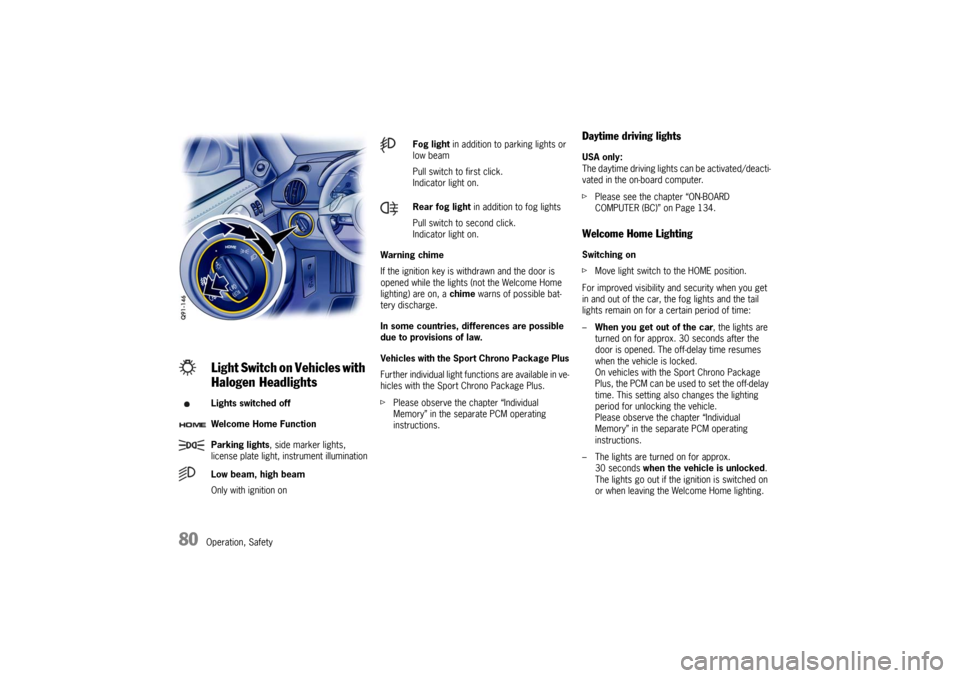
Light Switch on Vehicles with
Halogen HeadlightsLights switched off
Welcome Home Function
Parking lights , side marker lights,
license plate light, instrument illumination
Low beam, high beam
Only with ignition on
Fog light in addition to parking lights or
low beam
Pull switch to first click.
Indicator light on.
Rear fog light in addition to fog lights
Pull switch to second click.
Indicator light on.