fuse PORSCHE CAYNNE 2004 1.G User Guide
[x] Cancel search | Manufacturer: PORSCHE, Model Year: 2004, Model line: CAYENNE, Model: PORSCHE CAYENNE 2004 1.GPages: 379, PDF Size: 13.91 MB
Page 202 of 379

202
Driving and Driving Safety When driving on slopes with soft sand on vehicles
with Tiptronic S:
fUse the manual select mode M in addition to
the Low Range program.
If your vehicle becomes stuck nevertheless:
fDo not spin the wheels. Instead, use branches,
mats or similar items to provide adequate
traction so that you can drive out of the critical
area.
Track rutsOther vehicles leave ruts in many off-road courses
or gravel roads.
fPay attention to the ground clearance of the
car.
Please see the chapter “GROUND
CLEARANCE” on Page 357.
Caution!
Risk of damage to the vehicle floor when
driving through ruts that are too deep.
fAlways bear in mind the car's ground clearan-
ce.
fDo not drive over ruts that are too deep.
Note on operation
fActivate the Low Range program and engage
differential locks if necessary.
Tips on driving
fIn cases of doubt, drive with one wheel on the
strip of grass between the ruts.
fAvoid high engine speeds (max. 2,500 rpm).
fDrive slowly.
10_Cayenne_21_KW17.book Seite 202 Donnerstag, 9. April 2009 3:33 15
Page 219 of 379

Luggage Compartment, Loadspace and Storage
219
Compact disc player
Caution!
To avoid damage to compact disc player and
discs.
fUse only compact discs labeled as shown,
having no dirt, damage or warpage.
fNever attempt to disassemble or oil any part
of the player unit. Do not insert any object
other than a disc into the slot.Remember there
are no user-serviceable parts inside the
compact disc player.
fDo not allow the disc to sustain any finger-
prints, scrapes or stickers on the surfaces.
This may cause poor sound quality.
Hold the disc only on the edge or center hole.
fWhen not in use, take the disc out of the player,
put the disc back into its case and store it
away from dust, heat, damp and direct sun-
light.
Leaving the disc on the dashboard in the sun
can damage the disc.fIf the disc gets dirty, clean the disc by wiping
the surfaces from the center to the outside in
a radial direction with a soft cloth.
Do not use a conventional record cleaner or
anti-static record preservative.
Disc cleaners are available in audio stores.
Car Telephone and Aftermarket Alarms Important legal and safety information
regarding the use of cellular telephones
Some states may prohibit the use of cellular tele-
phones while driving a vehicle. Check the laws and
regulations on the use of cellular telephones in the
areas where you drive.
Danger!
Risk of an accident.
Severe personal injury or death can result in
the event of an accident.
Looking away from the road or turning your
attention away from your driving can cause
an accident and lead to serious personal
injury or death.
When using your cellular telephone, you should
always:
fGive full attention to your driving - pull off the
road and park before making or answering a
call if traffic conditions so require; andfKeep both hands on the steering wheel - use
hands-free operation (if available) - pull off the
road and park before using a hand-held tele-
phone.
It is essential to observe the telephone
manufacturer's instructions before operating
the telephone.
Any portable telephone or radio transmitter which
is used in a Porsche must be properly installed in
accordance with the technical requirements of
Porsche.
The transmission power must not exceed
10 W.
The devices must possess a type approval for
your vehicle and have an “e” symbol.
If you should require equipment with transmission
power values greater than 10 W, please consult
your authorized Porsche dealer for this purpose.
He is familiar with the technical requirements for
installing devices of this kind.
The antennas for all radios and telephones with a
transmitting antenna must be externally mounted.
The improper installation of radios or telephones
or use of a radio or telephone with a transmitting
antenna inside the car may cause the warning
lights to come on.
Improper installation of such equipment can
create a discharged battery or excessive current
draw from added equipment.
10_Cayenne_21_KW17.book Seite 219 Donnerstag, 9. April 2009 3:33 15
Page 230 of 379
230
Tr a i l e r H i t c h
Trailer Coupling
Warning!
Risk of accident.
fFollow the operating instructions for the trailer
recommended by the trailer manufacturer.
fDo not modify or repair the trailer coupling.
fBefore having new ADAPTER fitted, find out
from your authorized Porsche dealer about the
current authorization status.
fUse only ADAPTER makes tested and
approved by Porsche.fEnsure that all trailer equipment conforms to
the appropriate classification for total gross
trailer weight and tongue weight.
fPlease see the chapter “WEIGHTS” on
Page 356.
fPlease see the chapter “LOADING
INFORMATION” on Page 231.
RetrofittingHave a trailer coupling retrofitted only by an
authorized Porsche dealer. The dealer is familiar
with the manufacturer's specifications and any
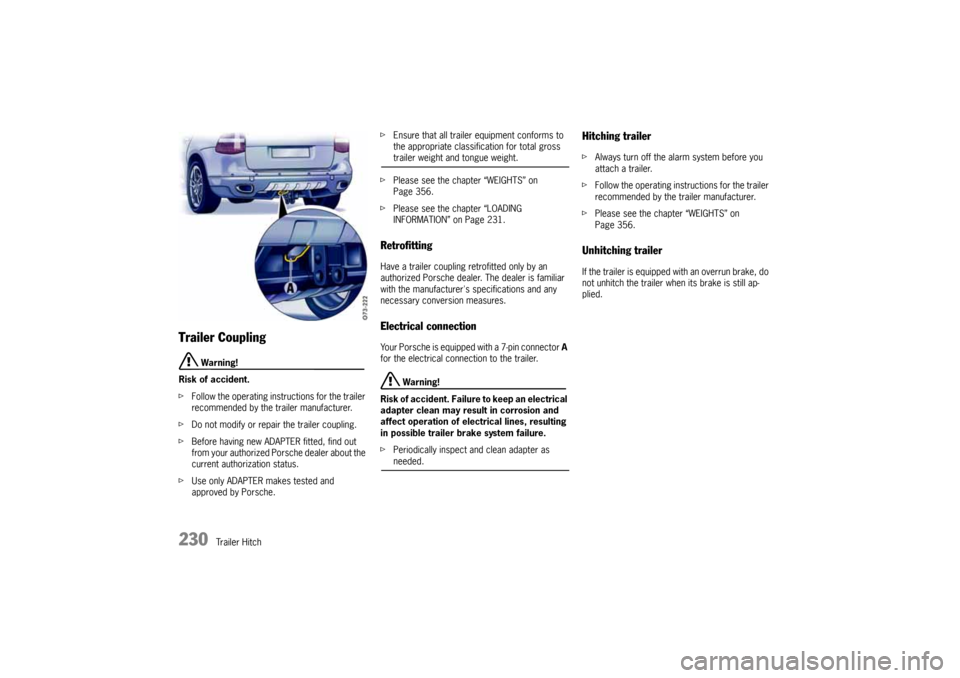
necessary conversion measures.Electrical connectionYour Porsche is equipped with a 7-pin connector A
for the electrical connection to the trailer.
Warning!
Risk of accident. Failure to keep an electrical
adapter clean may result in corrosion and
affect operation of electrical lines, resulting
in possible trailer brake system failure.
fPeriodically inspect and clean adapter as needed.
Hitching trailerfAlways turn off the alarm system before you
attach a trailer.
fFollow the operating instructions for the trailer
recommended by the trailer manufacturer.
fPlease see the chapter “WEIGHTS” on
Page 356.Unhitching trailerIf the trailer is equipped with an overrun brake, do
not unhitch the trailer when its brake is still ap-
plied.
10_Cayenne_21_KW17.book Seite 230 Donnerstag, 9. April 2009 3:33 15
Page 233 of 379

Trailer Hitch
233
Stowing load in the vehicle
Warning!
Danger of injury.
An unsecured or incorrectly positioned cargo
can slip out of place or endanger the vehicle
occupants during braking, direction changes
or in accidents.
Never transport objects which are not
secured.
fAlways transport cargo in the cargo area,
never in the passenger compartment (e.g. on
or in front of the seats).
fSupport the cargo on the seat backrests
whenever possible. Always lock the backrests
into place.
fPlace the cargo behind unoccupied seats
whenever possible.
fStow heavy objects as close to the front of the
cargo area as possible, with lightweight ob-
jects behind them.
fThe cargo must never project over the top
edge of the seat backrest.
fAlways protect the passenger compartment
with a luggage safety net and a luggage
compartment cover.
Do not drive with objects on top of the luggage
compartment cover.fIf the rear seats are not occupied, the back-
rests can be additionally secured with the safe-
ty belts. Simply cross the outer safety belts
and insert each into the opposite buckle.
fMake sure that the cargo cannot damage the
heating filaments of the rear window and the
TV antenna of the side window.
Luggage net
fLuggage must be stowed completely covered
by the luggage net.
The luggage net can prevent only lightweight
objects from slipping.
Tie-down belts
fDo not use elastic belts or straps to tie down
cargo.
fDo not place belts and straps over sharp
edges.
fObserve the directions for use and information
for the tie-down equipment.
fUse only belts with a tear strength of at least
1543 lbs. (700 kg) and a maximum width of
1in. (25mm).
fCross the belts over the load.Driving
fThe car's handling changes depending on the
vehicle loading. Adapt your driving style to the
changed driving behavior.
fDo not exceed the maximum gross weight and
the axle load.
fPlease see the chapter “WEIGHTS” on
Page 356.
fNever drive with the rear window or rear lid
open.
Exhaust gases can enter the passenger
compartment.
fAdapt the tire pressure to the load.
fPlease see the chapter “SETTING VEHICLE
LOADING AND ADJUSTING TIRE PRESSURE”
on Page 135.
fPlease see the chapter “TIRE PRESSURES,
COLD (68 °F/20 °C)” on Page 354.
10_Cayenne_21_KW17.book Seite 233 Donnerstag, 9. April 2009 3:33 15
Page 255 of 379
Maintenance and Car Care
255
Coolant LevelThe coolant provides year-round protection from
corrosion and freezing down to -31 °F (-35 °C)
(Nordic countries -40 °F (-40 °C).
fUse only anti-freeze authorized by Porsche.
fCheck the coolant level regularly.
Further important information concerning “mainte-
nance” can be found in a separate chapter.
fPlease see the chapter “EXERCISE EXTREME
CAUTION WHEN WORKING ON YOUR VEHICLE”
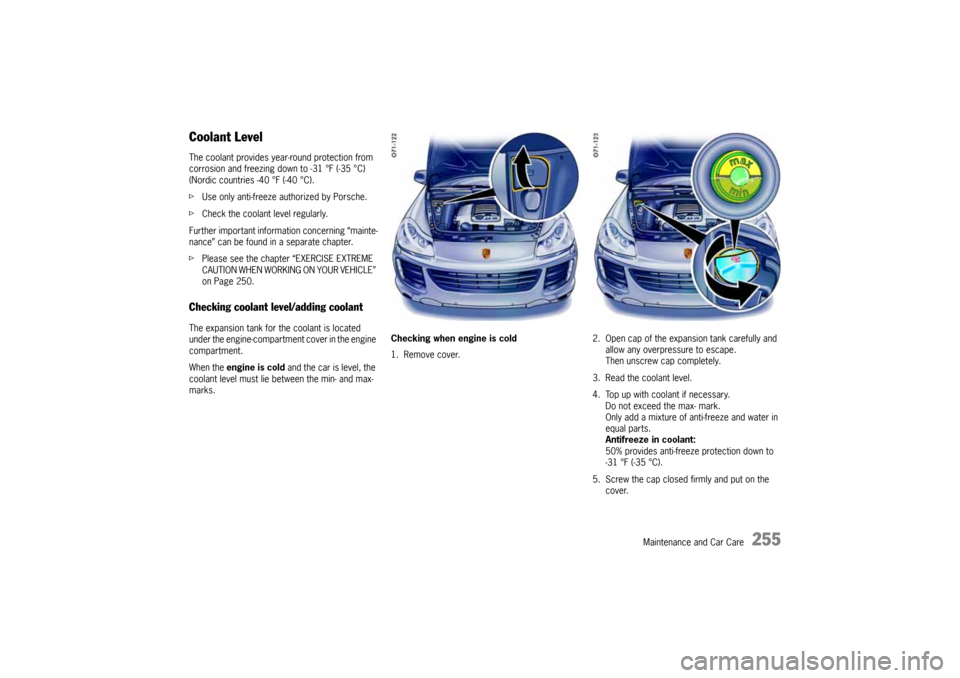
on Page 250.Checking coolant level/adding coolantThe expansion tank for the coolant is located
under the engine-compartment cover in the engine
compartment.
When the engine is cold and the car is level, the
coolant level must lie between the min- and max-
marks.Checking when engine is cold
1. Remove cover.2. Open cap of the expansion tank carefully and
allow any overpressure to escape.
Then unscrew cap completely.
3. Read the coolant level.
4. Top up with coolant if necessary.
Do not exceed the max- mark.
Only add a mixture of anti-freeze and water in
equal parts.
Antifreeze in coolant:
50% provides anti-freeze protection down to
-31 °F (-35 °C).
5. Screw the cap closed firmly and put on the
cover.
10_Cayenne_21_KW17.book Seite 255 Donnerstag, 9. April 2009 3:33 15
Page 257 of 379
Maintenance and Car Care
257
Brake-Fluid LevelfUse only new (unused) Original Porsche brake
fluid.
Further important information concerning “mainte-
nance” can be found in a separate chapter.
fPlease see the chapter “EXERCISE EXTREME
CAUTION WHEN WORKING ON YOUR VEHICLE”
on Page 250.
Warning!
Brake fluid is hazardous to your health, and
may be fatal if swallowed.
Brake fluid also attacks paintwork.
fKeep brake fluid out of children's reach.
fImmediately rinse off spilled brake fluid with
clean water.
fIf brake fluid gets into your eye, immediately
rinse with clean water for a few minutes. Then
see a doctor immediately.
fPlease note all the information on the refill container of the brake fluid.
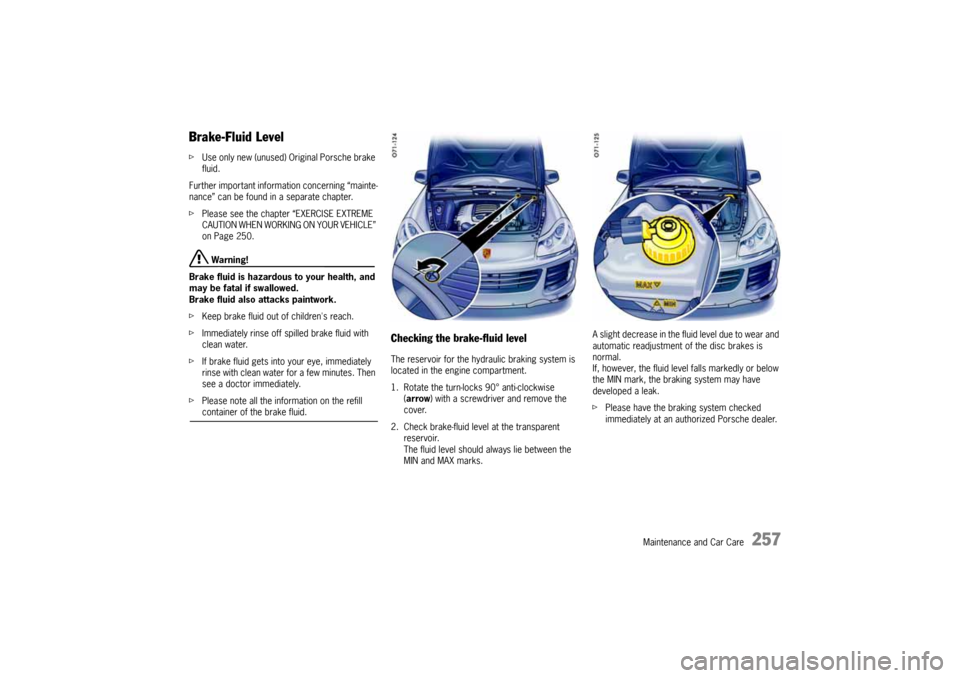
Checking the brake-fluid levelThe reservoir for the hydraulic braking system is
located in the engine compartment.
1. Rotate the turn-locks 90° anti-clockwise
(arrow) with a screwdriver and remove the
cover.
2. Check brake-fluid level at the transparent
reservoir.
The fluid level should always lie between the
MIN and MAX marks.A slight decrease in the fluid level due to wear and
automatic readjustment of the disc brakes is
normal.
If, however, the fluid level falls markedly or below
the MIN mark, the braking system may have
developed a leak.
fPlease have the braking system checked
immediately at an authorized Porsche dealer.
10_Cayenne_21_KW17.book Seite 257 Donnerstag, 9. April 2009 3:33 15
Page 259 of 379
Maintenance and Car Care
259
Power Steering
Warning!
Risk of accident resulting in serious personal
injury or death. When the engine is stationary
(e.g. when on tow) or the hydraulic system
fails, there is no assistance for steering.
Therefore, substantially more force will have
to be exerted.
fExercise great care when on tow.
fHave the fault remedied at your nearest authorized Porsche dealer.
The flow noise heard at full steering lock is design-
related and does not indicate a defect in the
steering system.
Further important information concerning “mainte-
nance” can be found in a separate chapter.
fPlease see the chapter “EXERCISE EXTREME
CAUTION WHEN WORKING ON YOUR VEHICLE”
on Page 250.
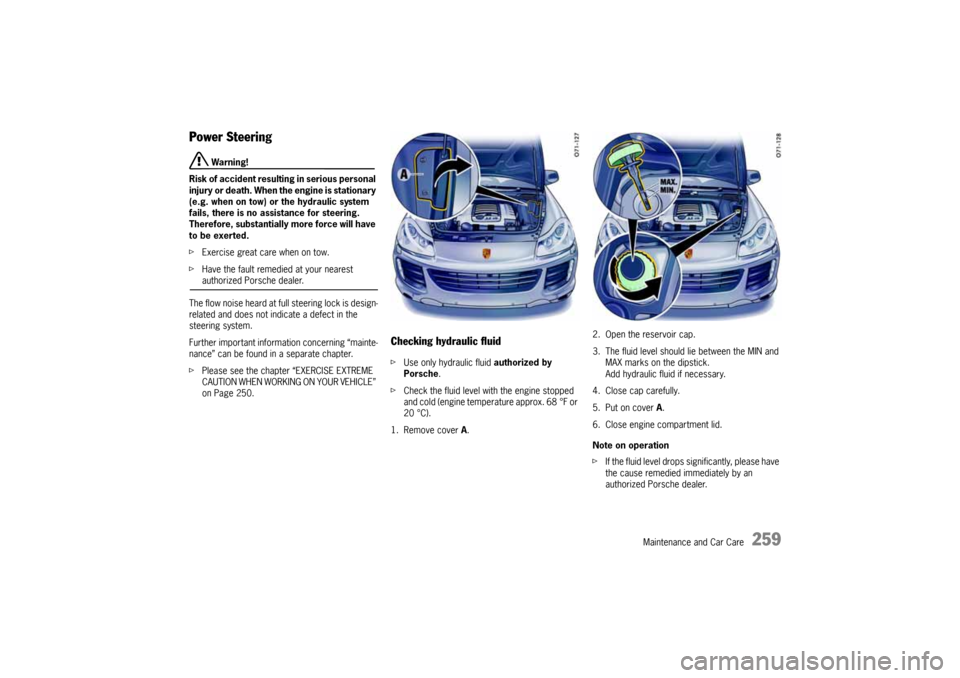
Checking hydraulic fluidfUse only hydraulic fluid authorized by
Porsche.
fCheck the fluid level with the engine stopped
and cold (engine temperature approx. 68 °F or
20 °C).
1. Remove cover A.2. Open the reservoir cap.
3. The fluid level should lie between the MIN and
MAX marks on the dipstick.
Add hydraulic fluid if necessary.
4. Close cap carefully.
5. Put on cover A.
6. Close engine compartment lid.
Note on operation
fIf the fluid level drops significantly, please have
the cause remedied immediately by an
authorized Porsche dealer.
10_Cayenne_21_KW17.book Seite 259 Donnerstag, 9. April 2009 3:33 15
Page 275 of 379

Maintenance and Car Care
275
UndercoatingThe underside of your car is durably protected
against chemical and mechanical influences.
As it is not possible to exclude the risk of damage
to this protective coating in day to day driving, it
is advisable to have the underside of the car
inspected at certain intervals - preferably before
the start of winter and again in spring - and the
undercoating restored as necessary.
Your authorized Porsche dealer is familiar with the
bodyseal treatment procedures and has the ne-
cessary equipment for applying factory approved
materials. We recommend that you entrust them
with such work and inspections.
Unlike conventional spray oils, undercoating and
rust-proofing compounds based on bitumen or
wax do not attack the sound-proofing materials
applied at the factory.
Warning!
Danger of fire resulting in serious personal
injury or death.
fDo not apply additional undercoating or rust-
proofing on or near the exhaust manifold,
exhaust pipes, catalytic converters or heat
shields. During driving the substance used for undercoating could overheat and ignite.fBefore applying fresh underseal, carefully re-
move deposits or dirt and grease. Once it has
dried, the new undercoating compound forms
a tough protective coating which provides effi-
cient rust-proofing of the floor panels and com-
ponents.
fAlways apply a fresh coating of suitable pre-
servative to unprotect areas after cleaning the
underside of the body, the transmission, the
engine or carrying out repairs to underbody,
engine or transmission components.
Effective rust-proofing is particularly important
during the cold weather season. If your car is
driven frequently in areas where salt has been
spread on the roads, the whole engine compart-
ment should be cleaned thoroughly after the
winter to prevent salt from causing any lasting
damage. A full under-body wash should also be
performed at the same time.
Cleaning headlights, lights, interior and
exterior plastic parts, adhesive filmsObserve the following points:
fUse only clean water and a little dishwashing
detergent or interior window cleaner to clean
headlights, lights, plastic parts, adhesive films
and surfaces.
Use a soft sponge or a soft, lint-free cloth.
Note
An interior window cleaner can also be used to
clean plastic surfaces (observe cleaning instruc-
tions on the container!).
We recommend the Porsche interior window
cleaner.
fGently wipe the surface without applying too
much pressure.
fDo not clean when dry.
fNever use other chemical cleaners or
solvents.
Rinse cleaned surfaces with clear water.
10_Cayenne_21_KW17.book Seite 275 Donnerstag, 9. April 2009 3:33 15
Page 277 of 379

Maintenance and Car Care
277
Leather careThe natural surface markings of leather,
e.g. creases, healed scars, insect sting marks,
structural differences and slight variations in
shade and grain add to the attractiveness of the
high-quality natural leather product.
Observe the following care instructions:
Caution!
The leather will be damaged by the use of
unsuitable cleaning and care agents and by
inappropriate treatment.
fDo not use caustic cleaners or hard cleaning
objects!
fPerforated leather must under no circum-stances get wet on its reverse side.
fAll types of leather should be cleaned regularly
to remove fine dust using a soft, damp, white
woollen cloth or a commercially available
microfibre cloth.
fRemove heavy contamination with a leather
cleaner.
Please always follow the instructions for use
given on the containers.
We recommend the Porsche leather care
product.
fOnce cleaned, leather (particularly the heavily
stressed leather seats) must be treated only
with Porsche leather care product.
Carpets and matsfUse only a vacuum cleaner or a medium stiff
brush.
fRemove stains and spots with Porsche stain
remover.
The Porsche range of accessories includes floor-
mats to protect the carpets in summer and winter.
Warning!
Risk of an accident resulting in serious
personal injury or death.
fAlways check the movement of the pedals
before driving and make sure that they are not
obstructed by a floor mat or any other object.
fSecure the floor mat to prevent it from sliding
into positions that could interfere with the safe
operation of your vehicle – do not lay them
loosely in the vehicle.
Your Porsche dealer will be glad to offer you
floor mats of correct size including a securing possibility.
Cleaning airbags covers
Danger!
There is a danger of serious personal injury
or death if the airbag system is impaired by
improper cleaning work.
fDo not make any modifications whatsoever on
individual components such as the padded
covers of the steering wheel, the passenger
side of the dashboard, the front seats, the roof
pillars and the rooflinings.
fLet your authorized Porsche dealer clean these components.
Cleaning fabric liningsFabric linings on pillars, headliner and sun visors,
etc., must be treated only using suitable cleaning
agents or a suitable dry foam and a soft brush.
10_Cayenne_21_KW17.book Seite 277 Donnerstag, 9. April 2009 3:33 15
Page 278 of 379

278
Maintenance and Car Care
Cleaning AlcantarafDo not use a leather care product to clean
Alcantara.
For regular care it is sufficient to clean the cover
with a soft brush. Heavy abrasion or rubbing when
cleaning causes a permanent change in the
surface.
Cleaning when lightly soiled
fWet a soft cloth with water or a neutral soap
solution and wipe off the dirt.
Cleaning when heavily soiled
fWet a soft cloth with lukewarm water or
thinned white spirit and dab the dirt from the
outside in.Cleaning safety beltsfUse mild detergent to clean soiled belts.
fWhen drying, avoid direct sunlight.
fOnly use suitable cleaning agents.
fDo not tint or bleach the belts.
The belt fabric could be weakened, thus affec-
ting safety.
Storing your PorscheIf you intend to store your Porsche for a prolonged
period, please consult your authorized Porsche
dealer. The staff will be glad to advise you on the
most suitable and necessary methods.
fClean your vehicle thoroughly inside and out-
side. Clean the engine compartment. The
under carriage and chassis components
should be free of dirt and salt deposits.
fFill up the fuel tank.
fChange the oil and oil filter, and run the engine
for several minutes.
fIncrease the tire pressure to 58 psi (4 bar). It
is not recommended to lift the vehicle, due to
the possibility of corrosion on shock absorber
piston shafts.The vehicle should be moved
slightly, approximately every four weeks, to
prevent flat spot on the tires.
Climate control
The air conditioning system should be in good
working condition and fully charged.
Windshield/Headlight washer
fCheck and correct antifreeze/cleaning solution
level as necessary.Electrical system
fRemove the battery from the vehicle and store
it in a cool dry place, not on a cement floor.
When the battery is disconnected, the alarm
system is deactivated.
fRecharge the battery every 3 months. If the
battery remains in the vehicle with the cables
connected, it is necessary to check, remove
and recharge the battery every 2-3 weeks.
Do not fast charge the battery.
fPlease see the chapter “CHARGE STATE” on
Page 320.
Vehicle interior
The interior must be dry, especially in the area of
the floor carpets. The use of drying agents (Silica-
Gel) is recommended in vehicles with leather inte-
rior and in areas with high humidity. The recom-
mended amount is 3 fabric bags of 1.1 lbs.
(500 grams) each placed on the floor carpets.
fWindows, doors, lids and roof must be closed.
The air vents should be opened.
10_Cayenne_21_KW17.book Seite 278 Donnerstag, 9. April 2009 3:33 15