engine oil PORSCHE CAYNNE 2004 1.G Owner's Manual
[x] Cancel search | Manufacturer: PORSCHE, Model Year: 2004, Model line: CAYENNE, Model: PORSCHE CAYENNE 2004 1.GPages: 379, PDF Size: 13.91 MB
Page 260 of 379

260
Maintenance and Car Care
Changing Air CleanerRegular replacement of the filter element is part of
servicing.
fIn dusty conditions, clean the filter element
more frequently and replace if necessary.
Further important information concerning “mainte-
nance” can be found in a separate chapter.
fPlease see the chapter “EXERCISE EXTREME
CAUTION WHEN WORKING ON YOUR VEHICLE”
on Page 250.Changing Particle FilterThe fresh air passing through the particle filter into
the passenger compartment is virtually free of
dust and pollen.
fIf the outside air is polluted by exhaust fumes,
press the recirculating-air button.
A dirty filter can be the cause of reduced air
throughput.
fHave filter replaced by your authorized
Porsche dealer.
fRegular replacement of the filter is part of
servicing.
Automatic Transmission Fluid The torque converter and the transmission are
lubricated with Automatic Transmission Fluid
(ATF).
fPlease see the chapter “CAPACITIES” on
Page 359.
Do not tow the car or run the engine without ATF
in the transmission. The automatic transmission
may be damaged by even a tiny speck of dirt, only
a clean funnel or spout must be used when adding
AT F.
The ATF and transmission oil has to be checked
and changed at the intervals listed in your Mainte-
nance Schedule.
We recommend that you have the ATF and trans-
mission oil changed at your Porsche dealer, who
has the required lubricants and the necessary fil-
ling equipment.
If you suspect an oil leak in the transmission, have
your authorized Porsche dealer check it out imme-
diately.
Manual Transmission OilThe transmission oil has to be checked and chan-
ged at the intervals listed in your Maintenance
Schedule.
fPlease see the chapter “CAPACITIES” on
Page 359.
We recommend that you have the transmission oil
changed at your Porsche dealer, who has the
required lubricants and the necessary filling equip-
ment.
If you suspect an oil leak in the transmission, have
your authorized Porsche dealer check it out imme-
diately.
10_Cayenne_21_KW17.book Seite 260 Donnerstag, 9. April 2009 3:33 15
Page 268 of 379

268
Maintenance and Car Care
RefuelingfTotal capacity approx. 26.4 gallons
(100 liters), including approx. 3 gallons
(12 liters) reserve.
Danger!
The RF energy from a cellphone can cause a
sparking on bare metal, much like aluminum
foil in a microwave oven. The spark could
ignite gasoline fumes present while refuling.
Static discharge from your body can ignite
gasoline fumes present when you get back
out of the vehicle and touch the fuel nozzle.
In either case, resulting fire can cause
serious damage to the vehicle, serious injury
or death to persons in immediate vicinity.
fDo not use a cellphone while pumping gas.
fDo not re-enter the vehicle while pumping gas.
1. Stop the engine and switch off the ignition.2. Slowly unscrew the tank cap.
Hang the tank cap’s plastic strap on the
hookA on the inside wall of the filler flap.
3. Insert pump nozzle fully into the filler neck with
the handle of the pump nozzle facing down.
4. Do not add further fuel once the correctly
operated automatic pump nozzle has switched
off.
Fuel could spray or could run over when
heated.
5. Replace the tank cap immediately after
refueling and turn it until you hear it and feel it
engage.Maintenance Note
If you lose the tank filler cap, you must replace it
only with an original part.
Caution!
Risk of damage. Decorative foils may bleach
of they come into contact with fuel.
fWipe off any spilt fuel immediately.Portable Fuel Containers
Danger!
Portable fuel containers, full or partially
empty, may leak causing an explosion, or
result in fire in case of an accident.
fNever carry additional fuel in portable contai-ners in your vehicle.
10_Cayenne_21_KW17.book Seite 268 Donnerstag, 9. April 2009 3:33 15
Page 269 of 379
Maintenance and Car Care
269
Fuel RecommendationsYour Porsche is equipped with catalytic conver-
ters and must use UNLEADED FUEL ONLY.
Your engine is designed to provide optimum
performance and fuel economy using unleaded
premium fuel with an octane rating of 98 RON
(93 CLC or AKI). Porsche therefore recom-
mends the use of these fuels in your vehicle.
Porsche also recognizes that these fuels may not
always be available. Be assured that your vehicle
will operate properly on unleaded premium fuels
with octane numbers of at least 95 RON
(90 CLC or AKI), since the engine's “Electronic
Octane™ knock control” will adapt the ignition
timing, if necessary.
It is important to observe the regular service inter-
vals, and particularly the oil change intervals, spe-
cified in your Maintenance Schedule.
The use of UNLEADED FUEL ONLY is critically
important to the life of the catalytic
converters. Deposits from leaded fuels will
ruin the converters and make it ineffective
as an emission control device.
Cars with catalytic converters have a smaller fuel
tank opening, and gas station pumps have smaller
nozzles. This will prevent accidental pumping of
leaded fuel into cars with catalytic converters.Unleaded fuels may not be available outside the
continental U.S. and Canada. Therefore, we
recommend you do not take your car to areas or
countries where unleaded fuel may not be
available.
Octane ratingsOctane rating indicates a fuel's ability to resist
detonation. Therefore, buying the correct octane
gas is important to prevent engine “damage”.
The RON octane rating is based on the research
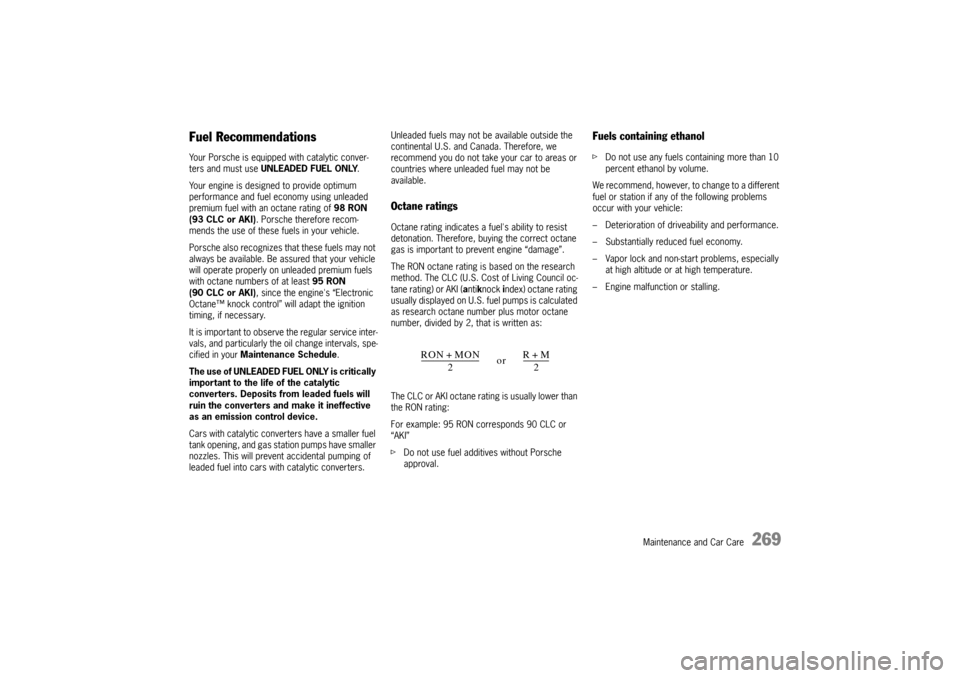
method. The CLC (U.S. Cost of Living Council oc-
tane rating) or AKI (antiknock index) octane rating
usually displayed on U.S. fuel pumps is calculated
as research octane number plus motor octane
number, divided by 2, that is written as:
The CLC or AKI octane rating is usually lower than
the RON rating:
For example: 95 RON corresponds 90 CLC or
“AKI”
fDo not use fuel additives without Porsche
approval.
Fuels containing ethanolfDo not use any fuels containing more than 10
percent ethanol by volume.
We recommend, however, to change to a different
fuel or station if any of the following problems
occur with your vehicle:
– Deterioration of driveability and performance.
– Substantially reduced fuel economy.
– Vapor lock and non-start problems, especially
at high altitude or at high temperature.
– Engine malfunction or stalling.
RON MON+
2 ----------------------------------
orRM+
2 ---------------
10_Cayenne_21_KW17.book Seite 269 Donnerstag, 9. April 2009 3:33 15
Page 273 of 379
Maintenance and Car Care
273
PaintfNever rub a dusty car with a dry cloth since
dust particles are abrasive and could dull and
damage the surface finish.
The paintwork of your car is exposed to all types
of mechanical and chemical conditions, particular-
ly climatic ones such as bright sunlight, rain, frost
and snow. Ultraviolet light, rapid changes in tem-
perature, rain, snow, industrial dust and chemical
deposits constantly attack the paint which is only
able to withstand such exposure in the long term
if it is given regular care and attention.
fDo not apply silicone polishes to the windshield
or window.
fDo not treat matt-painted components with
preservatives or polishes, otherwise the matt
effect will be lost.
Preservation
The paint surface becomes dull over time due to
weathering. It is therefore necessary to preserve
the paint regularly.
This keeps the paint shiny and elastic. Dirt is
prevented from adhering to the paint surface and
industrial dust is prevented from penetrating the
paint.
Provided it is washed and treated with preserva-
tive regularly, the brand new finish of your car will
be retained for years to come.
fSimply apply paint preservative after washing
the car and polish it smooth.Polishing
Do not resort to using Porsche polish until it
becomes evident that the normal preservatives no
longer produce the desired finish.
Removing spots and stains
fRemove tar stains, grease, oil spots and dead
insects etc. as soon as possible with Insect Re-
mover. They can cause discoloration if allowed
to remain on the paintwork.
fWash the affected area immediately after
treating it.
Minor paint damage
fHave minor paint damage, such as scratches,
scores or chips caused by flying stones,
repaired immediately by your authorized
Porsche dealer before corrosion begins.
However, if there are already traces of corrosion,
they must first be removed carefully and
thoroughly. Coat the area with a rust-proofing
primer and finish off with a top coat. The paint
code and color number are found on the data bank
in the Maintenance booklet and on the vehicle’s
data bank.
fPlease see the chapter “DATA BANK” on
Page 347.
Cleaning the engine compartment
Caution!
Risk of damage, e.g. to the alternator,
painted surfaces, and the valve covers.
fNever use high-pressure cleaning equipment
with a round-jet nozzle.
fAlways maintain a minimum distance of 21 in.
(50 cm).
fAlways cover the lid over the brake fluid reser-
voir prior to cleaning with a high-pressure
cleaner. Never point the cleaning jet directly at
the lid.
fDo not point the cleaning jet directly at any of the aforementioned components.
Note on operation
If the car is driven off-road frequently and after
driving on salted or gritted roads:
fClean the engine compartment regularly.
10_Cayenne_21_KW17.book Seite 273 Donnerstag, 9. April 2009 3:33 15
Page 275 of 379
Maintenance and Car Care
275
UndercoatingThe underside of your car is durably protected
against chemical and mechanical influences.
As it is not possible to exclude the risk of damage
to this protective coating in day to day driving, it
is advisable to have the underside of the car
inspected at certain intervals - preferably before
the start of winter and again in spring - and the
undercoating restored as necessary.
Your authorized Porsche dealer is familiar with the
bodyseal treatment procedures and has the ne-
cessary equipment for applying factory approved
materials. We recommend that you entrust them
with such work and inspections.
Unlike conventional spray oils, undercoating and
rust-proofing compounds based on bitumen or
wax do not attack the sound-proofing materials
applied at the factory.
Warning!
Danger of fire resulting in serious personal
injury or death.
fDo not apply additional undercoating or rust-
proofing on or near the exhaust manifold,
exhaust pipes, catalytic converters or heat
shields. During driving the substance used for undercoating could overheat and ignite.fBefore applying fresh underseal, carefully re-
move deposits or dirt and grease. Once it has
dried, the new undercoating compound forms
a tough protective coating which provides effi-
cient rust-proofing of the floor panels and com-
ponents.
fAlways apply a fresh coating of suitable pre-
servative to unprotect areas after cleaning the
underside of the body, the transmission, the
engine or carrying out repairs to underbody,
engine or transmission components.
Effective rust-proofing is particularly important
during the cold weather season. If your car is
driven frequently in areas where salt has been
spread on the roads, the whole engine compart-
ment should be cleaned thoroughly after the
winter to prevent salt from causing any lasting
damage. A full under-body wash should also be
performed at the same time.
Cleaning headlights, lights, interior and
exterior plastic parts, adhesive filmsObserve the following points:
fUse only clean water and a little dishwashing
detergent or interior window cleaner to clean
headlights, lights, plastic parts, adhesive films
and surfaces.
Use a soft sponge or a soft, lint-free cloth.
Note
An interior window cleaner can also be used to
clean plastic surfaces (observe cleaning instruc-
tions on the container!).
We recommend the Porsche interior window
cleaner.
fGently wipe the surface without applying too
much pressure.
fDo not clean when dry.
fNever use other chemical cleaners or
solvents.
Rinse cleaned surfaces with clear water.
10_Cayenne_21_KW17.book Seite 275 Donnerstag, 9. April 2009 3:33 15
Page 278 of 379
278
Maintenance and Car Care
Cleaning AlcantarafDo not use a leather care product to clean
Alcantara.
For regular care it is sufficient to clean the cover
with a soft brush. Heavy abrasion or rubbing when
cleaning causes a permanent change in the
surface.
Cleaning when lightly soiled
fWet a soft cloth with water or a neutral soap
solution and wipe off the dirt.
Cleaning when heavily soiled
fWet a soft cloth with lukewarm water or
thinned white spirit and dab the dirt from the
outside in.Cleaning safety beltsfUse mild detergent to clean soiled belts.
fWhen drying, avoid direct sunlight.
fOnly use suitable cleaning agents.
fDo not tint or bleach the belts.
The belt fabric could be weakened, thus affec-
ting safety.
Storing your PorscheIf you intend to store your Porsche for a prolonged
period, please consult your authorized Porsche
dealer. The staff will be glad to advise you on the
most suitable and necessary methods.
fClean your vehicle thoroughly inside and out-
side. Clean the engine compartment. The
under carriage and chassis components
should be free of dirt and salt deposits.
fFill up the fuel tank.
fChange the oil and oil filter, and run the engine
for several minutes.
fIncrease the tire pressure to 58 psi (4 bar). It
is not recommended to lift the vehicle, due to
the possibility of corrosion on shock absorber
piston shafts.The vehicle should be moved
slightly, approximately every four weeks, to
prevent flat spot on the tires.
Climate control
The air conditioning system should be in good
working condition and fully charged.
Windshield/Headlight washer
fCheck and correct antifreeze/cleaning solution
level as necessary.Electrical system
fRemove the battery from the vehicle and store
it in a cool dry place, not on a cement floor.
When the battery is disconnected, the alarm
system is deactivated.
fRecharge the battery every 3 months. If the
battery remains in the vehicle with the cables
connected, it is necessary to check, remove
and recharge the battery every 2-3 weeks.
Do not fast charge the battery.
fPlease see the chapter “CHARGE STATE” on
Page 320.
Vehicle interior
The interior must be dry, especially in the area of
the floor carpets. The use of drying agents (Silica-
Gel) is recommended in vehicles with leather inte-
rior and in areas with high humidity. The recom-
mended amount is 3 fabric bags of 1.1 lbs.
(500 grams) each placed on the floor carpets.
fWindows, doors, lids and roof must be closed.
The air vents should be opened.
10_Cayenne_21_KW17.book Seite 278 Donnerstag, 9. April 2009 3:33 15
Page 280 of 379

280
Minor Repairs
Exercise Extreme Caution when
Working on your Vehicle
Danger!
Ignoring the following instructions may cau-
se serious personal injury or death.
fThe engine compartment of any motor vehicle
is a potentially hazardous area. If you are not
fully familiar with proper repair procedures, do
not attempt the adjustments described on the
following pages.
This caution applies to the entire vehicle.
fO n l y w o r k o n y o u r v e h i c l e o u t d o o r s o r i n a w e l l
ventilated area.
fEnsure that there are no open flames in the
area of your vehicle at any time when fuel
fumes might be present. Be especially
cautious of such devices such as hot water
heaters which ignite a flame intermittently.
fBefore working on any part in the engine com-
partment, turn the engine off and let it cool
down sufficiently. Hot engine compartment
components can burn skin on contact.
fBe alert and cautious around engine at all
times while the engine is running.
If you have to work on the engine while it is run-
ning, always put the parking brake on and put
the gearshift lever in neutral or the Tiptronic
selector lever in position P or N.fIn particular, be very careful to ensure that
items of clothing (ties, shirt, sleeves etc.),
jewelry, long hair, hand or fingers cannot get
caught in the engine-compartment blower, fan,
belts or other moving parts.
The radiator and radiator fans are in the front
of the car.
The fans can start or continue running as a
function of temperature, even with the engine
switched off.
Carry out work in these areas only with the
engine off and exercise extreme caution.
fYour Porsche is equipped with an electronic
ignition system. When the ignition is on, high
voltage is present in all wires connected with
the ignition system; therefore, exercise
extreme caution when working on any part of
the engine while the ignition is on or the engine
is running.
fAlways support your car with safety stands if it
is necessary to work under the car. The jack
supplied with the car is not adequate for this
purpose.
For vehicles with air suspension with level
control and height adjustment:
Please see the chapter “RAISING VEHICLE
WITH THE JACK” on Page 192.fWhen working under the car without safety
stands but with the wheels on the ground,
make sure the car is on level ground, the
wheels are blocked, and that the engine can-
not be started.
Remove the ignition key.
fDo not smoke or allow an open flame around
the battery or fuel.
Keep a fire extinguisher close at hand.
fIncomplete or improper servicing may cause
problems in the operation of the car. If in doubt
about any servicing, have it done by your
authorized Porsche dealer.
Improper maintenance during the warranty
period may affect your Porsche warranty
coverage.
fSupplies of fluids, e.g. engine oil, brake fluid or
coolant, are hazardous to your health. Keep
these fluids out of children's reach and dispose
of them in accordance with the appropriate
regulations.
fSome countries require additional tools and
special spare parts to be carried in your vehi-
cle.
Please make enquiries before driving abroad.
10_Cayenne_21_KW17.book Seite 280 Donnerstag, 9. April 2009 3:33 15
Page 295 of 379
Minor Repairs
295
Sequence of operation
Warning!
The jack must be used only to raise the car
for wheel changing.The jack must never be
used as a support to work underneath the
vehicle. If the jack is accidentally dislodged,
you or bystanders could suffer severe
personal injury.
fNever jack up other vehicles or other loads
with the jack.
fAlways place the car on stable supports if you
have to work under it. When working under the
vehicle, always use safety stands specifically designed for this purpose.
fPlease use a suitable knee rest to protect your
clothing against soiling.
Flat TireNote
The tools required for changing a wheel (e.g. jack,
wheel bolt wrench, assembly aids, folding
wedges) are only supplied with the vehicle if the
vehicle comes with a collapsible spare wheel or
full-size spare wheel as standard. Your authorized
Porsche dealer will be pleased to advise you.
1. Stop the vehicle as far away from the driving
lane as possible.
The car must be parked on a firm and flat
surface offering adequate grip.
2. Switch on the emergency flashers.
3. Fully apply the parking brake.
4. Shift into 1st gear or move the Tiptronic
selector lever to position P.
5. Straighten the front wheels.
6. Withdraw the ignition key to lock the steering
and prevent the engine from being started.
7. Have any passengers leave the vehicle.
8. Set up a warning triangle at a suitable
distance.
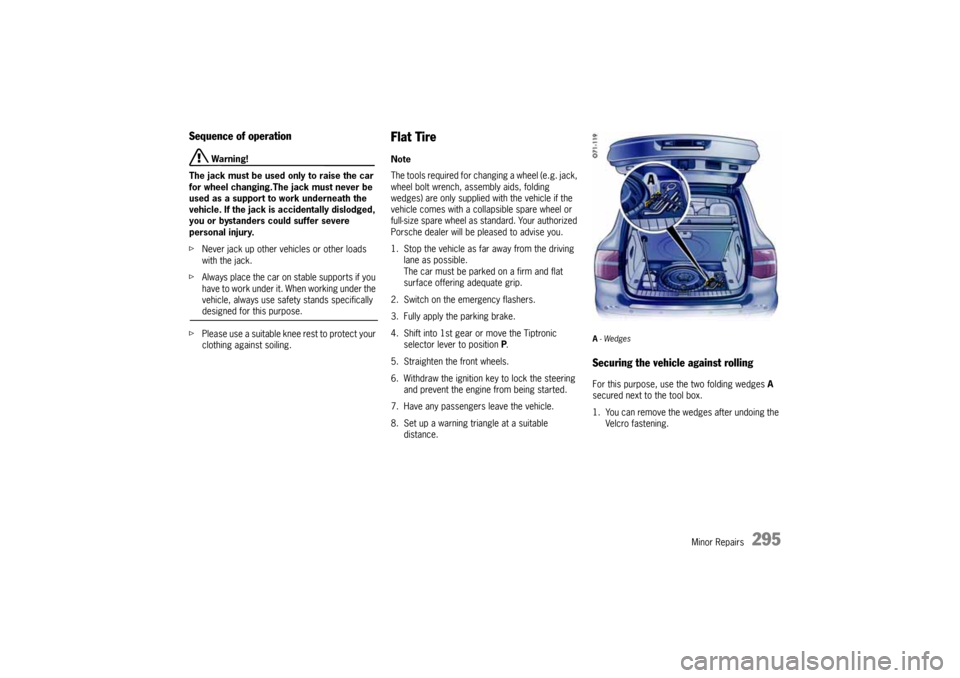
A-WedgesSecuring the vehicle against rollingFor this purpose, use the two folding wedges A
secured next to the tool box.
1. You can remove the wedges after undoing the
Velcro fastening.
10_Cayenne_21_KW17.book Seite 295 Donnerstag, 9. April 2009 3:33 15
Page 319 of 379

Minor Repairs
319
Fuse assignment – fuse box in engine compartmentNotes
fUse the plastic grippers from the fuse boxes in the dashboard to replace the fuses.
Fuse numbers that are not listed in the table are not assigned in the fuse box.
fFor information on the fuse plan: Please see the chapter “FUSE PLAN AND FUSE BOX IN ENGINE COMPARTMENT” on Page 313. Cayenne
No.Cayenne S/Cayenne GTS/
Cayenne S Transsyberia
No.Designation Rating in A
1
1
Fan
60
22Fan30
7
7
Ignition coils
15
8 - Ignition coils15
-8Tank vent valve, air-conditioning compressor, air-conditioning control unit, intake pipe switch-
over, crankcase vent15
9
-
Engine control unit
20
-
9
Quantity control valve, camshaft adjuster, valve lift adjuster
15
10 -Water run-on pump relay, tank leakage detection, carbon canister shut-off valve, fan, pressure
sensor for air conditioner10
-10Cooling air output stages, pressure sensor for air conditioner,tank leakage detection, exhaust
flap control valve, oil-level sensor10
11
-
Oil-level sensor, air-conditioning compressor, air-conditioning control unit, crankcase vent
15
-
11
Engine control unit, fuel valve
15
12 - Camshaft adjustment, tank vent, fuel valve, variable intake manifold 10
13
13
Fuel pump, right
15
14 14 Fuel pump, left15
15
15
Engine control unit, main relay
10
17 17 Oxygen sensors ahead of catalytic converter 15
18
18
Oxygen sensors behind catalytic converter
7.5
10_Cayenne_21_KW17.book Seite 319 Donnerstag, 9. April 2009 3:33 15
Page 349 of 379

Tire Pressure and Technical Data
349
Engine Data
Cayenne Cayenne S Cayenne GTS,
Cayenne S Transsyberia
Ty p e
6-cylinder V-engine
8-cylinder V-engine
8-cylinder V-engine
Number of cylinders 6 8 8
Bore
3.5 in. (89 mm)
3.78 in. (96 mm)
3.78 in. (96 mm)
Stroke 3.8 in. (96.4 mm) 3.27 in. (83 mm) 3.27 in. (83 mm)
Displacement
219.5 cu. in. (3598 cm
3)
293.3 cu. in. (4806 cm
3)
293.3 cu. in. (4806 cm
3)
Net-horsepower 213 kW (290 HP) 283 kW (385 HP) 298 kW (405 HP)
at engine speed
6200 rpm
6200 rpm
6500 rpm
Net. torque 273 ftlb. (370 Nm) 369 ftlb. (500 Nm) 369 ftlb. (500 Nm)
at engine speed
3000 rpm
3500 rpm
3500 rpm
Maximum permitted engine speed 6700 rpm 6700 rpm 6700 rpm
Engine oil consumption
up to 1.5 liters/1000 km
(1.6 quarts/622 miles)
up to 1.5 liters/1000 km
(1.6 quarts/622 miles)
up to 1.5 liters/1000 km (1.6
quarts/622 miles)
10_Cayenne_21_KW17.book Seite 349 Donnerstag, 9. April 2009 3:33 15