ESP PORSCHE CAYNNE 2010 1.G Repair Manual
[x] Cancel search | Manufacturer: PORSCHE, Model Year: 2010, Model line: CAYENNE, Model: PORSCHE CAYENNE 2010 1.GPages: 379, PDF Size: 13.91 MB
Page 286 of 379

286
Minor Repairs
Tire damage, puncturefPlease see the chapter “HIGH-PRESSURE
CLEANING EQUIPMENT, STEAM CLEANERS”
on Page 271.
Danger!
Risk of serious personal injury or death.
Driving the vehicle with low tire pressure
increases risk of a tire failure and resulting
loss of control. Furthermore, low tire pres-
sure increases rate of wear of the affected
tires.
fCheck tires – including sidewalls – regularly for
foreign bodies, nicks, cuts, cracks and bulges.
fAfter driving off road, examine tires for signs
of damage such as cuts, tears, bulges or
foreign objects stuck in the tread. Replace a
damaged tire if necessary.
fCross curb edges slowly and at right angles if
possible.
Avoid driving over steep or sharp curbs.
fIn cases of doubt, have the wheel (particularly
the inner side) checked by an authorized Porsche dealer.In case of tire damage, where it is uncertain
whether there is a break in the ply with all its con-
sequences or tire damage caused by thermal or
mechanical overloading due to loss of pressure or
any other prior damage, we recommend that the
tire be replaced for safety reasons.
I f o n e f a u l t y t i re i s re p l a c e d i t s h o u l d b e n o t e d t h a t
the difference in tread depth on one axle must not
exceed 30%. Handling inconsistencies may result.
fPerform a visual inspection if necessary.
Tire replacementsfUse only tire makes and types tested by
Porsche.
If you do not use a Porsche recommended
replacement tire, make sure that you
purchase your new tires from a reputable tire
dealer and that the dealer complies with all
manufacturers warnings for those tires.
Only tires with the same manufacturer and
with the same specification code (e.g. “N0”,
“N1”...) should be mounted on the vehicle.
Before mounting new tires, check with your
Porsche dealer about the current release
status.
Tires should be replaced no less than on one axle
at the time. Only tires of the same make and type
must be used. Mixed tires are not permissible and
will affect vehicle performance, safety, and can
affect vehicle warranty.Porsche dealers can recommend the most current
replacement tire options for your vehicle.
Initially, new tires do not have their full traction.
You should therefore drive at moderate speeds
during the first 60 - 120 miles (100 - 200 km).
Tires must always remain on the same side of
the vehicle.
When wheels are removed, the direction of rota-
tion and position of each wheel should be marked.
If new tires are installed only on one axle, a notice-
able change in handling occurs due to the different
tread depth of the other tires. This happens espe-
cially if only rear tires are replaced. However, this
condition disappears as the new tires are broken
in.
fPlease adjust your driving style accordingly.
Installation of new tires should only be done by a
qualified tire technician.
Valves
fUse only plastic valve caps.
fThe rubber valves must be replaced whenever
the tires are changed.
fThe fitting and replacement specifications
must be observed for metal valves.
fOnly use Original Porsche metal valves.
fProtect the valve inserts against soiling with
valve caps.
Soiled valve inserts can cause a gradual loss
of air.
10_Cayenne_21_KW17.book Seite 286 Donnerstag, 9. April 2009 3:33 15
Page 287 of 379
Minor Repairs
287
Parking at the curb
Danger!
Hard impacts against curbs (or traffic
islands) are dangerous and may cause hid-
den tire damage which is not noticeable until
later. Such damage can result in accidents at
high speeds causing serious personal injury
or death. Depending on the force of impact,
the edge of the rim can also be damaged.
fIf you are in doubt, have the wheel checked by
an expert, particularly if you suspect damage
on the inside.
fIf you must drive over a curb or other obstacle,
drive slowly and at an obtuse angle. Exercise care when parking along curbs.
Maintenance Note
Tire repairs are not permissible under any circum-
stances.
Wheel alignment, wheel balancingAs a precaution, have wheels with summer tires
balanced in the spring, and those with mud and
snow tires before winter. Unbalanced wheels may
affect car handling and tire life.
Only the specified weights may be used for wheel
balancing. Self-adhesive weights must not come into contact
with cleaning agents, since they could drop off.
Uneven tread wear indicates wheel imbalance. In
this event, the vehicle should be checked at an
authorized Porsche dealer.
Danger!
If, during a trip, uneven running or vibrations
occur that could be caused by damage to
tires or the car, the speed must be reduced
immediately, but without braking sharply. If
you continue your trip without having the
cause of the fault remedied, you might lose
control of your vehicle which could cause
serious personal injury or death.
fStop the vehicle and check the tires.
fIf no cause for the fault can be found, drive ca-
refully to the nearest authorized Porsche dea-ler.
Wheels with Tire Pressure Monitoring
(TPM) sensorsBefore changing wheels, make sure that the
wheels are compatible with your vehicle’s TPM.
fCheck this with your authorized Porsche dea-
ler.
Removing and storing tiresfAfter changing, adjust tire pressure and torque
wheel bolts diagonally.
Please see the chapter “CHANGING WHEELS”
on Page 294.
fStore tires in a cool and dry place. Rotate peri-
odically to avoid flat spots.
fAvoid contact with petrol, oil and grease.
Tires must always remain on the same side of
the vehicle.
When wheels are removed, the direction of
rotation and position of each wheel should be
marked.
Example
FR (front right), FL, RR and RL.
Wheels must always be fitted in accordance with
their marking.
The perception that tire durability and perfor-
mance are not affected by storage and age is
unfounded.
Chemical additives, which make the rubber elas-
tic, lose their effectiveness over the course of
time and the rubber becomes brittle and cracks.
Therefore, the tires, especially the spare tire,
should be inspected from time to time.
10_Cayenne_21_KW17.book Seite 287 Donnerstag, 9. April 2009 3:33 15
Page 296 of 379
296
Minor Repairs
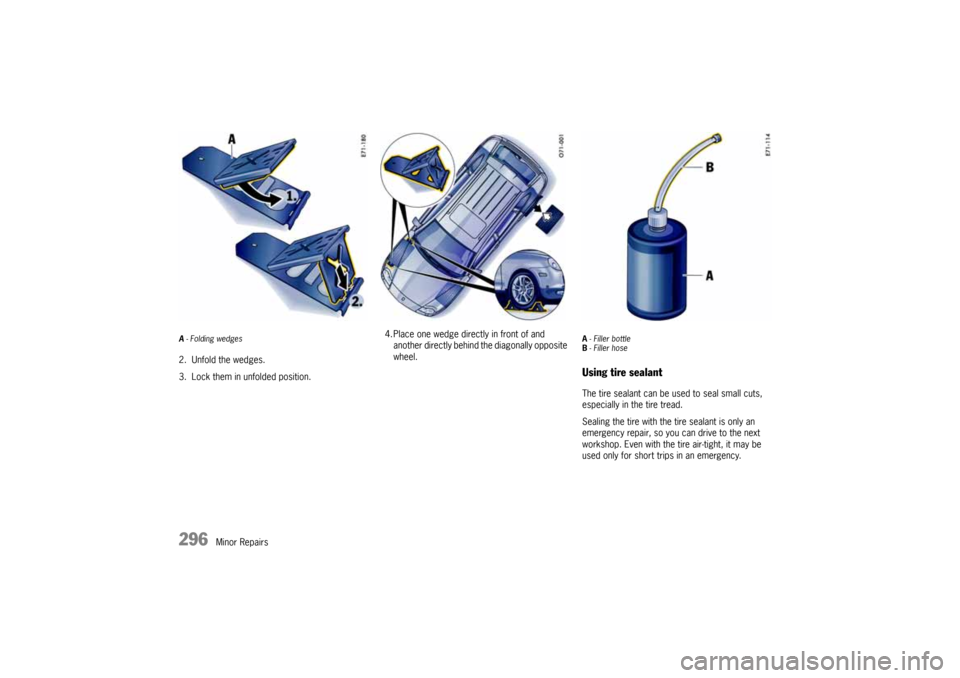
A - Folding wedges2. Unfold the wedges.
3. Lock them in unfolded position.4. Place one wedge directly in front of and
another directly behind the diagonally opposite
wheel.
A- Filler bottle
B- Filler hoseUsing tire sealantThe tire sealant can be used to seal small cuts,
especially in the tire tread.
Sealing the tire with the tire sealant is only an
emergency repair, so you can drive to the next
workshop. Even with the tire air-tight, it may be
used only for short trips in an emergency.
10_Cayenne_21_KW17.book Seite 296 Donnerstag, 9. April 2009 3:33 15
Page 300 of 379
300
Minor Repairs Maintenance Note
The jacking point on the vehicle must be free of
dirt.
1. Slightly loosen the wheel bolts of the wheel to
be changed.
2. Only set up the jack at the rear jacking point
designed for the purpose. The jack foot must
be in contact over its whole area and must be
positioned directly below the head piece.
Use a suitable support if necessary.
3. Hold jack still and wind it up until its head
enters the jacking point on the vehicle.
Only jack vehicle up until the wheel to be
changed is completely off the ground.
4. After lowering the vehicle, remove the jack.
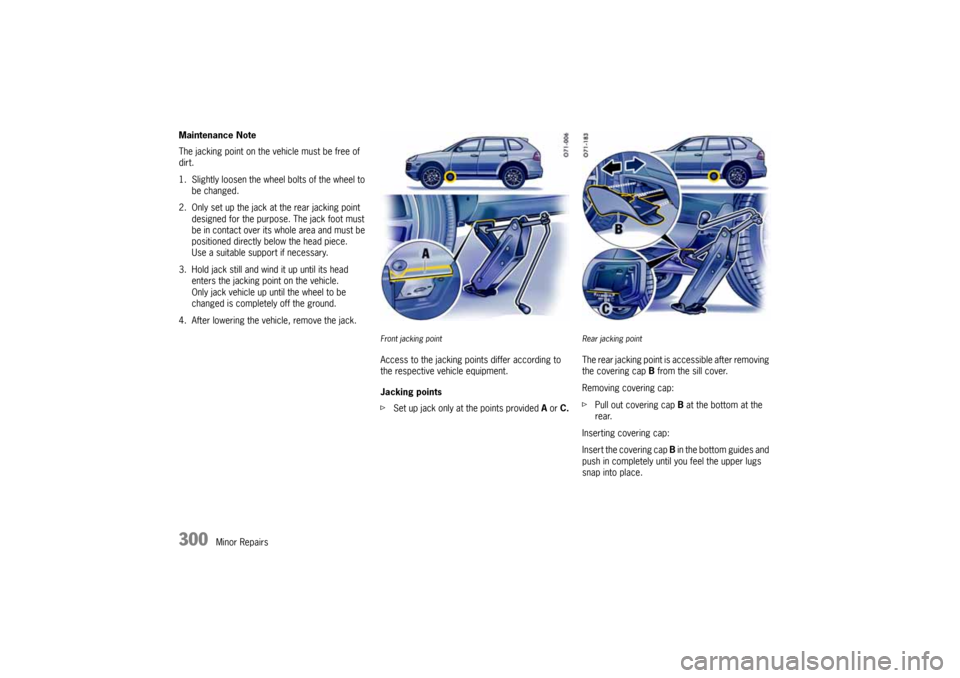
Front jacking pointAccess to the jacking points differ according to
the respective vehicle equipment.
Jacking points
fSet up jack only at the points provided A or C.
Rear jacking pointThe rear jacking point is accessible after removing
the covering cap B from the sill cover.
Removing covering cap:
fPull out covering cap B at the bottom at the
rear.
Inserting covering cap:
Insert the covering cap B in the bottom guides and
push in completely until you feel the upper lugs
snap into place.
10_Cayenne_21_KW17.book Seite 300 Donnerstag, 9. April 2009 3:33 15
Page 302 of 379
302
Minor Repairs
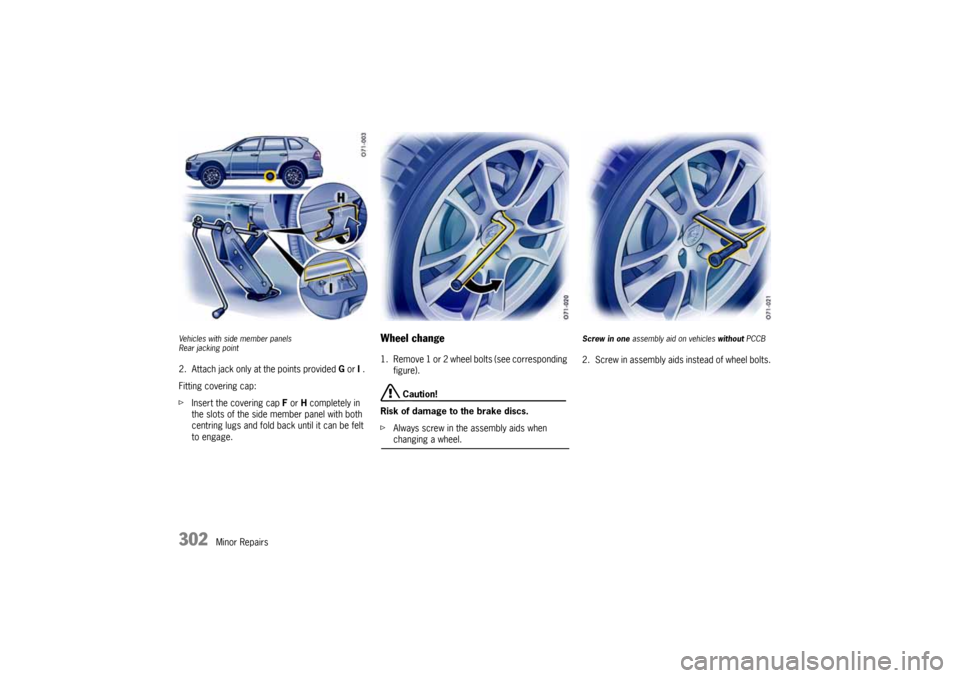
Vehicles with side member panels
Rear jacking point2. Attach jack only at the points provided G or I .
Fitting covering cap:
fInsert the covering cap F or H completely in
the slots of the side member panel with both
centring lugs and fold back until it can be felt
to engage.
Wheel change1. Remove 1 or 2 wheel bolts (see corresponding
figure).
Caution!
Risk of damage to the brake discs.
fAlways screw in the assembly aids when changing a wheel.
Screw in one assembly aid on vehicles without PCCB2. Screw in assembly aids instead of wheel bolts.
10_Cayenne_21_KW17.book Seite 302 Donnerstag, 9. April 2009 3:33 15
Page 305 of 379
Minor Repairs
305
8. Inflate the tire if necessary.
Please see the chapter “TIRE PRESSURES,
COLD (68 °F/20 °C)” on Page 354.
On vehicles with Tire Pressure Monitoring:
Please see the chapter “SETTING THE TIRE
TYPE AND SIZE” on Page 134.
9. Lower the car and remove the jack.
10.Tighten wheel bolts in diagonally opposite
sequence.
Maintenance Note
fImmediately after changing a wheel, use
a torque wrench to check the prescribed
tightening torque of the wheel bolts
(160 Nm/118 ftlb.).
fSpacer, steel nuts, and plastic covers should
be stored together.
Fitting the 17 mm spacer1. Remove wheel.
2. Fit the spacer with the wheel bolts A used to
fasten the wheel.
Tightening torque: 160 Nm (118 ftlb.)
3. Fit wheel.
To d o t h i s use the original wheel nuts for
fastening the wheels.
Tightening torque: 160 Nm (118 ftlb.)
Place plastic covers onto the steel nuts.
Note
There is no anti-theft protection for the wheel nuts.Collapsible spare wheelThe collapsible spare wheel is fastened under the
floor in the luggage compartment.
On vehicles with 17 mm spacers:
fBefore fitting a collapsible spare wheel on the
rear axle always remove the corresponding
spacer.
For information on the spacers:
Please see the chapter “SPACERS” on
Page 293.
For information about removing the spacers:
Please see the chapter “CHANGING A WHEEL
WITH REMOVAL OF 17 MM SPACER” on
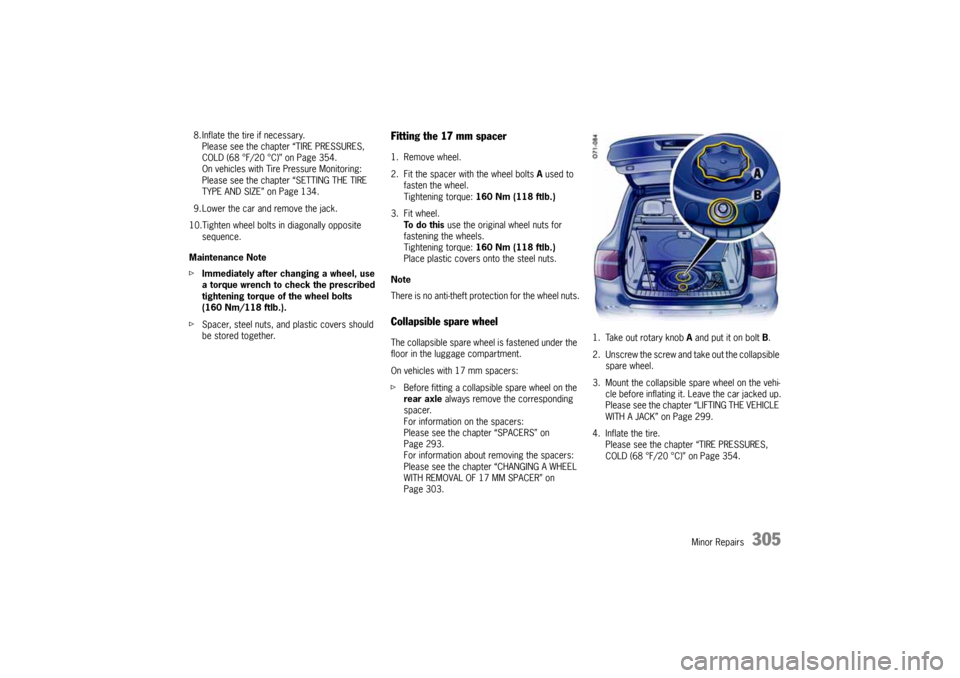
Page 303.1. Take out rotary knob A and put it on bolt B.
2. Unscrew the screw and take out the collapsible
spare wheel.
3. Mount the collapsible spare wheel on the vehi-
cle before inflating it. Leave the car jacked up.
Please see the chapter “LIFTING THE VEHICLE
WITH A JACK” on Page 299.
4. Inflate the tire.
Please see the chapter “TIRE PRESSURES,
COLD (68 °F/20 °C)” on Page 354.
10_Cayenne_21_KW17.book Seite 305 Donnerstag, 9. April 2009 3:33 15
Page 311 of 379
Minor Repairs
311
Closing spare wheel bracket
Warning!
Danger of injury and risk of accident if the
spare wheel bracket is operated improperly.
fOperate the spare wheel bracket only using
button B.
fIf the vehicle is tilted to the side, more effort
will be required to swing the spare wheel
bracket.
fMake sure that no persons or animals are
within the range of movement of the spare wheel bracket.
1. Check whether additional lock C is engaged. If
necessary, slide additional lock C to the right.
2. Swing spare wheel bracket closed with force.
3. Check lock and observe indication on the multi-
purpose display of the instrument panel.
The indicator light must go out when the spare
wheel bracket is locked.
Automatic locking
In the multi-purpose display of the instrument
panel, you can set different variants of locking and
unlocking the doors and the rear lid as well as the
check-back signal when locking and unlocking the
vehicle and save them on the respective remote
control.
fPlease see the chapter “SETTING REAR LID
LOCKING” on Page 144.
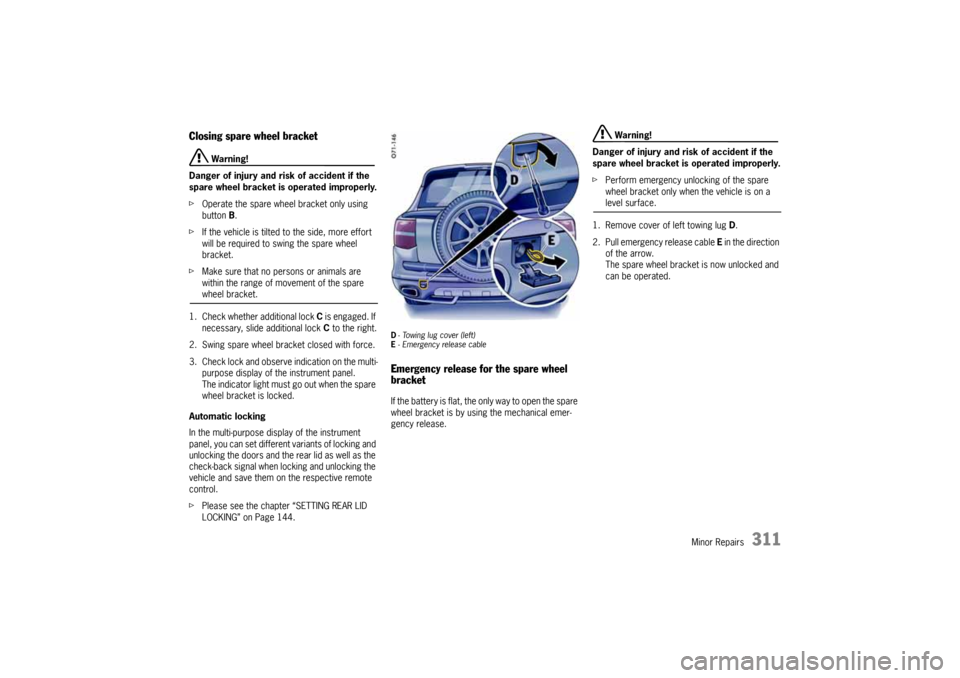
D- Towing lug cover (left)
E- Emergency release cableEmergency release for the spare wheel
bracketIf the battery is flat, the only way to open the spare
wheel bracket is by using the mechanical emer-
gency release.
Warning!
Danger of injury and risk of accident if the
spare wheel bracket is operated improperly.
fPerform emergency unlocking of the spare
wheel bracket only when the vehicle is on a level surface.
1. Remove cover of left towing lug D.
2. Pull emergency release cable E in the direction
of the arrow.
The spare wheel bracket is now unlocked and
can be operated.
10_Cayenne_21_KW17.book Seite 311 Donnerstag, 9. April 2009 3:33 15
Page 312 of 379
312
Minor Repairs
Electrical SystemIn order to avoid damage and faults in electrical or
electronic systems, electrical accessories should
be installed at your authorized Porsche dealer.
fUse only accessories authorized by Porsche.
Warning!
Risk of short circuit and fire, resulting in
serious personal injury or death.
Replacing fuses or relays with engine running
or the ignition on could cause electrical
shock.
fDisconnect the negative terminal on the
battery during all work on the electrical sys-tem.
RelaysRelays should be checked or changed only by an
authorized workshop.
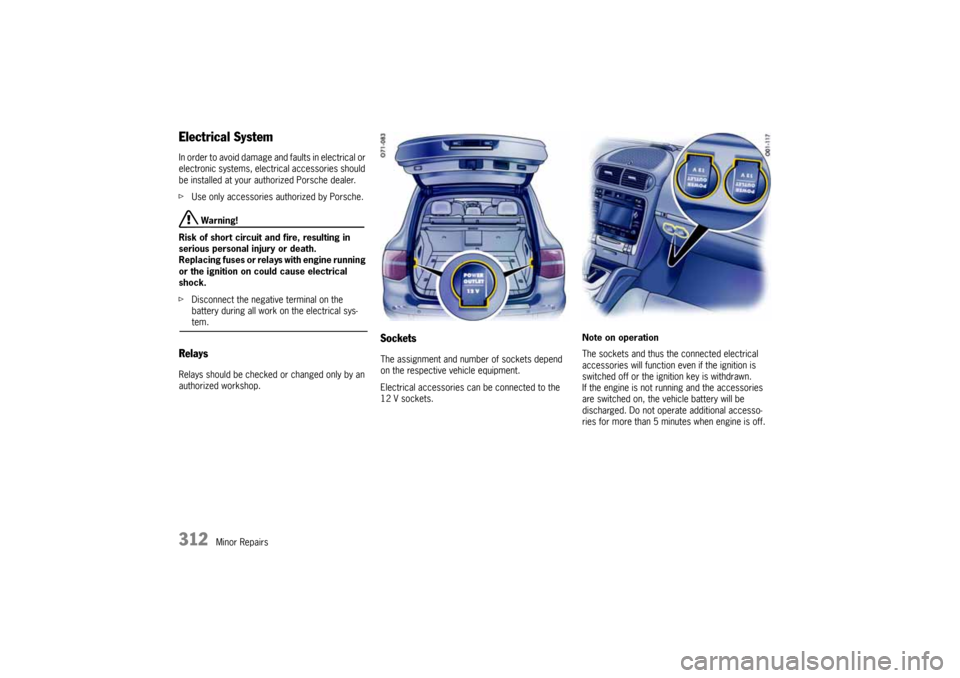
SocketsThe assignment and number of sockets depend
on the respective vehicle equipment.
Electrical accessories can be connected to the
12 V sockets.Note on operation
The sockets and thus the connected electrical
accessories will function even if the ignition is
switched off or the ignition key is withdrawn.
If the engine is not running and the accessories
are switched on, the vehicle battery will be
discharged. Do not operate additional accesso-
ries for more than 5 minutes when engine is off.
10_Cayenne_21_KW17.book Seite 312 Donnerstag, 9. April 2009 3:33 15
Page 313 of 379
Minor Repairs
313
Changing fusesIn order to prevent damage to the electrical
system due to short circuits and overloads, the
individual circuits are protected by fuses.
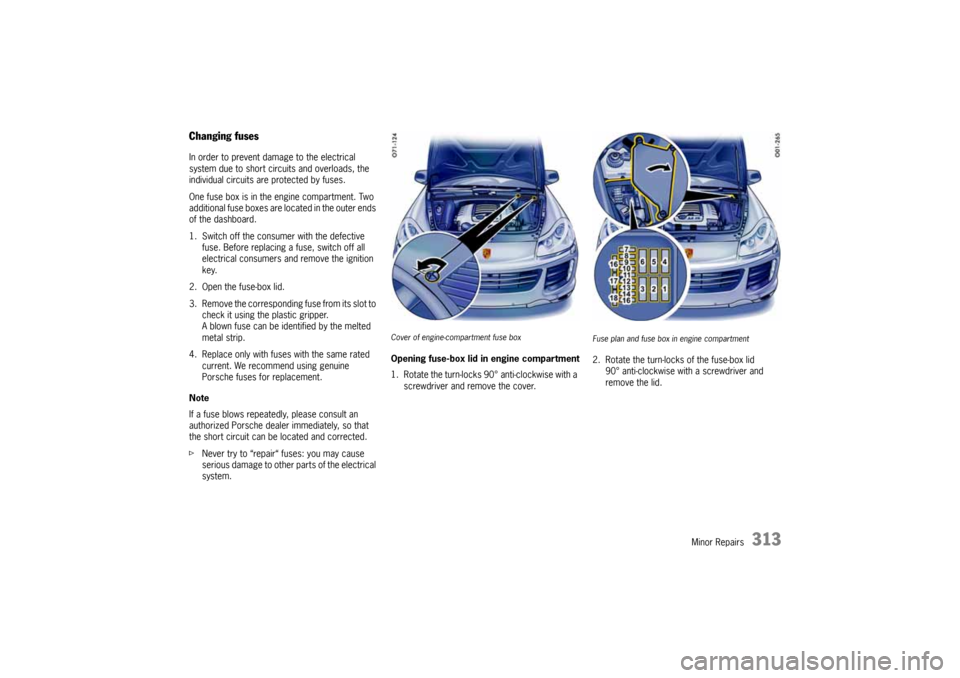
One fuse box is in the engine compartment. Two
additional fuse boxes are located in the outer ends
of the dashboard.
1. Switch off the consumer with the defective
fuse. Before replacing a fuse, switch off all
electrical consumers and remove the ignition
key.
2. Open the fuse-box lid.
3. Remove the corresponding fuse from its slot to
check it using the plastic gripper.
A blown fuse can be identified by the melted
metal strip.
4. Replace only with fuses with the same rated
current. We recommend using genuine
Porsche fuses for replacement.
Note
If a fuse blows repeatedly, please consult an
authorized Porsche dealer immediately, so that
the short circuit can be located and corrected.
fNever try to “repair“ fuses: you may cause
serious damage to other parts of the electrical
system.
Cover of engine-compartment fuse boxOpening fuse-box lid in engine compartment
1. Rotate the turn-locks 90° anti-clockwise with a
screwdriver and remove the cover.
Fuse plan and fuse box in engine compartment2. Rotate the turn-locks of the fuse-box lid
90° anti-clockwise with a screwdriver and
remove the lid.
10_Cayenne_21_KW17.book Seite 313 Donnerstag, 9. April 2009 3:33 15
Page 342 of 379
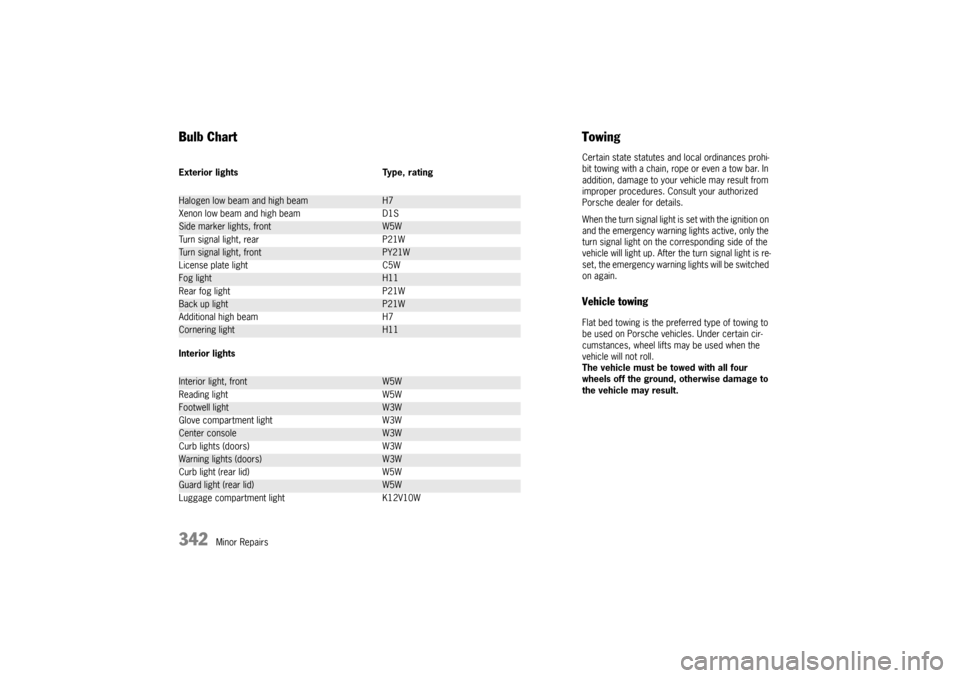
342
Minor Repairs
Bulb ChartExterior lights Type, ratingHalogen low beam and high beam
H7
Xenon low beam and high beam D1S
Side marker lights, front
W5W
Turn signal light, rear P21W
Turn signal light, front
PY21W
License plate light C5W
Fog light
H11
Rear fog light P21W
Back up light
P21W
Additional high beam H7
Cornering light
H11
Interior lights
Interior light, front
W5W
Reading light W5W
Footwell light
W3W
Glove compartment light W3W
Center console
W3W
Curb lights (doors) W3W
Warning lights (doors)
W3W
Curb light (rear lid) W5W
Guard light (rear lid)
W5W
Luggage compartment light K12V10W
TowingCertain state statutes and local ordinances prohi-
bit towing with a chain, rope or even a tow bar. In
addition, damage to your vehicle may result from
improper procedures. Consult your authorized
Porsche dealer for details.
When the turn signal light is set with the ignition on
and the emergency warning lights active, only the
turn signal light on the corresponding side of the
vehicle will light up. After the turn signal light is re-
set, the emergency warning lights will be switched
on again.Vehicle towingFlat bed towing is the preferred type of towing to
be used on Porsche vehicles. Under certain cir-
cumstances, wheel lifts may be used when the
vehicle will not roll.
The vehicle must be towed with all four
wheels off the ground, otherwise damage to
the vehicle may result.
10_Cayenne_21_KW17.book Seite 342 Donnerstag, 9. April 2009 3:33 15