lights PORSCHE CAYNNE 2010 1.G Repair Manual
[x] Cancel search | Manufacturer: PORSCHE, Model Year: 2010, Model line: CAYENNE, Model: PORSCHE CAYENNE 2010 1.GPages: 379, PDF Size: 13.91 MB
Page 197 of 379

Driving and Driving Safety
197
Recommended procedure
fDeactivate the Low Range off-road driving
program.
fClean headlights and tail lights and check them
for signs of damage.
fClean the front and rear lincense plates.
fClean the tire tread with a jet of water and
remove any foreign objects.
fClean wheels, wheel housings and the under-
body with a jet of water.
fCheck whether the car has picked up plant
parts or branches.
These materials increase the risk of fire and
can damage fuel lines, brake hoses, boots of
the axle joints and drive shafts.
fAfter off-road driving, always check the entire
floor assembly, tires, body structure, steering
system, running gear and exhaust system for
signs of damage.fAfter driving for an extended period through
mud, sand, water or substances with a similar
soiling effect, check the brake discs, brake
pads, wheels and axle joints and have them
cleaned.
fIf you experience severe vibrations after
driving off road, check the wheels for foreign
substances.
These substances can produce an imbalance
which might be responsible for the vibrations.
Removing these deposits may remedy the
problem.
Uphill driving
Danger!
Danger of serious personal injury or death
and risk of damage if the vehicle should
overturn.
fDo not turn around when driving uphill.
fIf it is not possible to climb a gradient, the car
must be backed down in reverse gear.
fDo not drive over embankments or slopes at
steep diagonal angles.
fIf the vehicle starts to tilt, immediately steer in
the direction of the tilt (line of slope).
fWhen driving uphill, never let the vehicle roll
backward when in idle or not in gear.
Exclusive use of the footbrake is too risky in such situations.
10_Cayenne_21_KW17.book Seite 197 Donnerstag, 9. April 2009 3:33 15
Page 200 of 379

200
Driving and Driving Safety Soiling can impair the braking action.
fCheck and clean the brakes if they have been
soiled.
Danger of steering assistance failing during
a long journey in the water if the drive belt
slips.
fIf the steering assistance fails, more effort will
be required to steer.
Danger of damaging electrical systems
fAvoid driving through salt water.
Notes on operation
fActivate the Low Range program.
fSwitch the air conditioner off.
fSwitch the headlights off.Tips on driving
fAvoid high engine speeds (max. 2,500 rpm).
fDo not perform manual gear changes when
driving, and try to avoid stopping.
Moving off in the water can be difficult due to
the high resistance and the loose surface
involved.
fStart the water crossing at a shallow place at
walking speed.
fAfter checking the body of water, take the
shortest path through it.
fNever drive into the water at high speed. The
resulting “bow wave” could damage the engine
and its accessories.
fAdjust your driving style to the unfamiliar sur-
roundings.
fCross the body of water slowly and at a con-
stant speed.
fNever turn around when crossing a body of
water.
fIf it is not possible to cross the body of water,
the car must be backed out of it in reverse
gear.
The servo pump and alternator can fail if the car is
driven through water for an extended period.
fIf the servo pump fails, substantially more
force will have to be exerted in order to steer. Maintenance Note
The car requires a special check after the water
crossing.
fRemove mud from the tire tread.
fBriefly apply the brakes in order to dry them
after driving through the water.10_Cayenne_21_KW17.book Seite 200 Donnerstag, 9. April 2009 3:33 15
Page 203 of 379
Luggage Compartment, Loadspace and Storage
203 Luggage Compartment, Loadspace and Storage
Folding rear seats forward and returning
to upright position ...................................... 204
Loadspace ................................................ 207
Cargo management system ........................ 208
Luggage Compartment Cover ..................... 211
Luggage safety net .................................... 212
Ski Bag ..................................................... 214
Roof Transport System............................... 216
Off-road roof-mounted Headlights
Cayenne S Transsyberia............................. 217
Car Audio Operation/Tips............................ 218
Porsche Communication Management
(PCM) ........................................................ 220
iPod, USB and AUX..................................... 221
Storage ..................................................... 222
Cupholder.................................................. 226
Ashtray...................................................... 227
Cigarette Lighter ........................................ 228
10_Cayenne_21_KW17.book Seite 203 Donnerstag, 9. April 2009 3:33 15
Page 204 of 379
204
Luggage Compartment, Loadspace and Storage
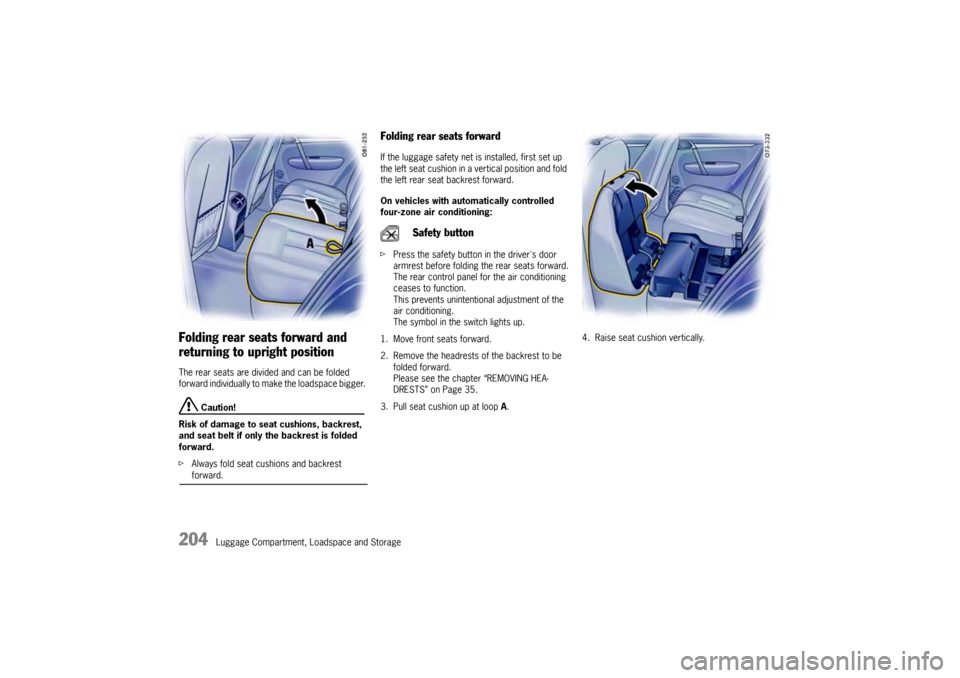
Folding rear seats forward and
returning to upright positionThe rear seats are divided and can be folded
forward individually to make the loadspace bigger.
Caution!
Risk of damage to seat cushions, backrest,
and seat belt if only the backrest is folded
forward.
fAlways fold seat cushions and backrest forward.
Folding rear seats forwardIf the luggage safety net is installed, first set up
the left seat cushion in a vertical position and fold
the left rear seat backrest forward.
On vehicles with automatically controlled
four-zone air conditioning:
fPress the safety button in the driver's door
armrest before folding the rear seats forward.
The rear control panel for the air conditioning
ceases to function.
This prevents unintentional adjustment of the
air conditioning.
The symbol in the switch lights up.
1. Move front seats forward.
2. Remove the headrests of the backrest to be
folded forward.
Please see the chapter “REMOVING HEA-
DRESTS” on Page 35.
3. Pull seat cushion up at loop A.4. Raise seat cushion vertically.
Safety button
10_Cayenne_21_KW17.book Seite 204 Donnerstag, 9. April 2009 3:33 15
Page 217 of 379
Luggage Compartment, Loadspace and Storage
217
Off-road roof-mounted Headlights
Cayenne S TranssyberiafPlease read the separate instructions for fitting
and operating the off-road roof-mounted
headlights.DisclaimerThe off-road roof-mounted headlights provided
with your Cayenne S Transsyberia have been
designed and manufactured solely for off-road
use. The use of these lights while on a public road
in your country may not be legal or may be legal
only under specified conditions. Check your
national, state/provincial and local laws or
regulations regarding any restrictions and/or
limitations for public highway use prior to
installation. It is common in many countries, for
example, that such roof-mounted headlights must
be hooded or covered while you are on a public
road.
Under no circumstances should the electrical
circuits for these lights be connected to the
circuits for the other lights provided with your
vehicle.
Safety Notes!
fCompletely remove the off-road roof-mounted
headlights before using an automatic car wash
– risk of damage to the vehicle!
fBefore every trip, and at regular intervals
during long trips, check that the off-road
roof-mounted headlights are secured to the
vehicle properly.
fWith the off-road roof-mounted headlights
fitted, do not exceed a maximum speed of
110 mph (180 km/h).
Nevertheless, Porsche recommends that you
do not exceed the posted speed limit.
fDriving, braking and steering behaviour
change due to the higher center of gravity and
the greater wind-resistant area. You should
adapt your driving style appropriately.
fSince fuel consumption and noise are
increased when the off-road roof-mounted
headlights are fitted, they should not remain on the vehicle when not in use.
Note on operation
If the engine is not running and the off-road
roof-mounted headlights are switched on, the
vehicle battery will be discharged.
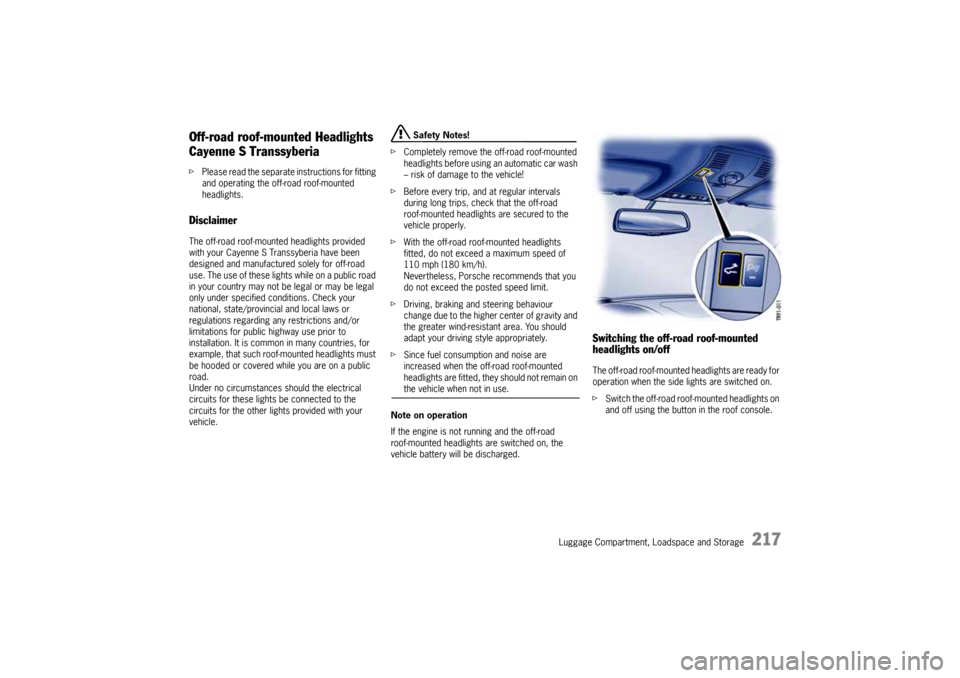
Switching the off-road roof-mounted
headlights on/offThe off-road roof-mounted headlights are ready for
operation when the side lights are switched on.
fSwitch the off-road roof-mounted headlights on
and off using the button in the roof console.
10_Cayenne_21_KW17.book Seite 217 Donnerstag, 9. April 2009 3:33 15
Page 219 of 379

Luggage Compartment, Loadspace and Storage
219
Compact disc player
Caution!
To avoid damage to compact disc player and
discs.
fUse only compact discs labeled as shown,
having no dirt, damage or warpage.
fNever attempt to disassemble or oil any part
of the player unit. Do not insert any object
other than a disc into the slot.Remember there
are no user-serviceable parts inside the
compact disc player.
fDo not allow the disc to sustain any finger-
prints, scrapes or stickers on the surfaces.
This may cause poor sound quality.
Hold the disc only on the edge or center hole.
fWhen not in use, take the disc out of the player,
put the disc back into its case and store it
away from dust, heat, damp and direct sun-
light.
Leaving the disc on the dashboard in the sun
can damage the disc.fIf the disc gets dirty, clean the disc by wiping
the surfaces from the center to the outside in
a radial direction with a soft cloth.
Do not use a conventional record cleaner or
anti-static record preservative.
Disc cleaners are available in audio stores.
Car Telephone and Aftermarket Alarms Important legal and safety information
regarding the use of cellular telephones
Some states may prohibit the use of cellular tele-
phones while driving a vehicle. Check the laws and
regulations on the use of cellular telephones in the
areas where you drive.
Danger!
Risk of an accident.
Severe personal injury or death can result in
the event of an accident.
Looking away from the road or turning your
attention away from your driving can cause
an accident and lead to serious personal
injury or death.
When using your cellular telephone, you should
always:
fGive full attention to your driving - pull off the
road and park before making or answering a
call if traffic conditions so require; andfKeep both hands on the steering wheel - use
hands-free operation (if available) - pull off the
road and park before using a hand-held tele-
phone.
It is essential to observe the telephone
manufacturer's instructions before operating
the telephone.
Any portable telephone or radio transmitter which
is used in a Porsche must be properly installed in
accordance with the technical requirements of
Porsche.
The transmission power must not exceed
10 W.
The devices must possess a type approval for
your vehicle and have an “e” symbol.
If you should require equipment with transmission
power values greater than 10 W, please consult
your authorized Porsche dealer for this purpose.
He is familiar with the technical requirements for
installing devices of this kind.
The antennas for all radios and telephones with a
transmitting antenna must be externally mounted.
The improper installation of radios or telephones
or use of a radio or telephone with a transmitting
antenna inside the car may cause the warning
lights to come on.
Improper installation of such equipment can
create a discharged battery or excessive current
draw from added equipment.
10_Cayenne_21_KW17.book Seite 219 Donnerstag, 9. April 2009 3:33 15
Page 234 of 379

234
Tr a i l e r H i t c h
Towing a trailer
Warning!
Driving with a trailer
fAlways see the permissible towing capacity,
vertical coupling load and rear-axle load.
Please see the chapter “WEIGHTS” on
Page 356.
fWhen connected, the trailer must always be
horizontal behind the towing vehicle. If neces-
sary, use a trailer with an adjustable drawbar.
fWhen the vehicle is driven in the mountains, the
engine output decreases as altitude increases.
The maximum weights stated are the values at
sea level. The total permissable weight of the
car-trailer combination must therefore be re-
duced by 10% for each increment of 3,280 ft.
(1,000 meters) altitude. A fractional increment
counts as the full 3,280 ft. (1,000 meters).
Please take this into consideration when plan-
ning your route.Distributing the load
fDistribute the load in the trailer so that heavy
objects are as close to the axle as possible.
Always safeguard all objects against slipping
and tie them down securely.
fYou should make the best possible use of the
trailer coupling's rated vertical coupling load
when loading the trailer, but never exceed it.
Tire pressure
fSelect the vehicle tire pressure for full load
when towing a trailer.
fPlease see the chapter “TIRE PRESSURES,
COLD (68 °F/20 °C)” on Page 354.
fCheck the tire pressure of the trailer's wheels
according to the manufacturer's instructions.Door mirrors
fIf the width of the trailer obstructs your view of
the traffic behind the trailer, you must have
additional door mirrors fitted.
Headlights, lights
fAlways check the headlight adjustment before
driving with a trailer.
If necessary, correct with the headlight beam
adjustment function.
fCheck whether the plug of the trailer is
plugged into the towing vehicle and whether all
lights function.
10_Cayenne_21_KW17.book Seite 234 Donnerstag, 9. April 2009 3:33 15
Page 237 of 379
Parking
237
Parking AidsParkAssist provides a visual and acoustic indica-
tion to the driver of the distance between the
vehicle and a large obstacle.
ParkAssist is switched on automatically when the
ignition is switched on and remains active up to a
speed of approx. 9 mph (14 km/h).
ParkAssist is switched off automatically at high
speed. ParkAssist is switched on again auto-
matically when the speed drops below approx.
9 mph (14 km/h).
The selector lever position determines activation
levels for ParkAssist and the corresponding area
that is monitored.
Tiptronic selector lever position:–P – ParkAssist is not activated.
–R, N – ParkAssist is activated for the front and
rear areas.
–D, M – ParkAssist is activated for the front
area.Gearshift lever position:–R – ParkAssist is activated for the front and
rear areas.
–In all other gearshift positions – ParkAssist
is activated for the front area.
Note
On vehicles with manual transmission, the parking
assistant is not switched on in the rear area if the
vehicle rolls backward without reverse gear
engaged.
Warning!
Risk of serious personal injury or death.
ParkAssist cannot detect small objects such
as children and pets.
Even when using ParkAssist, the driver is still
responsible for taking due care when
parking and when assessing obstacles.
fMake sure that no persons especially small
children, animals or obstacles are within the maneuvering area.
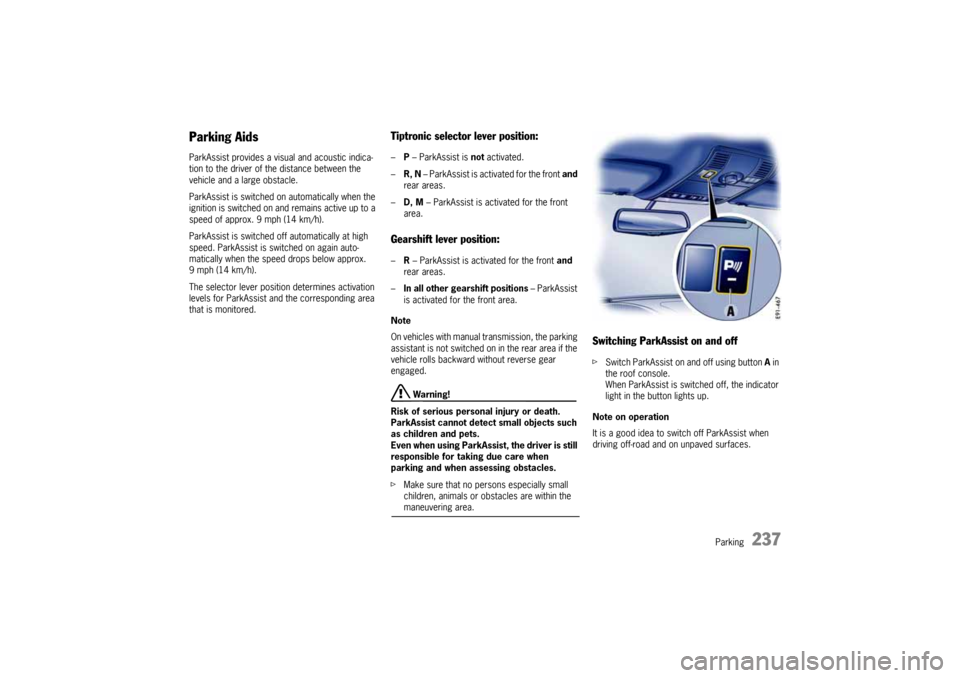
Switching ParkAssist on and offfSwitch ParkAssist on and off using button A in
the roof console.
When ParkAssist is switched off, the indicator
light in the button lights up.
Note on operation
It is a good idea to switch off ParkAssist when
driving off-road and on unpaved surfaces.
10_Cayenne_21_KW17.book Seite 237 Donnerstag, 9. April 2009 3:33 15
Page 239 of 379

Parking
239
A- Front display – left monitoring area
B- Front display – right monitoring areaWarning indicators, signal tones, distances
The warning indicator for the front area is located
on the dashboard.
The warning indicator for the rear area is located
in the rooflining at the rear of the loadspace.
The warning indicators for the various monitoring
areas (left and right) are subdivided respectively
into one green, 4 yellow and 2 red light segments
C- Rear display – right monitoring area
D- Rear display – left monitoring areaIf ParkAssist is activated, the green light seg-
ments of the active warning indicators are lit up
continuously.
If the vehicle approaches an obstacle that has
been detected by the sensors, one or more of the
yellow or red light segments lights up, depending
on the distance to the obstacle.If the first yellow light segment lights up, the
obstacle is still 48 in. (120 cm) (to the front) or
48 in. to 59 in. (120 to 150 cm) (to the rear)
away.
A brief signal tone sounds when reversing.
An intermittent tone sounds when the distance
becomes less than approx. 24 in. (60 cm). The
fourth yellow light segment lights up.
A continuous tone sounds when the distance be-
comes less than approx. 10 in. (25 cm) (on vehic-
les with trailer coupling: approx. 14 in. (35 cm)).
The second red light segment lights up.
If the obstacle is approached even closer, the
system may not be able to recognize the obstacle
any longer.
fSet the radio volume so that the signal tones
are not drowned out.
You can have the volume of the signal tones
adjusted to your own requirements at your
authorized Porsche dealer.
Note on operation
If the obstacle is approached even closer after the
continuous tone sounds and the second red light
segment lights up, the system may not be able to
recognize the obstacle any longer.
10_Cayenne_21_KW17.book Seite 239 Donnerstag, 9. April 2009 3:33 15
Page 240 of 379

240
Parking Limits of ultrasonic measurement
– ParkAssist cannot detect sound-absorbing
obstacles (e.g. winter operation, powder
snow),
– Sound-reflecting obstacles (e.g. glass sur-
faces, flat painted surfaces),
– And very thin obstacles.
Other ultrasound sources (e.g. pneumatic brakes
of other vehicles, jackhammers) can interfere with
detection of obstacles.
Fault indication without warning tone
All red light segments of the active warning indica-
tors light up when there is a temporary fault in
ParkAssist.
Note
Correct operation is no longer ensured if there is
a temporary fault (e.g. caused by ice formation or
heavy soiling on the sensors).
The system detects the temporary fault.
All light segments light up until a speed of
9mph (14km/h) is reached.
ParkAssist is ready for operation again when the
interference has been eliminated.Fault indication with warning tone
In the event of a long-lasting fault in ParkAssist,
the red light segments of the active warning indi-
cators light up and a continuous tone sounds for
three seconds after a transmission range has
been selected.
Possible causes
– Defect or system fault.
fSwitch ParkAssist off.
When ParkAssist is switched off, the indicator
light in the button lights up.
Please see the chapter “SWITCHING
PARKASSIST ON AND OFF” on Page 237.
fPlease have the fault remedied at an
authorized Porsche dealer.Driving with a trailer
The ParkAssist rear monitoring area is switched
off when the trailer’s power supply is plugged in.
10_Cayenne_21_KW17.book Seite 240 Donnerstag, 9. April 2009 3:33 15