lights PORSCHE CAYNNE 2010 1.G Workshop Manual
[x] Cancel search | Manufacturer: PORSCHE, Model Year: 2010, Model line: CAYENNE, Model: PORSCHE CAYENNE 2010 1.GPages: 379, PDF Size: 13.91 MB
Page 162 of 379
162
Driving and Driving Safety
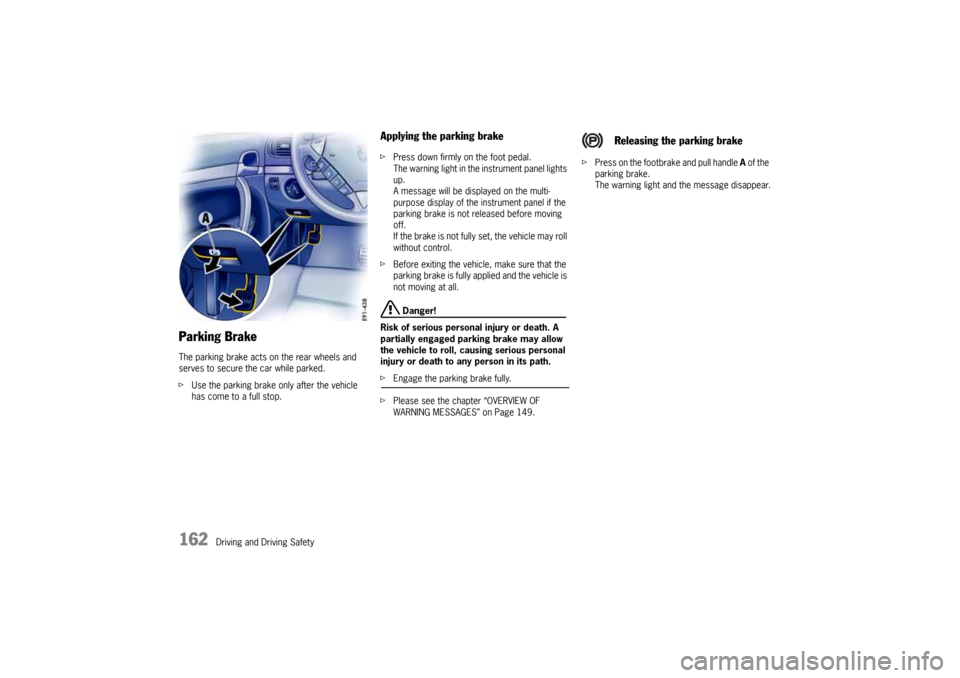
Parking BrakeThe parking brake acts on the rear wheels and
serves to secure the car while parked.
fUse the parking brake only after the vehicle
has come to a full stop.
Applying the parking brakefPress down firmly on the foot pedal.
The warning light in the instrument panel lights
up.
A message will be displayed on the multi-
purpose display of the instrument panel if the
parking brake is not released before moving
off.
If the brake is not fully set, the vehicle may roll
without control.
fBefore exiting the vehicle, make sure that the
parking brake is fully applied and the vehicle is
not moving at all.
Danger!
Risk of serious personal injury or death. A
partially engaged parking brake may allow
the vehicle to roll, causing serious personal
injury or death to any person in its path.
fEngage the parking brake fully.
fPlease see the chapter “OVERVIEW OF
WARNING MESSAGES” on Page 149.fPress on the footbrake and pull handle A of the
parking brake.
The warning light and the message disappear.
Releasing the parking brake
10_Cayenne_21_KW17.book Seite 162 Donnerstag, 9. April 2009 3:33 15
Page 163 of 379

Driving and Driving Safety
163
The warning lights will go out after the parking
brake is fully released.
The warning lights are not an indicator that the
parking brake is fully applied; it is only intended to
be a warning to release the parking brake before
driving the car.
Caution!
A partially engaged brake will overheat the
rear brakes, reduce their effectiveness and
cause excessive wear.
fRelease the parking brake fully.
fWhen parking your car, press down firmly on
the foot pedal.
fMove the Tiptronic selector lever to “P”
(Tiptronic) or move the gearshift lever to
reverse or first gear (Manual transmission).
fOn hills also turn the front wheels towards the
curb.
BrakesfMake it a habit to check the operation of your
brakes before driving.
Keep in mind that the braking distance increases
very rapidly as the speed increases. At 60 mph
(100 km/h), for example, it is not twice but four
times longer than 30 mph (50 km/h). Tire traction
is also less effective when the roads are wet or
slippery.
fTherefore, always maintain a safe distance
from the car in front of you.Vehicles without Porsche Ceramic
Composite Brake (PCCB)Even though the brake discs consist of alloyed
grey cast iron, they will unavoidably start to cor-
rode if your car is parked for an extended period.
The brakes will tend to “rub” as a result.
The nature, extent and effects of corrosion
depend on the amount of time the vehicle was
parked, whether road salt or grit was spread and
whether grease-dissolving agents were used in
car washes.
If the braking comfort is noticeably impaired, we
recommend having the brake system checked by
experts at an authorized Porsche dealer.
Brake system functionYour Porsche is equipped with a power assisted
hydraulic dual circuit brake system with disc
brakes at the front and rear.
Both circuits function independently. One brake
circuit operates the front left and rear right wheel
and the other operates the front right and rear left
wheel.
If one brake circuit has failed, the other will still
operate. However, you will notice an increased
pedal travel when you apply the brakes.Failure of
one brake circuit will cause the stopping distance
to increase.
Warning!
Risk of an accident, resulting in serious per-
sonal injury or death.
In the unlikely event of hydraulic failure of
one brake circuit:
fPush the brake pedal down firmly and hold it in
that position. A mechanical linkage activates
the second circuit, and you will be able to bring
the vehicle to a stop.
fAfter bringing your vehicle to a complete stop,
avoid driving the vehicle and instead have it
towed to the nearest authorized Porsche dealer for repair.
Parking Brake warning
light USA
Parking Brake warning
light Canada
10_Cayenne_21_KW17.book Seite 163 Donnerstag, 9. April 2009 3:33 15
Page 164 of 379

164
Driving and Driving Safety Brake system warning light
You can check the functionality of the brake sys-
tem warning light by switching the ignition to the
“On” position and verifying that the warning light
illuminates.
The warning light in the instrument panel lights up.
A message will be displayed on the multi-purpose
display of the instrument panel if the brake fluid
level is too low, or (if the brake pedal travel has in-
creased) one of the two brake circuits has failed.
A greater braking pressure will be required, stop-
ping distances will be longer and the braking
behavior will change, particularly in curves.
With correctly adjusted brakes and a correctly
working brake system, the pedal travel to the
point of brake application should be 1-3/16 in. to
1-9/16 in. (30 to 40 mm). Whenever the brake
pedal travel exceeds this value, have the brake
system checked.
Brake pedal
Warning!
Risk of an accident, resulting in serious per-
sonal injury or death.
Any obstruction of the brake pedal could in-
crease the stopping distance.
fAlways check the movement of the brake pedal
before driving and make sure that it is not
obstructed by a floor mat or any other object.
fSecure the floor mat to prevent it from sliding
into positions that could interfere with the safe
operation of your vehicle.
Your Porsche dealer will be glad to offer you
floor mats of the correct size including a securing possibility.
Note
In case one of the two brake circuits fails,
increased pedal travel is required to bring your
vehicle to a full stop.
Warning!
To avoid overheating and premature wear of
the brakes:
fBefore descending a steep grade, reduce
speed and shift the transmission into a lower
gear to control speed.
fDo not “ride the brakes” by resting your foot on
the pedal when not intending to apply brake
pressure.
fDo not hold the pedal down too long or too
often. This could cause the brakes to get hot and not function properly.
Brake warning light USA
Brake warning light
Canada
10_Cayenne_21_KW17.book Seite 164 Donnerstag, 9. April 2009 3:33 15
Page 169 of 379
Driving and Driving Safety
169
Manual transmission, clutch
Warning!
Risk of accident, resulting in serious perso-
nal injury or death.
fDo not obstruct the pedal travel with floor mats
or other objects.To avoid damage to the clutch and transmis-
sion:
fAlways depress the clutch pedal fully when
changing gears. Make sure that the gearshift
lever is completely engaged.
fOnly shift into reverse when the car has come
to a complete stop
Floor mats of the correct size and with the
appropriate fasteners are available from your
authorized Porsche dealer.
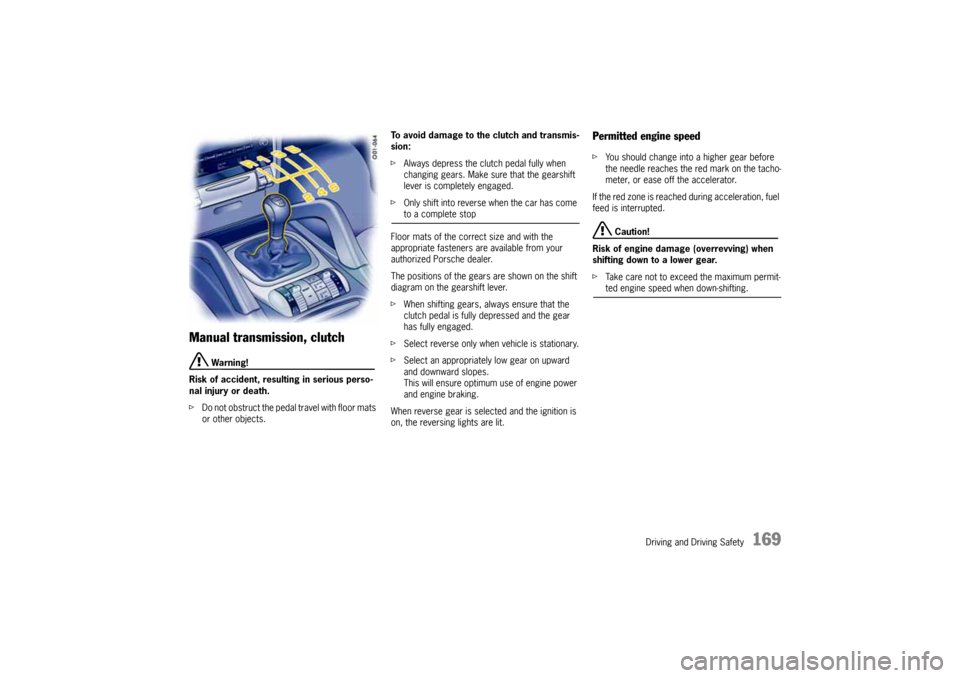
The positions of the gears are shown on the shift
diagram on the gearshift lever.
fWhen shifting gears, always ensure that the
clutch pedal is fully depressed and the gear
has fully engaged.
fSelect reverse only when vehicle is stationary.
fSelect an appropriately low gear on upward
and downward slopes.
This will ensure optimum use of engine power
and engine braking.
When reverse gear is selected and the ignition is
on, the reversing lights are lit.
Permitted engine speedfYou should change into a higher gear before
the needle reaches the red mark on the tacho-
meter, or ease off the accelerator.
If the red zone is reached during acceleration, fuel
feed is interrupted.
Caution!
Risk of engine damage (overrevving) when
shifting down to a lower gear.
fTake care not to exceed the maximum permit-ted engine speed when down-shifting.
10_Cayenne_21_KW17.book Seite 169 Donnerstag, 9. April 2009 3:33 15
Page 178 of 379
178
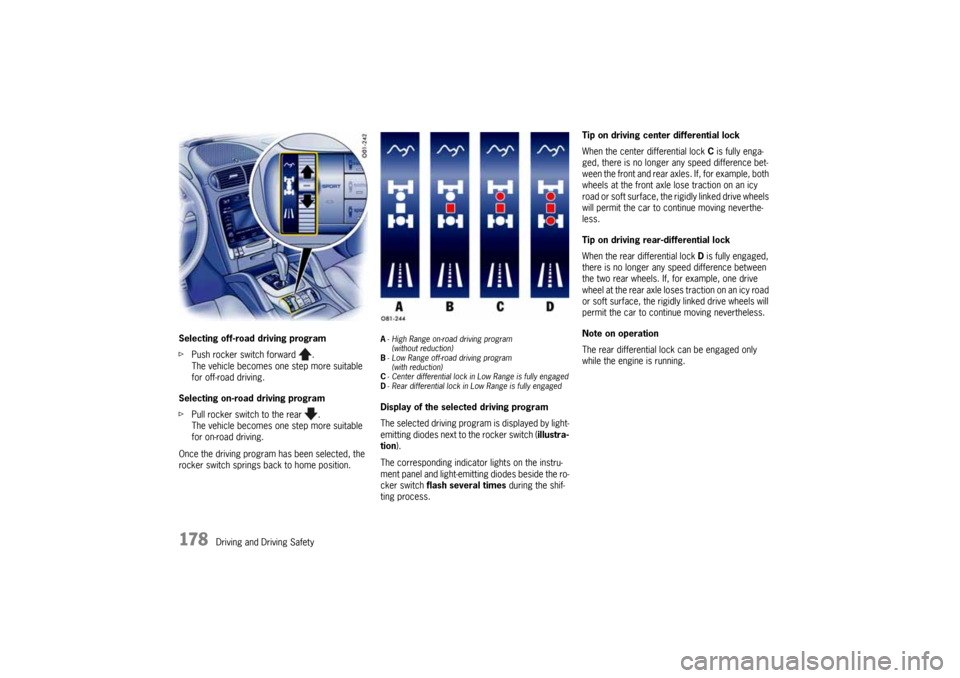
Driving and Driving Safety Selecting off-road driving program
fPush rocker switch forward .
The vehicle becomes one step more suitable
for off-road driving.
Selecting on-road driving program
fPull rocker switch to the rear .
The vehicle becomes one step more suitable
for on-road driving.
Once the driving program has been selected, the
rocker switch springs back to home position.
A-High Range on-road driving program
(without reduction)
B-Low Range off-road driving program
(with reduction)
C-Center differential lock in Low Range is fully engaged
D-Rear differential lock in Low Range is fully engagedDisplay of the selected driving program
The selected driving program is displayed by light-
emitting diodes next to the rocker switch (illustra-
tion).
The corresponding indicator lights on the instru-
ment panel and light-emitting diodes beside the ro-
cker switch flash several times during the shif-
ting process.Tip on driving center differential lock
When the center differential lock C is fully enga-
ged, there is no longer any speed difference bet-
ween the front and rear axles. If, for example, both
wheels at the front axle lose traction on an icy
road or soft surface, the rigidly linked drive wheels
will permit the car to continue moving neverthe-
less.
Tip on driving rear-differential lock
When the rear differential lock D is fully engaged,
there is no longer any speed difference between
the two rear wheels. If, for example, one drive
wheel at the rear axle loses traction on an icy road
or soft surface, the rigidly linked drive wheels will
permit the car to continue moving nevertheless.
Note on operation
The rear differential lock can be engaged only
while the engine is running.
10_Cayenne_21_KW17.book Seite 178 Donnerstag, 9. April 2009 3:33 15
Page 180 of 379

180
Driving and Driving Safety Switching Sport mode on and off
Sport mode can be activated when the ignition is
switched on and when the on-road driving program
High Range (without reduction) is selected.
fPress SPORT button E in the center console.
When Sport mode is switched on, the light-
emitting diode F in the SPORT button is lit.
When Sport mode is switched on, the logo SPORT
appears on the multi-purpose display.
After the ignition is switched off, Sport mode is
automatically reset to Normal mode.
Warning messages
A warning appears on the multi-purpose display of
the instrument panel in the event of a fault.
fFor information on warning messages on the
multi-purpose display:
Please see the chapter “OVERVIEW OF
WARNING MESSAGES” on Page 149.Vehicles with air suspension
If you wish to use the characteristics of Sport
mode and the sports exhaust system, but would
like a more comfortable running-gear setup, you
can:
– switch PASM and PDCC separately to Normal
or Comfort mode and/or
– raise the ride height of the vehicle.
fPress the corresponding PASM button in the
center console. The light-emitting diode in the
button of the selected running-gear setup
lights up.
In addition, the selected running-gear setup is
shown on the multi-purpose display of the
instrument panel for approx. 12 seconds.
Please see the chapter “PORSCHE ACTIVE
SUSPENSION MANAGEMENT (PASM)” on
Page 193.
Please see the chapter “PORSCHE DYNAMIC
CHASSIS CONTROL (PDCC)” on Page 194.
Press the rocker switch in the center console for-
ward. The corresponding light-emitting diode next
to the rocker switch lights up continuously after
the adjustment process. The level change is also
indicated on the multi-purpose display of the in-
strument panel.
Please see the chapter “AIR SUSPENSION WITH
LEVEL CONTROL AND HEIGHT ADJUSTMENT” on
Page 190.
10_Cayenne_21_KW17.book Seite 180 Donnerstag, 9. April 2009 3:33 15
Page 184 of 379

184
Driving and Driving Safety The events below inform the driver of PSM control
operations and warn him to adapt her/his driving
style to the road conditions:
– The multi-functional information light in the
instrument panel lights up.
– Light in the PSM Off button flashes.
– Hydraulic noises can be heard.
– The vehicle decelerates and steering-wheel
forces are altered as the PSM controls the
brakes.
– Reduced engine power.
– The brake pedal pulsates and its position is
changed during braking.
In order to achieve full vehicle deceleration,
foot pressure must be increased after begin-
ning of the brake pedal pulsing.
Examples of PSM control operations
– If the front wheels of the vehicle drift on a
corner, engine power is reduced and the rear
wheel on the inside of the corner is braked if
necessary.
– If the rear of the vehicle swings out on a
corner, the front wheel on the outside of the
corner is braked.– Brake system prefilling:
The brake system is prepared for possible sub-
sequent emergency braking if the accelerator
pedal is released suddenly and quickly.
The brake system is prefilled and the brake
pads are already applied gently to the brake
discs.
– Brake booster:
In the event of an emergency braking operation
where the pedal force is insufficient, a brake
booster provides the braking pressure neces-
sary for maximum deceleration at all 4 wheels.
Combined use of PSM and PTM/PTM Plus
In order to ensure optimal stabilization of the ve-
hicle, the center differential lock (PTM) and possib-
ly the rear differential lock (PTM Plus) are also
opened when PSM interventions occur.
Tip on driving
When PSM is switched off, wheel-specific brake in-
terventions and the traction control system (TCS)
are also inactive.
The automatic brake differential (ABD) remains on.Off-road PSM
(PSM in Low Range program)
When Low Range is active, an off-road PSM
specially matched to off-road driving is activated
to enhance traction.
In order to improve driveability on difficult terrain,
the response of the off-road PSM is less sensitive
in the low speed range when the vehicle is opera-
ted in the Low Range off-road driving program.
If the brakes are highly stressed, the automatic
brake differential (ABD) switches itself off to
protect the brakes. It remains deactivated until the
brake system has cooled sufficiently.
Engine drag torque control
In conditions of excessive slip, the engine drag
torque control system prevents all driven wheels
from locking up when the car is passing. This is
also the case for downshifts on a slippery road.
10_Cayenne_21_KW17.book Seite 184 Donnerstag, 9. April 2009 3:33 15
Page 185 of 379
Driving and Driving Safety
185
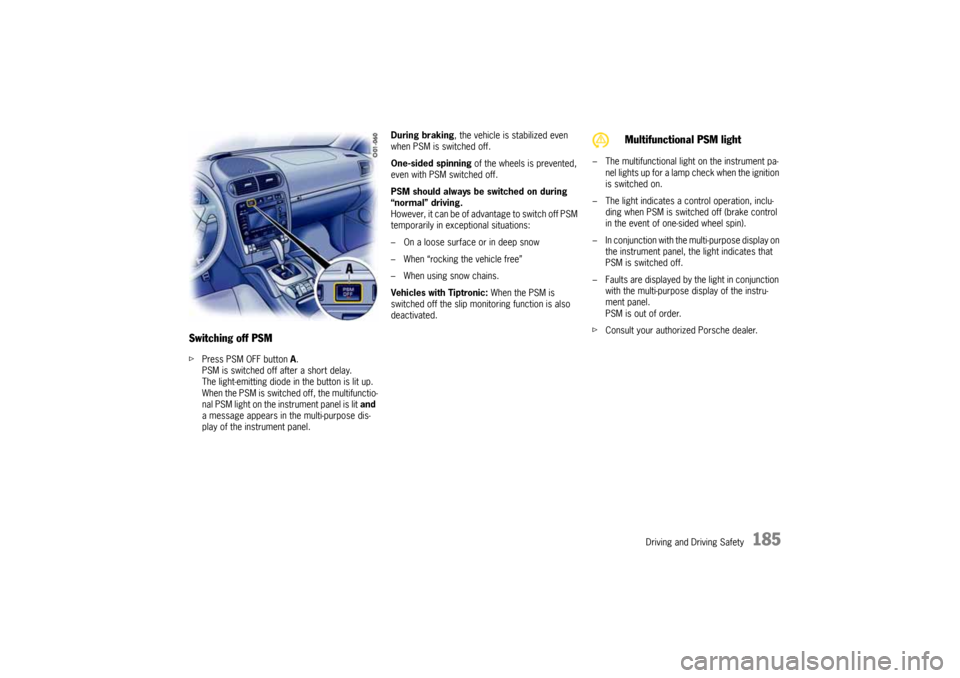
Switching off PSMfPress PSM OFF button A.
PSM is switched off after a short delay.
The light-emitting diode in the button is lit up.
When the PSM is switched off, the multifunctio-
nal PSM light on the instrument panel is lit and
a message appears in the multi-purpose dis-
play of the instrument panel.During braking, the vehicle is stabilized even
when PSM is switched off.
One-sided spinning of the wheels is prevented,
even with PSM switched off.
PSM should always be switched on during
“normal” driving.
However, it can be of advantage to switch off PSM
temporarily in exceptional situations:
– On a loose surface or in deep snow
– When “rocking the vehicle free”
– When using snow chains.
Vehicles with Tiptronic: When the PSM is
switched off the slip monitoring function is also
deactivated.– The multifunctional light on the instrument pa-
nel lights up for a lamp check when the ignition
is switched on.
– The light indicates a control operation, inclu-
ding when PSM is switched off (brake control
in the event of one-sided wheel spin).
– In conjunction with the multi-purpose display on
the instrument panel, the light indicates that
PSM is switched off.
– Faults are displayed by the light in conjunction
with the multi-purpose display of the instru-
ment panel.
PSM is out of order.
fConsult your authorized Porsche dealer.
Multifunctional PSM light
10_Cayenne_21_KW17.book Seite 185 Donnerstag, 9. April 2009 3:33 15
Page 187 of 379

Driving and Driving Safety
187
Warning light
If the ABS warning lights light up in the instrument
panel and on the multi-purpose display of the
instrument panel while the engine is running, the
ABS has switched off because of a fault.
In this event, the braking system will operate with-
out lock prevention,as in cars without ABS.
fAdapt your driving style to the changed
braking behavior.
fThe ABS must be checked immediately at an
authorized Porsche dealer. This is necessary
in order to prevent the occurrence of further
faults whose effects cannot be defined.
The ABS control unit is adjusted for the approved
tire dimensions.
The use of tires with non-approved dimensions can
lead to different wheel speeds, causing the ABS to
switch off.
Off-road ABS
(ABS in Low Range program)
When Low Range is active, an ABS specially
matched to off-road driving is activated automati-
cally.In the event of braking on loose ground, the per-
missible slip values for ABS braking are increased
so that the off-road braking distance is reduced
(wheels dig into the surface).
If the driver needs to steer, this off-road driving
program is automatically switched off to maintain
steerability.
Hillholder -
moving-off assistant on vehicles with
Tiptronic SIn Tiptronic selector lever positions D and M, the
hillholder function makes it easier to move off
from a standstill on an upward slope when the
engine is running. The driver does not have to
apply the brake.
The hillholder thus makes moving off on slopes
easier.
Danger!
Risk of accident, resulting in serious perso-
nal injury or death.
The vehicle can roll backwards if the Hillhol-
der is switched off.
fAlways apply the footbrake on slopes.Hillholder is not active:
– In Tiptronic selector lever positions N and R
– In the limp-home mode and
– If not all of the wheels are touching the ground
(on difficult terrain, for example).
Warning!
In spite of the advantages of the hillholder func-
tion, it is still the driver’s responsibility to adapt
her/his driving style and maneuvers in line with
situational conditions.
The increased safety that is provided should not
induce you to take greater risks with your safety.
The limits set by the physics of driving cannot be
overcome, even with the hillholder function.
Driving at the limits should be avoided, e.g., on icy
slopes or on slippery surfaces. In this and similar
cases, the support of the hillholder function is not
guaranteed.
10_Cayenne_21_KW17.book Seite 187 Donnerstag, 9. April 2009 3:33 15
Page 193 of 379
Driving and Driving Safety
193
Porsche Active Suspension
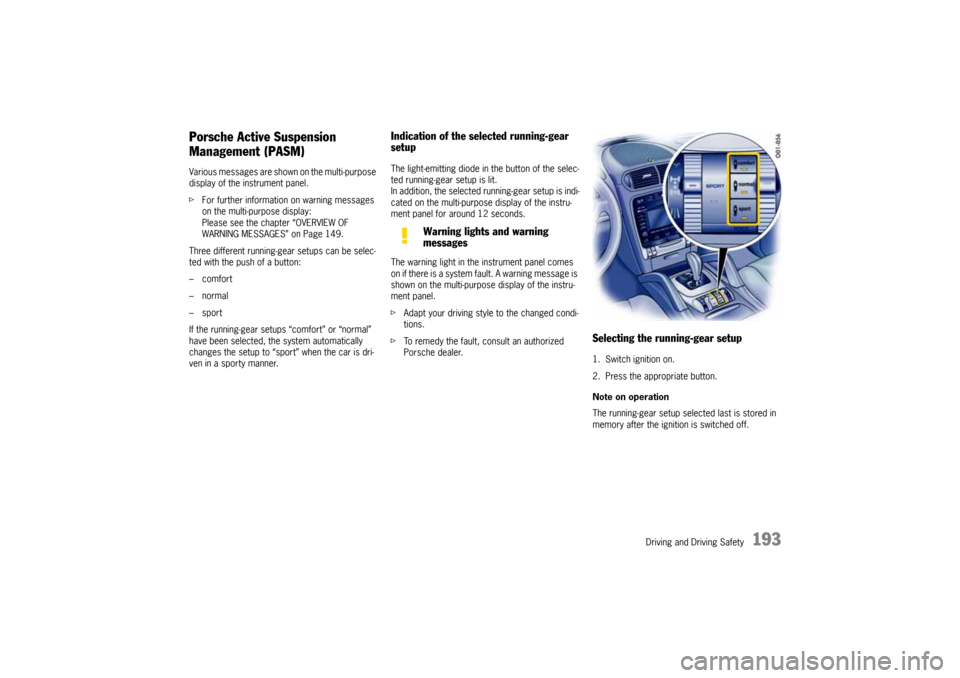
Management (PASM)Various messages are shown on the multi-purpose
display of the instrument panel.
fFor further information on warning messages
on the multi-purpose display:
Please see the chapter “OVERVIEW OF
WARNING MESSAGES” on Page 149.
Three different running-gear setups can be selec-
ted with the push of a button:
–comfort
–normal
–sport
If the running-gear setups “comfort” or “normal”
have been selected, the system automatically
changes the setup to “sport” when the car is dri-
ven in a sporty manner.
Indication of the selected running-gear
setupThe light-emitting diode in the button of the selec-
ted running-gear setup is lit.
In addition, the selected running-gear setup is indi-
cated on the multi-purpose display of the instru-
ment panel for around 12 seconds.
The warning light in the instrument panel comes
on if there is a system fault. A warning message is
shown on the multi-purpose display of the instru-
ment panel.
fAdapt your driving style to the changed condi-
tions.
fTo remedy the fault, consult an authorized
Porsche dealer.
Selecting the running-gear setup1. Switch ignition on.
2. Press the appropriate button.
Note on operation
The running-gear setup selected last is stored in
memory after the ignition is switched off.
Warning lights and warning
messages
10_Cayenne_21_KW17.book Seite 193 Donnerstag, 9. April 2009 3:33 15