ESP PORSCHE CAYNNE 2011 2.G Information Manual
[x] Cancel search | Manufacturer: PORSCHE, Model Year: 2011, Model line: CAYENNE, Model: PORSCHE CAYENNE 2011 2.GPages: 69, PDF Size: 11.14 MB
Page 17 of 69
Standard on the Cayenne
Diesel, Cayenne S, Cayenne S
Hybrid and Cayenne Turbo.
Available as an option for the
Cayenne in conjunction with
the optional Tiptronic S.
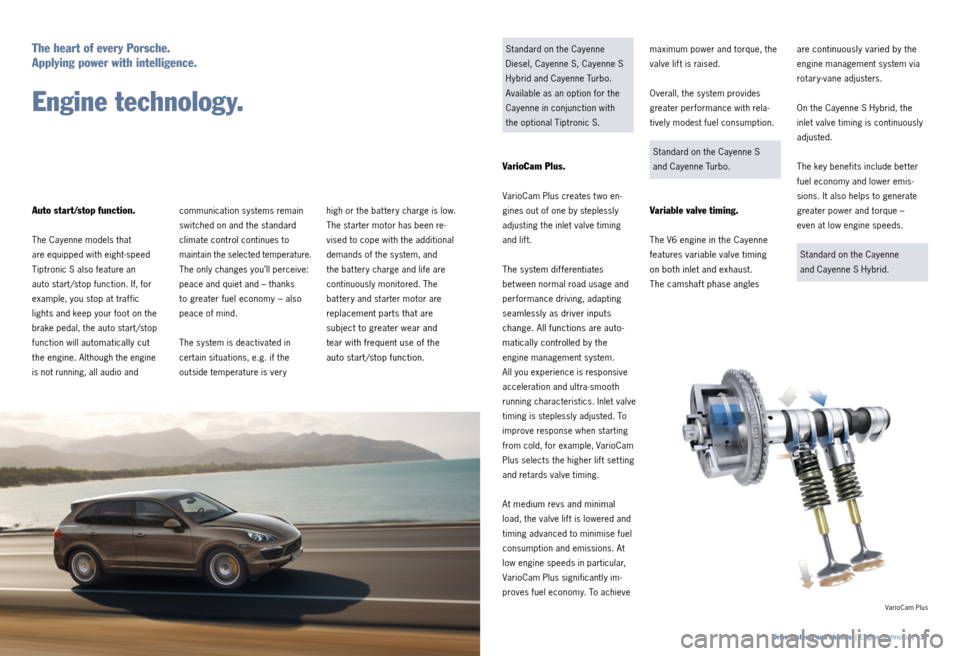
VarioCam Plus.
VarioCam Plus creates t wo en-
gines out of one by steplessly
adjusting the inlet valve timing
and lift.
The system dif ferentiates
bet ween normal road usage and
performance driving, adapting
seamlessly as driver inputs
change. All functions are auto -
matically controlled by the
engine management system.
All you experience is responsive
acceleration and ultra-smooth
running characteristics. Inlet valve
timing is steplessly adjusted. To
improve response when starting
from cold, for example, VarioCam
Plus selects the higher lif t set ting
and retards valve timing.
At medium revs and minimal
load, the valve lif t is lowered and
timing advanced to minimise fuel
consumption and emissions. At
low engine speeds in particular,
VarioCam Plus significantly im-
proves fuel economy. To achieve maximum power and torque, the
valve lif t is raised.
Overall, the system provides
greater performance with rela-
tively modest fuel consumption.
Standard on the Cayenne S
and Cayenne Turbo.
Variable valve timing.
The V6 engine in the Cayenne
features variable valve timing
on both inlet and exhaust.
The camshaft phase angles are continuously varied by
the
engine management system via
rotary-vane adjusters.
On the Cayenne S Hybrid, the
inlet valve timing is continuously
adjusted.
The key benefits include bet ter
fuel economy and lower emis-
sions. It also helps to generate
greater power and torque –
even at low engine speeds.
Standard on the Cayenne
and Cayenne S Hybrid.
high or the bat tery charge is low.
The starter motor has been re-
vised to cope with the additional
demands of the system, and
the bat tery charge and life are
continuously monitored. The
bat tery and starter motor are
replacement parts that are
subject to greater wear and
tear with frequent use of the
auto start /stop function.
communication systems remain
switched on and
the standard
climate control
continues to
maintain the selected temperature.
The only changes you’ll perceive:
peace and quiet and – thanks
to greater fuel economy – also
peace of mind.
The system is deactivated in
certain situations, e.g. if the
outside temperature is very
Auto start/stop function.
The Cayenne models that
are equipped with eight-speed
Tiptronic S also feature an
auto start /stop function. If, for
ex ample, you stop at traf fic
lights and keep your foot on the
brake pedal, the auto start /stop
function will
automatically cut
the engine.
Although the engine
is not running,
all audio and
The heart of every Porsche.
Applying power with intelligence.
Engine technology.
VarioCam Plus
Drive systems and chassis | Engine technology · 37
Page 18 of 69
consistently within a specific
temperature range. The engines
in the Cayenne models are
therefore designed for ef ficient
cooling.
In order to reduce the frictional
losses that occur during warm -up,
all Cayenne models feature com-
prehensive thermal management.
Using intelligent control, it
activates the dif ferent cooling
circuits individually and on de-
mand, thereby ensuring that the
optimum operating temperature
for the engine and transmission
is reached more quickly. This
minimises friction – and keeps
fuel consumption and CO
2 emis-
sions low.
The V8 engines have an enhanced
coolant management system
offering effective temperature
control throughout the engine.
While 20 % of coolant flows longi-
tudinally through the crankcase,
the remaining 80 % serves the
cylinder heads using the proven
cross-flow principle (from hot to
cold).
On all Cayenne models, the piston
heads are cooled using oil-spray
jets integrated within the main
lubrication system.
The entire cooling system is
designed for prolonged heav y-
dut y use, e.g. of f-road driving
or heav y towing and carrying
applications.Lubrication.
The V8 engines use dry-sump
lubrication to ensure a consistent
supply of oil in all load conditions,
especially in of f-road terrain.
The oil reservoir is located inside
the engine. This saves on space
and reduces weight.
Oil is circulated around the V8
engines using a demand- driven
pump. This has been designed
for the toughest driving scenarios
on and off road, including per-
formance driving and extreme
gradients. The V6 engines have a wet-sump
lubrication system.
Ensuring a
reliable supply of oil, no mat ter
how challenging the driving
conditions.
Direct fuel injection on the
diesel engine (common-rail
injection system).
On the Cayenne Diesel, direct
fuel injection comes courtesy of
a common -rail injection system.
The injection pressure is now up
to 2,000 bar, ensuring optimum
distribution of the air/fuel mixture
– for greater performance. The
piezoelectric injectors provide
flexible injection rate
adjustment,
using exactly metered quantities
of fuel, with multiple injections
for each power stroke to deliver
smooth combustion.
Cooling systems.
A high -performance engine can
only maintain its maximum
capabilit y over a long service life
if all components are operating
Direct fuel injection (DFI).
DFI injects fuel directly into the
combustion chamber at up to
120 bar with millisecond precision
using electromagnetic injectors.
The injector position and spray
geometry have been carefully
designed to improve output,
torque, fuel economy and emis-
sions. The swirling of the fuel as
it enters each chamber increases
the mixing of air and fuel, thereby
enhancing combustion. By form-
ing the air/fuel mixture directly
in the combustion chamber, DFI
contributes to engine cooling.
As a result, it was possible to in-
crease the compression ratio and
therefore power and efficiency.
Compression with precision.
Essential for getting right to the point.
38 · Drive systems and chassis | Engine technology
Page 19 of 69

response, even at low revs and
road speeds. This is particularly
useful when driving in urban
traf fic. The supercharger has a
low-temperature water cooling
system for cooling the charge air.
Variable Turbine Geometry in
the Cayenne Diesel.
The turbocharger in the
Cayenne Diesel features Variable
Turbine Geometry (V TG). The
gas-flow from the engine is
channelled onto the turbines via
electronically adjustable guide
vanes. By changing the vane
angle, the system can replicate
the geometry in all t ypes of
turbo, large or small , and thus
achieve the optimum gas-flow characteristics. As a result, even
at low engine rpm, the turbine
speed is maximised. For a sig-
nificant increase in boost pres-
sure, excellent cylinder charging
plus greater power and torque.
Electronic engine management.
Cultured performance in all
driving scenarios requires com-
prehensive engine control. The
electronic engine management
system does this by continually
monitoring the relevant input data
from a variet y of sophisticated
sensors. This data is then com-
pared with a corresponding set of
reference values. Based on this
information, a range of key engine
functions, e.g. ignition and in-
jection timings as well as injection
quantities, are seamlessly and
automatically adjusted. Other
major functions include on -board
recuperation. It ensures that the
on -board power supply is only
replenished while the vehicle is
on the overrun. This boosts fuel
economy as well as performance,
and ensures maximum engine
output during acceleration. All
this goes unnoticed by the driver,
apart from the obvious benefits:
lower fuel consumption and CO
2
emissions plus greater power and
torque at all times.
Exhaust system.
The light weight exhaust systems
in the Cayenne models are made
from special, long-life stainless
steel. The key features of the cata-
lysts are high ef ficiency, faster
warm -up and a long service life.
Sports exhaust system.
Available as an option on the
Cayenne and Cayenne S, the
sports exhaust system
1) provides
an even more distinctive sound.
For the looks to match, it comes
with a specially designed set
of t win dual-tube tailpipes with
a high-gloss finish.
All exhaust systems, standard and
sports, comply with the stringent
EU5 emissions legislation.
2)
Turbocharging system in the
Cayenne Turbo.
In the Cayenne Turbo, the engine
is assisted by t win turbocharger
units arranged in parallel –
one for each bank of cylinders.
Incoming air is passed through
a filter and compressed by the
turbine units. Its temperature is
then reduced in the t win inter-
cooler system, which improves
cylinder charging and limits
thermal loads on the engine.
Supercharging system in the
Cayenne S Hybrid.
The engine in the Cayenne S
Hybrid is equipped with a
supercharger. For a more direct
Air intake system.
The Cayenne models are all
equipped with a resonance air
intake system. This technology
uses the pressure waves
generated by the inlet valves
to ‘force’ air into the engine.
The ef fect is enhanced in the
Cayenne and Cayenne S by a
t wo -stage intake manifold. This
variable geometry combines
all the benefits of a long intake
tube (higher torque at low rpm)
with those of a shorter length
(more power at higher rpm).
The result: highly impressive
torque ratings across the entire
engine speed range.
1 ) For Cayenne only in conjunction with Tiptronic S.2) The data presented here was recorded using the Euro 5 test procedure (715/2007/ EC and 692/2008/ EC) and the NEDC (New European Driving Cycle). The respective figures were not recorded on individual vehicles and do not constitute part of the of fer. This data is provided solely for the purposes of comparison bet ween the respective models. For more information on individual models, please contact your Porsche Centre.
Tailpipes on the Cayenne, Cayenne Diesel, Cayenne S and Cayenne S Hybrid
Tailpipes on the Cayenne Turbo
Drive systems and chassis | Engine technology · 41
Spor ts exhaust system (optional)
Page 21 of 69
The sensors are used to measure
a range of values, including the
rotational speed of all four wheels,
the lateral and longitudinal
acceleration of the car, and
the current steering angle.
If, for example, the rear wheels
threaten to lose traction under
acceleration, a greater proportion
of drive torque is automatically
transmit ted to the front axle by a more positive engagement of
the multi-plate clutch. In addition,
ASR minimises wheel spin. During
cornering, the required level of
engine torque is distributed to the
front wheels to ensure excellent
lateral stabilit y.
In conjunction with advanced
Porsche Stabilit y Management
(PSM, p. 66), PTM ensures the
perfect distribution of drive
torque for optimum traction in all road scenarios, whether on
long straights, through tight cor-
ners or on surfaces with dif ferent
friction coef ficients. If one of the
wheels is about to lose traction,
PTM uses the ABD function to
apply the corresponding brake.
As a result, more drive is auto -
matically transferred to the op-
posite wheel. If both wheels on
one axle are in danger of slipping,
ASR immediately intervenes
and modifies engine output to maintain drive. As well as en-
hancing traction and active safety,
Porsche Traction Management
(PTM) of fers exceptional handling
and driving dynamics.
Standard on the Cayenne,
Cayenne S and Cayenne Turbo.
Torque is distributed bet ween the
front and rear axles by means of
the electronically variable multi-
plate clutch. For the toughest
off-road terrain, the differential
can be locked using the PTM
control on the centre console.
With the aid of on -board sensors,
the status of the car is continu-
ously monitored and the front /
rear split is adjusted to match
changing driving conditions.
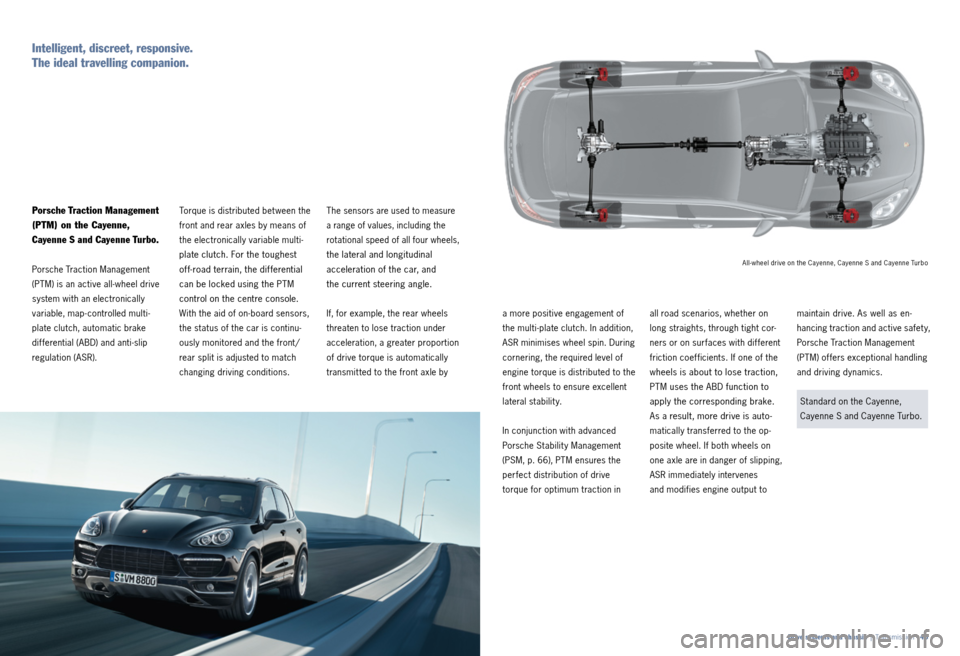
Porsche Traction Management
(PTM) on the Cayenne,
Cayenne S and Cayenne Turbo.
Porsche Traction Management
(PTM) is an active all-wheel drive
system with an electronically
variable, map - controlled multi -
plate clutch, automatic brake
dif ferential (ABD) and anti-slip
regulation (ASR).
Intelligent, discreet, responsive.
The ideal travelling companion.
All -wheel drive on the Cayenne, Cayenne S and Cayenne Turbo
Drive systems and chassis | Transmission · 45
Page 25 of 69
3. Normal Level.
Max. ground clearance: 210 mm
(Cayenne Turbo: 215 mm).
4. Low Level I.
22 mm below Normal Level;
max. ground clearance: 188 mm
(Cayenne Turbo: 193 mm);
automatically selected above
138 km/ h (86 mph).
5. Low Level II.
32 mm below Normal Level;
max. ground clearance: 178 mm
(Cayenne Turbo: 183 mm);
automatically selected above
210 km/ h (130 mph).
(Not manually selectable.) 6. Loading Level.
52 mm below Normal Level;
max. ground clearance: 158 mm
(Cayenne Turbo: 163 mm);
only selectable when vehicle is
stationary.
Air suspension with PASM
standard on the Cayenne Turbo.
Optional for all other Cayenne
models.
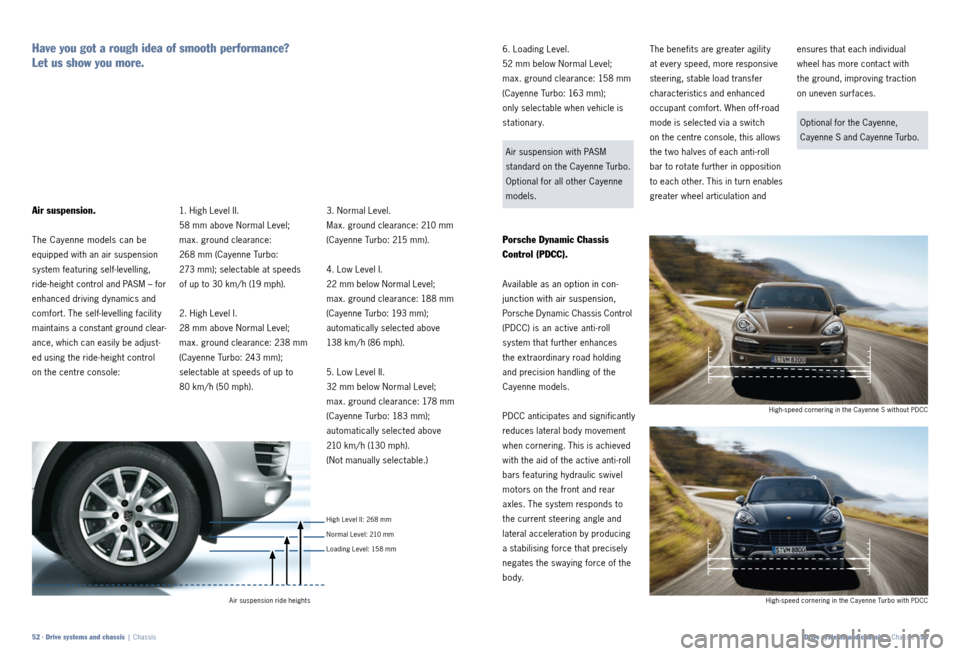
Porsche Dynamic Chassis
Control (PDCC).
Available as an option in con-
junction with air suspension,
Porsche Dynamic Chassis Control
(PDCC) is an active anti-roll
system that further enhances
the extra ordinary road holding
and precision handling of the
Cayenne models.
PDCC anticipates and significantly
reduces lateral body movement
when cornering. This is achieved
with the aid of the active anti-roll
bars featuring hydraulic swivel
motors on the front and rear
axles. The system responds to
the current steering angle and
lateral acceleration by producing
a stabilising force that precisely
negates the swaying force of the
body. The benefits are greater agilit y
at every speed, more responsive
steering, stable load transfer
characteristics and enhanced
occupant comfort. When off-road
mode is selected via a switch
on the centre console, this allows
the t wo halves of each anti-roll
bar to rotate further in opposition
to each other. This in turn enables
greater wheel articulation and
ensures that each individual
wheel has more contact with
the ground, improving traction
on uneven surfaces.
Optional for the Cayenne,
Cayenne S and Cayenne Turbo.
1. High Level II.
58 mm above Normal Level;
max. ground clearance:
268 mm (Cayenne Turbo:
273 mm); selectable at speeds
of up to 30 km/ h (19 mph).
2. High Level I.
28 mm above Normal Level;
max. ground clearance: 238 mm
(Cayenne Turbo: 243 mm);
selectable at speeds of up to
80 km/ h (50 mph). Air suspension.
The Cayenne models can be
equipped with an air suspension
system featuring self-levelling,
ride-height control and PASM – for
enhanced driving dynamics and
comfort. The self-levelling facilit y
maintains a constant ground clear-
ance, which can easily be adjust-
ed using the ride-height control
on the centre console:
Have you got a rough idea of smooth performance?
Let us show you more.
High -speed cornering in the Cayenne Turbo with PDCCHigh -speed cornering in the Cayenne S without PDCC
52 · Drive systems and chassis | ChassisDrive systems and chassis | Chassis · 53
Air suspension ride heights
Loading Level: 158 mm Normal Level: 210 mm High Level II: 268 mm
Page 26 of 69
high -mounted upper arms are
in aluminium. This axle design
ensures accurate wheel location,
greater agilit y and minimal inter-
ference on uneven surfaces.
The subframe is secured on large
rubber mountings that reduce
road noise to a minimum. It is
also specially constructed to
increase stabilit y. For enhanced comfort and even greater active
and passive safet y. In the event
of an impact, the subframe
deforms in a predefined manner.
Rear axle.
The rear axle features multi-link
suspension. Ideal for performance
road and track use, it also copes
well with the extremely high
towing and carrying loads that
are possible with each Cayenne.
The suspension struts are angled
to allow longer suspension travel
and create a deeper and wider
cargo area. As well as providing
additional space, the car is also
easier to load.
The rear axle design minimises
dive and squat under acceleration
and braking. It also improves mid-
corner stabilit y and compensates
for sudden load transfer. In short:
it enables a more relaxed way
of driving. Examples of intelligent
light weight construction on the
rear axle include hollow drive
shafts.
Steering.
The steering system has been
completely revised and adapted
for a more immediate response
and greater driving dynamics.
Around the straight-ahead pos-
ition, in particular, the ratio is
now more direct. With the variable
steering ratio and special valve
set tings on the power-steering
system, optimum manoeuvrabilit y
is ensured. The turning circle
of the Cayenne models is just
11.9 metres.
The steering column itself
consists of multiple collapsing
sections linked by t wo universal
joints and a special deformation
element provides additional safet y
in the event of a front impact. Electro -hydraulic power steering
is used for the first time on the
Cayenne S Hybrid. The demand-
driven pump only provides
assistance to the steering as
and when required, thereby
contributing to overall efficiency.
Servotronic.
Servotronic is a speed-sensitive
power-steering system.
At higher speeds, the steering
becomes firmer, inputs are more
precise and driver comfort is
enhanced. At lower speeds, it
enables easy manoeuvrability
and parking.
Standard on the Cayenne S
Hybrid. Optional for all other
Cayenne models.
Front axle.
The chassis on the Cayenne
models offers a direct response –
for a more rewarding driving
experience.
The wishbones on the subf rame-
mounted front suspension with
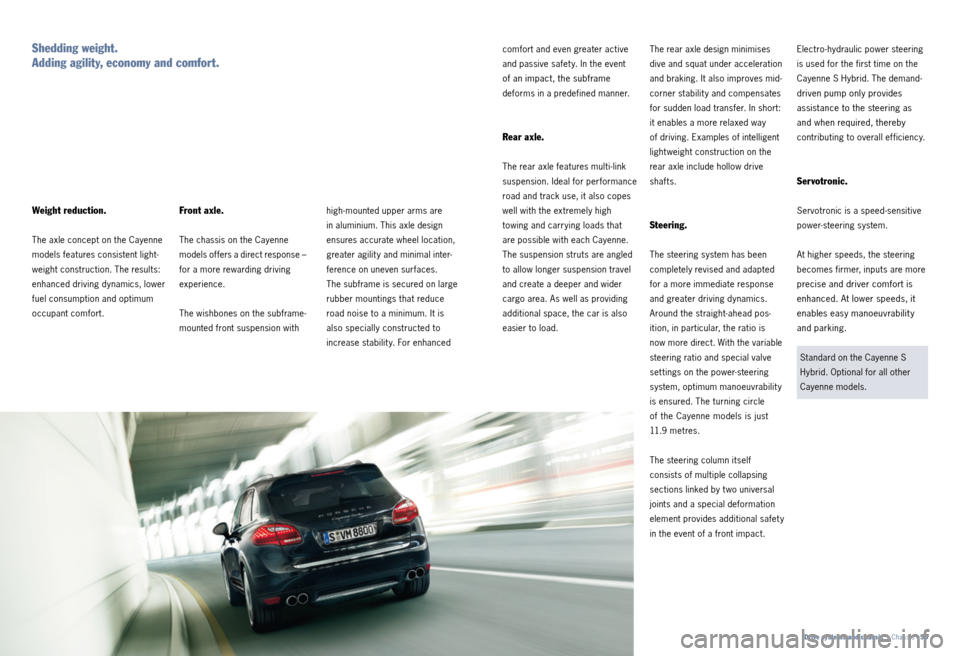
Weight reduction.
The axle concept on the Cayenne
models features con sistent light-
weight construction. The results:
enhanced driving dynamics, lower
fuel consumption and optimum
occupant comfort.
Shedding weight.
Adding agility, economy and comfort.
Drive systems and chassis | Chassis · 55
Page 29 of 69
Standard on all Cayenne
models.
Halogen main headlights.
The projector-beam halogen main
headlights feature automatic
static range control and reflection
high-beam lights – for optimum
illumination of the road.
Standard on the Cayenne,
Cayenne Diesel, Cayenne S
and Cayenne S Hybrid.
Bi-Xenon main headlights with
Porsche Dynamic Light System
(PDLS).
Featuring halogen auxiliary
headlights, integrated headlight
cleaning and automatic dynamic
range control, the Bi-Xenon main
headlights provide more uniform
illumination of the road in both
dipped and high-beam mode.
The dynamic cornering light
function swivels the main
headlights towards the inside of
a bend
based on the current
steering angle and road speed.
The static cornering lights acti-
vate the auxiliary headlights in order to illuminate more of the
road in tight bends and turns.
PDLS also features speed-
sensitive headlight control and
an adverse weather function,
which is activated in conjunction
with the rear foglight – for even
greater safet y, not just at night
and during cornering.
Standard on the Cayenne Turbo.
Optional for all other Cayenne
models.
Daytime running lights.
Fit ted as standard on all
Cayenne models: LED day time
running lights. On the Cayenne,
Cayenne Diesel, Cayenne S
and Cayenne S Hybrid, these
are arranged horizontally in the front light units, whereas
on the Cayenne Turbo each
main headlight unit has four
LED spotlights. Day time running
lights improve safet y in the
day time as they make you more
visible to other road users.
Taillights.
LED technology is used for all
functions on the rear light mod-
ules. For an ultra-fast response
and greater luminance. In short:
for greater safet y.
In an emergency stop, the
adaptive LED brake lights on
the Cayenne models pulsate
to alert the traf fic behind more
quickly to a critical situation.
The high -level third brake light is
integrated into the roof spoiler.
Automatic headlight activation.
The headlights are automatically
switched on when darkness sets
in or when driving through a tun-
nel in the day time. Other features
include an automatic switch - of f
and ‘Welcome Home’ function –
when you arrive at a destination
after dark, the headlights remain
illuminated for a user- defined
period, lighting your path from
the car.
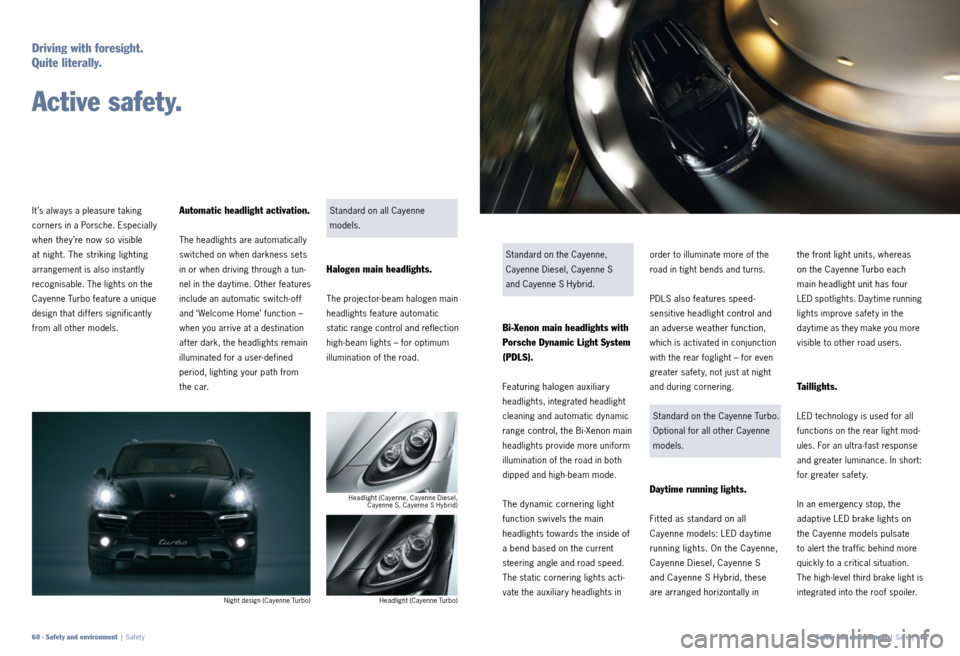
It ’s always a pleasure taking
corners in a Porsche. Especially when they’re now so visible
at night. The striking lighting
arrangement is also instantly
recog nisable. The lights on the
Cayenne Turbo feature a unique
design that dif fers significantly
from all other models.
Driving with foresight.
Quite literally.
Active safety.
Night design (Cayenne Turbo)
Headlight (Cayenne, Cayenne Diesel,
Cayenne S, Cayenne S Hybrid)
Headlight (Cayenne Turbo)
Safety and environment | Safet y · 61
60 · Safety and environment | Safet y
Page 31 of 69
Porsche Ceramic Composite Brake (PCCB)
To do this, the engine manage-
ment system adjusts the gener-
ator current depending on the
brake pedal position, recovers
part of the kinetic energy and
stores it in the bat tery. When
the pressure on the brake pedal
exceeds a certain threshold, the
brakes are applied.
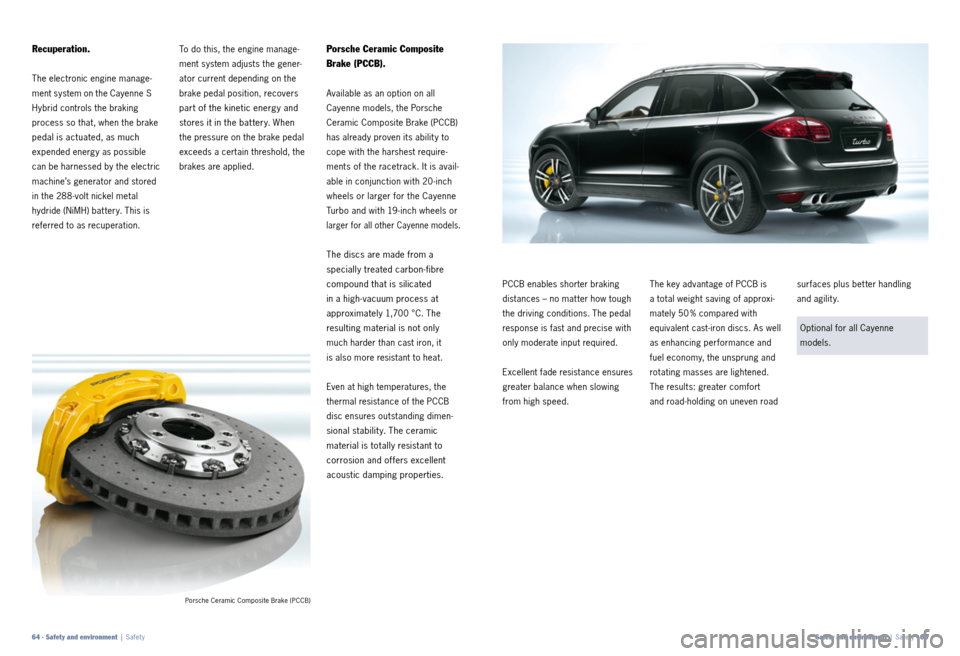
Porsche Ceramic Composite
Brake (PCCB).
Available as an option on all
Cayenne models, the Porsche
Ceramic Composite Brake (PCCB)
has already proven its abilit y to
cope with the harshest require-
ments of the racetrack. It is avail -
able in conjunction with 20-inch
wheels or larger for the Cayenne
Turbo and with 19-inch wheels or
larger for all other Cayenne models.
The discs are made from a
specially treated carbon-fibre
compound that is silicated
in a high-vacuum process at
approximately 1,700 °C. The
resulting material is not only
much harder than cast iron, it
is also more resistant to heat.
Even at high temperatures, the
thermal resistance of the PCCB
disc ensures outstanding dimen-
sional stabilit y. The ceramic
material is totally resistant to
corrosion and offers excellent
acoustic damping properties.
PCCB enables shorter braking
distances – no mat ter how tough
the driving conditions. The pedal
response is fast and precise with
only moderate input required.
Excellent fade resistance ensures
greater balance when slowing
from high speed.The key advantage of PCCB is
a total weight saving of approxi-
mately 50 % compared with
equivalent cast-iron discs. As well
as enhancing performance and
fuel economy, the unsprung and
rotating masses are lightened.
The results: greater comfort
and road-holding on uneven road surfaces plus bet ter handling
and agility.
Optional for all Cayenne
models.
Recuperation.
The electronic engine manage-
ment system on the Cayenne S
Hybrid controls the braking
process so that, when the brake
pedal is actuated, as much
expended energy as possible
can be harnessed by the electric
machine’s generator and stored
in the 288-volt nickel metal
hydride (NiMH) bat tery. This is
referred to as recuperation.
Safety and environment | Safet y · 65
64 · Safety and environment | Safet y
Page 32 of 69

PSM has three additional func-
tions that help reduce braking
distances. If the throt tle pedal
is released suddenly, PSM
automatically readies the braking
system. The pressure in the
brake lines is marginally increased,
bringing each of the pads into
light contact with the correspond-
ing disc. If the driver goes on
to apply the brakes, the calipers
respond more quickly and the
braking distance is reduced. In an emergency stop – i.e. when
the pressure on the brake pedal
exceeds a certain threshold –
the brake assist function uses the
PSM hydraulics to apply maximum
braking force at all four wheels.
For added safet y, the system
also readies the brakes whenever
a decreasing distance to the
vehicle in front is detected. The
optional adaptive cruise control
and PSM interact to prefill the
brakes.
Even if adaptive cruise control is
inactive, the system registers the
speed of the vehicle in front and
automatically readies the braking
system. In addition, the system
alerts the driver to the decreasing distance by briefly tugging on
the brakes.
PSM also features a trailer
stabilisation function – for a
significant contribution to car
and trailer safet y.
Within the laws of physics, it
compensates for load transfer
caused by throt tle and brake
inputs up to the maximum degree
of lateral acceleration. It also en-
hances the car’s driving dynamics
and directional stabilit y when
accelerating on inconsistent road
surfaces.
Other features include a special
control strategy in the ABS
for braking on loose surfaces.
By briefly locking the wheels, a wedge is formed ahead of each
t yre which provides additional
purchase to help slow the car,
e.g. on gravel or snow.
For a more involving driving
experience, PSM can also be
disabled, but remains active in
the background.
Standard on all Cayenne
models.
accele ration of the car. Using
this information, it is possible to
calculate the actual direction of
travel at any given moment. If
the car begins to oversteer or
understeer, PSM applies selective
braking on individual wheels to
restore stabilit y. If necessar y,
PSM can also intervene in the
engine management system to
temporarily modif y the amount of
drive transmit ted to the wheels.
Porsche Stability Management
(PSM).
Porsche Stabilit y Management
(PSM) is an electronic control
system that uses a range of
functions – including anti-lock
braking (ABS) – to help stabilise
the vehicle (and trailer, if fit ted)
in hazardous road scenarios.
Throughout each journey, sensors
monitor the direction, speed,
yaw velocit y and lateral
Preparing for the road ahead.
With a little help from PSM.
Safety and environment | Safet y · 67
Page 36 of 69

Thanks to single-spark coils on
each of the cylinders, the entire
ignition system on the petrol-
engined models, with the
exception of the spark plugs,
is maintenance -free.
These modest service require-
ments mean less waste disposal
and fewer demands on natural
resources. They also lower the
cost of ownership while keeping
your car on the road.The Cayenne S Hybrid doesn’t
require any additional servicing.
Service intervals for the Cayenne
models are dependent on a range
of factors, including local fuel
qualit y. For full details of service
intervals in your country, please
consult the relevant price list
or contact your Porsche Centre.
Materials and recycling.
Owning a Porsche should be a
lasting pleasure with minimal
impact on the environment. This
Porsche principle can be summed
up in one word: sustainabilit y.
The light weight exhaust on the
Cayenne models, for example,
is constructed from long-life
stainless steel.
Every Porsche model is entirely
free of asbestos, CFCs and
components manufactured using
CFCs. All legal requirements in
respect of recycling are fulfilled.
Materials are clearly labelled for subsequent identification and
sorting to facilitate ef ficient
recycling.
While more than 95 % of the car
can be recycled using current
technologies, the chances are
your Cayenne may never need
recycling at all. After all, t wo
thirds of all the cars we have ever
made are still on the road today.
For more information on
environmental issues, please
visit w w w.porsche.com.
Servicing.
With lengthy service intervals
and long-life components, vehicle
maintenance is kept to a min-
imum. In the case of the oil filter,
for example, all that ’s replaced
is an easily recyclable paper
element. The oil filter casing
remains on the car.
All moving parts inside the engine
are fully self-adjusting. The valve
clearances, for instance, feature
automatic hydraulic control.
Noise.
As paradoxical as it may seem,
the distinctive Porsche sound is
also created by what you don’t
hear – the absence of unwanted
noise. Naturally, its main origin is
deep within the engine. But that ’s
not all. Our holistic approach
to vehicle design also extends
to the acoustics. Which is why
we’ve optimised them for the
entire car.
To minimise ‘play’ bet ween com-
ponents, we’ve used stronger,
lighter and more temperature-
resistant materials. This reduces
mechanical noise. Large-volume
silencers and air intake manifolds
also help to eliminate noise –
throughout the life of the car.
Tyre noise has been drastically
reduced in collaboration with
our of ficial t yre partners. Wind
noise levels have also been
lowered thanks to aerodynamic
refinements.
All that remains is a sound that is
pure Porsche.
74 · Safety and environment | Environment