MPG PORSCHE CAYNNE 2011 2.G Information Manual
[x] Cancel search | Manufacturer: PORSCHE, Model Year: 2011, Model line: CAYENNE, Model: PORSCHE CAYENNE 2011 2.GPages: 69, PDF Size: 11.14 MB
Page 8 of 69
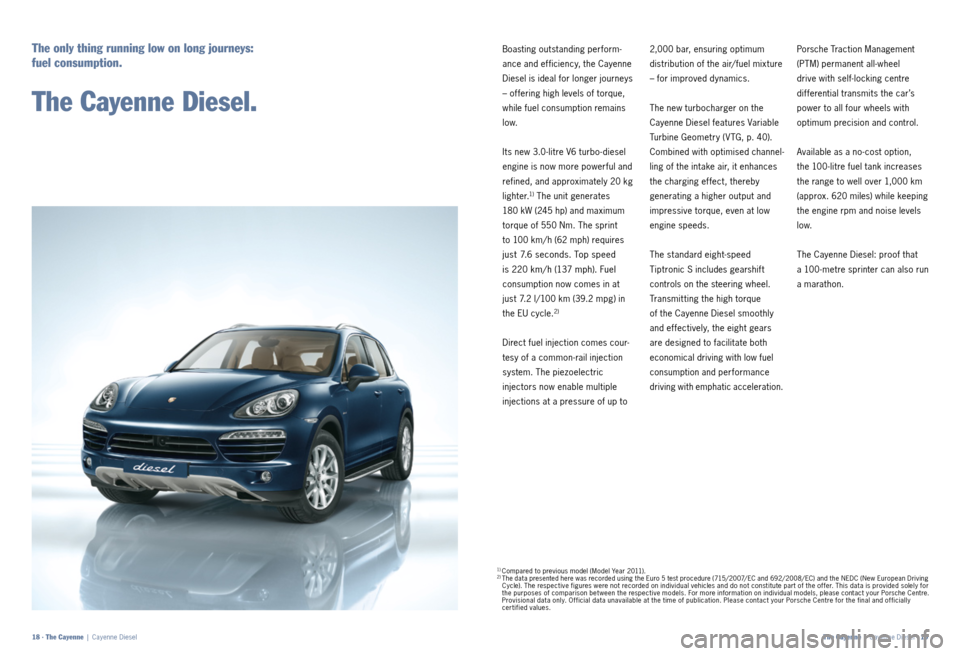
Boasting outstanding perform-
ance and ef ficiency, the Cayenne
Diesel is ideal for longer journeys
– of fering high levels of torque,
while fuel consumption remains
l o w.
Its new 3.0 -litre V6 turbo - diesel
engine is now more powerful and
refined, and approximately 20 kg
l i g h t e r.
1) The unit generates
180 kW (245 hp) and maximum
torque of 550 Nm. The sprint
to 100 km/ h (62 mph) requires
just 7.6 seconds. Top speed
is 220 km/ h (137 mph). Fuel
con sumption now comes in at
just 7.2 l/100 km (39.2 mpg) in
the EU cycle.
2)
Direct fuel injection comes cour-
tesy of a common-rail injection
system. The piezoelectric
injectors now enable multiple
injections at a pressure of up to 2,000 bar, ensuring optimum
distribution of the air/fuel mixture
– for improved dynamics.
The new turbocharger on the
Cayenne Diesel features Variable
Turbine Geometry (V TG, p. 40).
Combined with optimised channel-
ling of the intake air, it enhances
the charging ef fect, thereby
generating a higher output and
impressive torque, even at low
engine speeds.
The standard eight-speed
Tiptronic S includes gearshif t
controls on the steering wheel.
Transmit ting the high torque
of the Cayenne Diesel smoothly
and ef fectively, the eight gears
are designed to facilitate both
economical driving
with low fuel
consumption and
performance
driving with em phatic accele ration.
Porsche Traction Management
(PTM) permanent all-wheel
drive with self-locking centre
dif ferential transmits the car’s
power to all four wheels with
optimum precision and control.
Available as a no - cost option,
the 100 -litre fuel tank increases
the range to well over 1,000 km
(approx. 620 miles) while keeping
the engine rpm and noise levels
l o w.
The Cayenne Diesel: proof that
a 100 -metre sprinter can also run
a marathon. The only thing running low on long journeys:
fuel consumption.
The Cayenne Diesel.
1) Compared to previous model (Model Year 2011).2) The data presented here was recorded using the Euro 5 test procedure (715/2007/ EC and 692/2008/ EC) and the NEDC (New European Driving Cycle). The respective figures were not recorded on individual vehicles and do not constitute part of the of fer. This data is provided solely for the purposes of comparison bet ween the respective models. For more information on individual models, please contact your Porsche Centre.
Provisional data only. Of ficial data unavailable at the time of publication. Please contact your Porsche Centre for the final and of ficially
certified values.
The Cayenne | Cayenne Diesel · 19
18 · The Cayenne | Cayenne Diesel
Page 13 of 69
The Cayenne S Hybrid has a
3.0 -litre V6 supercharged engine.
The charging effect of the
compressor ensures high levels
of torque, even at low engine
speeds. The unit generates an
output of 245 kW (333 hp).
440 Nm of torque is available
bet ween 3,000 and 5,250 rpm,
enabling a low-rev, economical
driving st yle while offering
exceptional reserves of power.
At 288 volts, the electric machine
has a maximum output of
34 kW (47 hp). The benefits of
the synchronous motor with
inner rotor design are extremely
compact dimensions and high
levels of efficiency. It also acts as
a starter motor and alternator.
Working in tandem, both units
provide a total output of 279 kW
(380 hp) and maximum torque
of 580 Nm, propelling the car
from 0 to 100 km/ h (62 mph) in
just 6.5 seconds. These are the
levels of acceleration you would
usually expect from an eight-
cylinder unit, but with fuel con-
sumption of under 8.2 l/100 km
(34.4 mpg) in the EU cycle.
1)
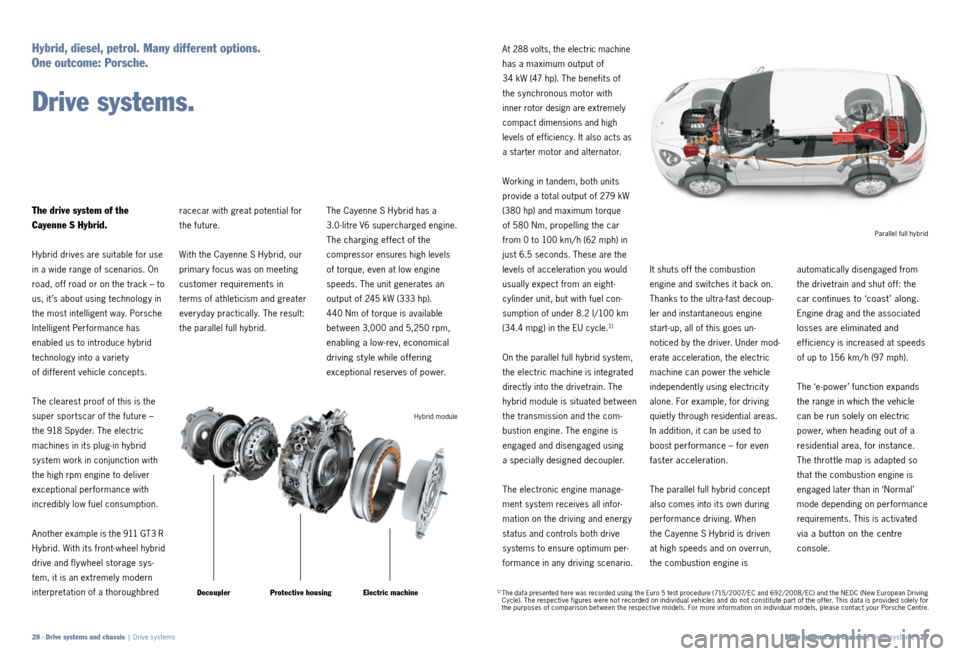
On the parallel full hybrid system,
the electric machine is integrated
directly into the drivetrain. The
hybrid module is situated bet ween
the transmission and the com -
bustion engine. The engine is
engaged and disengaged using
a specially designed decoupler.
The electronic engine manage-
ment system receives all infor-
mation on the driving and energy
status and controls both drive
systems to ensure optimum per-
formance in any driving scen ario.
racecar with great potential for
the future.
With the Cayenne S Hybrid, our
primary focus was on meeting
customer requirements in
terms of athleticism and greater
everyday practically. The result:
the parallel full hybrid.
The drive system of the
Cayenne S Hybrid.
Hybrid drives are suitable for use
in a wide range of scenarios. On
road, of f road or on the track – to
us, it ’s about using technology in
the most intelligent way. Porsche
Intelligent Performance has
enabled us to introduce hybrid
technology into a variet y
of different vehicle concepts.
The clearest proof of this is the
super sportscar of the future –
the 918 Spyder. The electric
machines in its plug-in hybrid
system work in conjunction with
the high rpm engine to deliver
exceptional performance with
incredibly low fuel consumption.
Another example is the 911 GT3 R
Hybrid. With its front-wheel hybrid
drive and fly wheel storage sys-
tem, it is an extremely modern
interpretation of a thoroughbred
Hybrid, diesel, petrol. Many different options.
One outcome: Porsche.
Drive systems.
1) The data presented here was recorded using the Euro 5 test procedure (715/2007/ EC and 692/2008/ EC) and the NEDC (New European Driving Cycle). The respective figures were not recorded on individual vehicles and do not constitute part of the of fer. This data is provided solely for the purposes of comparison bet ween the respective models. For more information on individual models, please contact your Porsche Centre.
Drive systems and chassis | Drive systems · 29
28 · Drive systems and chassis | Drive systems Parallel full hybrid
It shuts of f the combustion
engine and switches it back on.
Thanks to the ultra-fast decoup-
ler and instantaneous engine
start-up, all of this goes un-
noticed by the driver.
Under mod-
erate
acceleration, the electric
machine can power the vehicle
independently using electricit y
alone. For example, for driving
quietly through residential areas
.
In
addition, it can be used to
boost
performance – for even
faster acceleration.
The parallel full hybrid concept
also comes into its own during
performance driving. When
the Cayenne S Hybrid is driven
at high speeds and on overrun,
the combustion engine is automatically disengaged from
the drivetrain and shut off: the
car
continues to ‘coast’ along.
Engine drag and the associated
losses are eliminated and
efficiency is increased at speeds
of up to 156 km/ h (97 mph).
The ‘e-power’ function expands
the range in which the vehicle
can be run solely on electric
power, when heading out of a
residential area, for instance.
The throt tle map is adapted so
that the combustion engine is
engaged later than in ‘Normal’
mode depending on performance
requirements. This is activated
via a but ton on the centre
console.
Hybrid module
Decoupler
Protective housing Electric machine
Page 65 of 69
136 · Technical dataTechnical data · 137
CayenneCayenne Diesel
Chassis
Brakes 6-piston monobloc aluminium fixed
calipers at front, 4 - piston monobloc
aluminium brakes at rear, ABS 6-piston monobloc aluminium fixed
calipers at front, 4 - piston monobloc
aluminium brakes at rear, ABS
Wheels 8.0J x 18 8.0J x 18
Ty r e s 255/55 R 18 255/55 R 18
Unladen weight Manual gearbox/ Tiptronic STiptronic S
DIN 1,995 kg /2,030 kg 2,080 kg
EC
1) 2,070 kg /2,105 kg 2,155 k g
Permissible gross weight 2,765 kg /2,800 kg 2,840 kg
Maximum payload 770 kg / 770 kg 760 k g
Performance Manual gearbox/ Tiptronic STiptronic S
Top speed 230 km/ h (143 mph)/
230 km/ h (143 mph) 220 km/ h (137 mph)
0 –100 km/ h (0 – 62 mph) 7.5 secs/7.8 secs 7.6 secs
Flexibility (manual gearbox) in
second highest (5th) gear,
80 –120 km/ h (50 –75 mph) 9.6 secs
–
Over taking acceleration (automatic
transmission) 80 –120 km/ h
(5 0 –75 m p h) 5.4 secs
5.3 secs
Fuel consumption/emissions2)Manual gearbox/ Tiptronic STiptronic S
Fuel grade
3)Super Plus Diesel2)
Urban in l/100 km (mpg)15.9 (17.8)/13.2 (21.4) 8.4 (33.2)2)
Extra urban in l/100 km (mpg)8.5 (33.2)/8.0 (35.3) 6.5 (43.5)2)
Combined in l/100 km (mpg)11.2 (25.2)/9.9 (28.5) 7.2 (39.2)2)
CO2 emission in g/km263/236 1892)
Emissions standardEU5 EU5
Cayenne SCayenne S Hybrid Cayenne Turbo
6-piston monobloc aluminium fixed
calipers at front, 4 - piston monobloc
aluminium brakes at rear, ABS 6-piston monobloc aluminium fixed
calipers at front, 4 - piston monobloc
aluminium brakes at rear, ABS 6-piston monobloc aluminium fixed
calipers at front, 4 - piston monobloc
aluminium brakes at rear, ABS
8.0J x 18 8.0J x 18 8.5J x 19
255/55 R 18 255/55 R 18 265/50 R 19
Tiptronic S Tiptronic S Tiptronic S
2,065 kg 2,240 k g 2 ,17 0 k g
2 ,14 0 k g 2,315 k g 2,245 k g
2,840 kg 2,910 k g 2,880 kg
775 kg 670 kg 710 k g
Tiptronic S Tiptronic S Tiptronic S
258 km/ h (160 mph) 242 km/ h (150 mph) 278 km/ h (173 mph)
5.9 secs 6.5 secs 4.7 s e c s
– – –
4.0 secs 4.6 secs 3.1 secs
Tiptronic S Tiptronic S Tiptronic S
Super Plus Super Super Plus
14.4 (19.6) 8.7 (32.5) 15.8 (17.9)
8.2 (34.4) 7.9 (35.8) 8.4 (33.6)
10.5 (26.9) 8.2 (34.4) 11.5 (24.6)
245 193 270
EU5 EU5 EU5
1) The unladen weight (EC) complies with the relevant EC Directives and is valid for standard specification vehicles only. Some items of
optional equipment can increase this weight. The figure specified above includes 68 kg representing the driver and 7 kg for luggage.
2) Fuel consumption was recorded on vehicles with standard specification. Optional equipment may af fect fuel consumption and vehicle
per formance. The data presented here was recorded using the Euro 5 test procedure (715/2007/ EC and 692/2008/ EC) and the NEDC
(New European Driving Cycle). The respective figures were not recorded on individual vehicles and do not constitute par t of the of fer.
This data is provided solely for the purposes of comparison bet ween the respective models. For more information on individual models,
please contact your Porsche Centre. Provisional data only. Of ficial data unavailable at the time of publication. Please contact your Porsche
Centre for the final and of ficially cer tified values.
3) The petrol - engined models are designed to operate on fuels with an ethanol content of up to 10 %.
The diesel engine is compatible with a biodiesel blend of max. 7 %.