engine PORSCHE CAYNNE S 2005 1.G Owners Manual
[x] Cancel search | Manufacturer: PORSCHE, Model Year: 2005, Model line: CAYENNE S, Model: PORSCHE CAYENNE S 2005 1.GPages: 380, PDF Size: 3.17 MB
Page 260 of 380
260
Maintenance, Car Care Emergency unlocking
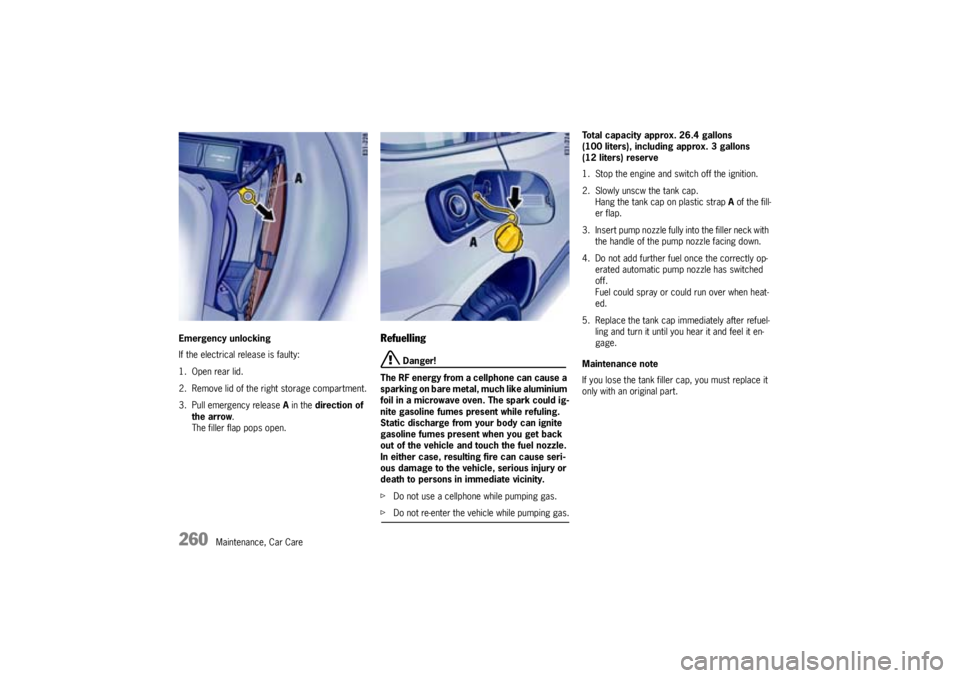
If the electrical release is faulty:
1. Open rear lid.
2. Remove lid of the right storage compartment.
3. Pull emergency release Ain the direction of
the arrow.
The filler flap pops open.
Refuelling
Danger!
The RF energy from a cellphone can cause a
sparking on bare metal, much like aluminium
foil in a microwave oven. The spark could ig-
nite gasoline fumes present while refuling.
Static discharge from your body can ignite
gasoline fumes present when you get back
out of the vehicle and touch the fuel nozzle.
In either case, resulting fire can cause seri-
ous damage to the vehicle, serious injury or
death to persons in immediate vicinity.
fDo not use a cellphone while pumping gas.
fDo not re-enter the vehicle while pumping gas.Total capacity approx. 26.4 gallons
(100 liters), including approx. 3 gallons
(12 liters) reserve
1. Stop the engine and switch off the ignition.
2. Slowly unscw the tank cap.
Hang the tank cap on plastic strap A of the fill-
er flap.
3. Insert pump nozzle fully into the filler neck with
the handle of the pump nozzle facing down.
4. Do not add further fuel once the correctly op-
erated automatic pump nozzle has switched
off.
Fuel could spray or could run over when heat-
ed.
5. Replace the tank cap immediately after refuel-
ling and turn it until you hear it and feel it en-
gage.
Maintenance note
If you lose the tank filler cap, you must replace it
only with an original part.
Page 261 of 380

Maintenance, Car Care
261
Fuel RecommendationsYour Porsche is equipped with catalytic convert-
ers and must use UNLEADED FUEL ONLY.
Your engine is designed to provide optimum per-
formance and fuel economy using unleaded premi-
um fuel with an octane rating of 98 RON
(93 CLC or AKI). Porsche therefore recom-
mends the use of these fuels in your vehicle.
Porsche also recognizes that these fuels may not
always be available. Be assured that your vehicle
will operate properly on unleaded premium fuels
with octane numbers of at least 95 RON
(90 CLC or AKI), since the engine's “Electronic
Oktane™ knock control“ will adapt the ignition tim-
ing, if necessary.
The use of UNLEADED FUEL ONLY is critically
important to the life of the catalytic convert-
ers. Deposits from leaded fuels will ruin the
converters and make it ineffective as an
emission control device.
Cars with catalytic converters have a smaller fuel
tank opening, and gas station pumps have smaller
nozzles. This will prevent accidental pumping of
leaded fuel into cars with catalytic converters.
Unleaded fuels may not be available outside the
continental U.S. and Canada. Therefore, we rec-
ommend you do not take your car to areas or
countries where unleaded fuel may not be avail-
able.
Octane ratingsOctane rating indicates a fuel's ability to resist det-
onation. Therefore, buying the correct octane gas
is important to prevent engine “damage“.
The RON octane rating is based on the research
method. The CLC (U.S. Cost of Living Council oc-
tane rating) or AKI (antiknockindex) octane rating
usually displayed on U.S. fuel pumps is calculated
as research octane number plus motor octane
number, divided by 2, that is written as:
The CLC or AKI octane rating is usually lower than
the RON rating:
For example: 95 RON equals 90 CLC or AKI
Fuels containing alcohol and etherSome areas of the U.S. require oxygenated fuels
during certain portions of the year. Oxygenated fu-
els are fuels which contain alcohols (such as meth-
anol or ethanol) or ether (such as MTBE).
Under normal conditions, the amount of these
compounds in the fuel will not affect driveability.
You may use oxygenated fuels in your Porsche,
provided the octane requirements for your vehicle
are met. We recommend, however, to change to a
different fuel or station if any of the following prob-
lems occur with your vehicle:
– Deterioration of driveability and performance.
– Substantially reduced fuel economy.
– Vapor lock and non-start problems, especially
at high altitude or at high temperature.
– Engine malfunction or stalling.
RON MON+
2 ---------------------------------- o rRM+
2 ---------------
Page 262 of 380

262
Maintenance, Car Care
Fuels containing MMTSome North American fuels contain an octane en-
hancing additive called methylcyclopentadienyl
manganese tricarbonyl (MMT).
If such fuels are used, your emission control sys-
tem performance may be negatively affected.
The check engine warning light on your instrument
panel may turn on.
If this occurs, Porsche recommends you stop us-
ing fuels containing MMT.
Portable Fuel Containers
Danger!
Portable fuel containers, full or partially
empty, may leak causing an explosion, or re-
sult in fire in case of an accident.
fNever carry additional fuel in portable contain-ers in your vehicle.
Fuel Evaporation ControlFuel tank ventingThe evaporation chamber and the carbon canister
prevent fuel from escaping to the atmosphere at
extreme high outside temperatures, when driving
abruptly around curves and when the car is parked
at an incline or in any other nonlevel position.Vapor control system and storageWhen the fuel tank is filled, vapors are collected in
the evaporation chamber by a vent line leading the
vapors to the carbon canister where they are
stored as long as the engine does not run.Purge systemWhen the engine is running, the fuel vapors from
the canister will be mixed with fresh air from the
ambient air of the canister. This mixture will be di-
rected to the intake air housing by the tank vent
line, mixed with the intake air and burned during
normal combustion.
Page 263 of 380

Maintenance, Car Care
263
Emission Control SystemIn the interest of clean airPollution of our environment has become a prob-
lem that is of increasing concern to all of us. We
urge you to join us in our efforts for cleaner air in
controlling the pollutants emitted from the auto-
mobile.
Porsche has developed an emission control sys-
tem that controls or reduces those parts of the
emission that can be harmful to our environment.
Your Porsche is equipped with such a system.
Porsche warrants the Emission Control System in
your new car under the terms and conditions set
forth in the Warranty Booklet.
You, as the owner of the vehicle, have the respon-
sibility to provide regular maintenance service for
the vehicle and to keep a record of all mainte-
nance work performed. To facilitate record keep-
ing, have the service performed by authorized
Porsche dealers. They have Porsche trained tech-
nicians and special tools to provide fast and effi-
cient service.To assure efficient operation of the Emission
Control System:
fHave your vehicle maintained properly and in
accordance with the recommendations de-
scribed in your Maintenance Booklet. Lack of
proper maintenance, as well as improper use
of the vehicle, will impair the function of the
emission control system and could lead to
damage.
fDo not alter or remove any component of the
emission control system.
fDo not alter or remove any device, such as
heat shields, switches, ignition wires, valves,
etc., which are designed to protect your vehi-
cle's emission control system. In addition to
serious engine damage, this can result in a fire
if excess raw fuel reaches the exhaust system.
fDo not continue to operate your vehicle if you
detect engine misfire or other unusual operat-
ing conditions.
Parking
Warning!
Danger of fire.
fDo not park or operate the vehicle in areas
where the hot exhaust system may come in
contact with dry grass, brush, fuel spill or oth-
er flammable material.
fIf your car catches on fire for any reason, call
the fire department. Do not endanger your life by attempting to put out the fire.
Undercoating
Danger!
Danger of fire and serious personal injuries
or death.
fDo not apply additional undercoating or rust-
proofing on or near the exhaust manifold, ex-
haust pipes, catalytic converters or heat
shields. During driving the substance used for undercoating could overheat and ignite.
Page 264 of 380

264
Maintenance, Car Care
How Emission Control WorksWhen an automobile engine is running, it uses en-
ergy generated through the combustion of a mix-
ture of air and fuel. Depending on whether a car is
driven fast or slowly or whether the engine is cold
or hot, some of the fuel (hydrocarbons) may not
be burned completely, but may be discharged into
the engine crankcase or exhaust system. Additon-
al hydrocarbons may enter the atmosphere
through evaporation of fuel from the fuel tank.
These hydrocarbons (HC), when released into the
air, contribute to undesirable pollution.
In addition, carbon monoxide (CO) and oxides of
nitrogen (NOx) contribute to engine emissions.
They, too, are formed during the combustion pro-
cess and discharged into the exhaust system.
To reduce these pollutants, your Porsche is
equipped with a precisely calibrated fuel injection
system to assure a finely balanced air/fuel mixture
under all operating conditions.
Oxygen sensorThe oxygen sensor, installed in the exhaust pipe
continuously senses the oxygen content of the ex-
haust and signals the information to an electronic
control unit. The control unit corrects the air/fuel
ratio, so the engine always receives an accurately
metered air/fuel mixture.Crankcase ventilationThrough crankcase ventilation, undesirable emis-
sions from the engine crankcase are not permit-
ted to reach the outside atmosphere. These emis-
sions are recirculated from the crankcase to the
air intake system. From here the emissions mix
with the intake air and are later burned in the en-
gine.Catalytic convertersThe catalytic converters are efficient “clean-up“
devices built into the exhaust system of the vehi-
cle. The catalytic converters burn the undesirable
pollutants in the exhaust gas before it is released
into the atmosphere.
The exclusive use of unleaded fuel is critical-
ly important for the life of the catalytic con-
verters. Therefore, only unleaded fuel must
be used.The catalytic converters will be damaged by:
– push or tow starting the vehicle
– misfiring of the engine
– turning off the ignition while the vehicle is mov-
ing or
– driving until the fuel tank is completely empty
– by other unusual operating conditions.
fDo not continue to operate your vehicle under
these conditions, since raw fuel might reach
the catalytic converters. This could result in
overheating of the converters. Federal law pro-
hibits use of leaded fuel in this car.
Page 269 of 380

Maintenance, Car Care
269
Cleaning the engine compartment
Caution!
Risk of damage, e.g. to the alternator, paint-
ed surfaces, and the valve covers.
fNever use high-pressure cleaning units with a
round-jet nozzle.
fAlways maintain a minimum distance of 21 in.
(50 cm).
fAlways cover the lid over the brake fluid reser-
voir prior to cleaning with a high-pressure
cleaner. Never point the cleaning jet directly at
the lid.
fDo not point the cleaning jet directly at any of the aforementioned components.
Note on operation
If the car is driven off-road frequently and after
driving on salted or gritted roads:
fClean the engine compartment regularly.
WindowsThe road dust which settles on the windshield and
windows contains particles of tire rubber and oil
residue. The interior trim and upholstery release
particles, particularly in strong sunlight, which col-
lect on the insides of the windows. These deposits
are augmented by impurities in the air which en-
ters the car through the fresh air vents.
fClean all windows regularly, inside and outside,
with Porsche window cleaner.
fMake sure not to damage the TV antenna in the
side window when cleaning.
fIf you use a chamois leather for the windows,
do not use it for paintwork as it will otherwise
pick up a certain amount of preservative or pol-
ish and could smear the windows and thus im-
pair vision.
fRemove dead insects with insect remover.
Wiper bladesWiper blades that are in perfect condition are vital
for a clear view.
fReplace the wiper blades twice per year (be-
fore and after the cold season) or whenever
wiper performance deteriorates.
fPeriodically clean wiper blades with Porsche
window cleaner, especially after the vehicle
has been washed in a car wash.
If they are very dirty (e.g. with insect remains),
they can be cleaned with a sponge or cloth.
Page 270 of 380

270
Maintenance, Car Care
UndercoatingThe underside of your car is durably protected
against chemical and mechanical influences.
As it is not possible to exclude the risk of damage
to this protective coating in day to day driving, it
is advisable to have the underside of the car in-
spected at certain intervals - preferably before the
start of winter and again in spring - and the under-
coating restored as necessary.
Your authorized Porsche dealer is familiar with the
bodyseal treatment procedures and has the nec-
essary equipment for applying factory approved
materials. We recommend that you entrust them
with such work and inspections.
Unlike conventional spray oils, undercoating and
rust-proofing compounds based on bitumen or
wax do not attack the sound-proofing materials ap-
plied at the factory.
Danger!
Danger of fire and serious personal injuries.
fDo not apply additional undercoating or rust-
proofing on or near the exhaust manifold, ex-
haust pipes, catalytic converters or heat
shields. During driving the substance used for undercoating could overheat and ignite.
fBefore applying fresh underseal, carefully re-
move deposits or dirt and grease. Once it has
dried, the new undercoating compound forms
a tough protective coating which provides effi-
cient rust-proofing of the floor panels and com-
ponents.
fAlways apply a fresh coating of suitable preser-
vative to unprotected areas after cleaning the
underside of the body, the transmission, the
engine or carrying out repairs to under-body,
engine or transmission components.
Effective rust-proofing is particularly important
during the cold weather season. If your car is driv-
en frequently in areas where salt has been spread
on the roads, the whole engine compartment
should be cleaned thoroughly after the winter to
prevent salt from causing any lasting damage. A
full under-body wash should also be performed at
the same time.
Page 274 of 380

274
Maintenance, Car Care
Storing your PorscheIf you intend to store your Porsche for a prolonged
period, please consult your authorized Porsche
dealer. The staff will be glad to advise you on the
most suitable and necessary methods.
fClean your vehicle thoroughly inside and out-
side. Clean the engine compartment. The un-
der carriage and chassis components should
be free of dirt and salt deposits.
fFill up the fuel tank.
fChange the oil and oil filter, and run the engine
for several minutes.
fIncrease the tire pressure to 58 psi (4 bar).It is
not recommended to lift the vehicle, due to the
possibility of corrosion on shock absorber pis-
ton shafts.The vehicle should be moved slight-
ly, approximately every four weeks, to prevent
flat spot on the tires.Climate control
The air conditioning system should be in good
working condition and fully charged.
Windshield/Headlight washer
fCheck and correct antifreeze/cleaning solution
level as necessary.
Electrical system
fRemove the battery from the vehicle and store
it in a cool dry place, not on a cement floor.
When the battery is disconnected, the alarm
system is deactivated.
fRecharge the battery every 3 months. If the
battery remains in the vehicle with the cables
connected, it is necessary to check, remove
and recharge the battery every 2-3 weeks.
Do not fast charge the battery.
fPlease observe the chapter “CHARGE STATE”
on Page 320.Vehicle interior
The interior must be dry, especially in the area of
the floor carpets. The use of drying agents (Silica-
Gel) is recommended in vehicles with leather inte-
rior and in areas with high humidity. The recom-
mended amount is 3 fabric bags of 1.1 lbs.
(500 grams) each placed on the floor carpets.
Windows, doors, lids and roof must be closed.
The air vents should be opened.
Page 276 of 380

276
Practical Tips, Minor Repairs
Exercise Extreme Caution when
Working on your Vehicle
Danger!
Ignoring the following instructions may
cause serious personal injury or death.
fThe engine compartment of any motor vehicle
is a potentially hazardous area. If you are not
fully familiar with proper repair procedures, do
not attempt the adjustments described on the
following pages.
This caution applies to the entire vehicle.
fO n l y w o r k o n y o u r v e h i c l e o u t d o o r s o r i n a w e l l
ventilated area.
fEnsure that there are no open flames in the
area of your vehicle at any time when fuel
fumes might be present. Be especially cau-
tious of such devices such as hot water heat-
ers which ignite a flame intermittently.
fBefore working on any part in the engine com-
partment, turn the engine off and let it cool
down sufficiently. Hot engine compartment
components can burn skin on contact.
fBe alert and cautious around engine at all
times while the engine is running.
If you have to work on the engine while it is run-
ning, always put the handbrake on and put the
gearshift lever in neutral or the selector lever
in position P.fIn particular, be very careful to ensure that
items of clothing (ties, shirt, sleeves etc.), jew-
elry, long hair, hand or fingers cannot get
caught in the engine-compartment blower, fan,
belts or other moving parts.
The radiator and radiator fans are in the front
of the car.
The fans can start or continue running as a
function of temperature, even with the engine
switched off.
Carry out work in these areas only with the
engine off and exercise extreme caution.
fYour Porsche is equipped with an electronic
ignition system. When the ignition is on, high
voltage is present in all wires connected with
the ignition system; therefore, exercise
extreme caution when working on any part of
the engine while the ignition is on or the engine
is running.
fAlways support your car with safety stands if it
is necessary to work under the car. The jack
supplied with the car is not adequate for this
purpose.
fWhen working under the car without safety
stands but with the wheels on the ground,
make sure the car is on level ground, the
wheels are blocked, and that the engine can-
not be started.
Remove the ignition key.fDo not smoke or allow an open flame around
the battery or fuel.
Keep a fire extinguisher in close reach.
fIncomplete or improper servicing may cause
problems in the operation of the car. If in doubt
about any servicing, have it done by your
authorized Porsche dealer.
Improper maintenance during the warranty
period may affect your Porsche warranty cov-
erage.
fSupplies of fluids, e.g. engine oil, brake fluid or
coolant, are hazardous to your health. Keep
these fluids out of children's reach and dispose
of them in accordance with the appropriate
regulations.
fSome countries require additional tools and
special spare parts to be carried.
Please make enquiries before driving abroad.
Notes on Minor RepairsTool kitThe tool kit is accommodated in the spare-wheel
well under the cover of the loadspace floor.
Page 292 of 380

292
Practical Tips, Minor Repairs
Lifting the Vehicle with a Lifting
Platform or Garage liftfThe car must be raised only at the illustrated
jacking points.
Please observe the chapter “LIFTING THE
VEHICLE WITH A JACK” on Page 298.
Please observe the chapter “RAISING VEHICLE
WITH THE JACK” on Page 238.
fLifting at any other place may damage the vehi-
cle or may result in personal injury.
Caution!
Risk of serious damage to the engine or the
vehicle.
fNever lift the vehicle by the engine, transmis-
sion or axles.
fDo not damage any sensitive components in the vicinity of the jacking points.
A- Front jacking points platform lift
B- Front jacking point garage liftPlatform liftfBefore the car is driven on to a lifting platform,
it must be ensured that there is enough space
between the lifting platform and the vehicle.
C- Rear jacking points platform lift
D- Rear jacking point garage liftGarage liftA garage lift must be used only at the illustrated
jacking points.
fLifting at any other place may damage the vehi-
cle or may result in personal injury.