engine PORSCHE CAYNNE S 2005 1.G Owners Manual
[x] Cancel search | Manufacturer: PORSCHE, Model Year: 2005, Model line: CAYENNE S, Model: PORSCHE CAYENNE S 2005 1.GPages: 380, PDF Size: 3.17 MB
Page 295 of 380
Practical Tips, Minor Repairs
295
Flat Tire1. Stop the vehicle as far away from the driving
lane as possible.
The car must be parked on a firm and flat
surface offering adequate grip.
2. Switch on the emergency flashers.
3. Fully apply the parking brake.
4. Shift into 1st gear or move the selector lever
to position P.
5. Straighten the front wheels.
6. Withdraw the ignition key to lock the steering
and prevent the engine from being started.
7. Have any passengers leave the vehicle.
8. Set up a warning triangle at a suitable
distance.
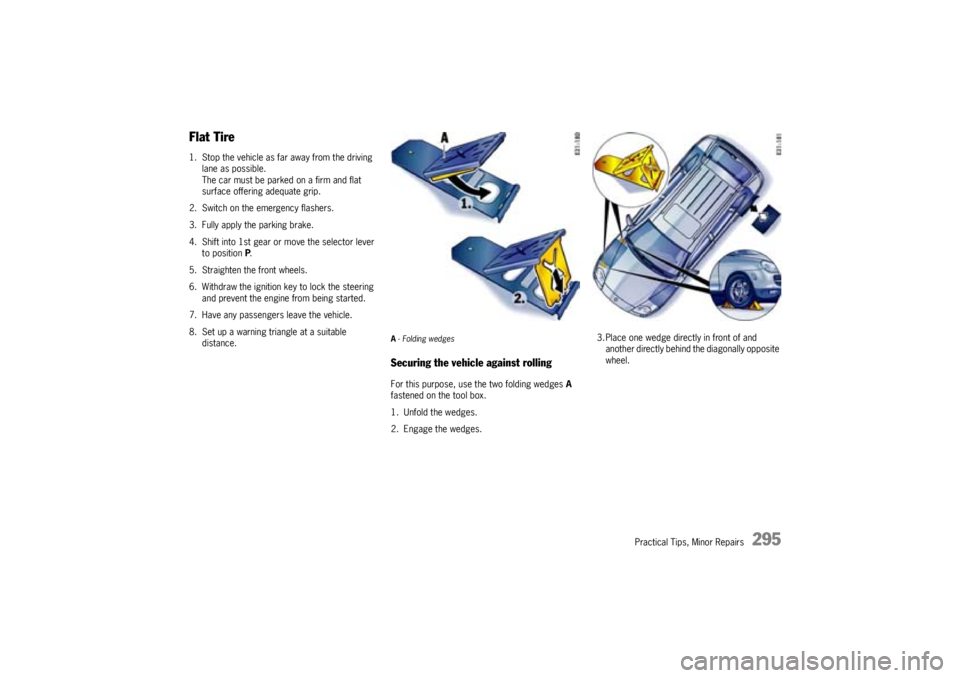
A- Folding wedgesSecuring the vehicle against rollingFor this purpose, use the two folding wedges A
fastened on the tool box.
1. Unfold the wedges.
2. Engage the wedges.3. Place one wedge directly in front of and
another directly behind the diagonally opposite
wheel.
Page 303 of 380
Practical Tips, Minor Repairs
303
Checking tire pressure with a pressure
gauge1. Remove the valve stem cap from the tire.
2. Press the pressure gauge onto the valve stem.
Note on operation
fDo not press too hard or force the valve stem
sideways, or air will escape.
If the sound of air escaping from the tire is
heard, reposition the pressure gauge.
3. Read the tire pressure on the gauge stem and
compare it to the permissble tire pressure.
This information can be found on the tire pres-
sure plate.
Please observe the chapter “TIRE PRES-
SURES, COLD” on Page 361.
4. Remove the pressure gauge.
fPlease observe the chapter “TIRE PRESSURE”
on Page 87.
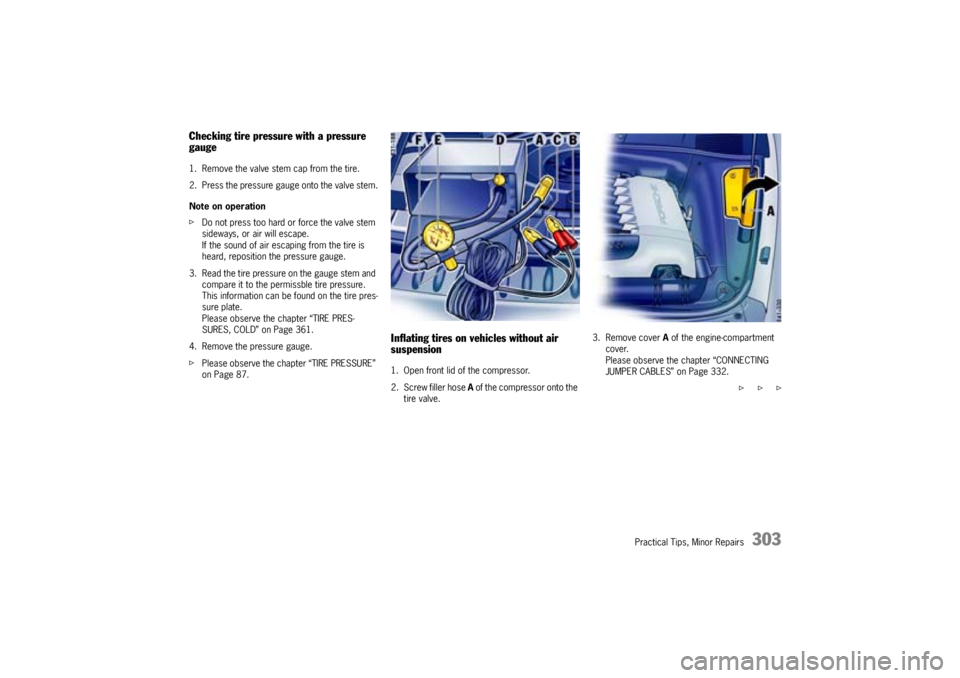
Inflating tires on vehicles without air
suspension1. Open front lid of the compressor.
2. Screw filler hose A of the compressor onto the
tire valve.3. Remove cover A of the engine-compartment
cover.
Please observe the chapter “CONNECTING
JUMPER CABLES” on Page 332.
f f f
Page 310 of 380
310
Practical Tips, Minor Repairs
Electrical SystemIn order to avoid damage and faults in electrical or
electronic systems, electrical accessories should
be installed at your authorized Porsche dealer.
fUse only accessories authorized by Porsche.
Warning!
Risk of short circuit and fire.
Replacing fuses or relays with engine running
or the ignition on could cause electrical
shock.
fDisconnect the battery during all work on the electrical system.
RelaysRelays should be checked or changed only by an
authorized workshop.Alarm system, central lockingThe status of the central locking and alarm system
is not changed by disconnecting the battery.
When the battery is disconnected, the alarm
system ceases to function.
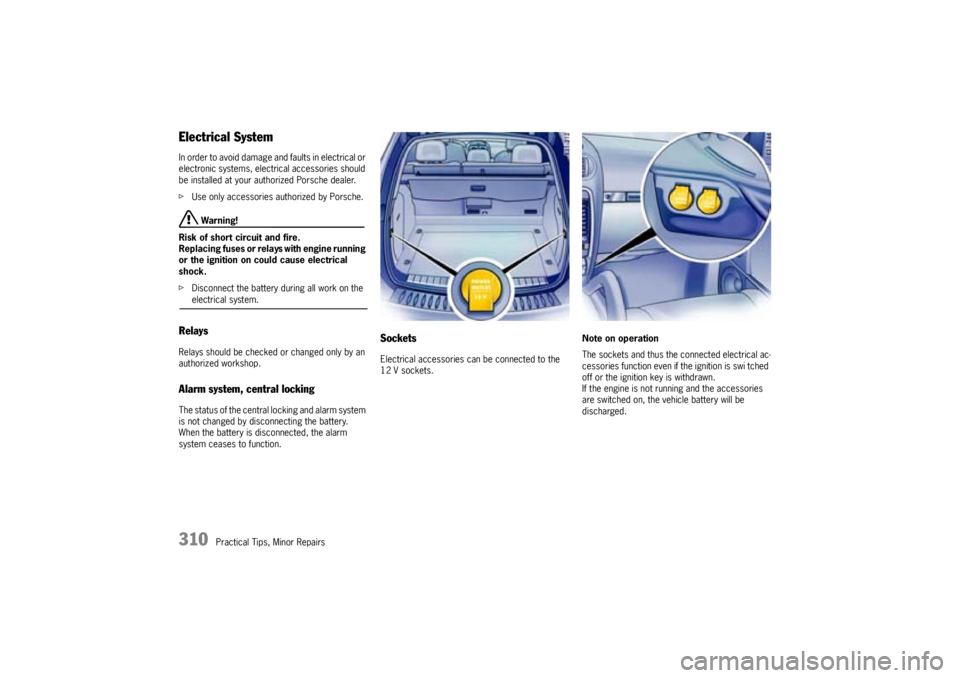
SocketsElectrical accessories can be connected to the
12 V sockets.Note on operation
The sockets and thus the connected electrical ac-
cessories function even if the ignition is swi tched
off or the ignition key is withdrawn.
If the engine is not running and the accessories
are switched on, the vehicle battery will be
discharged.
Page 311 of 380
Practical Tips, Minor Repairs
311
Changing fusesIn order to prevent damage to the electrical
system due to short circuits and overloads, the in-
dividual circuits are protected by fuses.
One fuse box is in the engine compartment. Two
additional fuse boxes are located in the outer ends
of the dashboard.
1. Switch off the consumer with the defective
fuse. Before replacing a fuse, switch off all
electrical consumers and remove the ignition
key.
2. Open the fuse-box lid.
3. Remove the corresponding fuse from its slot to
check it using the plastic gripper.
A blown fuse can be identified by the melted
metal strip.
4. Replace only with fuses of the same rating.
Note
If a fuse blows repeatedly, please consult an au-
thorized Porsche dealer immediately, so that the
short circuit can be located and corrected.
Never try to “repair“ fuses: you may cause serious
damage to other parts of the electrical system.
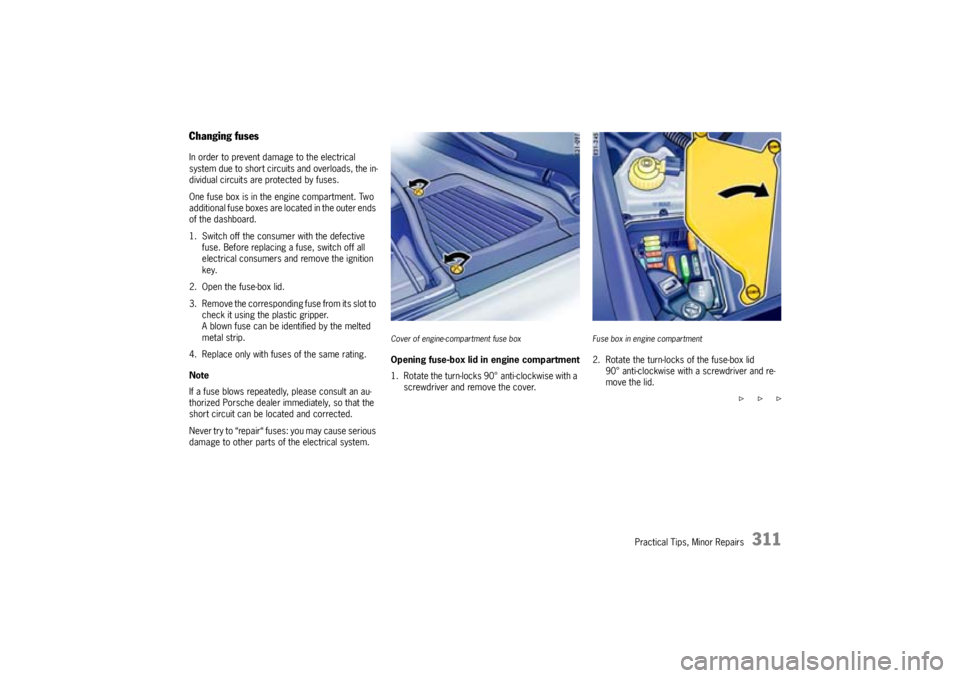
Cover of engine-compartment fuse boxOpening fuse-box lid in engine compartment
1. Rotate the turn-locks 90° anti-clockwise with a
screwdriver and remove the cover.
Fuse box in engine compartment2. Rotate the turn-locks of the fuse-box lid
90° anti-clockwise with a screwdriver and re-
move the lid.
f f f
Page 314 of 380
314
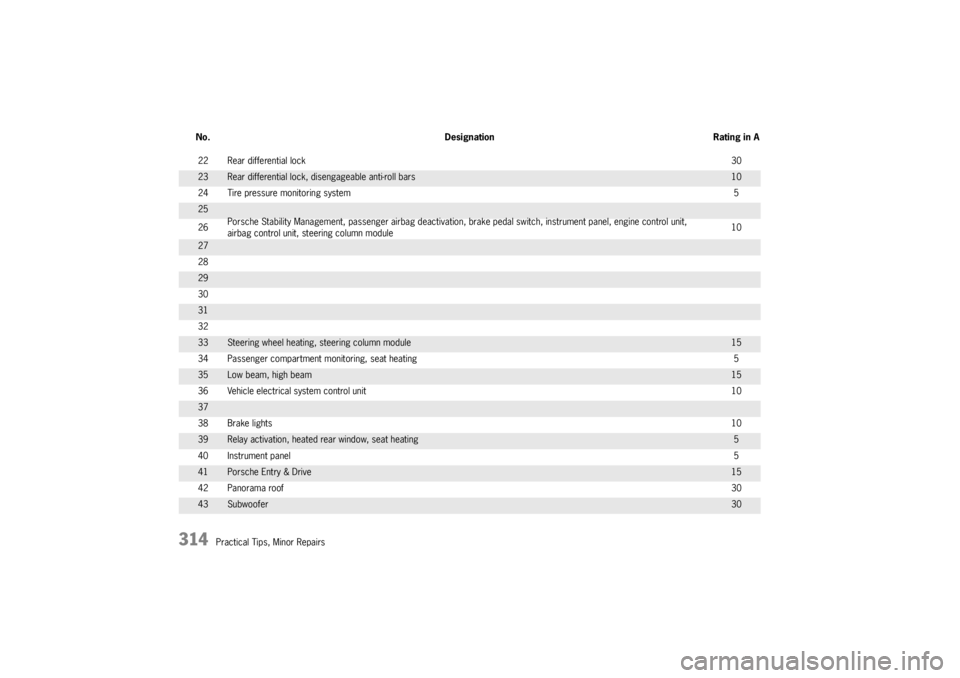
Practical Tips, Minor Repairs 22 Rear differential lock30
23
Rear differential lock, disengageable anti-roll bars
10
24 Tire pressure monitoring system5
2526Porsche Stability Management, passenger airbag deactivation, brake pedal switch, instrument panel, engine control unit,
airbag control unit, steering column module1027282930313233
Steering wheel heating, steering column module
15
34 Passenger compartment monitoring, seat heating5
35
Low beam, high beam
15
36 Vehicle electrical system control unit10
3738 Brake lights1039
Relay activation, heated rear window, seat heating
5
40 Instrument panel5
41
Porsche Entry & Drive
15
42 Panorama roof30
43
Subwoofer
30 No. Designation Rating in A
Page 319 of 380

Practical Tips, Minor Repairs
319
Fuse assignment – fuse box in engine compartmentNote
Use the plastic grippers from the fuse boxes in the dashboard to replace the fuses.No. Designation Rating in A
1
Fan
60
2Fan30
3
Secondary air pump
40
4 Secondary air pump40
567
Fuel injectors, ignition coils
20
8 Fuel injectors, ignition coils20
9
Engine control units
30
10 Engine components: radiator fans, afterrun pump, carbon canister valve, AC pressure sensor, tank leakage diagnosis 10
11
Engine components
15
12 E-box relay, secondary air pumps, afterrun pump relay5
13
Fuel pump
15
14 Fuel pump15
15
Engine control unit, fuel pump
10
17
Oxygen sensors
15
18 Oxygen sensors7,5
Page 320 of 380

320
Practical Tips, Minor Repairs
Battery
Danger!
Risk of short circuit and fire.
fObserve all warning notes on the battery.
fDisconnect the battery during all work on the
electrical system.
fDo not lay tools or other metal objects on the
battery as they could cause a short circuit
across the battery terminal.
Hydrogen gas generated by the battery
could cause an explosion, resulting in severe
personal injuries.
fDo not expose the battery to an open flame,
electrical spark or a lit cigarette.
Risk of explosion
fDo not wipe the battery with a dry cloth.
fBefore touching the battery, discharge any
static electricity by touching the vehicle.
Risk of severe personal injury and damage to
the fabric, metal or paint.
fWear eye protection.
fDo not allow battery acid to come in contact
with your skin, eyes, fabric or painted surfac-
es.fIf you get electrolyte, which is an acid, in your
eyes or on your skin, immediately rinse with
cold water for several minutes and call a doc-
tor.
fSpilled electrolyte must be rinsed off at once
with a solution of baking soda and water to
neutralize the acid.
Battery posts, terminals and related acces-
sories contain lead and lead compounds,
chemicals known to the State of California to
cause cancer and reproductive harm.
fAlways protect your skin by washing thorough-
ly with soap and water.
Charge stateA well charged battery will not only prevent start-
ing problems but will also last longer.
In order to avoid unintended battery
discharge
fSwitch off unnecessary electrical loads in city
traffic, on short trips or in a line of traffic.
fAlways remove the ignition key from the igni-
tion switch when leaving the vehicle or
switch ignition off in vehicles with Porsche En-
try & Drive.
fAvoid using the Porsche Communication
Management system and the audio system
when the engine is not running.
Battery carefEnsure that battery is securely mounted.
fKeep terminals and connections clean and
properly tightened. Corrosion can be prevent-
ed by coating the terminals and connections
with petroleum jelly or silicone spray.
fEnsure that vent caps are securely tightened to
prevent spillage.
Checking the electrolyte fluid level
(only on low-maintenance batteries)
Generally, the electrolyte level must be checked
more often in summer than in the winter, and more
often when driving long distances.
fWhen adding water, use only clean containers.
In no case may alcohol (e.g. window cleaner
residues) be permitted to enter the battery.
fUnscrew and open the filler vent caps of each
cell.
With the car on a level surface, the fluid level
should meet the indicator mark in each cell.
fIf necessary, top up with distilled water. Do not
use acid. Only fill up to the mark, otherwise the
electrolyte will overflow when the battery is be-
ing charged and cause damage.
Page 321 of 380

Practical Tips, Minor Repairs
321
Winter operationDuring the winter months, battery capacity tends
to decrease as temperatures drop. Additionally,
more power is consumed while starting, and the
headlights, heater, rear window defogger, etc.,
are used more frequently.
Let your Porsche dealer test the battery's capaci-
ty before winter sets in.Vehicle storageIf the car stands for long periods in the garage or
workshop, the doors and lids should be closed.
fRemove the ignition key and, if necessary, dis-
connect the battery.
Notes on operation
fWhen the battery is disconnected, the alarm
system ceases to function.
If the vehicle was locked before the battery
was disconnected, the alarm will be triggered
when the battery is reconnected.
To deactivate the alarm system:
fLock the vehicle and unlock it again.Maintenance note
Even if you put your vehicle out of operation, the
battery still discharges.
The battery will discharge more quickly if your ve-
hicle is not driven on a daily basis over a distance
of several miles. The more often you drive your ve-
hicle, and the longer the distance driven on each
trip, the more opportunity the vehicle‘s charging
system will have to recharge the batteries.
fTo preserve its efficiency, charge the battery
about every 6 weeks.
fCheck the battery acid level and top off with
distilled water if necessary.
fStore a battery that has been removed in a
dark, cool place, but not subject to freezing.
Putting vehicle into operationAfter the battery is connected or charged, the
PSM warning light lights up on the instrument pan-
el and a message appears on the multi-purpose
display of the instrument panel to indicate a fault.
This fault can be remedied with a few simple
steps:
1. Start the engine.
To do this, turn the ignition key or the control
unit (on vehicles that have Porsche Entry &
Drive) to ignition lock position 2 twice.2. Perform a few steering movements and drive
a short distance in a straight line until the PSM
warning light goes out and the message is
erased from the memory of the multi-purpose
display of the instrument panel.
3. If the warnings does not go out, then:
Drive carefully to the nearest authorized
Porsche dealer.
Have the fault remedied by an authorized
Porsche dealer.
4. After the warnings disappear:
Stop the vehicle in a suitable place.
5. Perform adaptation of the power windows:
Please observe the chapter “STORING FINAL
POSITION OF THE DOOR WINDOWS” on
Page 31.
6. On vehicles with tire pressure monitoring sys-
tem:
Please observe the chapter “SYSTEM LEAR-
NING PHASE” on Page 89.
f f f
Page 323 of 380
Practical Tips, Minor Repairs
323
Removing and installing battery
Danger!
Danger of explosion and injury and risk of
short circuit and damage to the alternator
and electronic control units.
fHave the battery removed and installed only by
a qualified professional.
fDo not disconnect battery while the engine is
running.
fDisconnect and connect the battery only with
the greatest care. Danger of short circuit and
explosion.
fDo not tilt the battery when removing it.Risk of caustic burns from escaping acid.
The battery is located in the battery box under the
left front seat.
If the battery is completely discharged, the vehicle
must be provided with external power at the jump-
lead starting points so that you can move the seat.
fPlease observe the chapter “EMERGENCY
STARTING WITH JUMPER CABLES” on
Page 331.Maintenance note
The seat mounting bolts must be replaced each
time they are loosened.
The bolts are micro-encapuslated and keep dust
and water out.
If this is not observed, it might not be possible to
attain the prescribed tightening torque of 37 ftlb
(50 Nm).
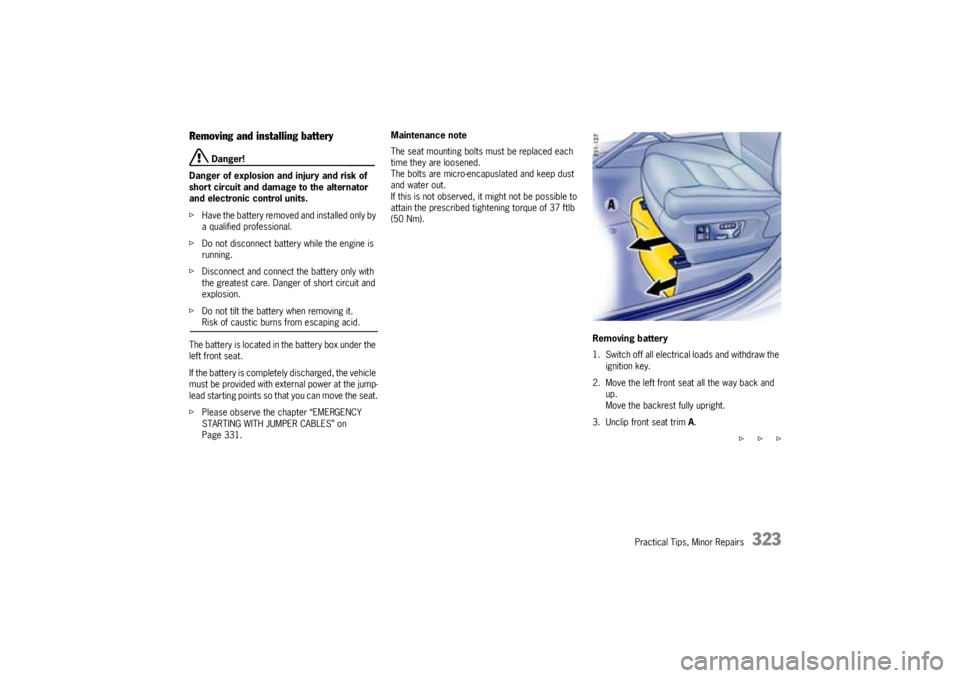
Removing battery
1. Switch off all electrical loads and withdraw the
ignition key.
2. Move the left front seat all the way back and
up.
Move the backrest fully upright.
3. Unclip front seat trim A.
f f f
Page 327 of 380
Practical Tips, Minor Repairs
327
Removing and installing auxiliary battery
Danger!
Danger of explosion and injury and risk of
short circuit and damage to the alternator
and electronic control units.
fHave the battery removed and installed only by
a qualified professional.
fDo not disconnect battery while the engine is
running.
fDisconnect and connect the battery only with
the greatest care. Danger of short circuit and explosion.
Note
The general information contained in the chapter
on the battery applies to the battery under the driv-
er’s seat and the battery in the luggage compart-
ment.
fPlease observe the chapter “CHARGE STATE”
on Page 320.The auxiliary battery is located in the luggage
compartment under the cargo area floor.
Any subwoofers or collapsible spare wheels that
may be in the vehicle must be removed before the
battery is removed.
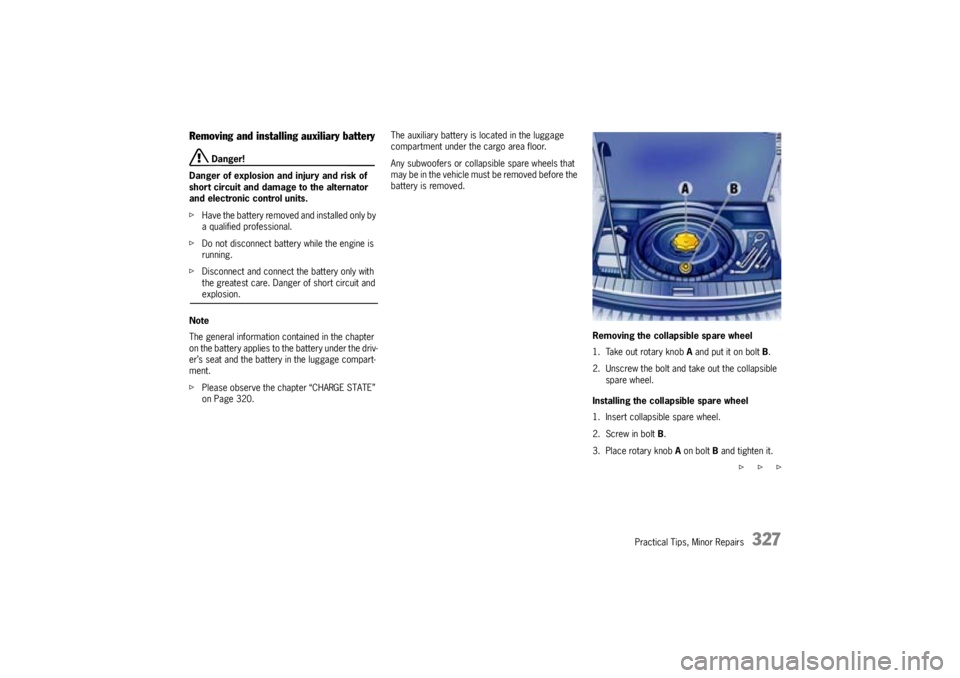
Removing the collapsible spare wheel
1. Take out rotary knob A and put it on bolt B.
2. Unscrew the bolt and take out the collapsible
spare wheel.
Installing the collapsible spare wheel
1. Insert collapsible spare wheel.
2. Screw in bolt B.
3. Place rotary knob A on bolt B and tighten it.
f f f