belt PORSCHE CAYNNE S 2005 1.G User Guide
[x] Cancel search | Manufacturer: PORSCHE, Model Year: 2005, Model line: CAYENNE S, Model: PORSCHE CAYENNE S 2005 1.GPages: 380, PDF Size: 3.17 MB
Page 44 of 380

44
Controls, Safety, Instruments
Fastening the safety beltfAssume a comfortable sitting position.
Adjust the backrest of the front seat so that the
belt always rests on your upper body and runs
across the middle of your shoulder.
fGrasp the belt tongue and pull the belt in a
slow, continuous motion across your chest and
lap.
Note on operation
The belt can be blocked if the vehicle is standing
at an angle or if the belt is pulled out using a jerk-
ing movement.fThe belt cannot be pulled out while accelerat-
ing and slowing down, when cornering and
when driving uphill.
fInsert the belt tongue into the appropriate
buckle on the inboard side of the seat, until it
locks securely with an audible click.
fMake sure that belts are not trapped or twist-
ed, and that they are not rubbing on sharp edg-
es.
fThe horizontal section of the belt should al-
ways fit snugly across the pelvis. Therefore, af-
ter fastening the belt, always pull the diagonal
part of the belt upwards.
Pregnant women should position the belt as
low as possible across the pelvis, and ensure
that it is not pressing against the abdomen.
fPull on the diagonal section of the belt now and
again during the journey to ensure that the
horizontal section remains tight.fMake sure that the belts and buckles fit
correctly on the rear seat bench.
Releasing the safety beltfHold the belt tongue.
fPress the red button (arrow).
fGuide belt tongue to the reel.
Page 45 of 380

Controls, Safety, Instruments
45
Safety belt height adjustmentThe heights of the belt deflectors for the driver’s
seat, passenger’s seat and the outer rear seats
can be adjusted.
Adjust the height of the safety belt so that it runs
across the middle of the shoulder, not against the
neck.
Adjusting belt height manually
fUpward – push belt deflector up.
fDownward – press button Aand move belt de-
flector.Adjusting belt height electrically
fOperate rocker switch B in the desired
direction until the optimal belt adjustment is
reached.
fPlease observe the chapter “FRONT SEAT
WITH MEMORY” on Page 33.
Automatic locking retractorThe safety belts for the passenger and rear seats
are equipped with an automatic locking retractor
for securing the child restraint system. When acti-
vated, this retractor allows you to securely fasten
the child restraint system in place so that inadvert-
ent movements will not occur.
Activating the automatic locking retractor
1. Pull the safety belt retractor completely out. At
this point the locking mechanism is activated.
2. Insert the safety belt tongue into the buckle
and make certain that it is properly latched.
3. Allow the safety belt to retract until it is tight on
the child restraint system. You may further
tighten the belt by pulling on it to allow more of
it to retract.
Releasing the safety belt
1. Unbuckle the safety belt latch.
2. Then make certain that the belt has fully re-
tracted. At this point the automatic locking fea-
ture will be disengaged.
Page 46 of 380
46
Controls, Safety, Instruments
Child Restraint AnchoragesfPlease observe the chapter “AUTOMATIC LO-
CKING RETRACTOR” on Page 45.
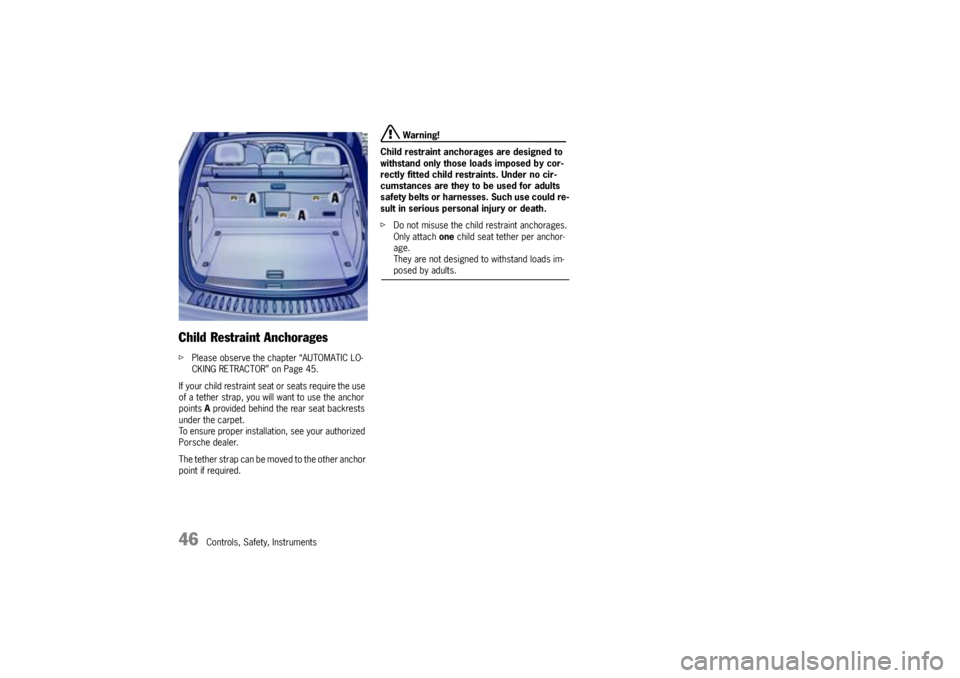
If your child restraint seat or seats require the use
of a tether strap, you will want to use the anchor
pointsA provided behind the rear seat backrests
under the carpet.
To ensure proper installation, see your authorized
Porsche dealer.
The tether strap can be moved to the other anchor
point if required.
Warning!
Child restraint anchorages are designed to
withstand only those loads imposed by cor-
rectly fitted child restraints. Under no cir-
cumstances are they to be used for adults
safety belts or harnesses. Such use could re-
sult in serious personal injury or death.
fDo not misuse the child restraint anchorages.
Only attach one child seat tether per anchor-
age.
They are not designed to withstand loads im-posed by adults.
Page 47 of 380
Controls, Safety, Instruments
47
Child Restraint SystemsPorsche recommends that all infants and children
be restrained in child restraint systems at all times
while the vehicle is in motion in accordance with
applicable laws.
The use of infant or child restraints is required by
law in all 50 states and the Canadian provinces.
The child restraint system should be one that com-
plies with U.S. Federal/Canadian Motor Vehicle
Safety Standards 213 and should be secured by a
lap belt or lap belt portion of a lap-shoulder belt or
for child seats equipped with the LATCH sytem
(LowerAnchorage and Tether for Children, also
known as ISOFIX) to the LATCH anchorages.
A statement by the seat manufacturer of compli-
ance with this standard can be found on the in-
struction label on the restraint and in the instruc-
tion manual provided with the restraint.
Danger!
Risk of serious personal injury or death to the
child.
fFollow all child restraint instructions and warnings in this manual.
– When using an infant or child restraint system,
be sure to follow all manufacturer's instruc-
tions on installation and use.
– Infants and small children should never be held
on the lap, nor should they share a safety belt
with another occupant while the vehicle is in
motion.
– Children too big for child restraint systems
should use regular safety belts. A shoulder belt
can be used providing it does not cross the
face or the neck of the child.
– For maximum safety and protection, do not
use a child restraint system in the front passen-
ger seat.
Danger!
The use of a child restraint system in the
front passenger seat can result in serious
personal injury or death to the child from an
airbag deployment.
To reduce risk of injury from an inflating air-
bag in an accident, Porsche strongly recom-
mends:
fDo not use a child restraint system in the front passenger seat.
fSeek appropriate advice from your authorized
Porsche dealer about the possible installation
of a Porsche child restraint system.
Rearward facing child restraint system:
fUse only in the rear seat. Must not ever be
used in the front seat.
Forward facing child restraint system:
fUse only in the rear seat. Must not ever be
used in the front seat.
Page 49 of 380

Controls, Safety, Instruments
49
Airbag SystemsThe Airbags in combination with the safety belts
makes up a safety system which offers the driver
and the passenger the greatest known protection
from injuries in case of accident.
Even if your vehicle is equipped with airbags, the
safety belts must be worn at all times,
because the front airbag system is only actuated
by frontal collisions with an impact of sufficient se-
verity. Below the actuation threshold of the airbag sys-
tem, and during types of collisions which do not
cause the actuation of the system, the safety belts
provide the primary protection to the occupants
when correctly worn.
Therefore, all persons within the vehicle
must wear safety belts at all times (in many
states, state law requires the use of safety belts).
fPlease observe the chapter “SAFETY BELTS”
on Page 42.
Thefront airbags are located under the padded
steering wheel panel on the driver’s side and, on
the passenger's side, in the dashboard.
Theside airbags for the front seats are installed
on the side in the seat backrests.
Thehead airbags are installed above the doors
in the roof area.
FunctionThe front airbags are triggered during a frontal col-
lision of sufficient force.
In the event of a side impact of corresponding
force, the side airbag on the impact side is
triggered.
The inflation process generates the amount of gas
required to fill the airbags at the necessary pres-
sure in fractions of a second.
Airbags protect the face and upper body, while si-
multaneously damping the motion of the driver
and passenger in the impact direction in the event
of a frontal impact or side impact.
Your vehicle is equipped with a crash sensing and
diagnostic module. This module will record the
use of the seat belt restraint system by the driver
and front passenger when the side airbags and
head airbags are inflated.
f f f
Page 50 of 380
50
Controls, Safety, Instruments Danger!
To provide optimal occupant protection, air-
bags must inflate at very high speed. If you
are not wearing your safety belt or are too
close to the airbag when its deployed, inflat-
ing airbags can result in serious personal in-
jury or death.
fMake sure there are no people, animals or ob-
jects between the driver or passenger and the
area into which the airbag inflates.
fSit back as far from the dashboard or steering
wheel as is practical, while still maintaining full
vehicle control.
fDo not lean against the inside of the doors.
fAlways hold the steering wheel by the outer
rim. Never rest your hands on the airbag panel.
fNever transport heavy or sharp objects on or
in front of the passenger seat.
fAlways keep the lid of the door storage com-
partment closed. Objects must not protrude
out of the door storage compartment.
fGive your passenger all of the information in
this chapter.
fNo changes must be made to the wiring or
components of the airbag system.fDo not add any additional coverings or stickers
to the steering wheel or in the area of the pas-
senger airbag and side airbags. Doing so may
adversely affect the functioning of the airbag
system or cause harm to the occupants if the
airbag system should deploy.
fDo not undertake any wiring for electrical ac-
cessory equipment in the vicinity of the airbag
wiring harnesses. Doing so may disable the air-
bag system or inadvertant inflation.
fIf the warning light comes on, the airbag sys-
tem should be repaired immediately by your
authorized Porsche dealer.
fAlways keep feet in the footwell while driving.
Do not put feet on the dashboard or the seat
area.
Note
Airbag components (e.g. steering wheel, door
trim) may be disassembled only by an authorized
Porsche dealer.
When disposing of a used airbag unit, our safety
instructions must be followed. These instructions
can be obtained at any authorized Porsche dealer.Faults are indicated by a warning light on the ta-
chometer and a message on the instrument
panel’s multi-purpose display.
fPlease observe the chapter “WARNING LIGHTS
AND WARNING MESSAGES” on Page 108.
fIn the following cases you should immedi-
ately consult an authorized Porsche
dealer in order to assure the airbag sys-
tem is functioning properly:
– If the warning light does not light up when the
ignition is switched on or
– If the warning light does not go out once the
engine is running or
– If the warning light appears while driving.
Warning lights and warning
messages
Page 52 of 380

52
Controls, Safety, Instruments
Steering WheelTiptronic rocker switchesThe Porsche Tiptronic is a six-speed transmission
and features an “automatic” and a “manual” gear-
shift mode.
You can change temporarily to manual mode using
rocker switches A on the steering wheel.
fPlease observe the chapter “TIPTRONIC S” on
Page 203.
HornfPress button B to operate the horn.Airbag unitAirbag unit C is located behind the padded steer-
ing wheel boss.
In conjunction with the safety belts, the “airbag” is
a safety system designed to provide the driver and
passengers with maximum protection from injury
in an accident.
fPlease observe the chapter “AIRBAG SYS-
TEMS” on Page 49.
Steering Wheel HeatingIf the interior temperature in the vehicle is lower
than +54°F (+12°C)when the ignition is switched
on, the steering wheel heating is switched on au-
tomatically.
When this happens, the steering wheel adjusts to
a temperature of +73°F (+23°C).
If the interior temperature rises above +71°F
(+22°C) when the vehicle is operational, the steer-
ing wheel heating switches off again.
Page 70 of 380
70
Controls, Safety, Instruments
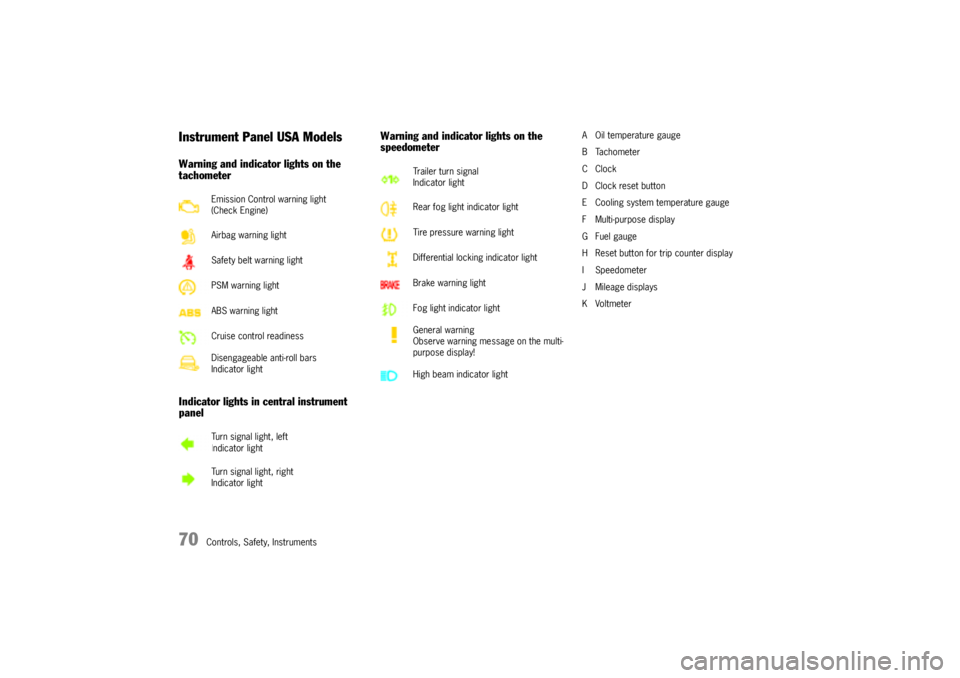
Instrument Panel USA ModelsWarning and indicator lights on the
tachometer
Indicator lights in central instrument
panelWarning and indicator lights on the
speedometer
A Oil temperature gauge
BTachometer
CClock
D Clock reset button
E Cooling system temperature gauge
F Multi-purpose display
G Fuel gauge
H Reset button for trip counter display
I Speedometer
J Mileage displays
KVoltmeter Emission Control warning light
(Check Engine)
Airbag warning light
Safety belt warning light
PSM warning light
ABS warning light
Cruise control readiness
Disengageable anti-roll bars
Indicator light
Turn signal light, left
Indicator light
Turn signal light, right
Indicator light
Trailer turn signal
Indicator light
Rear fog light indicator light
Tire pressure warning light
Differential locking indicator light
Brake warning light
Fog light indicator light
General warning
Observe warning message on the multi-
purpose display!
High beam indicator light
Page 72 of 380
72
Controls, Safety, Instruments
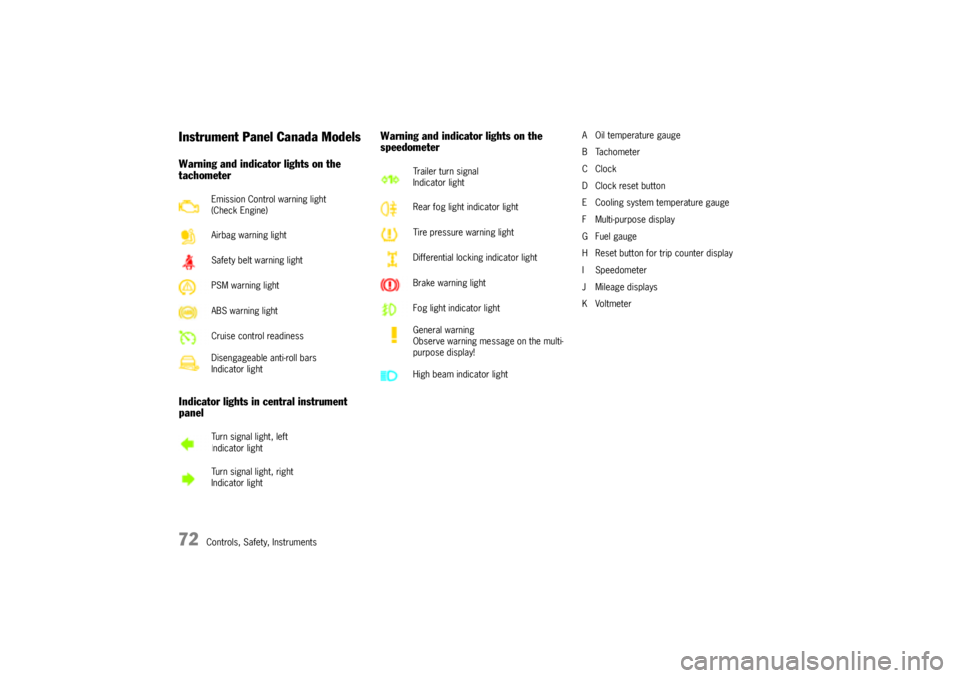
Instrument Panel Canada ModelsWarning and indicator lights on the
tachometer
Indicator lights in central instrument
panelWarning and indicator lights on the
speedometer
A Oil temperature gauge
BTachometer
CClock
D Clock reset button
E Cooling system temperature gauge
F Multi-purpose display
G Fuel gauge
H Reset button for trip counter display
I Speedometer
J Mileage displays
KVoltmeter Emission Control warning light
(Check Engine)
Airbag warning light
Safety belt warning light
PSM warning light
ABS warning light
Cruise control readiness
Disengageable anti-roll bars
Indicator light
Turn signal light, left
Indicator light
Turn signal light, right
Indicator light
Trailer turn signal
Indicator light
Rear fog light indicator light
Tire pressure warning light
Differential locking indicator light
Brake warning light
Fog light indicator light
General warning
Observe warning message on the multi-
purpose display!
High beam indicator light
Page 78 of 380
78
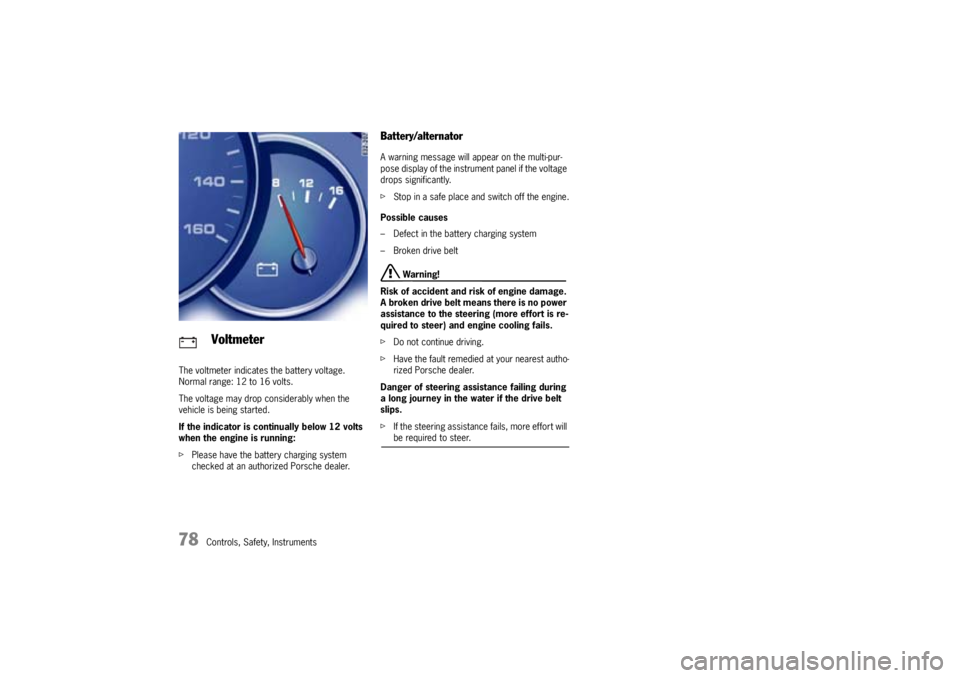
Controls, Safety, Instruments The voltmeter indicates the battery voltage.
Normal range: 12 to 16 volts.
The voltage may drop considerably when the
vehicle is being started.
If the indicator is continually below 12 volts
when the engine is running:
fPlease have the battery charging system
checked at an authorized Porsche dealer.
Battery/alternatorA warning message will appear on the multi-pur-
pose display of the instrument panel if the voltage
drops significantly.
fStop in a safe place and switch off the engine.
Possible causes
– Defect in the battery charging system
– Broken drive belt
Warning!
Risk of accident and risk of engine damage.
A broken drive belt means there is no power
assistance to the steering (more effort is re-
quired to steer) and engine cooling fails.
fDo not continue driving.
fHave the fault remedied at your nearest autho-
rized Porsche dealer.
Danger of steering assistance failing during
a long journey in the water if the drive belt
slips.
fIf the steering assistance fails, more effort will be required to steer.
Voltmeter