differential PORSCHE CAYNNE S 2005 1.G User Guide
[x] Cancel search | Manufacturer: PORSCHE, Model Year: 2005, Model line: CAYENNE S, Model: PORSCHE CAYENNE S 2005 1.GPages: 380, PDF Size: 3.17 MB
Page 228 of 380

228
Shifting Gear, Traction Systems
Driving systems for off-road drivingSpecially adapted driving programs or power-
transmission and running-gear control systems
are available for off-road driving:
– Off-road program Low Range
–Off-road PSM
–Off-road ABS
– Center differential lock
– Rear differential lock
fPlease observe the chapter “POWER-TRANS-
MISSION AND RUNNING-GEAR CONTROL SYS-
TEMS” on Page 217.
Before driving offTires
fCheck tread depth and tire pressure.
fCheck for damage and remove any foreign ob-
jects (e.g. stones) from the tread.
fReplace missing valve caps.
Rims
fReplace dented or damaged rims before
driving off road.
After driving off roadOff-road driving places a greater burden on the ve-
hicle than does normal driving on roads.
We recommend inspecting the vehicle after off-
road driving. Potential damage poses an accident
risk and impairs driving comfort. Damage on the
car is recognised in good time if the car is
checked.
Warning!
Car damage poses an accident risk for the
vehicle occupants and other road users.
fIn cases of doubt, have your vehicle checked
by your authorized Porsche dealer.
fExamine tires for signs of damage such as
cuts, tears, bulges or foreign objects stuck in
the tread. Replace a damaged tire if neces-
sary.
fHave any damage to your vehicle repaired by an authorized Porsche dealer without delay.
Page 230 of 380

230
Shifting Gear, Traction Systems
Uphill driving
Danger!
Danger of serious personal injury or death
and risk of damage if the vehicle should
overturn.
fDo not turn around when driving uphill.
fIf it is not possible to climb a gradient, the car
must be backed down in reverse gear.
fDo not drive over embankments or slopes at
an angle to the line of maximum gradient.
fIf the vehicle starts to tilt, immediately steer in
the direction of the tilt (line of slope).
fWhen driving uphill, never let the vehicle roll
backward when in idle or not in gear.
Exclusive use of the footbrake is too risky in such situations.Note on operation
fActivate Low Range before taking extreme up-
ward or downward gradients.
Tips on driving
fDo not perform manual gear changes when
driving, and try to avoid stopping.
fAvoid high engine speeds (max. 2,500 rpm).
Traction on uphill slopesNote on operation
fActivate Low Range and engage differential
locks if necessary.
Tips on driving
fWhen driving uphill, go easy on the accelerator
and make sure that wheels have sufficient trac-
tion (don't spin).
fAvoid high engine speeds (max. 2,500 rpm).
fDrive slowly.
Page 233 of 380

Shifting Gear, Traction Systems
233
Tips on driving
fAvoid high engine speeds (max. 2,500 rpm).
fDo not perform manual gear changes when
driving, and try to avoid stopping.
Moving off in the water can be difficult due to
the high resistance and the loose surface in-
volved.
fStart the water crossing at a shallow place at
walking speed.
fAfter checking the body of water, take the
shortest path through it.
fNever drive into the water at high speed. The
resulting “bow wave” could damage the engine
and its accessories.
fAdjust your driving style to the unfamiliar sur-
roundings.
fCross the body of water slowly and at a con-
stant speed.
fNever turn around when crossing a body of wa-
ter.
fIf it is not possible to cross the body of water,
the car must be backed out of it in reverse
gear.
The servo pump and alternator can fail if the car is
driven through water for an extended period.
fIf the servo pump fails, substantially more
force will have to be exerted in order to steer. Maintenance note
The car requires a special check after the water
crossing.
fRemove mud from the tire tread.
fBriefly brake the brakes dry after driving
through the water.
HumpsfPlease observe the chapter “GROUND CLEA-
RANCE” on Page 366.
Note on operation
fActivate Low Range and engage differential
locks if necessary.
Tips on driving
fJust before reaching the hump, ease off the ac-
celerator slightly and use the car's momentum
to cross the hump. This will prevent the car
from jumping over the hump and landing on the
following downward slope at an excessive
speed.
fAvoid high engine speeds (max. 2,500 rpm).
Page 234 of 380
234
Shifting Gear, Traction Systems
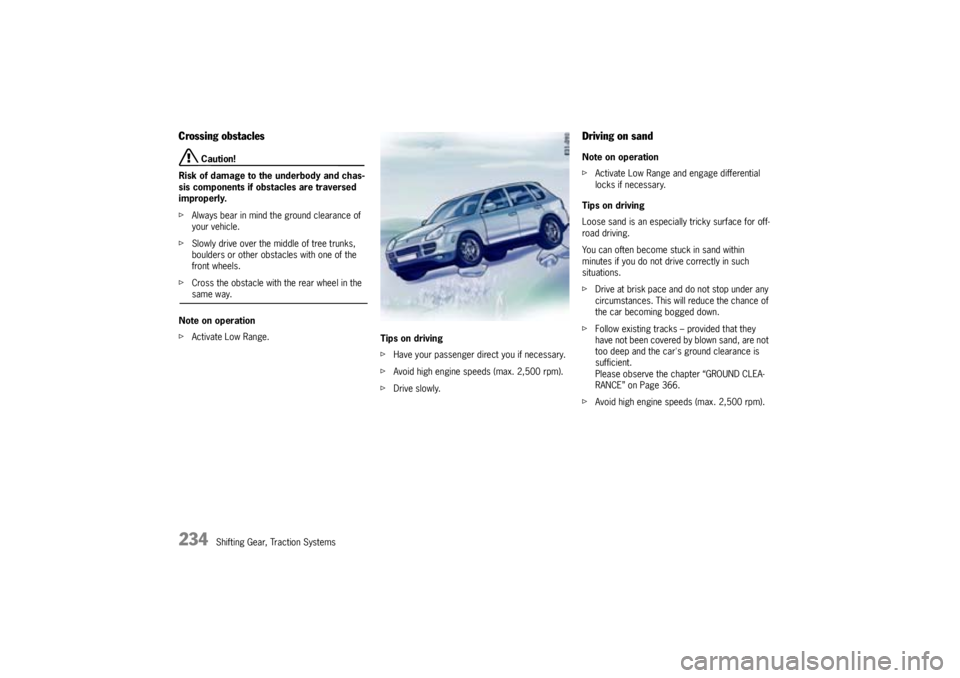
Crossing obstacles
Caution!
Risk of damage to the underbody and chas-
sis components if obstacles are traversed
improperly.
fAlways bear in mind the ground clearance of
your vehicle.
fSlowly drive over the middle of tree trunks,
boulders or other obstacles with one of the
front wheels.
fCross the obstacle with the rear wheel in the same way.
Note on operation
fActivate Low Range.
Tips on driving
fHave your passenger direct you if necessary.
fAvoid high engine speeds (max. 2,500 rpm).
fDrive slowly.
Driving on sandNote on operation
fActivate Low Range and engage differential
locks if necessary.
Tips on driving
Loose sand is an especially tricky surface for off-
road driving.
You can often become stuck in sand within
minutes if you do not drive correctly in such
situations.
fDrive at brisk pace and do not stop under any
circumstances. This will reduce the chance of
the car becoming bogged down.
fFollow existing tracks – provided that they
have not been covered by blown sand, are not
too deep and the car's ground clearance is
sufficient.
Please observe the chapter “GROUND CLEA-
RANCE” on Page 366.
fAvoid high engine speeds (max. 2,500 rpm).
Page 235 of 380

Shifting Gear, Traction Systems
235
When driving on slopes with soft sand on vehicles
with Tiptronic S:
fUse the manual select mode M in addition to
the Low Range program.
If your vehicle becomes stuck nevertheless:
Do not spin the wheels. Instead, use branches,
mats or similar items to provide adequate traction
so that you can drive out of the critical area.
Track rutsOther vehicles leave ruts in many off-road courses
or gravel roads.
fPlease observe the chapter “GROUND CLEA-
RANCE” on Page 366.
Caution!
Risk of damage to the vehicle floor when
driving through ruts that are too deep.
fAlways bear in mind the car's ground clear-
ance.
fDo not drive over ruts that are too deep.
Note on operation
fActivate Low Range and engage differential
locks if necessary.
Tips on driving
fIn cases of doubt, drive with one wheel on the
strip of grass.
fAvoid high engine speeds (max. 2,500 rpm).
fDrive slowly.
Page 314 of 380
314
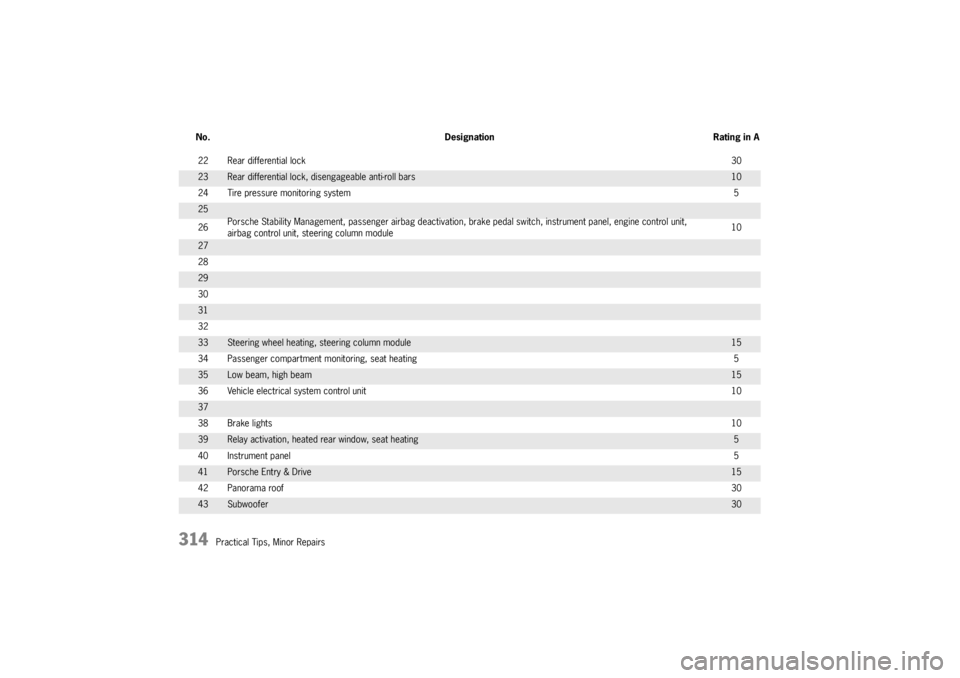
Practical Tips, Minor Repairs 22 Rear differential lock30
23
Rear differential lock, disengageable anti-roll bars
10
24 Tire pressure monitoring system5
2526Porsche Stability Management, passenger airbag deactivation, brake pedal switch, instrument panel, engine control unit,
airbag control unit, steering column module1027282930313233
Steering wheel heating, steering column module
15
34 Passenger compartment monitoring, seat heating5
35
Low beam, high beam
15
36 Vehicle electrical system control unit10
3738 Brake lights1039
Relay activation, heated rear window, seat heating
5
40 Instrument panel5
41
Porsche Entry & Drive
15
42 Panorama roof30
43
Subwoofer
30 No. Designation Rating in A
Page 315 of 380
Practical Tips, Minor Repairs
315
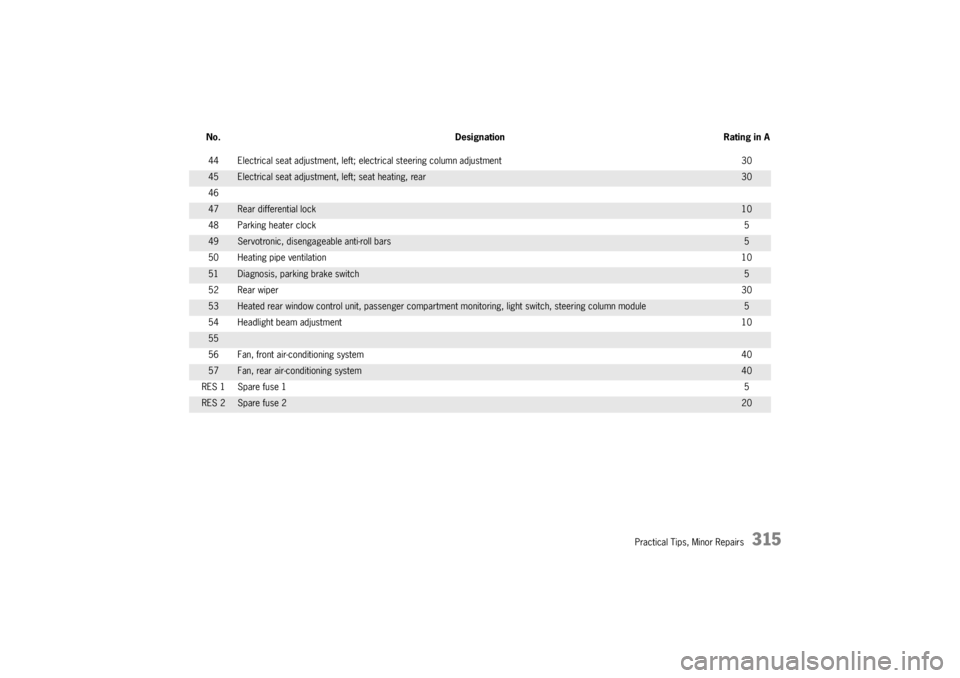
44 Electrical seat adjustment, left; electrical steering column adjustment 3045
Electrical seat adjustment, left; seat heating, rear
30
46
47
Rear differential lock
10
48 Parking heater clock5
49
Servotronic, disengageable anti-roll bars
5
50 Heating pipe ventilation10
51
Diagnosis, parking brake switch
5
52 Rear wiper30
53
Heated rear window control unit, passenger compartment monitoring, light switch, steering column module
5
54 Headlight beam adjustment10
5556 Fan, front air-conditioning system4057
Fan, rear air-conditioning system
40
RES 1 Spare fuse 15
RES 2
Spare fuse 2
20 No. Designation Rating in A
Page 316 of 380
316
Practical Tips, Minor Repairs
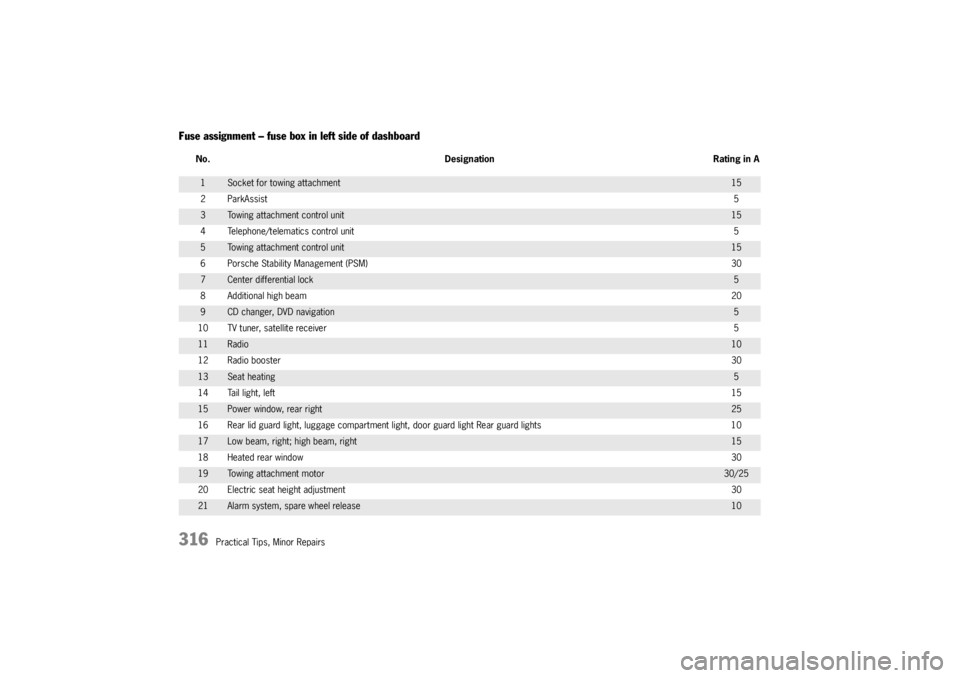
Fuse assignment – fuse box in left side of dashboard
No. Designation Rating in A1
Socket for towing attachment
15
2 ParkAssist5
3
Towing attachment control unit
15
4 Telephone/telematics control unit5
5
Towing attachment control unit
15
6 Porsche Stability Management (PSM)30
7
Center differential lock
5
8 Additional high beam20
9
CD changer, DVD navigation
5
10 TV tuner, satellite receiver5
11
Radio
10
12 Radio booster30
13
Seat heating
5
14 Tail light, left15
15
Power window, rear right
25
16 Rear lid guard light, luggage compartment light, door guard light Rear guard lights 10
17
Low beam, right; high beam, right
15
18 Heated rear window30
19
Towing attachment motor
30/25
20 Electric seat height adjustment30
21
Alarm system, spare wheel release
10
Page 317 of 380
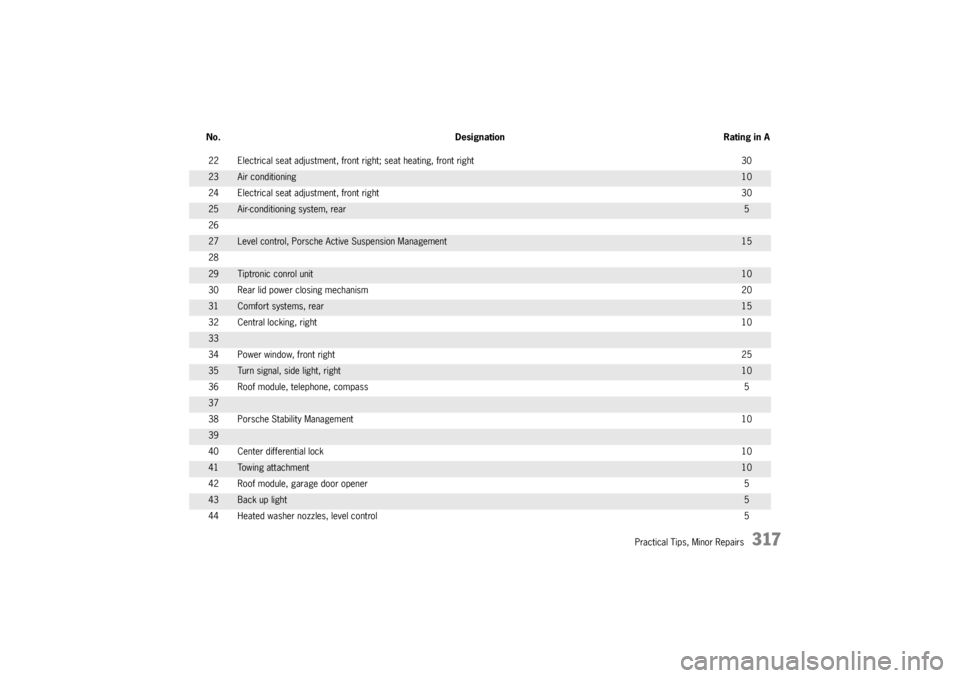
Practical Tips, Minor Repairs
317
22 Electrical seat adjustment, front right; seat heating, front right 3023
Air conditioning
10
24 Electrical seat adjustment, front right30
25
Air-conditioning system, rear
5
26
27
Level control, Porsche Active Suspension Management
15
28
29
Tiptronic conrol unit
10
30 Rear lid power closing mechanism20
31
Comfort systems, rear
15
32 Central locking, right10
3334 Power window, front right2535
Turn signal, side light, right
10
36 Roof module, telephone, compass5
3738 Porsche Stability Management103940 Center differential lock1041
Towing attachment
10
42 Roof module, garage door opener5
43
Back up light
5
44 Heated washer nozzles, level control5 No. Designation Rating in A
Page 318 of 380

318
Practical Tips, Minor Repairs
454647
Telephone preparation
10
48 Level control, Porsche Active Suspension Management10
49
Telephone, automatic anti-dazzle mirror
5
50 ParkAssist5
51
Tiptronic
20
52 Tiptronic5
53
Windscreen relay
30
54 Windscreen relay30
5556 Porsche Stability Management4057
Center differential lock, Low Range
40
RES 1 Spare fuse 110
RES 2
Spare fuse 2
30 No. Designation Rating in A