differential PORSCHE CAYNNE S 2005 1.G Owners Manual
[x] Cancel search | Manufacturer: PORSCHE, Model Year: 2005, Model line: CAYENNE S, Model: PORSCHE CAYENNE S 2005 1.GPages: 380, PDF Size: 3.17 MB
Page 70 of 380

70
Controls, Safety, Instruments
Instrument Panel USA ModelsWarning and indicator lights on the
tachometer
Indicator lights in central instrument
panelWarning and indicator lights on the
speedometer
A Oil temperature gauge
BTachometer
CClock
D Clock reset button
E Cooling system temperature gauge
F Multi-purpose display
G Fuel gauge
H Reset button for trip counter display
I Speedometer
J Mileage displays
KVoltmeter Emission Control warning light
(Check Engine)
Airbag warning light
Safety belt warning light
PSM warning light
ABS warning light
Cruise control readiness
Disengageable anti-roll bars
Indicator light
Turn signal light, left
Indicator light
Turn signal light, right
Indicator light
Trailer turn signal
Indicator light
Rear fog light indicator light
Tire pressure warning light
Differential locking indicator light
Brake warning light
Fog light indicator light
General warning
Observe warning message on the multi-
purpose display!
High beam indicator light
Page 72 of 380

72
Controls, Safety, Instruments
Instrument Panel Canada ModelsWarning and indicator lights on the
tachometer
Indicator lights in central instrument
panelWarning and indicator lights on the
speedometer
A Oil temperature gauge
BTachometer
CClock
D Clock reset button
E Cooling system temperature gauge
F Multi-purpose display
G Fuel gauge
H Reset button for trip counter display
I Speedometer
J Mileage displays
KVoltmeter Emission Control warning light
(Check Engine)
Airbag warning light
Safety belt warning light
PSM warning light
ABS warning light
Cruise control readiness
Disengageable anti-roll bars
Indicator light
Turn signal light, left
Indicator light
Turn signal light, right
Indicator light
Trailer turn signal
Indicator light
Rear fog light indicator light
Tire pressure warning light
Differential locking indicator light
Brake warning light
Fog light indicator light
General warning
Observe warning message on the multi-
purpose display!
High beam indicator light
Page 211 of 380
Shifting Gear, Traction Systems
211
Driving Programs for On-Road and
Off-Road DrivingTwo different driving programs with special power-
transmission and running-gear control systems
(such as ABS, off-road ABS and PSM, etc.) are pro-
vided in your Porsche, with the aim of realising the
best possible driving dynamics combined with
maximum safety.
All control systems meet these requirements for
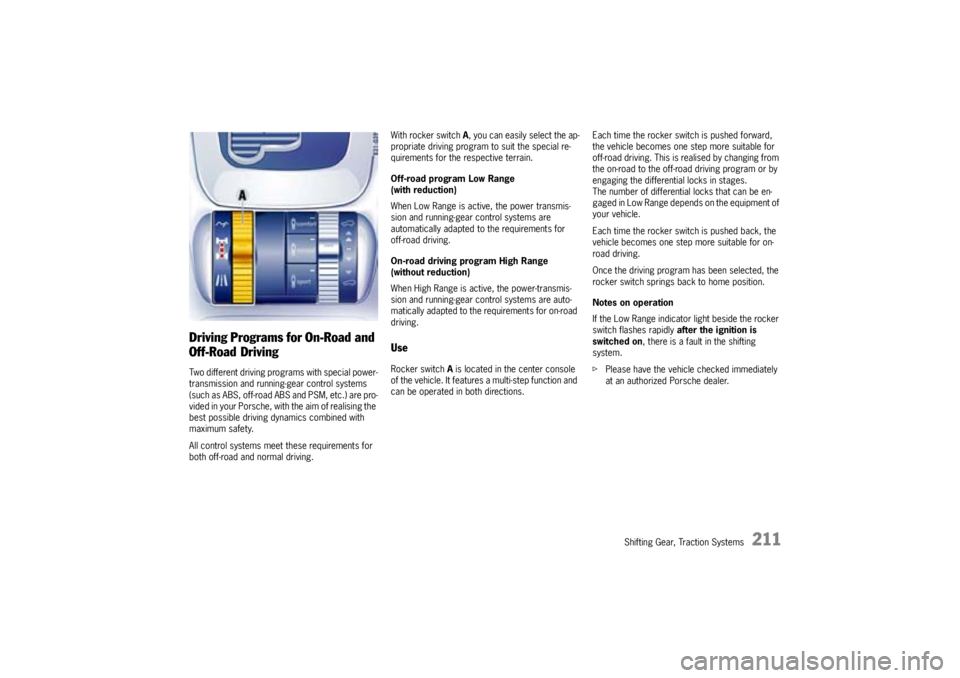
both off-road and normal driving.With rocker switch A, you can easily select the ap-
propriate driving program to suit the special re-
quirements for the respective terrain.
Off-road program Low Range
(with reduction)
When Low Range is active, the power transmis-
sion and running-gear control systems are
automatically adapted to the requirements for
off-road driving.
On-road driving program High Range
(without reduction)
When High Range is active, the power-transmis-
sion and running-gear control systems are auto-
matically adapted to the requirements for on-road
driving.
UseRocker switch A is located in the center console
of the vehicle. It features a multi-step function and
can be operated in both directions. Each time the rocker switch is pushed forward,
the vehicle becomes one step more suitable for
off-road driving. This is realised by changing from
the on-road to the off-road driving program or by
engaging the differential locks in stages.
The number of differential locks that can be en-
gaged in Low Range depends on the equipment of
your vehicle.
Each time the rocker switch is pushed back, the
vehicle becomes one step more suitable for on-
road driving.
Once the driving program has been selected, the
rocker switch springs back to home position.
Notes on operation
If the Low Range indicator light beside the rocker
switch flashes rapidly after the ignition is
switched on, there is a fault in the shifting
system.
fPlease have the vehicle checked immediately
at an authorized Porsche dealer.
Page 213 of 380
Shifting Gear, Traction Systems
213
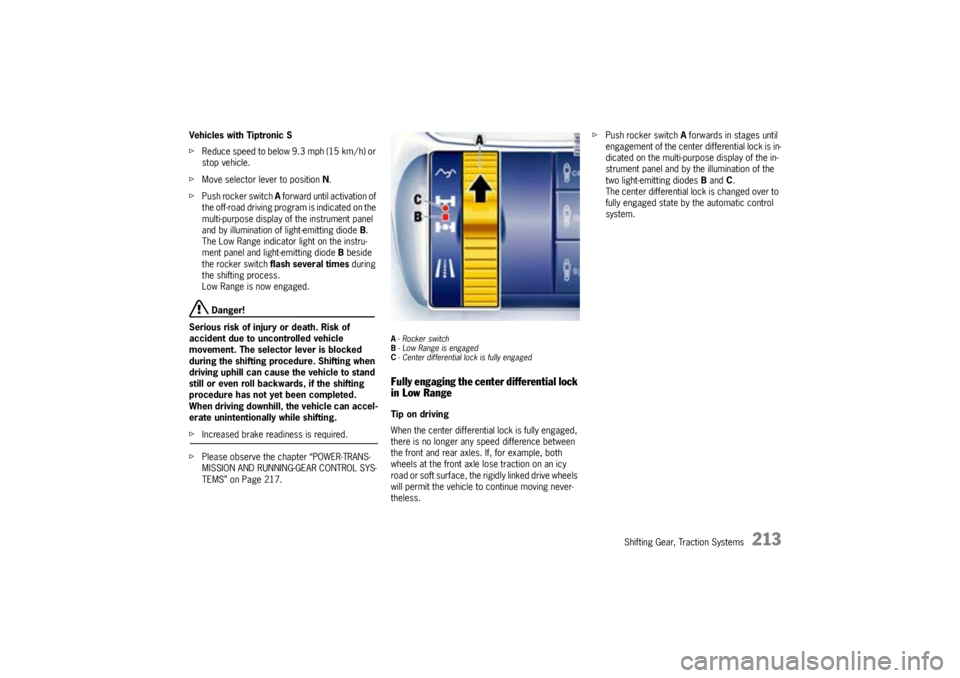
Vehicles with Tiptronic S
fReduce speed to below 9.3 mph (15 km / h) or
stop vehicle.
fMove selector lever to position N.
fPush rocker switch A forward until activation of
the off-road driving program is indicated on the
multi-purpose display of the instrument panel
and by illumination of light-emitting diodeB.
The Low Range indicator light on the instru-
ment panel and light-emitting diode B beside
the rocker switch flash several times during
the shifting process.
Low Range is now engaged.
Danger!
Serious risk of injury or death. Risk of
accident due to uncontrolled vehicle
movement. The selector lever is blocked
during the shifting procedure. Shifting when
driving uphill can cause the vehicle to stand
still or even roll backwards, if the shifting
procedure has not yet been completed.
When driving downhill, the vehicle can accel-
erate unintentionally while shifting.
fIncreased brake readiness is required.
fPlease observe the chapter “POWER-TRANS-
MISSION AND RUNNING-GEAR CONTROL SYS-
TEMS” on Page 217.
A- Rocker switch
B- Low Range is engaged
C- Center differential lock is fully engagedFully engaging the center differential lock
in Low RangeTip on driving
When the center differential lock is fully engaged,
there is no longer any speed difference between
the front and rear axles. If, for example, both
wheels at the front axle lose traction on an icy
road or soft surface, the rigidly linked drive wheels
will permit the vehicle to continue moving never-
theless.fPush rocker switch A forwards in stages until
engagement of the center differential lock is in-
dicated on the multi-purpose display of the in-
strument panel and by the illumination of the
two light-emitting diodes Band C.
The center differential lock is changed over to
fully engaged state by the automatic control
system.
Page 214 of 380
214
Shifting Gear, Traction Systems
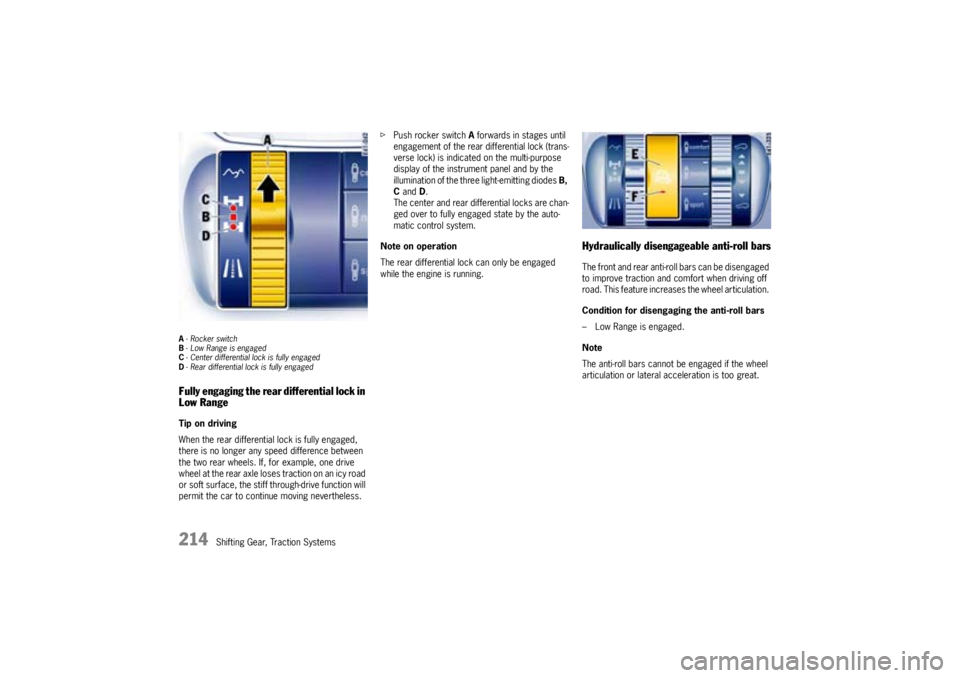
A- Rocker switch
B-Low Range is engaged
C- Center differential lock is fully engaged
D- Rear differential lock is fully engagedFully engaging the rear differential lock in
Low RangeTip on driving
When the rear differential lock is fully engaged,
there is no longer any speed difference between
the two rear wheels. If, for example, one drive
wheel at the rear axle loses traction on an icy road
or soft surface, the stiff through-drive function will
permit the car to continue moving nevertheless.fPush rocker switch A forwards in stages until
engagement of the rear differential lock (trans-
verse lock) is indicated on the multi-purpose
display of the instrument panel and by the
illumination of the three light-emitting diodes B,
Cand D.
The center and rear differential locks are chan-
ged over to fully engaged state by the auto-
matic control system.
Note on operation
The rear differential lock can only be engaged
while the engine is running.
Hydraulically disengageable anti-roll barsThe front and rear anti-roll bars can be disengaged
to improve traction and comfort when driving off
road. This feature increases the wheel articulation.
Condition for disengaging the anti-roll bars
– Low Range is engaged.
Note
The anti-roll bars cannot be engaged if the wheel
articulation or lateral acceleration is too great.
Page 217 of 380

Shifting Gear, Traction Systems
217
Power-Transmission and Running-Gear Control SystemsA complex interconnection of all control systems acting in power transmission and in the running gear has been realised in your Porsche.
All control systems have been linked with the aim of combining the best possible driving performance with maximum safety.
The following systems are involved:
System/designation Scope
PTM
Porsche Traction Management– Full-time all-wheel drive
– Electronically controlled center differential lock
– Automatic brake differential (ABD)
– Traction control system (TCS)
– Reduction gear/Low Range
PTM Plus
Porsche Traction ManagementIn addition to the PTM features, PTM Plus also includes:
– Electronically controlled rear differential lock
– Hydraulically disengageable anti-roll bars
PSM
Porsche Stability Management– Stability management system
– Anti-lock brake system (ABS)
– Traction control system (TCS)
– Automatic brake differential (ABD)
– Engine drag torque control (MSR)
Air suspension
with level control and height adjustment– Fully load bearing air spring struts with integral shock absorbers
– Air supply system with pressure accumulator
PAS M
Porsche Active Suspension Management– Shock absorber system with adaptive, continuous shock absorber control
Page 218 of 380

218
Shifting Gear, Traction Systems
Porsche Traction Management (PTM)Porsche Traction Management is a full-time all-
wheel control system designed to influence the
longitudinal and lateral dynamics. It is closely
linked with the Porsche Stability Management
(PSM) system:
PTM ensures the best possible power distribution
to the four driven wheels at the front and rear ax-
les. The system realises this optimal traction by in-
tervening in the lock control function of the trans-
fer case and rear differential. PTM is active at all
times and, unlike the PSM, cannot be switched off.Advantages of PTM
– Obvious improvement in traction, driving stabil-
ity and steering ability of the car.
– Vehicle is more manageable when driven at its
performance limits.
– Improved straight-ahead tracking and stability.
– The aforementioned features allow for a sport-
ier setup of the running gear.
– The TCS and ABD provide even better traction
for all wheels.
Safety notes!
In spite of the advantages of PTM, it is still the driv-
er’s responsibility to adapt his driving style and
maneuvres in line with road and weather condi-
tions, as well as the traffic situation.
The increased safety that is provided should not in-
duce you to take greater risks with your safety.
The limits set by the physics of driving cannot be
overcome, even with PTM.
Risks of accident due to inappropriate speed
cannot be reduced by PTM.
Page 219 of 380

Shifting Gear, Traction Systems
219
Full-time all-wheel drive
With the four-wheel drive, the drive power is vari-
ably distributed to the front and rear wheels.
Power distribution and wheel speed compensation
between the front and rear axles is realised with a
transfer box.
Distribution of the drive power depends on the
wheel speed difference between the two axles.
The transfer box always controls power distribu-
tion in such a way that optimal propulsion is
achieved, even on an unfavorable road surface.
Full-time four-wheel drive ensures optimal handling
and great stability.
Safety notes!
In spite of the advantages of four-wheel drive, it is
still the driver’s responsibility to adapt his driving
style and maneuvers in line with road and weather
conditions, as well as the traffic situation.
The increased safety that is provided should not in-
duce you to take greater risks with your safety.
The limits set by the physics of driving cannot be
overcome, even with four-wheel drive.
Risks of accident due to inappropriate speed can-
not be reduced by four-wheel drive.Automatic brake differential (ABD)
The ABD system controls the front and rear axles
separately. If one wheel of an axle starts to spin,
it is braked so that the other wheel on the same
axle can be driven.
The ABD recognises different driving states, and it
features control strategies adapted to these
states. In situations in which little propulsive power
is required, such as when the car moves off on a
level gravel surface, traction control already be-
comes active at low engine speeds. If great
propulsive power is required, e.g. when moving off
on an uphill slope or for rapid acceleration, the
ABD is adapted accordingly.
A special off-road program is used in Low Range
mode.Traction control system (TCS)
The traction control system prevents the wheels
from spinning by adjusting the engine power,
thereby ensuring good lane-holding ability and a
stable driving behavior.
Page 221 of 380

Shifting Gear, Traction Systems
221
The events below inform the driver of PSM control
operations and warn him to adapt his driving style
to the road conditions:
– The information light in the instrument panel
lights up.
– Hydraulic noises can be heard.
– The vehicle decelerates and steering-wheel
forces are altered as the PSM controls the
brakes.
– Reduced engine power.
– The brake pedal pulsates and its position is
changed during braking.
However, it is possible at any time to achieve
full vehicle deceleration by increasing the foot
pressure slightly.
Examples of PSM control operations
–Vehicle understeers:
If the front wheels of the vehicle drift on a
bend, engine power is reduced and the rear
wheel on the inside of the bend is braked if
necessary.
–Vehicle oversteers:
If the rear of the vehicle swings out on a bend,
the front wheel on the outside of the bend is
braked.Combined use of PSM and PTM/PTM Plus
In order to ensure optimal stabilisation of the
vehicle, the center differential lock (PTM) and
possibly the rear differential lock (PTM Plus) are
also opened when PSM interventions occur.
Tip on driving
When PSM is switched off, wheel-specific brake
interventions and the traction control system
(TCS) are also inactive.
The automatic brake differential (ABD) remains on.Off-road PSM
(PSM in Low Range program)
When Low Range is active, an off-road PSM
specially matched to off-road driving is activated
to enhance traction.
At a speed below 22 mph (35 km/h), the terrain
PSM intervenes later if the vehicle should under-
steer and thereby improves steerability in Low
Range.
If the brakes are highly stressed, the automatic
brake differential (ABD) switches itself off to
protect the brakes. It remains deactivated until the
brake system has cooled sufficiently.
Engine drag torque control
In conditions of excessive slip, the engine drag
torque control system prevents all driven wheels
from locking up when the car is overrunning. This
is also the case for downshifts on a slippery road.
Page 222 of 380
222
Shifting Gear, Traction Systems
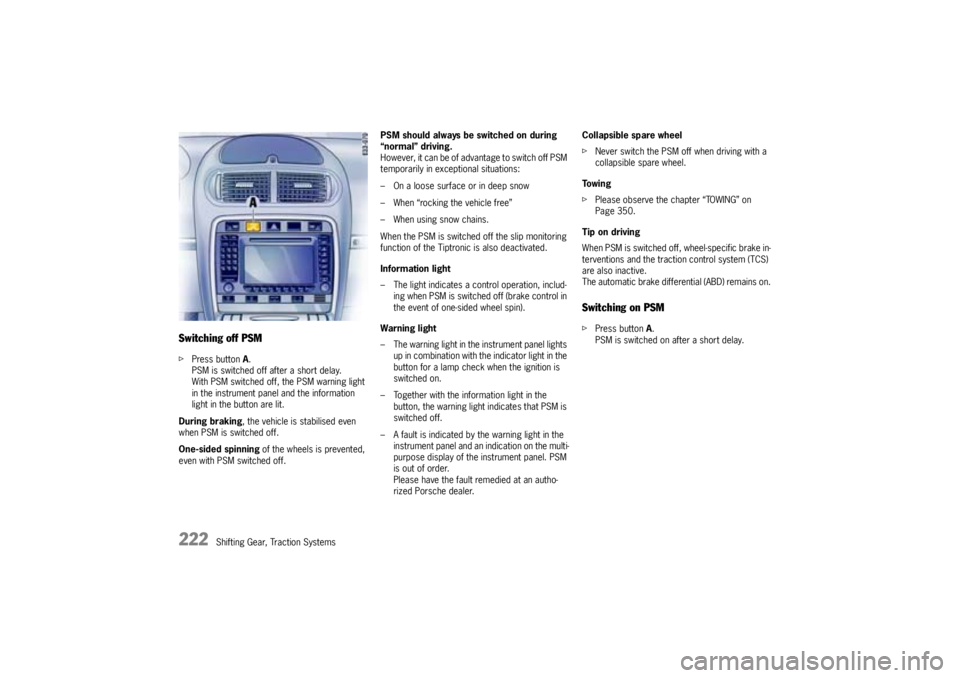
Switching off PSMfPress button A.
PSM is switched off after a short delay.
With PSM switched off, the PSM warning light
in the instrument panel and the information
light in the button are lit.
During braking, the vehicle is stabilised even
when PSM is switched off.
One-sided spinning of the wheels is prevented,
even with PSM switched off.PSM should always be switched on during
“normal” driving.
H o w e v e r, i t c a n b e o f a d v a n t a g e t o s w i t c h o f f P S M
temporarily in exceptional situations:
– On a loose surface or in deep snow
– When “rocking the vehicle free”
– When using snow chains.
When the PSM is switched off the slip monitoring
function of the Tiptronic is also deactivated.
Information light
– The light indicates a control operation, includ-
ing when PSM is switched off (brake control in
the event of one-sided wheel spin).
Warning light
– The warning light in the instrument panel lights
up in combination with the indicator light in the
button for a lamp check when the ignition is
switched on.
– Together with the information light in the
button, the warning light indicates that PSM is
switched off.
– A fault is indicated by the warning light in the
instrument panel and an indication on the multi-
purpose display of the instrument panel. PSM
is out of order.
Please have the fault remedied at an autho-
rized Porsche dealer.Collapsible spare wheel
fNever switch the PSM off when driving with a
collapsible spare wheel.
To w i n g
fPlease observe the chapter “TOWING” on
Page 350.
Tip on driving
When PSM is switched off, wheel-specific brake in-
terventions and the traction control system (TCS)
are also inactive.
The automatic brake differential (ABD) remains on.
Switching on PSMfPress button A.
PSM is switched on after a short delay.