engine PORSCHE CAYNNE S 2005 1.G User Guide
[x] Cancel search | Manufacturer: PORSCHE, Model Year: 2005, Model line: CAYENNE S, Model: PORSCHE CAYENNE S 2005 1.GPages: 380, PDF Size: 3.17 MB
Page 16 of 380

16
Controls, Safety, Instruments
Never invite car theft!An unlocked car with the key in the ignition lock in-
vites car theft.
A steering wheel lock and a gong alarm are stan-
dard equipment in your Porsche. The gong alarm
will sound if you open the driver's door while the
key is still in the ignition lock. It is your reminder to
pull the key out of the ignition lock and to lock the
doors.
Warning!
Any uncontrolled movement of the vehicle
may result in serious personal injury and
property damage.
Never leave your vehicle unattended with the
key in the ignition lock, especially if children
and/or pets are left unattended in the vehi-
cle. They can operate power windows and
other controls. If the engine is left running,
they may accidentally engage the shift lever.
fAlways remove the ignition key.
fAlways set the parking brake.
fLock the doors with the key or with the remote control.
Warning!
Risk of a serious accident.
The steering column will lock when you re-
move the key while you are driving or as the
car is rolling to a stop. You will not be able to
steer the car.
fNever remove the key from the steering lock while you are driving.To protect your vehicle and your possessions
from theft, you should always proceed as fol-
lows when leaving your vehicle:
fClose windows.
fClose sliding/lifting roof or Panorama Roof
System.
fRemove ignition key (switch ignition off in vehi-
cles that have Porsche Entry & Drive).
fEngage steering lock.
fLock storage tray between the front seats and
glove compartment.
fRemove valuables (e.g. car documents, radio
control module, telephone, house keys) from
the car.
fLock doors.
fLock the glove compartment.
fClose oddment trays.
fCover luggage compartment with the luggage
compartment cover.
fClose rear lid and rear window.
Page 28 of 380

28
Controls, Safety, Instruments
The following alarm contacts are
monitored– Doors
– Engine compartment lid
– Rear lid
–Rear window
– Passenger compartment
– Vehicle inclination
If one of these alarm contacts is interrupted, the
alarm horn sounds for approx. 30 seconds and
the emergency flashers flash.
After 10 seconds of interruption the alarm is
triggered again. This cycle is repeated ten times.Temporarily deactivating ultrasound
passenger compartment monitoring
system and inclination sensorIf people or animals are remaining in the locked ve-
hicle or the vehicle is being transported on a pas-
senger train or ship, for example, the passenger
compartment monitoring system and inclination
sensor must be deactivated.
When locked again, the passenger compartment
monitoring system and inclination sensor are acti-
vated once more.Deactivating
fLock the vehicle quickly twice with the remote
control or
fIn vehicles with Porsche Entry & Drive, operate
buttonA in the door handle quickly twice.
The doors are locked but can be opened from the
inside:
1. Pull inner door handle once.
Door lock is unlocked.
2. Pull inner door handle again.
Door can be opened.
fInform any persons remaining in the vehicle
that the alarm system will be triggered if the
door is opened.Switching on
fUnlock the vehicle and lock it again.
Note on operation
You can deactivate the passenger compartment
monitoring system and inclination sensor sepa-
rately on the multi-purpose display in the instru-
ment panel.
fPlease observe the chapter “COMFORT” on
Page 103.
Page 50 of 380

50
Controls, Safety, Instruments Danger!
To provide optimal occupant protection, air-
bags must inflate at very high speed. If you
are not wearing your safety belt or are too
close to the airbag when its deployed, inflat-
ing airbags can result in serious personal in-
jury or death.
fMake sure there are no people, animals or ob-
jects between the driver or passenger and the
area into which the airbag inflates.
fSit back as far from the dashboard or steering
wheel as is practical, while still maintaining full
vehicle control.
fDo not lean against the inside of the doors.
fAlways hold the steering wheel by the outer
rim. Never rest your hands on the airbag panel.
fNever transport heavy or sharp objects on or
in front of the passenger seat.
fAlways keep the lid of the door storage com-
partment closed. Objects must not protrude
out of the door storage compartment.
fGive your passenger all of the information in
this chapter.
fNo changes must be made to the wiring or
components of the airbag system.fDo not add any additional coverings or stickers
to the steering wheel or in the area of the pas-
senger airbag and side airbags. Doing so may
adversely affect the functioning of the airbag
system or cause harm to the occupants if the
airbag system should deploy.
fDo not undertake any wiring for electrical ac-
cessory equipment in the vicinity of the airbag
wiring harnesses. Doing so may disable the air-
bag system or inadvertant inflation.
fIf the warning light comes on, the airbag sys-
tem should be repaired immediately by your
authorized Porsche dealer.
fAlways keep feet in the footwell while driving.
Do not put feet on the dashboard or the seat
area.
Note
Airbag components (e.g. steering wheel, door
trim) may be disassembled only by an authorized
Porsche dealer.
When disposing of a used airbag unit, our safety
instructions must be followed. These instructions
can be obtained at any authorized Porsche dealer.Faults are indicated by a warning light on the ta-
chometer and a message on the instrument
panel’s multi-purpose display.
fPlease observe the chapter “WARNING LIGHTS
AND WARNING MESSAGES” on Page 108.
fIn the following cases you should immedi-
ately consult an authorized Porsche
dealer in order to assure the airbag sys-
tem is functioning properly:
– If the warning light does not light up when the
ignition is switched on or
– If the warning light does not go out once the
engine is running or
– If the warning light appears while driving.
Warning lights and warning
messages
Page 59 of 380
Controls, Safety, Instruments
59
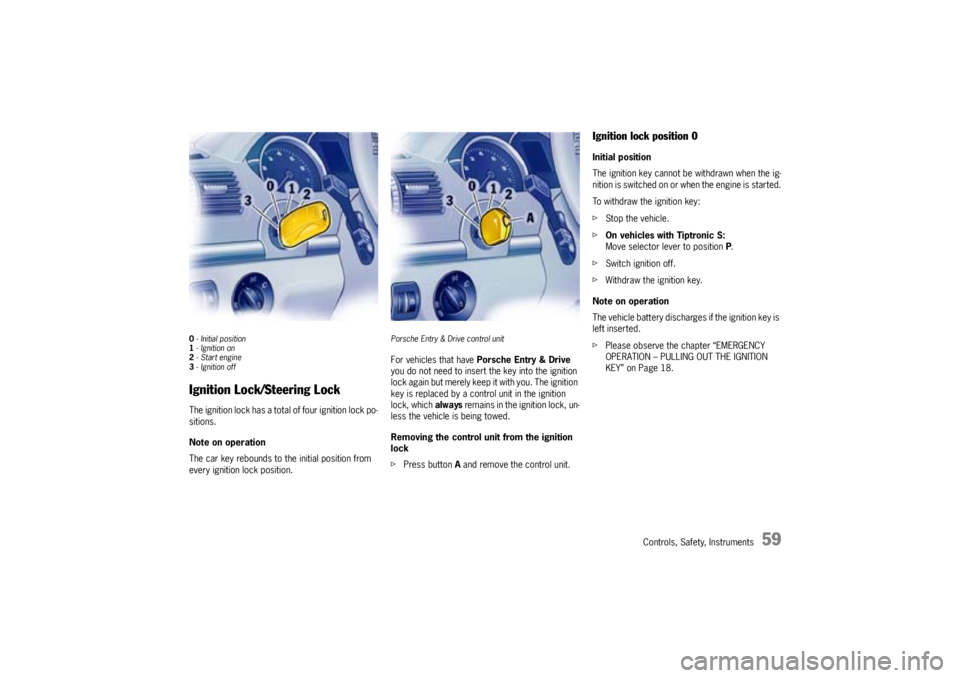
0- Initial position
1- Ignition on
2-Start engine
3- Ignition offIgnition Lock/Steering LockThe ignition lock has a total of four ignition lock po-
sitions.
Note on operation
The car key rebounds to the initial position from
every ignition lock position.
Porsche Entry & Drive control unitFor vehicles that have Porsche Entry & Drive
you do not need to insert the key into the ignition
lock again but merely keep it with you. The ignition
key is replaced by a control unit in the ignition
lock, which always remains in the ignition lock, un-
less the vehicle is being towed.
Removing the control unit from the ignition
lock
fPress button A and remove the control unit.
Ignition lock position 0Initial position
The ignition key cannot be withdrawn when the ig-
nition is switched on or when the engine is started.
To withdraw the ignition key:
fStop the vehicle.
fOn vehicles with Tiptronic S:
Move selector lever to position P.
fSwitch ignition off.
fWithdraw the ignition key.
Note on operation
The vehicle battery discharges if the ignition key is
left inserted.
fPlease observe the chapter “EMERGENCY
OPERATION – PULLING OUT THE IGNITION
KEY” on Page 18.
Page 60 of 380

60
Controls, Safety, Instruments
Ignition lock position 1Ignition on
fTurn ignition key to position 1.
Ignition is switched on.
Note on operation
All electrical equipment can be switched on.
The warning lights light up for a lamp check.
fPlease observe the chapter “INSTRUMENT PA-
NEL USA MODELS” on Page 70.Ignition lock position 2Starting engine
fOperate footbrake.
fFully depress and hold the clutch pedal or on
vehicles with Tiptronic S:
move the selector lever to position P or N.
fDo not press the accelerator pedal.
The engine control module will provide the
correct starting mixture.
fTurn ignition key to ignition lock position 2.fDo not operate the starter longer than approx.
10 seconds.
If necessary, repeat the starting procedure af-
ter a pause of approx. 10 seconds.
Turn the ignition key to ignition lock position 3
(ignition off) first.
fDo not warm up the engine when stationary.
Drive off immediately.
Avoid high revolutions and full throttle until the
engine has reached operating temperature.
fIf battery output is insufficient, jump leads can
be used to start the engine.
Please observe the chapter “EMERGENCY
STARTING WITH JUMPER CABLES” on
Page 331.
Notes on operation
The first operation of the starter is ended
automatically when the engine starts.
If the engine does not start, subsequent starter
operations will not be ended automatically.
When the engine is started, the warning lights
must go out.
Ignition lock position 3Ignition off
fTurn ignition key to ignition lock position 3.
Locking the steering column Vehicles without Porsche Entry & Drive
The steering column is automatically locked
when the ignition key is withdrawn from the
ignition lock.
The steering column is automatically unlocked
when the ignition key is inserted into the ignition
lock.
Vehicles with Porsche Entry & Drive
The steering column is automatically locked
when the ignition is switched off and the vehicle is
locked.
fTo lock intentionally, once the ignition is
switched off, turn the control unit again to the
ignition lock position 3 and hold it there for
2seconds.
The steering column is locked.
The steering column is automatically unlocked
by turning the control unit from ignition lock
position0.
Page 61 of 380

Controls, Safety, Instruments
61
Starting and Stopping the EnginefPlease observe the chapter “IMMOBILIZER” on
Page 19.
fPlease observe the chapter “EMISSION
CONTROL SYSTEM” on Page 263.
Danger!
Risk of poisoning. Exhaust gas contains
colorless and odorless carbon monoxide
(CO), which is toxic even in low concentra-
tion. Carbon monoxide can cause uncon-
sciousness and even death if inhaled.
fNever start or let the engine run in an en-
closed, unventilated area. It is not recommend-
ed to sit in your car for prolonged periods with
the engine on and the car not moving.
An unattended vehicle with a running engine
is potentially hazardous. If warning lights
should come on to indicate improper opera-
tion, they would go unnoticed.
fNever leave the engine idling unattended.
Danger of fire.
fDo not drive or park your car where combus-
tible materials, such as dry grass or leaves,
can come into contact with the hot exhaust
system.
fIf your car catches on fire for any reason, call
the fire department. Do not endanger your life by attempting to put out the fire.
Starting vehicles with manual
transmissionfOperate footbrake.
fFully depress and hold the clutch pedal.
fPut the gearshift lever in neutral.
fDo not press the accelerator pedal. The engine
control module will provide the correct starting
mixture.
fTurn ignition key to ignition lock position 2.
fDo not operate the starter longer than approx.
10 seconds. If necessary, repeat the starting
procedure after a pause of approx.
10 seconds. Turn the ignition key back to
ignition lock position 3 first.
The first operation of the starter is ended automat-
ically when the engine starts.
If the engine does not start, subsequent starter
operations will not be ended automatically.fDo not warm up the engine when stationary.
Drive off immediately.
Avoid high revolutions and full throttle until the
engine has reached operating temperature.
fIf battery output is insufficient, jump leads can
be used to start the engine.
fPlease observe the chapter “EMERGENCY
STARTING WITH JUMPER CABLES” on
Page 331.
Note on operation
To ensure a good charge condition for the battery
and thus its ability to start the engine, all electrical
accessories which are not required should be swit-
ched off when the ignition is switched on and when
engine revolutions are low (in stop and go traffic).
Page 62 of 380

62
Controls, Safety, Instruments
Starting vehicles with Tiptronic SfOperate footbrake.
fMove selector lever to position P or N.
fDo not press the accelerator pedal.
The engine control module will provide the
correct starting mixture.
fTurn ignition key to ignition lock position 2.
fDo not operate the starter longer than
approx. 10 seconds.
If necessary, repeat the starting procedure
after a pause of approx. 10 seconds. Turn the
ignition key back to ignition lock position 3
first.
The first operation of the starter is ended
automatically when the engine starts.
If the engine does not start, subsequent starter
operations will not be ended automatically.fDo not warm up the engine when stationary.
Drive off immediately.
Avoid high revolutions and full throttle until the
engine has reached operating temperature.
fIf battery output is insufficient, jump leads can
be used to start the engine.
Please observe the chapter “EMERGENCY
STARTING WITH JUMPER CABLES” on
Page 331.
Note on operation
To ensure a good charge condition for the battery
and thus its ability to start the engine, all electrical
accessories which are not required should be
switched off when the ignition is switched on and
when engine revolutions are low (in stop and go
traffic).
Starting with auxiliary batteryIf your vehicle is fitted with an additional battery
in the luggage compartment, you have the possi-
bility of starting the engine with the ignition key,
even if the main battery fails.
In vehicles with Porsche Entry & Drive:
1. Remove the Porsche Entry & Drive control unit
from the ignition lock.
Please observe the chapter “REMOVING THE
CONTROL UNIT FROM THE IGNITION LOCK” on
Page 59.
2. Insert the ignition key into the ignition lock and
start the engine as described.
fPlease have the cause of the fault remedied at
an authorized Porsche dealer.
Page 63 of 380

Controls, Safety, Instruments
63
StoppingfWithdraw the ignition key only when the vehicle
is stationary, otherwise the steering lock en-
gages and the vehicle cannot be steered.
fOnly switch the ignition off when the vehicle
comes to a stop, as there is no steering assis-
tance and brake boost when the engine is
switched off.
fAlways withdraw the ignition key and engage
the parking brake when leaving the vehicle.
The control unit always remains in the ignition
lock in vehicles that have Porsche Entry &
Drive.
Note on operation
The vehicle battery discharges if the ignition key is
left inserted.
Warning!
Danger of injury. Hot engine compartment
components can burn skin on contact.
fBefore working on any part in the engine com-
partment, turn the engine off and let it cool down sufficiently.Radiator fans
The radiator and radiator fans are in the front of
the car.
Warning!
Danger of injury. After the ignition is
switched off, the engine compartment and
coolant temperatures are monitored for ap-
prox. 30 minutes. During this period, and de-
pending on temperature, the radiator fan
may continue to run or start to run.
fCarry out work in these areas only with the en-gine off and exercise extreme caution.
Page 67 of 380

Controls, Safety, Instruments
67
Brake pedal
Warning!
Risk of an accident.
Any obstruction of the brake pedal could in-
crease the stopping distance.
fAlways check the movement of the brake pedal
before driving and make sure that it is not ob-
structed by a floor mat or any other object.
fSecure the floor mat to prevent it from sliding
into positions that could interfere with the safe
operation of your vehicle.
Your Porsche dealer will be glad to offer you
floor mats of the correct size including a secur-ing possibility.
Note
In case one of the two brake circuits fails, in-
creased pedal travel is required to bring your vehi-
cle to a full stop.
Warning!
To avoid overheating and premature wear of
the brakes:
fBefore descending a steep grade, reduce
speed and shift the transmission into a lower
driving position to control speed.
fDo not “ride the brakes“ by resting your foot on
the pedal when not intending to apply brake
pressure.
fDo not hold the pedal down too long or too of-
ten. This could cause the brakes to get hot and not function properly.
Brake boosterThe brake booster assists braking only when
the engine is running.
When the car is moving while the engine is not run-
ning, or if the brake booster is defective, more
pressure on the brake pedal is required to bring
the car to a stop.
Moisture, road salt or grit on brakes affects brak-
ing. When the vehicle is driven on salted or gritted
roads for extended periods, the brakes should be
washed down thoroughly about every 2 weeks. An
automatic carwash facility cannot do this job prop-
erly. Brakes will dry after a few cautious brake ap-
plications.
Warning!
Driving through water may reduce the trac-
tion. Moisture on brakes from road water, car
wash, or a coating of road salt or grit may af-
fect braking efficiency.
fCautiously apply brakes to test brakes after being exposed.
Page 69 of 380

Controls, Safety, Instruments
69
Warning!
fDo not obstruct the pedal travel with floor mats
or other objects.
The brake booster is ready for operation only
while the engine is running.
If the engine is switched off or there is a defect in
the brake booster, much greater force has to be
applied to the pedal when braking.
fPlease observe the chapter “TOWING” on
Page 350.
In heavy rain, while driving through water or after
leaving a car wash, the braking action may be de-
layed and increased pressure may be required.
fFor this reason, keep further back from the ve-
hicle in front and “dry” the brakes by applying
them at intervals. Make sure that following traf-
fic is not affected.
After a long drive over salted or gritted roads, a
coating may form on the brake discs and pads
that significantly reduces friction and thus braking
action.
fTherefore, clean the brake discs and pads ap-
prox. every 2 weeks with a strong jet of water.
The cleaning effect of automatic car washes is
insufficient.
To prevent corrosion of the brake discs, “brake
them dry” before parking the car.fEven though the brake discs consist of alloyed
grey cast iron, they will unavoidably start to
corrode if your car is parked for an extended
period. The brakes will tend to “rub” as a re-
sult.
The nature, extent and effects of corrosion de-
pend on the amount of time the vehicle was
parked, whether road salt or grit was spread
and whether grease-dissolving agents were
used in car washes.
If the braking comfort is noticeably impaired,
we recommend having the brake system
checked by experts at an authorized Porsche
dealer.
fTo relieve the braking system on downhill
stretches, change down to a lower gear in
good time to obtain engine braking.
If engine braking is insufficient on steep
stretches, operate the footbrake at intervals.
Continuous braking overheats the brakes and
reduces the braking effect.
fPlease observe the chapter “BRAKE-FLUID LE-
VEL” on Page 251.