engine PORSCHE CAYNNE S 2005 1.G Service Manual
[x] Cancel search | Manufacturer: PORSCHE, Model Year: 2005, Model line: CAYENNE S, Model: PORSCHE CAYENNE S 2005 1.GPages: 380, PDF Size: 3.17 MB
Page 143 of 380

Controls, Safety, Instruments
143
Notes on operation
The parking heater runs on fuel, and it therefore
cannot be switched on after the reserve warning
lights up.
fPlease observe the chapter “FUEL RESERVE
WARNING” on Page 76.
The parking heater must be operated at least
once per month, with the engine cold and the
blower at its lowest setting.
Ignition off: When the parking heater is running,
the remaining running time is shown on the display
panel.
Operation of the parking heater is clearly audible
when outside temperatures are low and the engine
is cold.Switching on
fPress ON/OFF button C.
The programed parking heating or parking ven-
tilation function is switched on.
Switching off
fPress ON/OFF button C again.
Note on operation
fAfter switching off the parking heater using
ON/OFF button C wait for at least 2 minutes
before you press the button again.
The combusion chamber is cleaned.
Switching parking heater on and
off
Page 152 of 380
152
Controls, Safety, Instruments
Sliding/Lifting RoofThe electric sliding/lifting roof is made of single-
sheet safety glass. It is equipped with a sliding-
roof cover that can be infinitely adjusted manually
to protect against the sun.
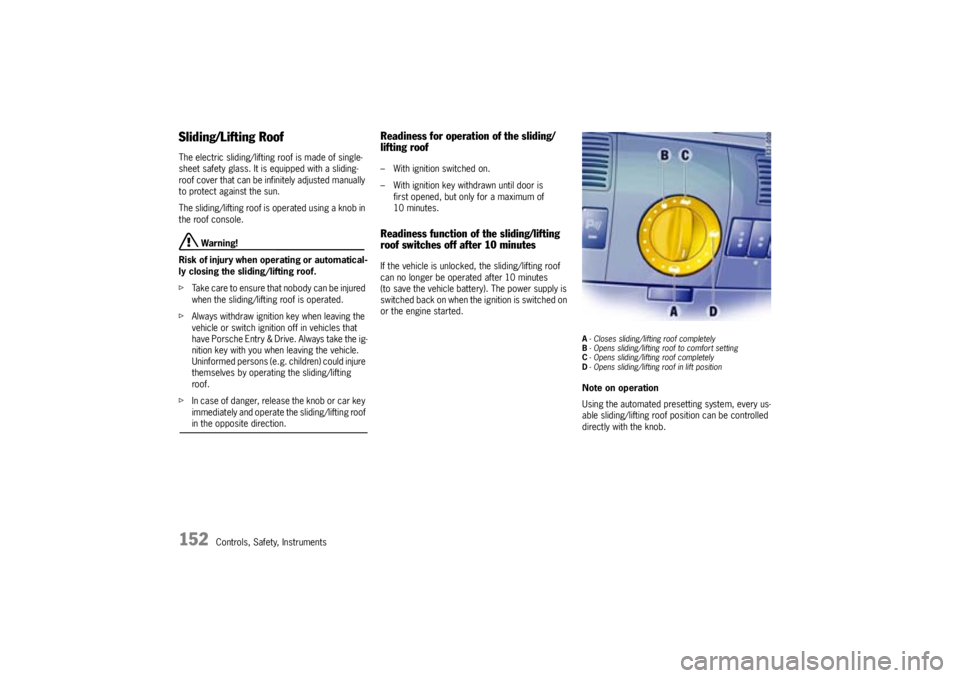
The sliding/lifting roof is operated using a knob in
the roof console.
Warning!
Risk of injury when operating or automatical-
ly closing the sliding/lifting roof.
fTake care to ensure that nobody can be injured
when the sliding/lifting roof is operated.
fAlways withdraw ignition key when leaving the
vehicle or switch ignition off in vehicles that
have Porsche Entry & Drive. Always take the ig-
nition key with you when leaving the vehicle.
Uninformed persons (e.g. children) could injure
themselves by operating the sliding/lifting
roof.
fIn case of danger, release the knob or car key
immediately and operate the sliding/lifting roof in the opposite direction.
Readiness for operation of the sliding/
lifting roof– With ignition switched on.
– With ignition key withdrawn until door is
first opened, but only for a maximum of
10 minutes.Readiness function of the sliding/lifting
roof switches off after 10 minutesIf the vehicle is unlocked, the sliding/lifting roof
can no longer be operated after 10 minutes
(to save the vehicle battery). The power supply is
switched back on when the ignition is switched on
or the engine started.
A- Closes sliding/lifting roof completely
B- Opens sliding/lifting roof to comfort setting
C- Opens sliding/lifting roof completely
D- Opens sliding/lifting roof in lift positionNote on operation
Using the automated presetting system, every us-
able sliding/lifting roof position can be controlled
directly with the knob.
Page 162 of 380
162
Controls, Safety, Instruments
Parking AidsParkAssistParkAssist provides a visual and acoustic indica-
tion to the driver of the distance between the
vehicle and a large obstacle.
ParkAssist is switched on automatically when the
engine is started and remains active up to a speed
of approx. 9 mph (14 km/h).
ParkAssist is switched off automatically at high
speed. ParkAssist is switched on again auto-
matically when the speed drops below approx.
9mph (14km/h).
The selector lever position determines activation
levels for ParkAssist and the corresponding area
that is monitored.
Selector lever position:
–P – ParkAssist is not activated.
–R, N – ParkAssist is activated for the front and
rear areas.
–D, M – ParkAssist is activated for the front ar-
ea.Gearshift lever position:
–R– ParkAssist is activated for the front and
rear areas.
–In all other gearshift positions – ParkAssist
is activated for the front area.
Note
On vehicles with manual transmission, the parking
assistant is not switched on in the rear area if the
vehicle rolls backward without reverse gear enga-
ged.
Danger!
Risk of serious personal injury or death.
ParkAssist cannot detect small objects such
as children and pets.
Even when using ParkAssist, the driver is still
responsible for taking due care when park-
ing and when assessing obstacles.
fMake sure that no persons especially small
children, animals or obstacles are within the maneuvering area.Switching ParkAssist on and off
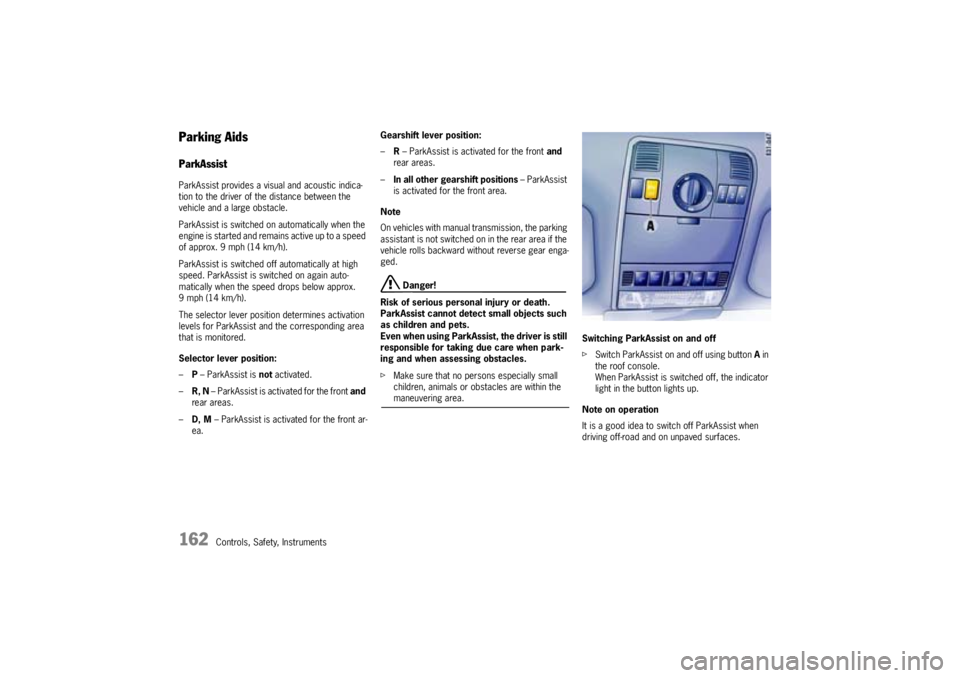
fSwitch ParkAssist on and off using button A in
the roof console.
When ParkAssist is switched off, the indicator
light in the button lights up.
Note on operation
It is a good idea to switch off ParkAssist when
driving off-road and on unpaved surfaces.
Page 174 of 380

174
Controls, Safety, Instruments If aftermarket systems are installed by non-dealer-
ship technicians or outside the selling dealer,
problems may result. Installation of aftermarket
equipment is not covered under the New Car War-
ranty.
fConsult your authorized Porsche dealer about
the installation of non Porsche approved equip-
ment.
Reception quality
The reception quality of your car telephone will
change constantly when you are driving. Interfer-
ence caused by buildings, landscape and weather
is unavoidable. It may become particularly difficult
to hear when using the hands-free function due to
external noise such as engine and wind noise.
Automatic car-wash
fUnscrew external antennas before using an au-
tomatic car-wash.
Porsche Communication
Management (PCM)
Warning!
There is a danger of accident if you set or
operate the on-board computer, radio, navi-
gation system, telephone or other equipment
when driving.
This could distract you from the traffic and
cause you to lose control of the vehicle re-
sulting in serious personal injury or death.
fOperate the components while driving only if
the traffic situation allows you to do so safely.
fCarry out any complicated operating or setting
procedures only with the vehicle stationary
fIf it is necessary to operate these components
while the vehicle is in motion, use the function keys on the multi-functional steering wheel.
fRefer to the separate operating instructions
before putting the PCM into operation.
When put into operation for the first time, a dis-
tance of approx. 3 miles (5 km) must be driven in
order for the navigation system to complete the
process of fine calibration. The same applies
when the tires are changed (e.g. summer/winter
tires) or new tires fitted. Full location accuracy is
not yet achieved during the fine-calibration pro-
cess.If the vehicle has been transported (e.g. ferry, car
train), the system may take a few minutes after be-
ing switched on before it determines the current
location.
Serious tire slip (e.g. spinning wheels on snow)
may result in temporarily inaccurate navigation.
When the battery has been disconnected, it may
take up to 15 minutes before the navigation
system is operational once more.
Satellite radioYou must have the satellite radio activated before
you can put it into operation. You will need a con-
tract with a provider in order to use this radio.
fRefer to the separate radio operating instruc-
tions before putting into operation.
Page 182 of 380
182
Controls, Safety, Instruments
Rear LidThe equipment features “Porsche Entry & Drive”
and “spare wheel bracket” affect operation of the
rear lid.
fPlease observe the chapter “UNLOCKING VE-
HICLE DOORS” on Page 24.
fPlease observe the chapter “SPARE WHEEL”
on Page 307.
Danger!
Risk of poisoning. Exhaust gases can enter
the passenger compartment when the rear
lid is open.
fAlways keep the rear lid closed when the
engine is running.
fAlways keep the rear lid closed while driving.
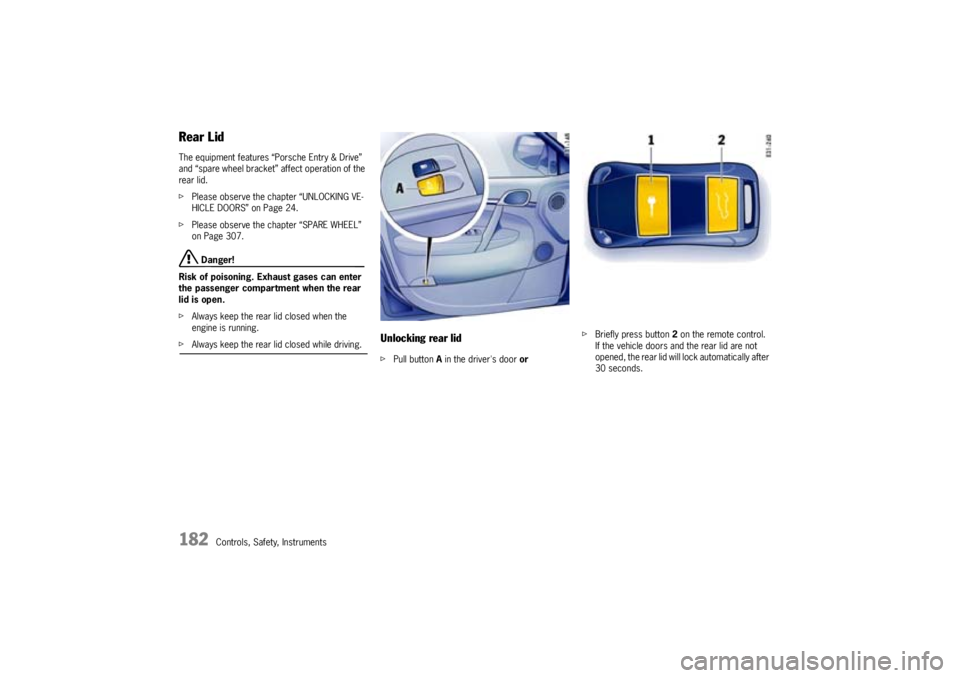
Unlocking rear lidfPull button Ain the driver's door orfBriefly press button 2 on the remote control.
If the vehicle doors and the rear lid are not
opened, the rear lid will lock automatically after
30 seconds.
Page 184 of 380
184
Controls, Safety, Instruments
Rear Window
Danger!
Risk of poisoning. Exhaust gases can enter
the passenger compartment when the rear
window is open.
fAlways keep the rear window closed when the
engine is running.
fAlways keep the rear window closed while driving.
fPlease observe the chapter “UNLOCKING VE-
HICLE DOORS” on Page 24.
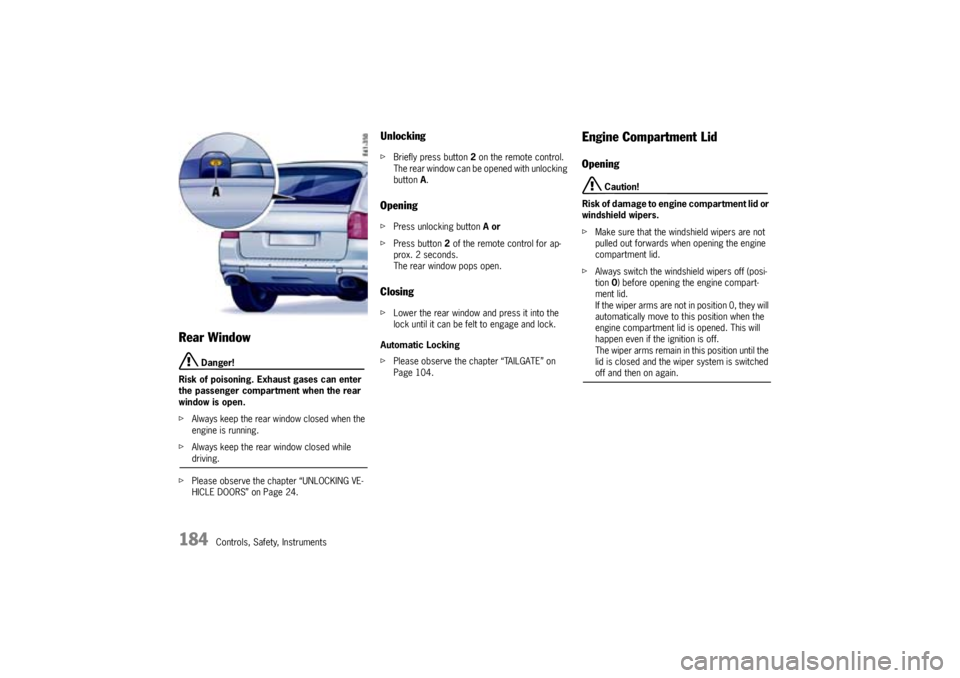
UnlockingfBriefly press button 2 on the remote control.
The rear window can be opened with unlocking
buttonA.OpeningfPress unlocking button Aor
fPress button 2of the remote control for ap-
prox. 2 seconds.
The rear window pops open.ClosingfLower the rear window and press it into the
lock until it can be felt to engage and lock.
Automatic Locking
fPlease observe the chapter “TAILGATE” on
Page 104.
Engine Compartment LidOpening
Caution!
Risk of damage to engine compartment lid or
windshield wipers.
fMake sure that the windshield wipers are not
pulled out forwards when opening the engine
compartment lid.
fAlways switch the windshield wipers off (posi-
tion0) before opening the engine compart-
ment lid.
If the wiper arms are not in position 0, they will
automatically move to this position when the
engine compartment lid is opened. This will
happen even if the ignition is off.
The wiper arms remain in this position until the
lid is closed and the wiper system is switched off and then on again.
Page 185 of 380
Controls, Safety, Instruments
185
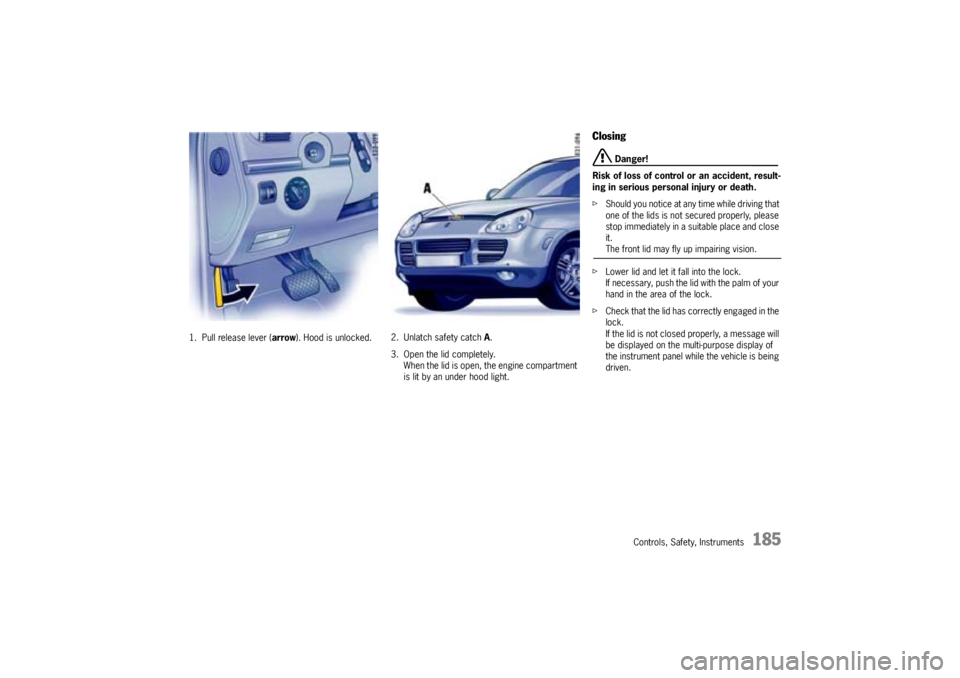
1. Pull release lever (arrow). Hood is unlocked.2. Unlatch safety catch A.
3. Open the lid completely.
When the lid is open, the engine compartment
is lit by an under hood light.
Closing
Danger!
Risk of loss of control or an accident, result-
ing in serious personal injury or death.
fShould you notice at any time while driving that
one of the lids is not secured properly, please
stop immediately in a suitable place and close
it.The front lid may fly up impairing vision.
fLower lid and let it fall into the lock.
If necessary, push the lid with the palm of your
hand in the area of the lock.
fCheck that the lid has correctly engaged in the
lock.
If the lid is not closed properly, a message will
be displayed on the multi-purpose display of
the instrument panel while the vehicle is being
driven.
Page 198 of 380

198
Controls, Safety, Instruments
Towing a trailer
Warning!
Driving with a trailer
fAlways observe the permissible towing capac-
ity, vertical coupling load and rear-axle load.
Please observe the chapter “WEIGHTS” on
Page 363.
fWhen connected, the trailer must always be
horizontal behind the towing vehicle. If neces-
sary, use a trailer with an adjustable drawbar.
fWhen the vehicle is driven in the mountains, the
engine output decreases as altitude increases.
The maximum weights stated are the values at
sea level. The total permissable weight of the
car-trailer combination must therefore be re-
duced by 10% for each increment of 3,280 ft.
(1,000 meters) altitude. A fractional increment
counts as the full 3,280 ft. (1,000 meters).
Please take this into consideration when plan-
ning your route.Distributing the load
fDistribute the load in the trailer so that heavy
objects are as close to the axle as possible.
Always safeguard all objects against slipping
and tie them down securely.
fYou should make the best possible use of the
trailer coupling's rated vertical coupling load
when loading the trailer, but never exceed it.
Tire pressure
fSelect the vehicle tire pressure for full load
when towing a trailer.
fPlease observe the chapter “Tire pressure ta-
bles”.
fCheck the tire pressure of the trailer's wheels
according to the manufacturer's instructions.Door mirrors
fIf the width of the trailer obstructs your view of
the traffic behind the trailer, you must have ad-
ditional door mirrors fitted.
Headlights, lights
fAlways check the headlight adjustment before
driving with a trailer.
If necessary, correct with the headlight beam
adjustment function.
fCheck whether the plug of the trailer is
plugged into the towing vehicle and whether all
lights function.
Page 199 of 380

Controls, Safety, Instruments
199
Driving with a trailer
When towing a trailer you must under all circum-
stances adapt your speed to prevailing road and
driving conditions. Never exeed a speed of
50 mph (80 km/h). Towing at excessive speed
can result in loss of control.
fCarefully and gradually familiarize yourself with
the handling and braking behavior of the car-
trailer combination.
fDo not drive with the towing vehicle empty and
the trailer loaded.
If this unfavorable combination is unavoidable,
please drive especially slowly.
fBear in mind the different vehicle handling and
size in situations such as braking, parking,
cornering and overtaking, etc.
fThe driving stability of the car-trailer combina-
tion worsens as the speed increases. There-
fore, drive especially slowly on downhill
stretches and in the case of unfavorable road
and weather conditions (such as wind).
fDrive in an appropriately low gear on downhill
stretches in order to make use of the engine
braking effect.fSlow down immediately if the trailer starts to
sway. Do not countersteer; brake if necessary.
Never attempt to straighten out the car-trailer
combination by accelerating.
fActivate Low Range when moving off on steep
slopes.
fUnder no circumstances may people, animals
or objects be in the space between the trailer
and the towing vehicle when the vehicle is
moving.
fWhen reversing, bear in mind that ParkAssist is
not active.
Maintenance note
Please take into consideration that driving with a
trailer places markedly greater stress on all vehi-
cle components. Expert inspection and mainte-
nance after every use are indispensable prerequi-
sites for proper functioning and safety.
Page 202 of 380
202
Shifting Gear, Traction Systems
Manual transmission, clutch
Warning!
Risk of accident.
fDo not obstruct the pedal travel with floor mats or other objects.
Floor mats of the correct size and with the
appropriate fasteners are available from your
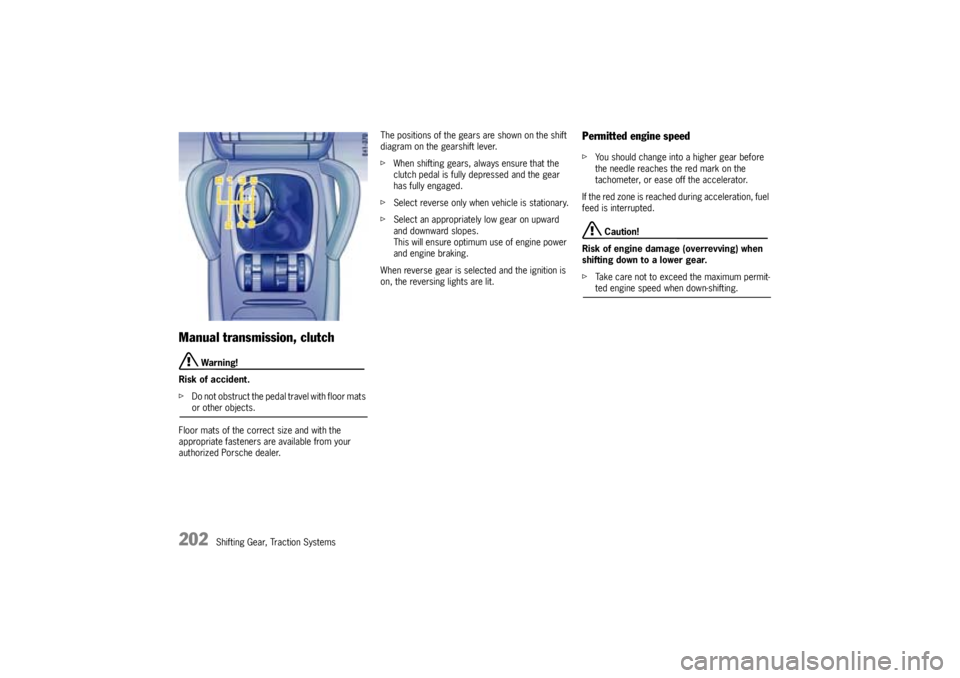
authorized Porsche dealer.The positions of the gears are shown on the shift
diagram on the gearshift lever.
fWhen shifting gears, always ensure that the
clutch pedal is fully depressed and the gear
has fully engaged.
fSelect reverse only when vehicle is stationary.
fSelect an appropriately low gear on upward
and downward slopes.
This will ensure optimum use of engine power
and engine braking.
When reverse gear is selected and the ignition is
on, the reversing lights are lit.
Permitted engine speedfYou should change into a higher gear before
the needle reaches the red mark on the
tachometer, or ease off the accelerator.
If the red zone is reached during acceleration, fuel
feed is interrupted.
Caution!
Risk of engine damage (overrevving) when
shifting down to a lower gear.
fTake care not to exceed the maximum permit-ted engine speed when down-shifting.