fuse PORSCHE CAYNNE S 2005 1.G User Guide
[x] Cancel search | Manufacturer: PORSCHE, Model Year: 2005, Model line: CAYENNE S, Model: PORSCHE CAYENNE S 2005 1.GPages: 380, PDF Size: 3.17 MB
Page 197 of 380

Controls, Safety, Instruments
197
Stowing load in the vehicle
Warning!
Danger of injury.
An unsecured or incorrectly positioned cargo
can slip out of place or endanger the vehicle
occupants during braking, direction changes
or in accidents.
Never transport objects which are not se-
cured.
fAlways transport cargo in the cargo area, nev-
er in the passenger compartment (e.g. on or in
front of the seats).
fSupport the cargo on the seat backrests when-
ever possible. Always lock the backrests into
place.
fPlace the cargo behind unoccupied seats
whenever possible.
fStow heavy objects as close to the front of the
cargo area as possible, with lightweight ob-
jects behind them.
fThe cargo must never project over the top
edge of the seat backrest.
fAlways protect the passenger compartment
with a luggage safety net and a luggage
compartment cover.
Do not drive with objects on top of the luggage
compartment cover.fIf the rear seats are not occupied, the back-
rests can be additionally secured with the safe-
ty belts. Simply cross the outer safety belts
and insert each into the opposite buckle.
fMake sure that the cargo cannot damage the
heating filaments of the rear window and the
TV antenna of the side window.
Luggage net
fLuggage must be stowed completely covered
by the luggage net.
The luggage net can prevent only lightweight
objects from slipping.
Tie-down belts
fDo not use elastic belts or straps to tie down
cargo.
fDo not place belts and straps over sharp edg-
es.
fObserve the directions for use and information
for the tie-down equipment.
fUse only belts with a tear strength of at least
1543 lbs. (700 kg) and a maximum width of
1in. (25mm).
fCross the belts over the load.Driving
fThe car's handling changes depending on the
vehicle loading. Adapt your driving style to the
changed driving behavior.
fDo not exceed the maximum gross weight and
the axle load.
fPlease observe the chapter “WEIGHTS” on
Page 363.
fNever drive with the rear window or rear lid
open.
Exhaust gases can enter the passenger
compartment.
fAdapt the tire pressure to the load.
fPlease observe the chapter “LOAD” on
Page 93.
fPlease observe the chapter “TIRE PRESSU-
RES, COLD” on Page 361.
Page 205 of 380

Shifting Gear, Traction Systems
205
D - Automatic selection mode (in the road
driving program)The functions of selector lever positions Dand M
differ in the on-road program, High Range, and in
the off-road program, Low Range.
fUse selector lever position D for “normal” driv-
ing.
The gears are shifted automatically according
to the accelerator position and speed.
Depending on the way the vehicle is driven and on
the resistance (e.g. uphill), the gear-changing
points are shifted towards higher or lower engine-
speed ranges. Movement of the accelerator,
driving speed, longitudinal and lateral acceleration
and the road profile all have an influence on the
gear-changing characteristic.
When PSM is switched off, transmission gear
changes are done at higher engine speeds.
Unwanted upward shifts, e.g. before bends, are
prevented by swiftly releasing the accelerator ped-
al.
Depending on lateral acceleration, upward chang-
es on bends are not made until the engine-speed
limit is reached.
During braking, and depending on the amount of
deceleration, the Tiptronic changes down earlier.
For subsequent cornering, the right gear is en-
gaged when pressure is applied to the brakes be-
fore the bend.The bend is taken in the right gear, and when you
accelerate out of the bend you do not have to
change down.
Moving off
In 2nd gear, the vehicle moves off with the throttle
only slightly open. Move off in 1st gear with the
throttle open wider or when the engine is cold.
When PSM is switched off, the car generally
moves off in 1st gear.
Shifting gear on the steering wheel
By shifting gear with the rocker switches on the
steering wheel, you can temporarily change from
automatic selection mode D to manual selection
mode M.
Advantages
– Shifting down before bends and on entering
built-up areas.
– Shifting down on downward slopes (engine
braking).
– Shifting down for brief spurts of acceleration.
– Selecting 1st or 2nd gear for moving off.
The manual selection mode remains engaged:
– For cornering (depending on the lateral accel-
eration) and overrunning,
– When the vehicle is stationary (e.g. at a junc-
tion).The system leaves manual selection mode:
– automatically after around 8 seconds
(unless car is cornering, overrunning or
stationary),
– if you depress the accelerator to kickdown.
Temporary change-down
Precondition
– Speed is higher than approx. 33 mph
(54 km/h).
fDepress accelerator quickly.
The Tiptronic changes temporarily to the sport-
iest gear-changing map, i.e. to the highest pos-
sible gear-changing points. Correspondingly,
the transmission shifts down immediately by
one, two or three gears.
Ending the function
fRelease the accelerator markedly (by approx.
25%).
f f f
Page 206 of 380

206
Shifting Gear, Traction Systems Kickdown
The kickdown function is active in selector lever
position D.
fFor optimum acceleration, e.g. when overtak-
ing, depress the accelerator pedal beyond the
full-throttle point (kickdown).
The transmission shifts down depending on the
speed of travel and engine speed.
Upward shifts occur at the highest possible engine
speeds.
These gear-changing speeds remain active until
the accelerator is released to approx. 80% of the
full-throttle position.
D - Automatic selection mode (in the off-
road driving program)The functions of selector lever positions Dand M
differ in the on-road program, High Range, and in
the off-road program, Low Range.
fUse selector lever position D for “normal” driv-
ing.
The gears are shifted automatically according
to the accelerator position and speed.
The gears are shifted automatically according to
the accelerator position and speed. The gear-
changing points have been adjusted to achieve the
best possible vehicle control on difficult terrain.Depending on the route profile, the gear-changing
points are shifted towards higher or lower engine-
speed ranges. On steep downhill stretches, up-
ward shifts are prevented until medium engine
speeds are reached (at least 2,500 rpm).
When the car is overrunning, an automatic upshift
does not occur when the engine speed limit is
reached.
Moving off
The car moves off in 1st gear.
Shifting gear on the steering wheel
By shifting gear with the rocker switches on the
steering wheel, you can temporarily change from
automatic selection mode D to manual selection
mode M.
Advantages
– Shifting down on downward slopes (engine
braking).
– Shifting down for brief spurts of acceleration.
– Selecting 1st/2nd or 3rd gear for moving off.
The manual selection mode remains engaged:
– For overrunning
– Depending on lateral acceleration
– When the vehicle is stationary (e.g. at a junc-
tion).The system leaves manual selection mode:
– Automatically after around 8 seconds
(unless car is subject to high lateral accelera-
tion, is overrunning or stationary),
– if you depress the accelerator to kickdown.
Kickdown
The kickdown function is active in selector lever
position D.
fFor optimum acceleration, e.g. when overtak-
ing, depress the accelerator pedal beyond the
full-throttle point (kickdown).
The transmission shifts down depending on the
speed of travel and engine speed.
Upward shifts occur at the highest possible engine
speeds.
These gear-changing speeds remain active until
the accelerator is released to approx. 80% of the
full-throttle position.
Tip on driving
Unlike in the on-road driving program, an automat-
ic upshift is not performed in manual selection
modeM when the engine-speed limit is reached.
Page 231 of 380

Shifting Gear, Traction Systems
231
Driving downhill
Danger!
There is a danger of serious personal injury
or death and risk of damage if the vehicle
should overturn.
fDo not drive over slopes at an angle to the line
of maximum gradient.
fDrive downhill slowly, with the wheels pointing
straight ahead.
fIf the vehicle starts to tilt, immediately steer in
the direction of the tilt (line of slope).
fWhen driving downhill, never let the vehicle roll
when in idle.
fUse engine braking effect.
If the engine braking effect is not adequate, gently apply the foot brake.Note on operation
fActivate Low Range. The off-road ABS is
switched on automatically.
Tips on driving
The same general principle as for uphill driving ap-
plies to downhill driving.
fDo not perform manual gear changes when
driving, and try to avoid stopping.
fAvoid high engine speeds (max. 2,500 rpm).
A special circuit of the off-road ABS permits con-
trolled brief lock-up of the front wheels so that they
can dig into the loose surface more effectively.
Locked wheels slip and can no longer be steered.
fWhen driving down steep hills on unpaved sur-
faces, brake carefully and do not start to slide.
Page 235 of 380

Shifting Gear, Traction Systems
235
When driving on slopes with soft sand on vehicles
with Tiptronic S:
fUse the manual select mode M in addition to
the Low Range program.
If your vehicle becomes stuck nevertheless:
Do not spin the wheels. Instead, use branches,
mats or similar items to provide adequate traction
so that you can drive out of the critical area.
Track rutsOther vehicles leave ruts in many off-road courses
or gravel roads.
fPlease observe the chapter “GROUND CLEA-
RANCE” on Page 366.
Caution!
Risk of damage to the vehicle floor when
driving through ruts that are too deep.
fAlways bear in mind the car's ground clear-
ance.
fDo not drive over ruts that are too deep.
Note on operation
fActivate Low Range and engage differential
locks if necessary.
Tips on driving
fIn cases of doubt, drive with one wheel on the
strip of grass.
fAvoid high engine speeds (max. 2,500 rpm).
fDrive slowly.
Page 249 of 380
Maintenance, Car Care
249
Coolant LevelfPlease observe the chapter “EXERCISE
EXTREME CAUTION WHEN WORKING ON YOUR
VEHICLE” on Page 242.
The coolant provides year-round protection from
corrosion and freezing down to -31°F (-35°C)
(Nordic countries -40°F (-40°C)).
fUse only anti-freeze authorized by Porsche.
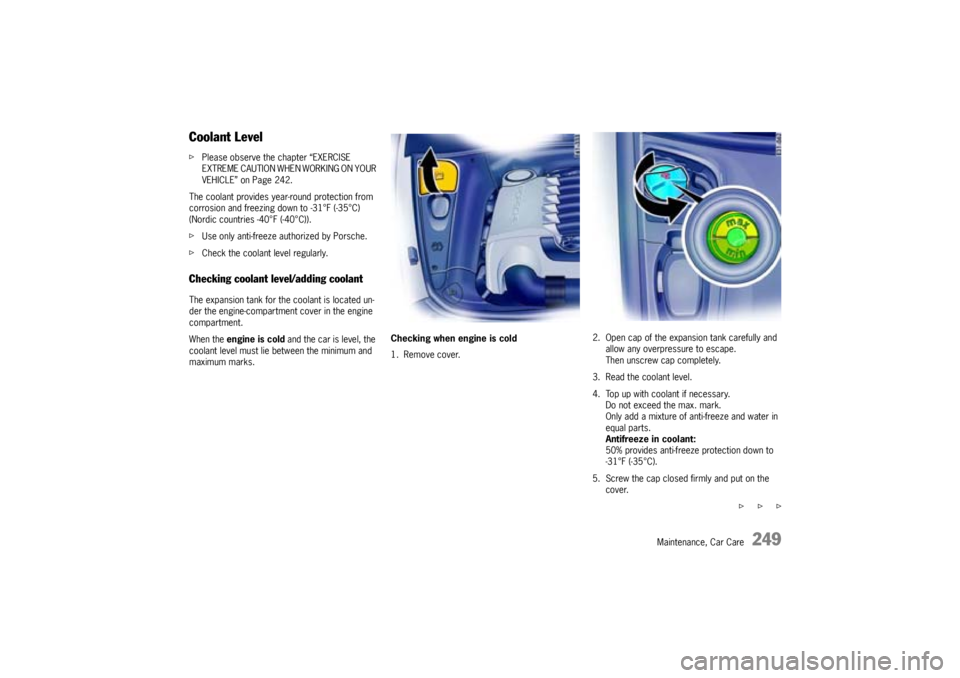
fCheck the coolant level regularly.Checking coolant level/adding coolantThe expansion tank for the coolant is located un-
der the engine-compartment cover in the engine
compartment.
When the engine is cold and the car is level, the
coolant level must lie between the minimum and
maximum marks.Checking when engine is cold
1. Remove cover.2. Open cap of the expansion tank carefully and
allow any overpressure to escape.
Then unscrew cap completely.
3. Read the coolant level.
4. Top up with coolant if necessary.
Do not exceed the max. mark.
Only add a mixture of anti-freeze and water in
equal parts.
Antifreeze in coolant:
50% provides anti-freeze protection down to
-31°F (-35°C).
5. Screw the cap closed firmly and put on the
cover.
f f f
Page 251 of 380
Maintenance, Car Care
251
Brake-Fluid LevelfPlease observe the chapter “EXERCISE
EXTREME CAUTION WHEN WORKING ON YOUR
VEHICLE” on Page 242.
fUse only new (unused) Original Porsche brake
fluid.
Warning!
Brake fluid is hazardous to your health, and
may be fatal if swallowed.
Brake fluid also attacks paintwork.
fKeep brake fluid out of children's reach.
fImmediately rinse off spilled brake fluid with
clean water.
fIf brake fluid gets into your eye, immediately
rinse with clean water for a few minutes. Then
see a doctor immediately.
fPlease note all the information on the refill container of the brake fluid.
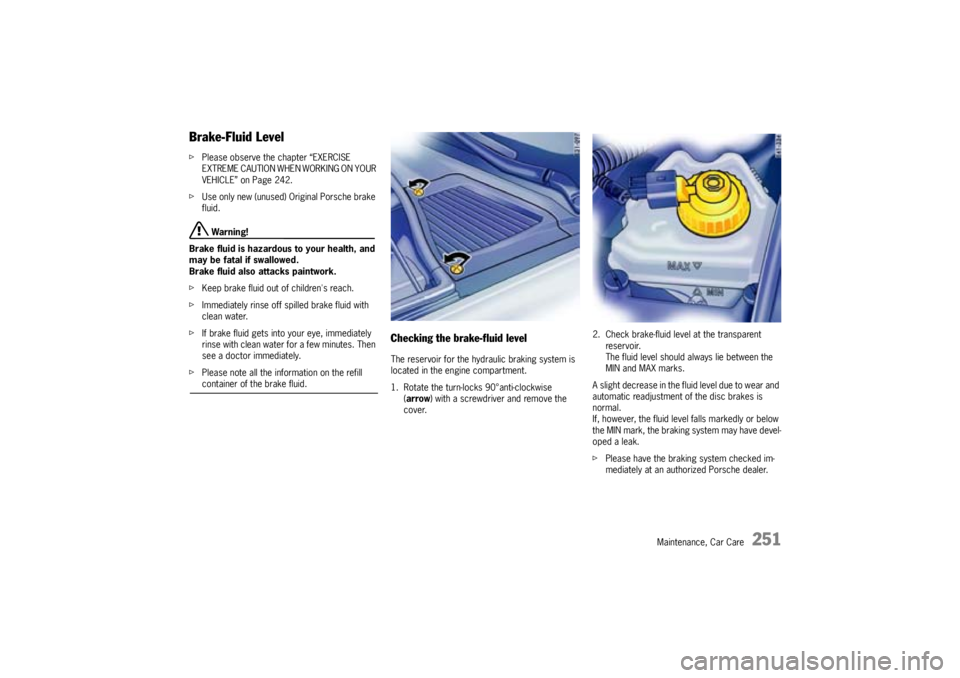
Checking the brake-fluid levelThe reservoir for the hydraulic braking system is
located in the engine compartment.
1. Rotate the turn-locks 90°anti-clockwise
(arrow) with a screwdriver and remove the
cover.2. Check brake-fluid level at the transparent
reservoir.
The fluid level should always lie between the
MIN and MAX marks.
A slight decrease in the fluid level due to wear and
automatic readjustment of the disc brakes is
normal.
If, however, the fluid level falls markedly or below
the MIN mark, the braking system may have devel-
oped a leak.
fPlease have the braking system checked im-
mediately at an authorized Porsche dealer.
Page 252 of 380
252
Maintenance, Car Care
Changing the brake fluidBrake fluid absorbs moisture from the air over
time. This accumulation of water lowers the boil-
ing point and, under certain operating conditions,
can affect the braking action.
fTherefore, have the brake fluid changed in ac-
cordance with the change intervals stated in
the booklet “Guarantee and Maintenance”.
The warning light in the instrument panel and the
warning message on the multi-purpose display of
the instrument panel indicate
– indicate the brake level fluid is too low or,
– in conjunction with large pedal travel could in-
dicate a braking-circuit failure.
Note on operation
If the warning lights should light up while driving:
fStop immediately in a suitable place.
fDo not continue driving.
Please have the fault remedied at your nearest
authorized Porsche dealer.
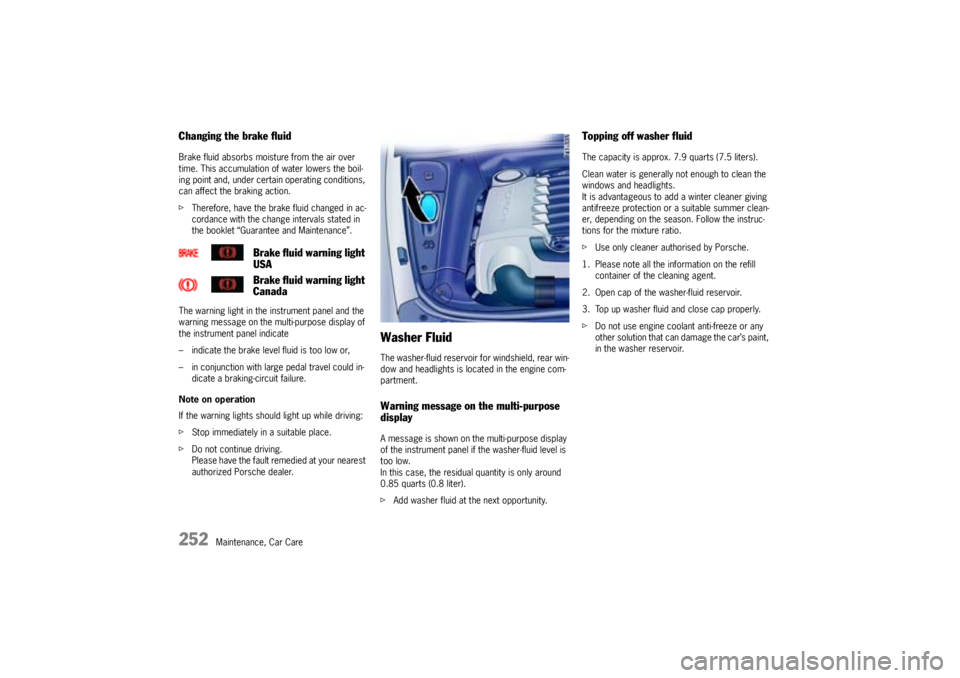
Washer FluidThe washer-fluid reservoir for windshield, rear win-
dow and headlights is located in the engine com-
partment.Warning message on the multi-purpose
displayA message is shown on the multi-purpose display
of the instrument panel if the washer-fluid level is
too low.
In this case, the residual quantity is only around
0.85 quarts (0.8 liter).
fAdd washer fluid at the next opportunity.
Topping off washer fluidThe capacity is approx. 7.9 quarts (7.5 liters).
Clean water is generally not enough to clean the
windows and headlights.
It is advantageous to add a winter cleaner giving
antifreeze protection or a suitable summer clean-
er, depending on the season. Follow the instruc-
tions for the mixture ratio.
fUse only cleaner authorised by Porsche.
1. Please note all the information on the refill
container of the cleaning agent.
2. Open cap of the washer-fluid reservoir.
3. Top up washer fluid and close cap properly.
fDo not use engine coolant anti-freeze or any
other solution that can damage the car’s paint,
in the washer reservoir.
Brake fluid warning light
USA
Brake fluid warning light
Canada
Page 253 of 380
Maintenance, Car Care
253
Power Steering
Warning!
Risk of accident. When the engine is station-
ary (e.g. when on tow) or the hydraulic sys-
tem fails, there is no assistance for steering.
Therefore, substantially more force will have
to be exerted.
fExercise great care when on tow.
fHave the fault remedied at your nearest autho-rized Porsche dealer.The flow noise heard at full steering lock is design-
related and does not indicate a defect in the steer-
ing system.
Checking hydraulic fluidfPlease observe the chapter “EXERCISE
EXTREME CAUTION WHEN WORKING ON YOUR
VEHICLE” on Page 242.
fUse only hydraulic fluid authorized by
Porsche.
fCheck the fluid level with the engine stopped
and cold (engine temperature approx. 68° F or
20°C).
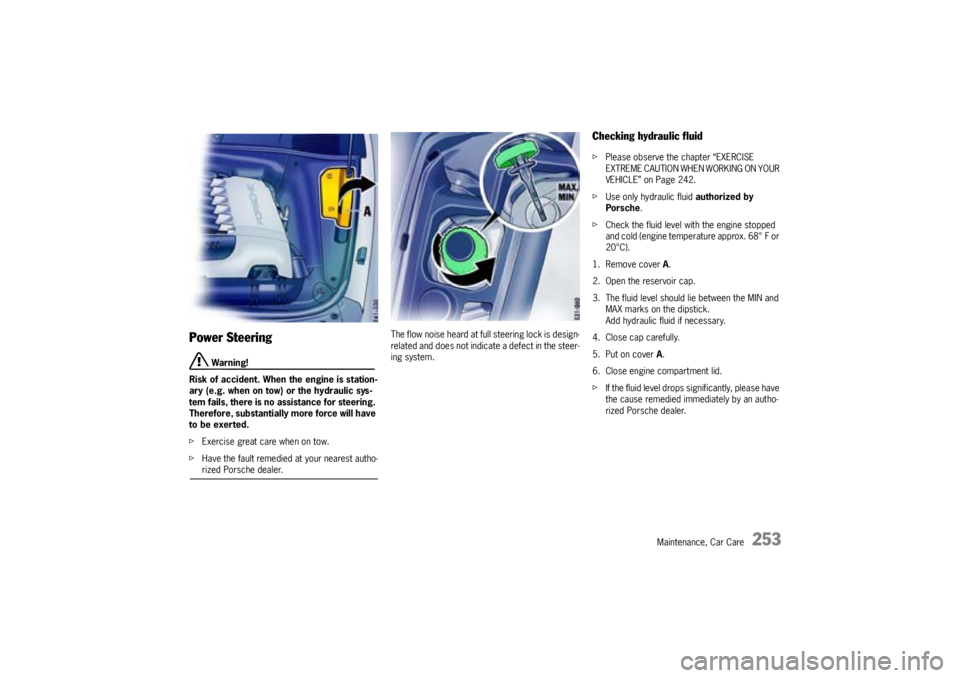
1. Remove cover A.
2. Open the reservoir cap.
3. The fluid level should lie between the MIN and
MAX marks on the dipstick.
Add hydraulic fluid if necessary.
4. Close cap carefully.
5. Put on cover A.
6. Close engine compartment lid.
fIf the fluid level drops significantly, please have
the cause remedied immediately by an autho-
rized Porsche dealer.
Page 271 of 380

Maintenance, Car Care
271
Headlights, lights, interior and exterior
plastic partsfUseonlyclean water and a little dishwashing
detergent to clean headlights, lights, plastic
parts and surfaces.
Do not clean when dry.
Use a soft sponge or a soft, lint-free cloth.
Gently wipe the surface without applying too
much pressure.
The Porsche inside window cleaner is also
suitable for cleaning plastic surfaces.
Follow the cleaning instructions on the
container.
Never use other chemical cleaners or
solvents.
fRinse cleaned surfaces with clear water.
Door, roof, lid and window sealsfWash dirt (e.g. abrasion, dust, road salt or grit)
from all seals regularly using warm soapy wa-
ter. Do not use any chemical cleaning agents
or solvents.
When there is a frost hazard, the outer door seals
and the lid seals can be protected against freezing
into place by a suitable care product.
In order to prevent damage to the anti-fric-
tion coating, the inner door seals must not be
treated with care products.
Light alloy wheelsfPlease observe the chapter “AUTOMATIC CAR
WASHES” on Page 267.
Pitting may occur if metallic particles which cause
contact corrosion (e.g. brass or copper in brake
dust) are allowed to remain on the aluminum too
long.
fIf possible, wash the wheels with a sponge or
wash brush about every two weeks. In areas
where road salt or grit is spread on winter
roads or there is a lot of airborne industrial
dust, it is best to clean the wheels weekly.
The Porsche Light Alloy Wheel Cleaner
(ph-value 9.5) can be used for this pur-
pose.
If the ph-value of the detergent is in-
corect, the protective coating on the
wheels will be destroyed.
Polishes which dissolve oxides, such as those
frequently used for other metals, or abrasive
tools or agents are unsuitable because they
break down the oxide film of the protective
coating and will cause discoloration of the
wheel.
fEvery three months, after cleaning, coat the
wheels with a car wax or non-corrosive grease
(e.g. vaseline).
Using a clean cloth thoroughly rub the grease
into the surface.