fuse PORSCHE CAYNNE S 2005 1.G Owner's Manual
[x] Cancel search | Manufacturer: PORSCHE, Model Year: 2005, Model line: CAYENNE S, Model: PORSCHE CAYENNE S 2005 1.GPages: 380, PDF Size: 3.17 MB
Page 272 of 380

272
Maintenance, Car Care
Leather careCharacteristics and special features
The natural surface markings of leather, e.g.
creases, healed scars, insect sting marks, struc-
tural differences and slight variations in shade and
grain add to the attractiveness of the natural leath-
er product.
A special mention must be made here of natural
leather. For natural leather, carefully selected
hides of the highest quality are used. It is not
covered completely with dye on production. “Na-
ture’s signature” is therefore easily recogniz-
able.This fine material is distinguished by an out-
standing seating comfort, special suppleness and
a typical patina.Leather care and treatment
fClean all types of leather regularly to remove
fine dust using a soft, damp, white woollen
cloth or a commercially available microfibre
cloth.
fRemove heavy contamination with Porsche
leather cleaner.
Please always follow the instructions for use
given on the containers.
Caustic cleaners and hard cleaning objects
must not be used.
Perforated leather must under no circum-
stances get wet on its reverse side.
Once cleaned, leather (particularly the heavily
stressed leather seats) must be treated only with
Porsche leather care liquid.
Carpets and matsfUse only a vacuum cleaner or a medium stiff
brush.
fRemove stains and spots with Porsche stain
remover.
The Porsche range of accessories includes floor-
mats to protect the carpets in summer and winter.
Warning!
Risk of an accident.
fAlways check the movement of the pedals be-
fore driving and make sure that they are not ob-
structed by a floor mat or any other object.
fSecure the floor mat to prevent it from sliding
into positions that could interfere with the safe
operation of your vehicle – do not lie them
loosely in the vehicle.
Your Porsche dealer will be glad to offer you
floor mats of correct size including a securing possibility.
Page 273 of 380

Maintenance, Car Care
273
Airbags
Danger!
There is a danger of serious personal injury
or death if the airbag system is impaired by
improper cleaning work.
fDo not make any modifications whatsoever on
individual components such as the padded
covers of the steering wheel, the front seats,
the roof pillars and the rooflinings.
fLet your authorized Porsche dealer clean these components.
Fabric liningsFabric linings on pillars, headliner and sun visors,
etc., must be treated only using suitable cleaning
agents or a suitable dry foam and a soft brush.
AlcantarafDo not use a leather care product to clean Al-
cantara.
For regular care it is sufficient to clean the cover
with a soft brush.
Cleaning when lightly soiled
fWet a soft cloth with water or a neutral soap
solution and wipe off the dirt.
Cleaning when heavily soiled
fWet a soft cloth with lukewarm water or
thinned white spirit and dab the dirt from the
outside in.
Safety beltsfUse a mild detergent to clean soiled belts.
fWhen drying, avoid direct sunlight.
fOnly use suitable cleaning agents.
fDo not tint or bleach the belts.
The belt fabric could be weakened, thus affect-
ing safety.
Page 284 of 380

284
Practical Tips, Minor Repairs
Tire replacementsfUse only tire makes and types tested by
Porsche.
Only tires with the same manufacturer and
with the same specification code (e.g. “N0“,
“N1“...) should be mounted on the vehicle.
Tires should be replaced no less than on one axle
at the time. Only tires of the same make and type
must be used. Mixed tires are not permissible and
will affect vehicle performance, safety, and can
affect vehicle warranty.
Porsche dealers can recommend the most current
replacement tire options for your vehicle.
Initially, new tires do not have their full traction.
You should therefore drive at moderate speeds
during the first 60 - 120 miles (100 - 200 km).If new tires are installed only on one axle, a notice-
able change in handling occurs due to the different
tread depth of the other tires. This happens espe-
cially if only rear tires are replaced. However, this
condition disappears as the new tires are broken
in.
fPlease adjust your driving style accordingly.
Installation of new tires should only be done by a
qualified tire technician.
Valves
fUse only plastic valve caps.
fThe rubber valves must be replaced whenever
the tires are changed.
fThe fitting and replacement specifications
must be observed for metal valves.
fOnly use Original Porsche metal valves.
Parking at the curb
Danger!
Hard impacts against curbs (or traffic
islands) are dangerous and may cause hid-
den tire damage which is not noticeable until
later. Such damage can result in accidents at
high speeds causing severe personal injury.
Depending on the force of impact, the edge
of the rim can also be damaged.
fIf you are in doubt, have the wheel checked by
an expert, particularly if you suspect damage
on the inside.
fIf you must drive over a curb or other obstacle,
drive slowly and at an obtuse angle. Exercise care when parking along curbs.
Maintenance note
Tire repairs are not permissible under any circum-
stances.
Page 288 of 380

288
Practical Tips, Minor Repairs
Snow chains
Caution!
Risk of damage to body, axle or brake com-
ponents.
fUse only the fine-link snow chains recom-
mended and authorized by Porsche so that
sufficient clearance between the wheel well
and the chain is assured.
fFollow instructions issued by the supplier of the chains.
The best possible handling characteristics are
achieved when snow chains are fitted on all four
wheels of the vehicle. However, it is also possible
to fit snow chains on only one axle (preferably the
rear axle).fBefore fitting chains, remove accumulated ice
and snow from the wheel well.
fVehicles with snow chains must not be driven
faster than 30 mph (50 km/h).
Different states and countries have varying statu-
tory requirements regarding maximum speed.
fCheck with local authorities for possible
restrictions.
fRemove chains as soon as the roads are free
of ice and snow.
Page 296 of 380
296
Practical Tips, Minor Repairs
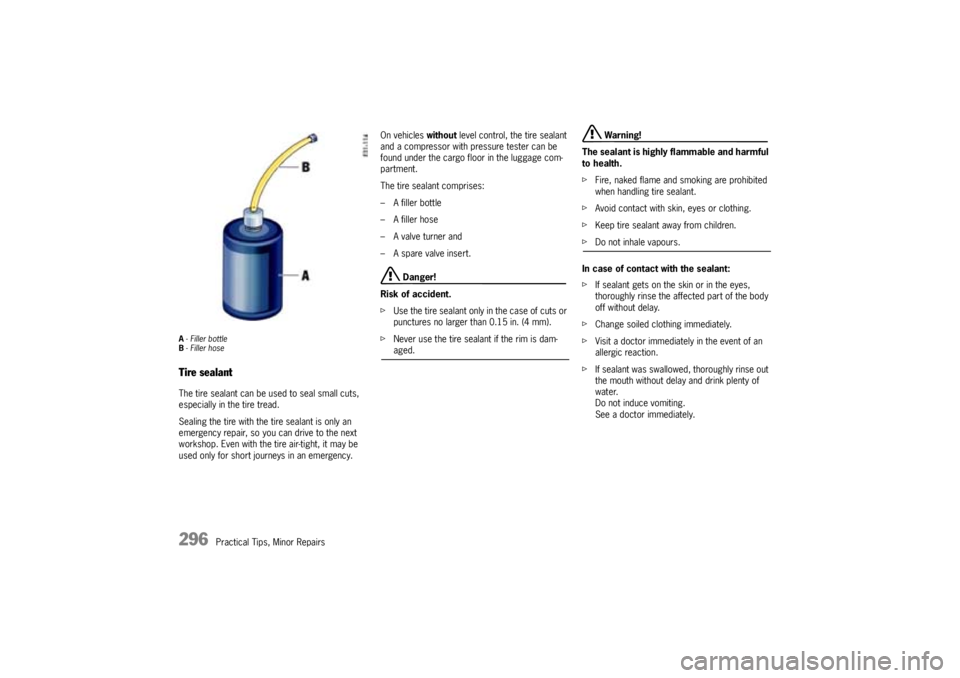
A- Filler bottle
B- Filler hoseTire sealantThe tire sealant can be used to seal small cuts,
especially in the tire tread.
Sealing the tire with the tire sealant is only an
emergency repair, so you can drive to the next
workshop. Even with the tire air-tight, it may be
used only for short journeys in an emergency.On vehicles without level control, the tire sealant
and a compressor with pressure tester can be
found under the cargo floor in the luggage com-
partment.
The tire sealant comprises:
– A filler bottle
– A filler hose
– A valve turner and
– A spare valve insert.
Danger!
Risk of accident.
fUse the tire sealant only in the case of cuts or
punctures no larger than 0.15 in. (4 mm).
fNever use the tire sealant if the rim is dam-aged.
Warning!
The sealant is highly flammable and harmful
to health.
fFire, naked flame and smoking are prohibited
when handling tire sealant.
fAvoid contact with skin, eyes or clothing.
fKeep tire sealant away from children.
fDo not inhale vapours.
In case of contact with the sealant:
fIf sealant gets on the skin or in the eyes,
thoroughly rinse the affected part of the body
off without delay.
fChange soiled clothing immediately.
fVisit a doctor immediately in the event of an
allergic reaction.
fIf sealant was swallowed, thoroughly rinse out
the mouth without delay and drink plenty of
water.
Do not induce vomiting.
See a doctor immediately.
Page 298 of 380

298
Practical Tips, Minor Repairs
Lifting the vehicle with a jack
Warning!
Danger of injury. The car may slip off the
jack.
fMake sure that no one is in the vehicle when
jacking up and changing a wheel.
fNever jack up the vehicle when it is parked on
a surface that slopes up, down or to the side.
fUse the jack only to raise the car for wheel
changing.
fAlways place the car on stable supports if work
has to be carried out under the car.
The car jack is not suitable for this.
Danger of injury if the level-control system
operates during the wheel change.
fSet the car to jacking mode before raising the
car.
Please observe the chapter “AIR SUSPENSION
WITH LEVEL CONTROL AND HEIGHT ADJUST-
MENT” on Page 236.
Risk of injury and damage if the vehicle is not
secured.
fSecure the vehicle against rolling.
fPlease observe the chapter “SECURING THE VEHICLE AGAINST ROLLING” on Page 295.Maintenance note
The jacking point on the vehicle must be free of
dirt.
1. Slightly loosen the wheel bolts of the wheel to
be changed.
2. Only set up the jack at the rear jacking point
designed for the purpose. The jack foot must
be in contact over its whole area and must be
positioned directly below the head piece.
Use a suitable support if necessary.
3. Hold jack still and wind it up until its head
enters the jacking point on the vehicle.
Only jack vehicle up until the wheel to be
changed is completely off the ground.
4. After lowering the vehicle, remove the jack.
Front jacking pointJacking point base
fSet up jack only at the points provided A or B.
Page 306 of 380
306
Practical Tips, Minor Repairs
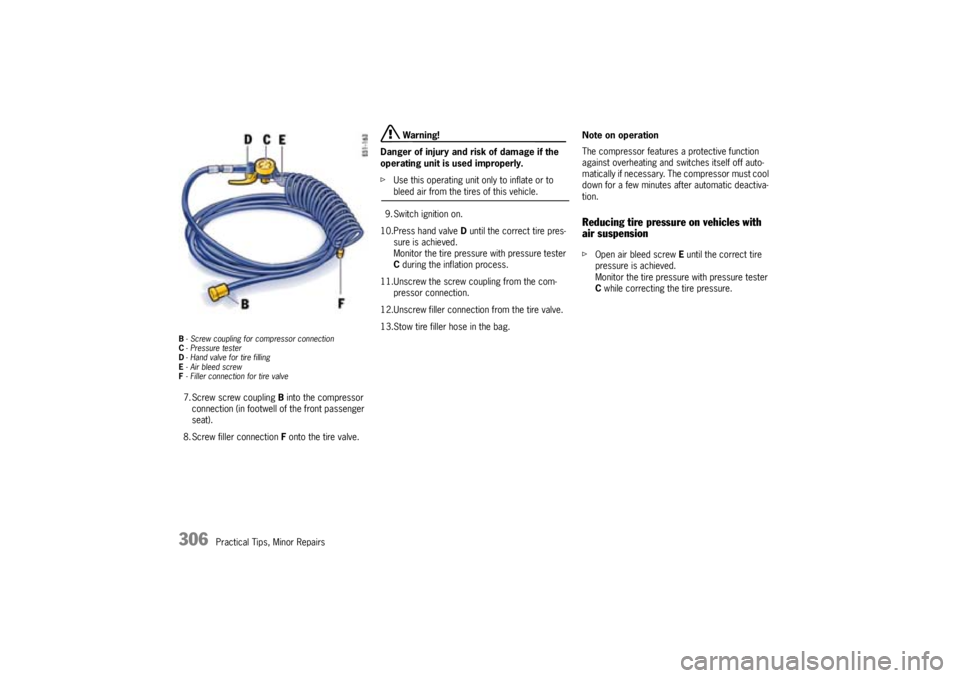
B- Screw coupling for compressor connection
C- Pressure tester
D- Hand valve for tire filling
E- Air bleed screw
F- Filler connection for tire valve7. Screw screw coupling B into the compressor
connection (in footwell of the front passenger
seat).
8. Screw filler connection F onto the tire valve.
Warning!
Danger of injury and risk of damage if the
operating unit is used improperly.
fUse this operating unit only to inflate or to bleed air from the tires of this vehicle.
9. Switch ignition on.
10.Press hand valve Duntil the correct tire pres-
sure is achieved.
Monitor the tire pressure with pressure tester
C during the inflation process.
11.Unscrew the screw coupling from the com-
pressor connection.
12.Unscrew filler connection from the tire valve.
13.Stow tire filler hose in the bag.Note on operation
The compressor features a protective function
against overheating and switches itself off auto-
matically if necessary. The compressor must cool
down for a few minutes after automatic deactiva-
tion.
Reducing tire pressure on vehicles with
air suspensionfOpen air bleed screw E until the correct tire
pressure is achieved.
Monitor the tire pressure with pressure tester
C while correcting the tire pressure.
Page 310 of 380
310
Practical Tips, Minor Repairs
Electrical SystemIn order to avoid damage and faults in electrical or
electronic systems, electrical accessories should
be installed at your authorized Porsche dealer.
fUse only accessories authorized by Porsche.
Warning!
Risk of short circuit and fire.
Replacing fuses or relays with engine running
or the ignition on could cause electrical
shock.
fDisconnect the battery during all work on the electrical system.
RelaysRelays should be checked or changed only by an
authorized workshop.Alarm system, central lockingThe status of the central locking and alarm system
is not changed by disconnecting the battery.
When the battery is disconnected, the alarm
system ceases to function.
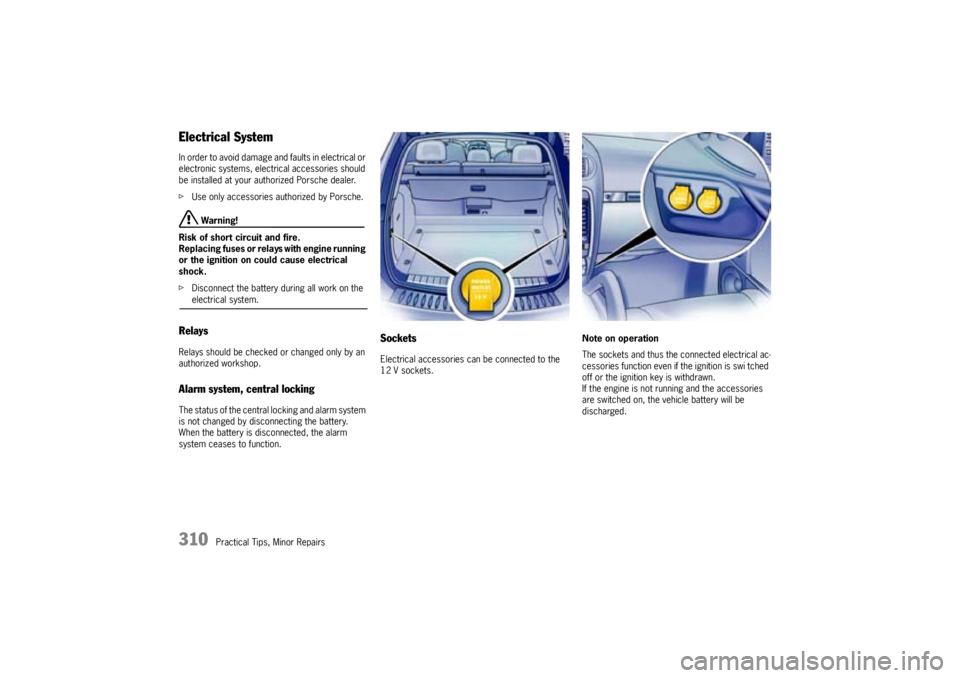
SocketsElectrical accessories can be connected to the
12 V sockets.Note on operation
The sockets and thus the connected electrical ac-
cessories function even if the ignition is swi tched
off or the ignition key is withdrawn.
If the engine is not running and the accessories
are switched on, the vehicle battery will be
discharged.
Page 311 of 380
Practical Tips, Minor Repairs
311
Changing fusesIn order to prevent damage to the electrical
system due to short circuits and overloads, the in-
dividual circuits are protected by fuses.
One fuse box is in the engine compartment. Two
additional fuse boxes are located in the outer ends
of the dashboard.
1. Switch off the consumer with the defective
fuse. Before replacing a fuse, switch off all
electrical consumers and remove the ignition
key.
2. Open the fuse-box lid.
3. Remove the corresponding fuse from its slot to
check it using the plastic gripper.
A blown fuse can be identified by the melted
metal strip.
4. Replace only with fuses of the same rating.
Note
If a fuse blows repeatedly, please consult an au-
thorized Porsche dealer immediately, so that the
short circuit can be located and corrected.
Never try to “repair“ fuses: you may cause serious
damage to other parts of the electrical system.
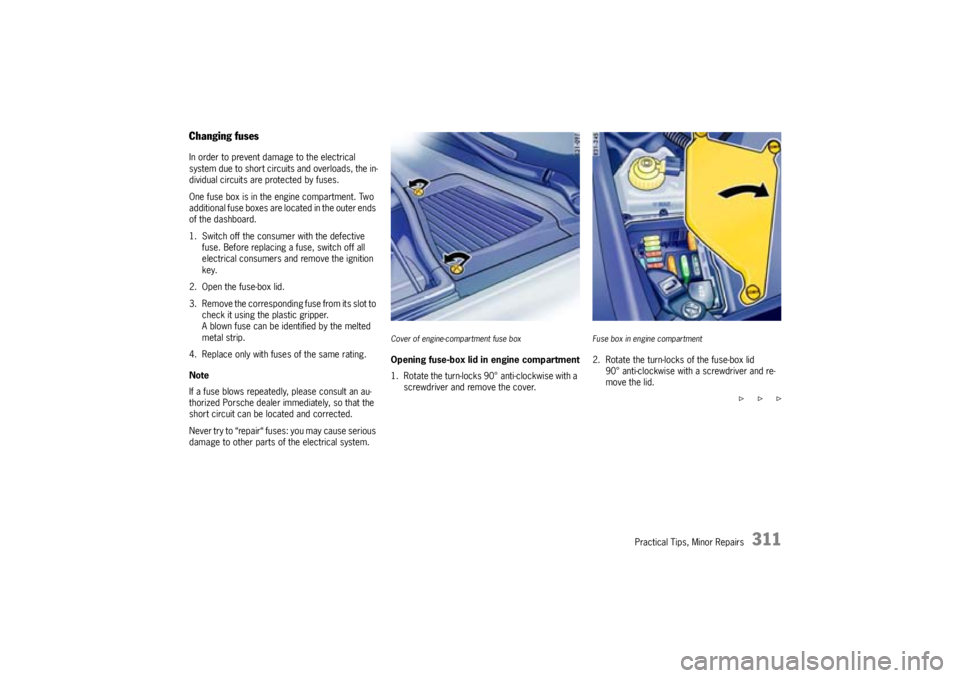
Cover of engine-compartment fuse boxOpening fuse-box lid in engine compartment
1. Rotate the turn-locks 90° anti-clockwise with a
screwdriver and remove the cover.
Fuse box in engine compartment2. Rotate the turn-locks of the fuse-box lid
90° anti-clockwise with a screwdriver and re-
move the lid.
f f f
Page 312 of 380
312
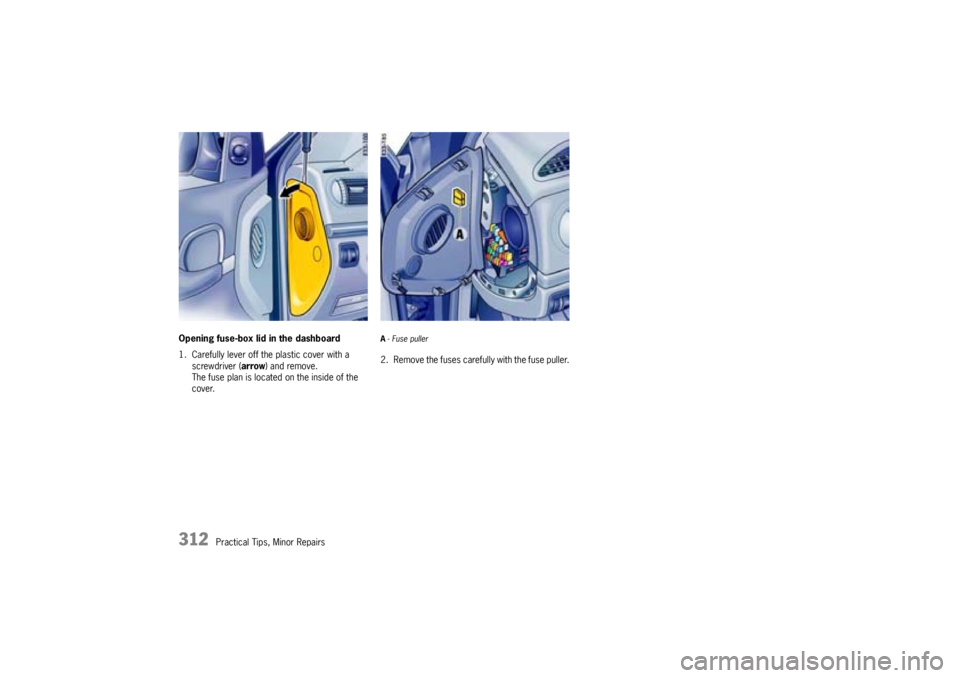
Practical Tips, Minor Repairs Opening fuse-box lid in the dashboard
1. Carefully lever off the plastic cover with a
screwdriver (arrow) and remove.
The fuse plan is located on the inside of the
cover.
A- Fuse puller2. Remove the fuses carefully with the fuse puller.