warning PORSCHE CAYNNE S 2005 1.G User Guide
[x] Cancel search | Manufacturer: PORSCHE, Model Year: 2005, Model line: CAYENNE S, Model: PORSCHE CAYENNE S 2005 1.GPages: 380, PDF Size: 3.17 MB
Page 30 of 380

30
Controls, Safety, Instruments
Power windows in passenger’s door and rear doorsNote on operation
Rocker switches A and B in the driver’s door have
a two-stage function:
– If the switch in question is pressed or pulled to
the first level, the front window is opened or
closed manually.
– If the switch is completely pressed or pulled to
the second level, the front window is opened or
closed automatically (one-touch operation).One-touch operation for front windows
fPull or press rocker switch to its final position
in the driver’s door.
Window moves to its final position.
Press or pull again to stop the window in the
desired position.
Comfort function when unlocking the vehicle
fHold the car key in the door lock in the unlock-
ing position until the windows and the
Panorama roof system have reached the de-
sired position.
If you unlock the vehicle with the key at the door
lock, only the driver’s door is opened. In order to
prevent the alarm system from being triggered,
you must switch the ignition on within 15 seconds
of opening the door.Comfort function when locking the vehicle
Warning!
Danger of injury. The window will close with
its full closing force.
fTake care to ensure that nobody can be injured when the windows close.
fHold the car key in the door lock in the locking
position until the windows and the sliding/lift-
ing roof or the Panorama roof system have
reached the desired position.
Comfort function when locking for vehicles
with Porsche Entry & Drive Warning!
Danger of injury. The window will close with
its full closing force.
fTake care to ensure that nobody can be injured when the windows close.
fPush the button in the door handle until the win-
dows and the sliding/lifting roof or the Panora-
ma roof system are closed.
Note on operation
The comfort function remains available for approx.
45 seconds after the vehicle has been locked.
Page 31 of 380

Controls, Safety, Instruments
31
Note on operation
If a door window is blocked during closing, it will
stop and open again by several inches.
However, this is not the case if:
– The rocker switch is pressed again within
10 seconds of the window being blocked and
– The windows are closed using the car key in
the door lock (comfort function).
The windows close with their full closing force.
Warning!
Danger of injury. If the rocker switch is
pressed again within 10 seconds of the
window being blocked, the window will close
with its full closing force.
fTake care to ensure that nobody can be injured when the windows close.
One-touch operation is disabled for 10 seconds
after blockage of the door window.
Storing final position of the door windowsThe end positions of the door windows are lost
when the battery is disconnected and reconnect-
ed. The one-touch operation of the windows is dis-
abled.
Perform these procedures for all windows:
1. Close window completely onceby pulling rock-
er switch.
2. Pull rocker switch again.
The upper end position of the window is
stored.
3. Open window completely onceby pressing
rocker switch.
4. Press rocker switch again.
The lower end position of the window is stored.The power windows, the central locking buttons
on the rear doors and the rear control panel for
the air conditioning can be disabled using the safe-
ty button Cin the armrest of the driver’s door.
Switching off
fPress safety button C.
The symbol in the safety button lights up.
Switching on
fPress safety button Cagain.
The symbol in the safety button goes out.
Safety button
Page 33 of 380
Controls, Safety, Instruments
33
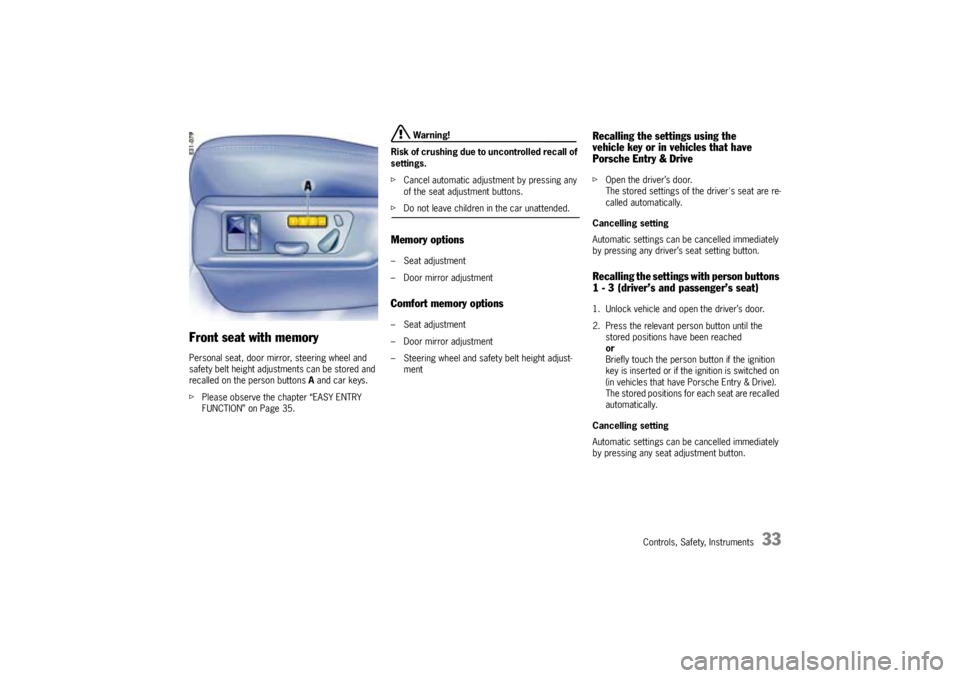
Front seat with memoryPersonal seat, door mirror, steering wheel and
safety belt height adjustments can be stored and
recalled on the person buttons A and car keys.
fPlease observe the chapter “EASY ENTRY
FUNCTION” on Page 35.
Warning!
Risk of crushing due to uncontrolled recall of
settings.
fCancel automatic adjustment by pressing any
of the seat adjustment buttons.
fDo not leave children in the car unattended.Memory options–Seat adjustment
– Door mirror adjustmentComfort memory options–Seat adjustment
– Door mirror adjustment
– Steering wheel and safety belt height adjust-
ment
Recalling the settings using the
vehicle key or in vehicles that have
Porsche Entry & DrivefOpen the driver’s door.
The stored settings of the driver's seat are re-
called automatically.
Cancelling setting
Automatic settings can be cancelled immediately
by pressing any driver’s seat setting button.Recalling the settings with person buttons
1 - 3 (driver’s and passenger’s seat)1. Unlock vehicle and open the driver’s door.
2. Press the relevant person button until the
stored positions have been reached
or
Briefly touch the person button if the ignition
key is inserted or if the ignition is switched on
(in vehicles that have Porsche Entry & Drive).
The stored positions for each seat are recalled
automatically.
Cancelling setting
Automatic settings can be cancelled immediately
by pressing any seat adjustment button.
Page 35 of 380
Controls, Safety, Instruments
35
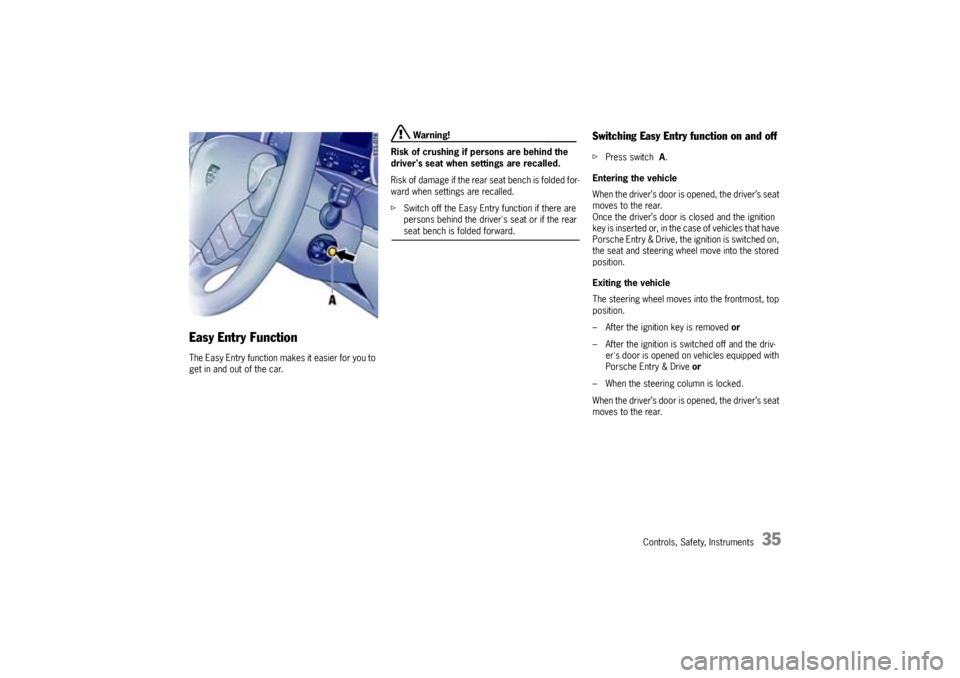
Easy Entry Function The Easy Entry function makes it easier for you to
get in and out of the car.
Warning!
Risk of crushing if persons are behind the
driver's seat when settings are recalled.
Risk of damage if the rear seat bench is folded for-
ward when settings are recalled.
fSwitch off the Easy Entry function if there are
persons behind the driver's seat or if the rear seat bench is folded forward.
Switching Easy Entry function on and offfPress switch A.
Entering the vehicle
When the driver’s door is opened, the driver’s seat
moves to the rear.
Once the driver’s door is closed and the ignition
key is inserted or, in the case of vehicles that have
Porsche Entry & Drive, the ignition is switched on,
the seat and steering wheel move into the stored
position.
Exiting the vehicle
The steering wheel moves into the frontmost, top
position.
– After the ignition key is removed or
– After the ignition is switched off and the driv-
er's door is opened on vehicles equipped with
Porsche Entry & Drive or
– When the steering column is locked.
When the driver’s door is opened, the driver’s seat
moves to the rear.
Page 42 of 380

42
Controls, Safety, Instruments
Safety Belts
Danger!
Always make sure your and your passengers'
safety belts are properly fastened while the
vehicle is in motion.
Failure to follow safety belt warnings may re-
sult in serious personal injury or death.
fFor your and your passengers' protection, use
safety belts at all times while the vehicle is in
motion.
fUse appropriate child restraint systems for all
small children.
Proper wearing of safety belts
fSafety belts must be positioned on the body as
to restrain the upper body and lap from sliding
forward. Improperly positioned safety belts
can cause serious personal injury in case of an
accident.
fThe shoulder belt should always rest on your
upper body. The shoulder belt should never be
worn behind your back or under your arm.
fFor maximum effectiveness, the lap belt
should be worn low across the hips.
fPregnant women should position the belt as
low as possible across the pelvis. Make sure it
is not pressing against the abdomen.
fBelts should not be worn twisted.fDo not wear belts over rigid or breakable ob-
jects in or on your clothing, such as eye glas-
ses, pens, keys, etc. as these may cause inju-
ry.
fSeveral layers of heavy clothing may interfere
with proper positioning of belts.
fBelts must not rub against sharp objects or
damage may occur to the belt.
fTwo occupants should never share the same
belt at the same time.
Care and maintenance
fKeep belt buckles free of any obstruction that
may prevent a secure locking.
fBelts that have been subjected to excessive
stretch forces in an accident must be inspect-
ed or replaced to ensure their continued effec-
tiveness in restraining you.
The same applies to belt tensioner systems
which have been triggered. In addition, the an-
chor points of the belts should be checked.
fIf safety belts do not work properly, see your
authorized Porsche dealer immediately.
fI f t h e b e l t s s h o w d a m a g e t o w e b b i n g , b i n d i n g s ,
buckles or retractors, they should be replaced
to ensure safe operation.
fDo not modify or disassemble the safety belts
in your vehicle.fThe belts must be kept clean or the retractors
may not work properly.
Please observe the chapter “CAR CARE IN-
STRUCTIONS” on Page 265.
fNever bleach or dye safety belts.
fDo not allow safety belts to retract until they
are completely dry after cleaning or this may
cause damage to the belt.
Page 43 of 380

Controls, Safety, Instruments
43
Belt tensionerDepending on the force of a collision, fastened
seat belts are automatically tightened in an acci-
dent.
The belt tensioners are triggered in:
– Front and rear impacts
The belt tensioners are not triggered in:
–Side impacts
– Vehicle overturning
Maintenance note
The belt tensioner system can be triggered only
once; the system must be replaced afterwards.
Work may be performed on the belt tensioner
system only by an authorized Porsche dealer.
Smoke is released when the belt tensioners are
triggered.
This does not indicate a fire in the vehicle.An audio-visual warning system is interconnect-
ed with the driver’s safety belt.
Every time the ignition is turned on, the gong will
sound for about 6 seconds to remind driver and
passenger to buckle up.
In addition, the gong will sound if vehicle speed
exceeds 6 mph (10 km/h.)
The safety belt warning lights in the instrument
panel and on-board computer will go off as soon
as the driver has buckled up.
Safety Belt Warning System
Page 46 of 380
46
Controls, Safety, Instruments
Child Restraint AnchoragesfPlease observe the chapter “AUTOMATIC LO-
CKING RETRACTOR” on Page 45.
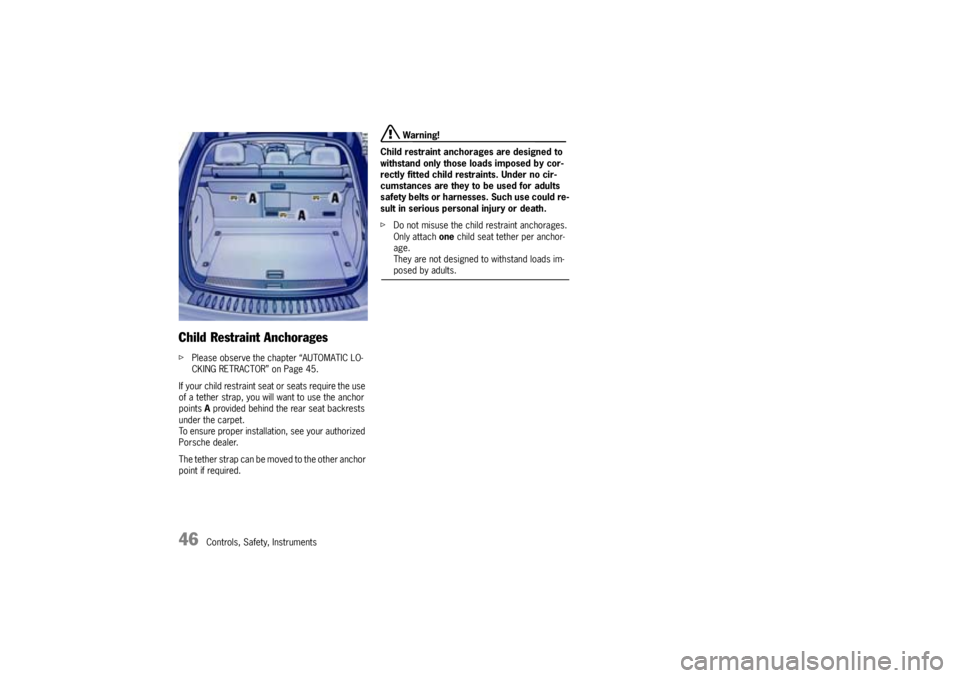
If your child restraint seat or seats require the use
of a tether strap, you will want to use the anchor
pointsA provided behind the rear seat backrests
under the carpet.
To ensure proper installation, see your authorized
Porsche dealer.
The tether strap can be moved to the other anchor
point if required.
Warning!
Child restraint anchorages are designed to
withstand only those loads imposed by cor-
rectly fitted child restraints. Under no cir-
cumstances are they to be used for adults
safety belts or harnesses. Such use could re-
sult in serious personal injury or death.
fDo not misuse the child restraint anchorages.
Only attach one child seat tether per anchor-
age.
They are not designed to withstand loads im-posed by adults.
Page 47 of 380
Controls, Safety, Instruments
47
Child Restraint SystemsPorsche recommends that all infants and children
be restrained in child restraint systems at all times
while the vehicle is in motion in accordance with
applicable laws.
The use of infant or child restraints is required by
law in all 50 states and the Canadian provinces.
The child restraint system should be one that com-
plies with U.S. Federal/Canadian Motor Vehicle
Safety Standards 213 and should be secured by a
lap belt or lap belt portion of a lap-shoulder belt or
for child seats equipped with the LATCH sytem
(LowerAnchorage and Tether for Children, also
known as ISOFIX) to the LATCH anchorages.
A statement by the seat manufacturer of compli-
ance with this standard can be found on the in-
struction label on the restraint and in the instruc-
tion manual provided with the restraint.
Danger!
Risk of serious personal injury or death to the
child.
fFollow all child restraint instructions and warnings in this manual.
– When using an infant or child restraint system,
be sure to follow all manufacturer's instruc-
tions on installation and use.
– Infants and small children should never be held
on the lap, nor should they share a safety belt
with another occupant while the vehicle is in
motion.
– Children too big for child restraint systems
should use regular safety belts. A shoulder belt
can be used providing it does not cross the
face or the neck of the child.
– For maximum safety and protection, do not
use a child restraint system in the front passen-
ger seat.
Danger!
The use of a child restraint system in the
front passenger seat can result in serious
personal injury or death to the child from an
airbag deployment.
To reduce risk of injury from an inflating air-
bag in an accident, Porsche strongly recom-
mends:
fDo not use a child restraint system in the front passenger seat.
fSeek appropriate advice from your authorized
Porsche dealer about the possible installation
of a Porsche child restraint system.
Rearward facing child restraint system:
fUse only in the rear seat. Must not ever be
used in the front seat.
Forward facing child restraint system:
fUse only in the rear seat. Must not ever be
used in the front seat.
Page 50 of 380
50
Controls, Safety, Instruments Danger!
To provide optimal occupant protection, air-
bags must inflate at very high speed. If you
are not wearing your safety belt or are too
close to the airbag when its deployed, inflat-
ing airbags can result in serious personal in-
jury or death.
fMake sure there are no people, animals or ob-
jects between the driver or passenger and the
area into which the airbag inflates.
fSit back as far from the dashboard or steering
wheel as is practical, while still maintaining full
vehicle control.
fDo not lean against the inside of the doors.
fAlways hold the steering wheel by the outer
rim. Never rest your hands on the airbag panel.
fNever transport heavy or sharp objects on or
in front of the passenger seat.
fAlways keep the lid of the door storage com-
partment closed. Objects must not protrude
out of the door storage compartment.
fGive your passenger all of the information in
this chapter.
fNo changes must be made to the wiring or
components of the airbag system.fDo not add any additional coverings or stickers
to the steering wheel or in the area of the pas-
senger airbag and side airbags. Doing so may
adversely affect the functioning of the airbag
system or cause harm to the occupants if the
airbag system should deploy.
fDo not undertake any wiring for electrical ac-
cessory equipment in the vicinity of the airbag
wiring harnesses. Doing so may disable the air-
bag system or inadvertant inflation.
fIf the warning light comes on, the airbag sys-
tem should be repaired immediately by your
authorized Porsche dealer.
fAlways keep feet in the footwell while driving.
Do not put feet on the dashboard or the seat
area.
Note
Airbag components (e.g. steering wheel, door
trim) may be disassembled only by an authorized
Porsche dealer.
When disposing of a used airbag unit, our safety
instructions must be followed. These instructions
can be obtained at any authorized Porsche dealer.Faults are indicated by a warning light on the ta-
chometer and a message on the instrument
panel’s multi-purpose display.
fPlease observe the chapter “WARNING LIGHTS
AND WARNING MESSAGES” on Page 108.
fIn the following cases you should immedi-
ately consult an authorized Porsche
dealer in order to assure the airbag sys-
tem is functioning properly:
– If the warning light does not light up when the
ignition is switched on or
– If the warning light does not go out once the
engine is running or
– If the warning light appears while driving.
Warning lights and warning
messages
Page 53 of 380
Controls, Safety, Instruments
53
Steering Wheel Adjustment
Warning!
Risk of accident. The steering wheel may
move further than desired if you attempt to
adjust it when driving.
You can lose control of the vehicle.
fDo not adjust the steering wheel when driving.
Risk of crushing due to uncontrolled recall of
seat memory settings.
fDo not leave children in the car unattended.
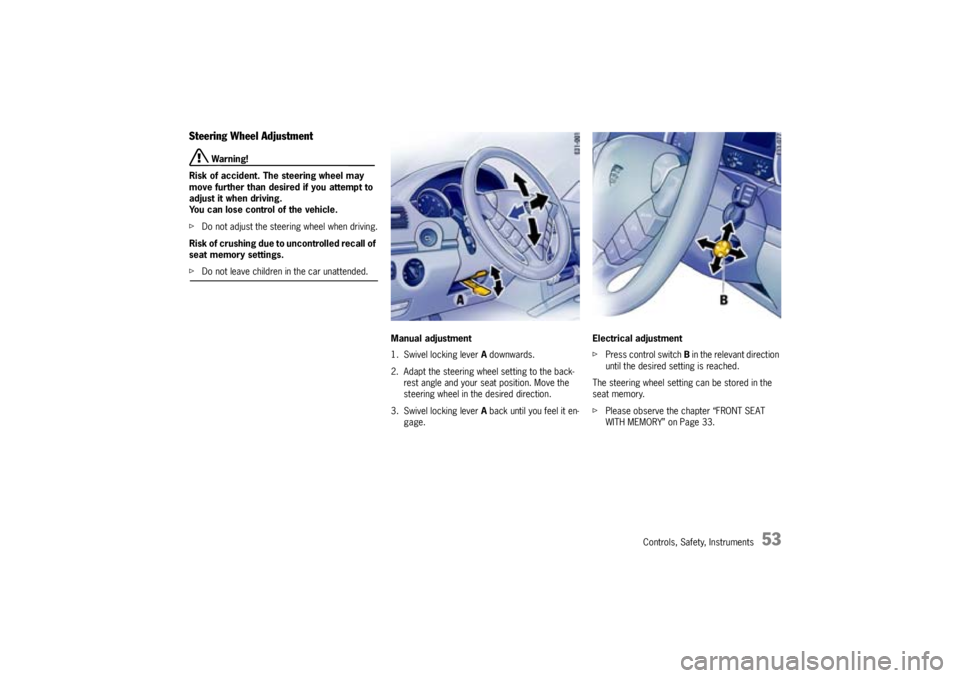
Manual adjustment
1. Swivel locking lever A downwards.
2. Adapt the steering wheel setting to the back-
rest angle and your seat position. Move the
steering wheel in the desired direction.
3. Swivel locking lever A back until you feel it en-
gage.Electrical adjustment
fPress control switch Bin the relevant direction
until the desired setting is reached.
The steering wheel setting can be stored in the
seat memory.
fPlease observe the chapter “FRONT SEAT
WITH MEMORY” on Page 33.