ignition PORSCHE CAYNNE S 2005 1.G Owner's Manual
[x] Cancel search | Manufacturer: PORSCHE, Model Year: 2005, Model line: CAYENNE S, Model: PORSCHE CAYENNE S 2005 1.GPages: 380, PDF Size: 3.17 MB
Page 54 of 380
54
Controls, Safety, Instruments
Multi-Functional Steering Wheel
Warning!
There is a danger of accident if you set or
operate the on-board computer, radio, navi-
gation system, telephone or other equipment
when driving.
This could distract you from the traffic and
cause you to lose control of the vehicle.
fOperate the components while driving only if
the traffic situation allows you to do so safely.
fCarry out any complicated operating or setting procedures only with the vehicle stationary.
Depending on the equipment in your vehicle, you
can use these function keys to operate the follow-
ing Porsche communication systems:
– Radio with CD drive
– CD changer
– Satelite radio
Readiness for operation of multi-
functional steering wheel– With ignition switched on and
– With Porsche communication systems
switched on.
fPlease observe the operating instructions sup-
plied for the Porsche communication systems
before operating the function keys.
Note on operation
The Porsche communication systems cannot be
switched on and off using the multi-functional
steering wheel.
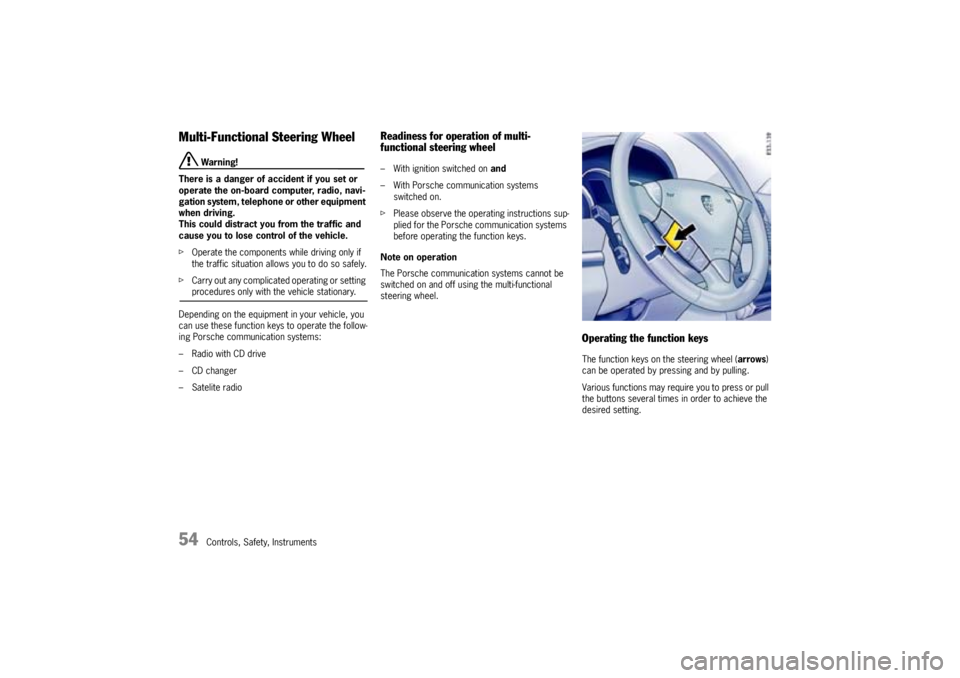
Operating the function keysThe function keys on the steering wheel (arrows)
can be operated by pressing and by pulling.
Various functions may require you to press or pull
the buttons several times in order to achieve the
desired setting.
Page 57 of 380

Controls, Safety, Instruments
57
Adjusting mirrorsfPlease observe the chapter “MIRRORS” on
Page 105.
1. Switch ignition on.
2. Select Afor the driver’s side or C for the
passenger’s side by turning the control switch.
3. Move the door mirrors in the appropriate
direction by tilting the control switch.
If the electrical adjustment facility fails
fAdjust the mirror by pressing on the mirror
face.Folding in door mirrorfSwitch ignition on.
fTurn control switch to D.
Both door mirrors fold in automatically.
If the electrical adjustment facility fails
fFold in mirror manually.
Unfolding door mirrorsfSwitch ignition on.
fTurn control switch to A or C.
Both door mirrors unfold automatically.
If the electrical adjustment facility fails
fUnfold mirrors manually.
Automatically swivelling down mirror
glass on the passenger's sidefPlease observe the chapter “FRONT SEAT
WITH MEMORY” on Page 33.
fPlease observe the chapter “PARKING AIDS”
on Page 162.Door mirror heatingThe door mirror heater is ready for operation
when the ignition is switched on.
Switching on
fTurn control switch to B.
Both door mirrors are heated.
Switching off
fChange the position of the control switch.
Page 59 of 380
Controls, Safety, Instruments
59
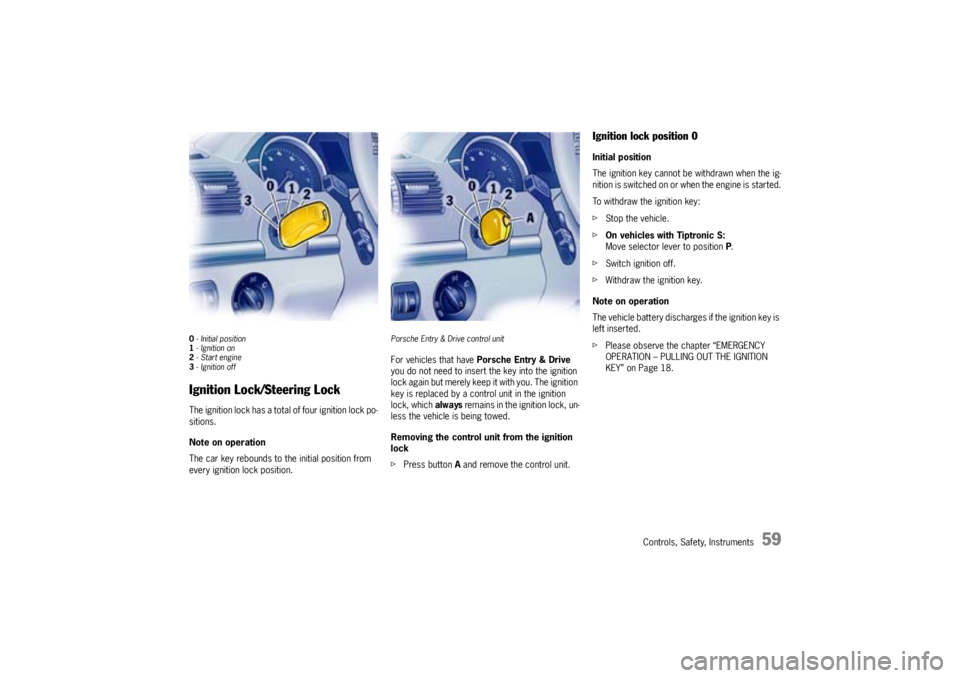
0- Initial position
1- Ignition on
2-Start engine
3- Ignition offIgnition Lock/Steering LockThe ignition lock has a total of four ignition lock po-
sitions.
Note on operation
The car key rebounds to the initial position from
every ignition lock position.
Porsche Entry & Drive control unitFor vehicles that have Porsche Entry & Drive
you do not need to insert the key into the ignition
lock again but merely keep it with you. The ignition
key is replaced by a control unit in the ignition
lock, which always remains in the ignition lock, un-
less the vehicle is being towed.
Removing the control unit from the ignition
lock
fPress button A and remove the control unit.
Ignition lock position 0Initial position
The ignition key cannot be withdrawn when the ig-
nition is switched on or when the engine is started.
To withdraw the ignition key:
fStop the vehicle.
fOn vehicles with Tiptronic S:
Move selector lever to position P.
fSwitch ignition off.
fWithdraw the ignition key.
Note on operation
The vehicle battery discharges if the ignition key is
left inserted.
fPlease observe the chapter “EMERGENCY
OPERATION – PULLING OUT THE IGNITION
KEY” on Page 18.
Page 60 of 380

60
Controls, Safety, Instruments
Ignition lock position 1Ignition on
fTurn ignition key to position 1.
Ignition is switched on.
Note on operation
All electrical equipment can be switched on.
The warning lights light up for a lamp check.
fPlease observe the chapter “INSTRUMENT PA-
NEL USA MODELS” on Page 70.Ignition lock position 2Starting engine
fOperate footbrake.
fFully depress and hold the clutch pedal or on
vehicles with Tiptronic S:
move the selector lever to position P or N.
fDo not press the accelerator pedal.
The engine control module will provide the
correct starting mixture.
fTurn ignition key to ignition lock position 2.fDo not operate the starter longer than approx.
10 seconds.
If necessary, repeat the starting procedure af-
ter a pause of approx. 10 seconds.
Turn the ignition key to ignition lock position 3
(ignition off) first.
fDo not warm up the engine when stationary.
Drive off immediately.
Avoid high revolutions and full throttle until the
engine has reached operating temperature.
fIf battery output is insufficient, jump leads can
be used to start the engine.
Please observe the chapter “EMERGENCY
STARTING WITH JUMPER CABLES” on
Page 331.
Notes on operation
The first operation of the starter is ended
automatically when the engine starts.
If the engine does not start, subsequent starter
operations will not be ended automatically.
When the engine is started, the warning lights
must go out.
Ignition lock position 3Ignition off
fTurn ignition key to ignition lock position 3.
Locking the steering column Vehicles without Porsche Entry & Drive
The steering column is automatically locked
when the ignition key is withdrawn from the
ignition lock.
The steering column is automatically unlocked
when the ignition key is inserted into the ignition
lock.
Vehicles with Porsche Entry & Drive
The steering column is automatically locked
when the ignition is switched off and the vehicle is
locked.
fTo lock intentionally, once the ignition is
switched off, turn the control unit again to the
ignition lock position 3 and hold it there for
2seconds.
The steering column is locked.
The steering column is automatically unlocked
by turning the control unit from ignition lock
position0.
Page 61 of 380

Controls, Safety, Instruments
61
Starting and Stopping the EnginefPlease observe the chapter “IMMOBILIZER” on
Page 19.
fPlease observe the chapter “EMISSION
CONTROL SYSTEM” on Page 263.
Danger!
Risk of poisoning. Exhaust gas contains
colorless and odorless carbon monoxide
(CO), which is toxic even in low concentra-
tion. Carbon monoxide can cause uncon-
sciousness and even death if inhaled.
fNever start or let the engine run in an en-
closed, unventilated area. It is not recommend-
ed to sit in your car for prolonged periods with
the engine on and the car not moving.
An unattended vehicle with a running engine
is potentially hazardous. If warning lights
should come on to indicate improper opera-
tion, they would go unnoticed.
fNever leave the engine idling unattended.
Danger of fire.
fDo not drive or park your car where combus-
tible materials, such as dry grass or leaves,
can come into contact with the hot exhaust
system.
fIf your car catches on fire for any reason, call
the fire department. Do not endanger your life by attempting to put out the fire.
Starting vehicles with manual
transmissionfOperate footbrake.
fFully depress and hold the clutch pedal.
fPut the gearshift lever in neutral.
fDo not press the accelerator pedal. The engine
control module will provide the correct starting
mixture.
fTurn ignition key to ignition lock position 2.
fDo not operate the starter longer than approx.
10 seconds. If necessary, repeat the starting
procedure after a pause of approx.
10 seconds. Turn the ignition key back to
ignition lock position 3 first.
The first operation of the starter is ended automat-
ically when the engine starts.
If the engine does not start, subsequent starter
operations will not be ended automatically.fDo not warm up the engine when stationary.
Drive off immediately.
Avoid high revolutions and full throttle until the
engine has reached operating temperature.
fIf battery output is insufficient, jump leads can
be used to start the engine.
fPlease observe the chapter “EMERGENCY
STARTING WITH JUMPER CABLES” on
Page 331.
Note on operation
To ensure a good charge condition for the battery
and thus its ability to start the engine, all electrical
accessories which are not required should be swit-
ched off when the ignition is switched on and when
engine revolutions are low (in stop and go traffic).
Page 62 of 380

62
Controls, Safety, Instruments
Starting vehicles with Tiptronic SfOperate footbrake.
fMove selector lever to position P or N.
fDo not press the accelerator pedal.
The engine control module will provide the
correct starting mixture.
fTurn ignition key to ignition lock position 2.
fDo not operate the starter longer than
approx. 10 seconds.
If necessary, repeat the starting procedure
after a pause of approx. 10 seconds. Turn the
ignition key back to ignition lock position 3
first.
The first operation of the starter is ended
automatically when the engine starts.
If the engine does not start, subsequent starter
operations will not be ended automatically.fDo not warm up the engine when stationary.
Drive off immediately.
Avoid high revolutions and full throttle until the
engine has reached operating temperature.
fIf battery output is insufficient, jump leads can
be used to start the engine.
Please observe the chapter “EMERGENCY
STARTING WITH JUMPER CABLES” on
Page 331.
Note on operation
To ensure a good charge condition for the battery
and thus its ability to start the engine, all electrical
accessories which are not required should be
switched off when the ignition is switched on and
when engine revolutions are low (in stop and go
traffic).
Starting with auxiliary batteryIf your vehicle is fitted with an additional battery
in the luggage compartment, you have the possi-
bility of starting the engine with the ignition key,
even if the main battery fails.
In vehicles with Porsche Entry & Drive:
1. Remove the Porsche Entry & Drive control unit
from the ignition lock.
Please observe the chapter “REMOVING THE
CONTROL UNIT FROM THE IGNITION LOCK” on
Page 59.
2. Insert the ignition key into the ignition lock and
start the engine as described.
fPlease have the cause of the fault remedied at
an authorized Porsche dealer.
Page 63 of 380

Controls, Safety, Instruments
63
StoppingfWithdraw the ignition key only when the vehicle
is stationary, otherwise the steering lock en-
gages and the vehicle cannot be steered.
fOnly switch the ignition off when the vehicle
comes to a stop, as there is no steering assis-
tance and brake boost when the engine is
switched off.
fAlways withdraw the ignition key and engage
the parking brake when leaving the vehicle.
The control unit always remains in the ignition
lock in vehicles that have Porsche Entry &
Drive.
Note on operation
The vehicle battery discharges if the ignition key is
left inserted.
Warning!
Danger of injury. Hot engine compartment
components can burn skin on contact.
fBefore working on any part in the engine com-
partment, turn the engine off and let it cool down sufficiently.Radiator fans
The radiator and radiator fans are in the front of
the car.
Warning!
Danger of injury. After the ignition is
switched off, the engine compartment and
coolant temperatures are monitored for ap-
prox. 30 minutes. During this period, and de-
pending on temperature, the radiator fan
may continue to run or start to run.
fCarry out work in these areas only with the en-gine off and exercise extreme caution.
Page 76 of 380
76
Controls, Safety, Instruments
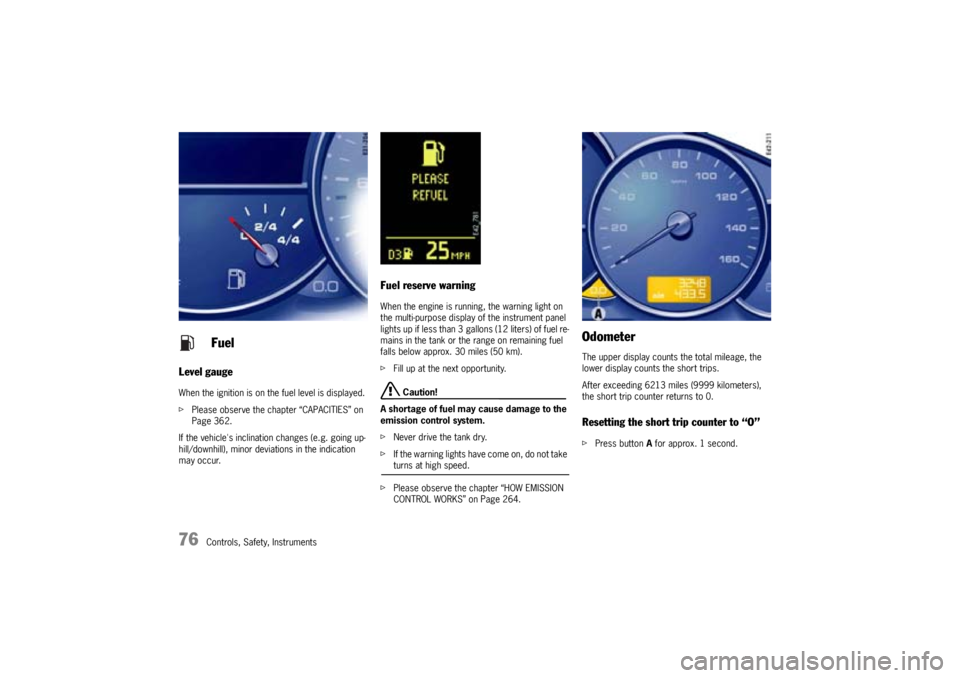
Level gaugeWhen the ignition is on the fuel level is displayed.
fPlease observe the chapter “CAPACITIES” on
Page 362.
If the vehicle's inclination changes (e.g. going up-
hill/downhill), minor deviations in the indication
may occur.
Fuel reserve warningWhen the engine is running, the warning light on
the multi-purpose display of the instrument panel
lights up if less than 3 gallons (12 liters) of fuel re-
mains in the tank or the range on remaining fuel
falls below approx. 30 miles (50 km).
fFill up at the next opportunity.
Caution!
A shortage of fuel may cause damage to the
emission control system.
fNever drive the tank dry.
fIf the warning lights have come on, do not take turns at high speed.
fPlease observe the chapter “HOW EMISSION
CONTROL WORKS” on Page 264.
OdometerThe upper display counts the total mileage, the
lower display counts the short trips.
After exceeding 6213 miles (9999 kilometers),
the short trip counter returns to 0.Resetting the short trip counter to “O”fPress button A for approx. 1 second.
Fuel
Page 79 of 380

Controls, Safety, Instruments
79
Emission ControlThe emission control system detects malfunctions
early that could, for example, cause increased pol-
lutant emissions or consequential damage.
Faults are indicated by the warning light in the in-
strument panel by being continuously lit or flash-
ing.
The faults are recorded in the control unit's fault
memory.
The warning light in the instrument panel lights up
when the ignition is switched on as a lamp check
and goes out approx. 4 seconds after the engine
starts.The warning light in the instrument panel flashes to
indicate operating states (e.g. engine misfiring)
which might cause damage to certain parts of the
emission control system.
fIn this case, immediately reduce the engine
load by easing off the accelerator.
The warning light in the instrument panel is lit
continuously after the critical range is left.
fIn order to avoid consequential damage to the
engine or emission control system (e.g. cata-
lytic converter) go immediately to the nearest
authorized Porsche dealer to have the fault
diagnosed and rectified.
Caution!
Risk of damage. If the warning light in the in-
strument panel continues flashing even when
you have eased off the accelerator pedal,
the emission control system may overheat.
fStop as soon as possible in a safe place.
Make sure that combustible materials, such as
dry grass or leaves, cannot come into contact
with the hot exhaust system.
fSwitch off the engine.
fContact your nearest authorized Porsche deal-er to have the fault rectified.
Check engine warning light
Page 80 of 380
80
Controls, Safety, Instruments
Multi-Purpose Display
Warning!
There is a danger of accident if you set or
operate the on-board computer, radio, navi-
gation system, telephone or other equipment
when driving.
This could distract you from the traffic and
cause you to lose control of the vehicle.
fOperate the components while driving only if
the traffic situation allows you to do so safely.
fCarry out any complicated operating or setting procedures only with the vehicle stationary.
It is not possible to describe all details of the
functions in this Owner's Manual.
The examples clearly demonstrate the functional
principle and clarify the menu structure.
As a rule, you can use the menu items:
MAIN MENU > SETTINGS > FACTORY SETTINGS
to return to the basic factory settings.
fPlease observe the chapter “FACTORY SET-
TINGS” on Page 107.
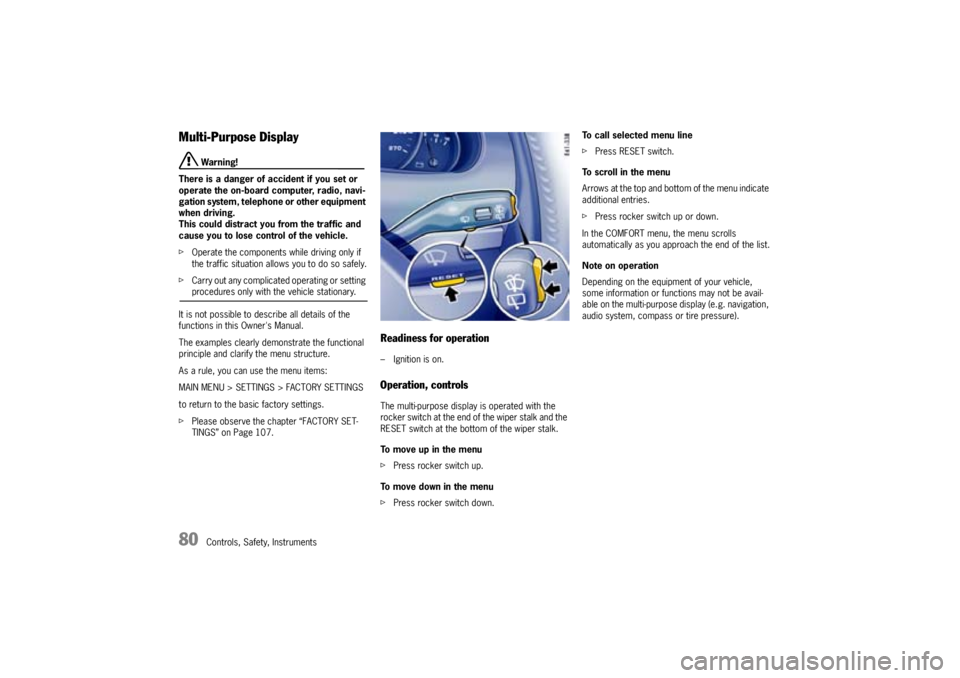
Readiness for operation– Ignition is on.Operation, controlsThe multi-purpose display is operated with the
rocker switch at the end of the wiper stalk and the
RESET switch at the bottom of the wiper stalk.
To move up in the menu
fPress rocker switch up.
To move down in the menu
fPress rocker switch down.To call selected menu line
fPress RESET switch.
To scroll in the menu
Arrows at the top and bottom of the menu indicate
additional entries.
fPress rocker switch up or down.
In the COMFORT menu, the menu scrolls
automatically as you approach the end of the list.
Note on operation
Depending on the equipment of your vehicle,
some information or functions may not be avail-
able on the multi-purpose display (e.g. navigation,
audio system, compass or tire pressure).