psm PORSCHE CAYNNE S 2005 1.G Owners Manual
[x] Cancel search | Manufacturer: PORSCHE, Model Year: 2005, Model line: CAYENNE S, Model: PORSCHE CAYENNE S 2005 1.GPages: 380, PDF Size: 3.17 MB
Page 70 of 380

70
Controls, Safety, Instruments
Instrument Panel USA ModelsWarning and indicator lights on the
tachometer
Indicator lights in central instrument
panelWarning and indicator lights on the
speedometer
A Oil temperature gauge
BTachometer
CClock
D Clock reset button
E Cooling system temperature gauge
F Multi-purpose display
G Fuel gauge
H Reset button for trip counter display
I Speedometer
J Mileage displays
KVoltmeter Emission Control warning light
(Check Engine)
Airbag warning light
Safety belt warning light
PSM warning light
ABS warning light
Cruise control readiness
Disengageable anti-roll bars
Indicator light
Turn signal light, left
Indicator light
Turn signal light, right
Indicator light
Trailer turn signal
Indicator light
Rear fog light indicator light
Tire pressure warning light
Differential locking indicator light
Brake warning light
Fog light indicator light
General warning
Observe warning message on the multi-
purpose display!
High beam indicator light
Page 72 of 380

72
Controls, Safety, Instruments
Instrument Panel Canada ModelsWarning and indicator lights on the
tachometer
Indicator lights in central instrument
panelWarning and indicator lights on the
speedometer
A Oil temperature gauge
BTachometer
CClock
D Clock reset button
E Cooling system temperature gauge
F Multi-purpose display
G Fuel gauge
H Reset button for trip counter display
I Speedometer
J Mileage displays
KVoltmeter Emission Control warning light
(Check Engine)
Airbag warning light
Safety belt warning light
PSM warning light
ABS warning light
Cruise control readiness
Disengageable anti-roll bars
Indicator light
Turn signal light, left
Indicator light
Turn signal light, right
Indicator light
Trailer turn signal
Indicator light
Rear fog light indicator light
Tire pressure warning light
Differential locking indicator light
Brake warning light
Fog light indicator light
General warning
Observe warning message on the multi-
purpose display!
High beam indicator light
Page 112 of 380

112
Controls, Safety, Instruments
Oil pressure too low Immediately stop in a suitable place and switch engine off.
Do not continue driving.
Check engine oil level. Add oil if necessary.
Do not continue driving if the warning light comes on even when
the oil level is correct. Have the fault remedied at an authorized
Porsche dealer.
Service in 1864 mls (3000 km)Service indicator
Bring the vehicle in for service no later than after the distance
shown has been covered.
Service nowService indicator
Have your vehicle serviced at an authorized Porsche dealer.
Brake pads – Workshop Have the brake pads replaced at an authorized Porsche dealer
without delay.
Warning – Brake circuit division Stop immediately in a suitable place. Do not continue driving.
Have the fault remedied at an authorized Porsche dealer.
ABS failure – WorkshopDrive carefully. Have the fault remedied at an authorized
Porsche dealer.
PSM failure – WorkshopDrive carefully. Have the fault remedied at an authorized
Porsche dealer.
Warning – Brake fluid level Stop immediately in a suitable place. Do not continue driving.
Have the fault remedied at an authorized Porsche dealer.
Parking brake Parking brake not released.
PSM onPorsche Stability Management was switched on.
PSM offPorsche Stability Management was switched off.
PHC failureThe Porsche Drive-Off Assistant (manual transmission) and the
Engine Braking Support (downhill assistance) are not available.
Brake booster faulty Greater braking pedal force necessary. Drive carefully to the
nearest authorized Porsche dealer.
Instrument
panelMulti-purpose
displayText display Meaning/measures
Page 125 of 380

Controls, Safety, Instruments
125
Accelerating (e.g. to overtake)Option 1
fIncrease the speed as usual with the accelera-
tor.
When you ease off the accelerator, the previ-
ously stored value is set again.
Option 2
fPush operating lever upwards into position 3
until the desired speed is reached.
The speed reached is maintained and stored
when the operating lever is released.
Option 3
fPush operating lever slightly upwards into po-
sition3(a maximum of 10 times).
The speed is increased by 1 mph (2 km/h).
Note on operation
Cruise control operation is automatically interrupt-
ed if the speed is increased by more than approx.
16 mph (25 km/h) for longer than 20 seconds.
DeceleratingOption 1
fPush operating lever down into position 4 until
the desired speed is reached.
The speed reached is maintained and stored
when the operating lever is released.
Option 2
fPush operating lever slightly downwards into
position4 (a maximum of 10 times).
The speed is reduced by 1 mph (2 km/h).
Interrupting cruise control operationThe speed driven before the interruption remains
stored in the memory.
fPush the operating lever forward to position 2
(it doesn’t engage) or
fOperate brake or clutch pedal or, on vehicles
with Tiptronic S, select position N.
fPlease observe the chapter “TIPTRONIC S” on
Page 203.
Cruise control operation is interrupted
automatically:
– If the set vehicle speed is exceeded by more
than approx. 16 mph (25 km/h) for longer than
20 seconds.
– If the actual vehicle speed falls by approx.
6 mph (10 km/h) below the set vehicle speed
for longer than 5 seconds (e.g. upward
slopes).
– If Porsche Stability Management (PSM) inter-
venes for longer than 0.2 seconds.
– If Low Range is switched on.
Page 205 of 380

Shifting Gear, Traction Systems
205
D - Automatic selection mode (in the road
driving program)The functions of selector lever positions Dand M
differ in the on-road program, High Range, and in
the off-road program, Low Range.
fUse selector lever position D for “normal” driv-
ing.
The gears are shifted automatically according
to the accelerator position and speed.
Depending on the way the vehicle is driven and on
the resistance (e.g. uphill), the gear-changing
points are shifted towards higher or lower engine-
speed ranges. Movement of the accelerator,
driving speed, longitudinal and lateral acceleration
and the road profile all have an influence on the
gear-changing characteristic.
When PSM is switched off, transmission gear
changes are done at higher engine speeds.
Unwanted upward shifts, e.g. before bends, are
prevented by swiftly releasing the accelerator ped-
al.
Depending on lateral acceleration, upward chang-
es on bends are not made until the engine-speed
limit is reached.
During braking, and depending on the amount of
deceleration, the Tiptronic changes down earlier.
For subsequent cornering, the right gear is en-
gaged when pressure is applied to the brakes be-
fore the bend.The bend is taken in the right gear, and when you
accelerate out of the bend you do not have to
change down.
Moving off
In 2nd gear, the vehicle moves off with the throttle
only slightly open. Move off in 1st gear with the
throttle open wider or when the engine is cold.
When PSM is switched off, the car generally
moves off in 1st gear.
Shifting gear on the steering wheel
By shifting gear with the rocker switches on the
steering wheel, you can temporarily change from
automatic selection mode D to manual selection
mode M.
Advantages
– Shifting down before bends and on entering
built-up areas.
– Shifting down on downward slopes (engine
braking).
– Shifting down for brief spurts of acceleration.
– Selecting 1st or 2nd gear for moving off.
The manual selection mode remains engaged:
– For cornering (depending on the lateral accel-
eration) and overrunning,
– When the vehicle is stationary (e.g. at a junc-
tion).The system leaves manual selection mode:
– automatically after around 8 seconds
(unless car is cornering, overrunning or
stationary),
– if you depress the accelerator to kickdown.
Temporary change-down
Precondition
– Speed is higher than approx. 33 mph
(54 km/h).
fDepress accelerator quickly.
The Tiptronic changes temporarily to the sport-
iest gear-changing map, i.e. to the highest pos-
sible gear-changing points. Correspondingly,
the transmission shifts down immediately by
one, two or three gears.
Ending the function
fRelease the accelerator markedly (by approx.
25%).
f f f
Page 207 of 380
Shifting Gear, Traction Systems
207
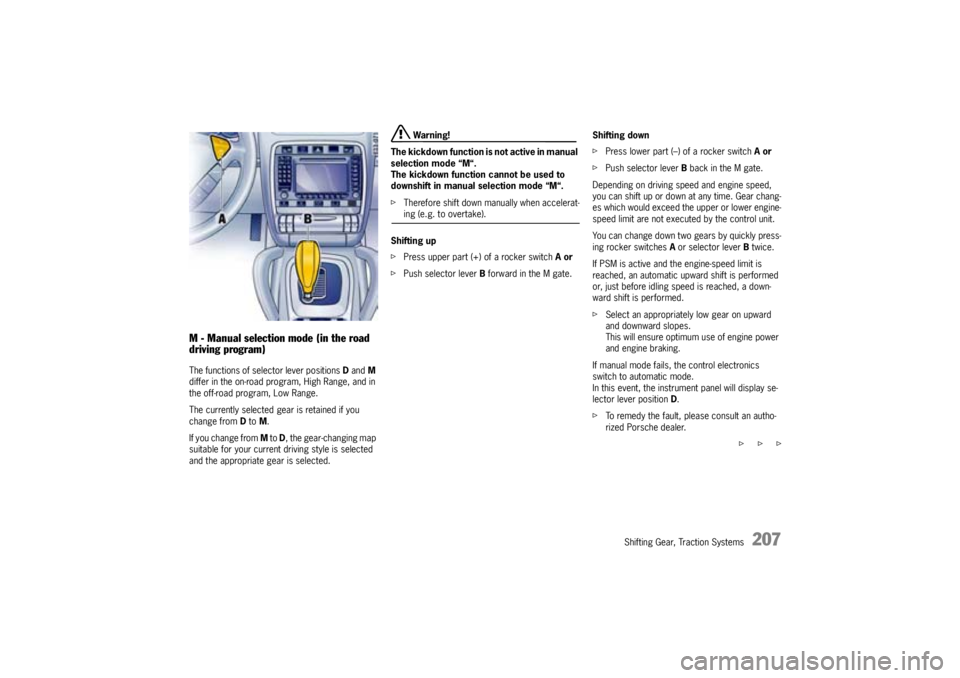
M - Manual selection mode (in the road
driving program)The functions of selector lever positions Dand M
differ in the on-road program, High Range, and in
the off-road program, Low Range.
The currently selected gear is retained if you
change from D to M.
If you change from M to D, the gear-changing map
suitable for your current driving style is selected
and the appropriate gear is selected.
Warning!
The kickdown function is not active in manual
selection mode “M“.
The kickdown function cannot be used to
downshift in manual selection mode “M“.
fTherefore shift down manually when accelerat-ing (e.g. to overtake).
Shifting up
fPress upper part (+) of a rocker switch Aor
fPush selector lever B forward in the M gate.Shifting down
fPress lower part (–) of a rocker switch Aor
fPush selector lever B back in the M gate.
Depending on driving speed and engine speed,
you can shift up or down at any time. Gear chang-
es which would exceed the upper or lower engine-
speed limit are not executed by the control unit.
You can change down two gears by quickly press-
ing rocker switches A or selector lever B twice.
If PSM is active and the engine-speed limit is
reached, an automatic upward shift is performed
or, just before idling speed is reached, a down-
ward shift is performed.
fSelect an appropriately low gear on upward
and downward slopes.
This will ensure optimum use of engine power
and engine braking.
If manual mode fails, the control electronics
switch to automatic mode.
In this event, the instrument panel will display se-
lector lever position D.
fTo remedy the fault, please consult an autho-
rized Porsche dealer.
f f f
Page 211 of 380
Shifting Gear, Traction Systems
211
Driving Programs for On-Road and
Off-Road DrivingTwo different driving programs with special power-
transmission and running-gear control systems
(such as ABS, off-road ABS and PSM, etc.) are pro-
vided in your Porsche, with the aim of realising the
best possible driving dynamics combined with
maximum safety.
All control systems meet these requirements for
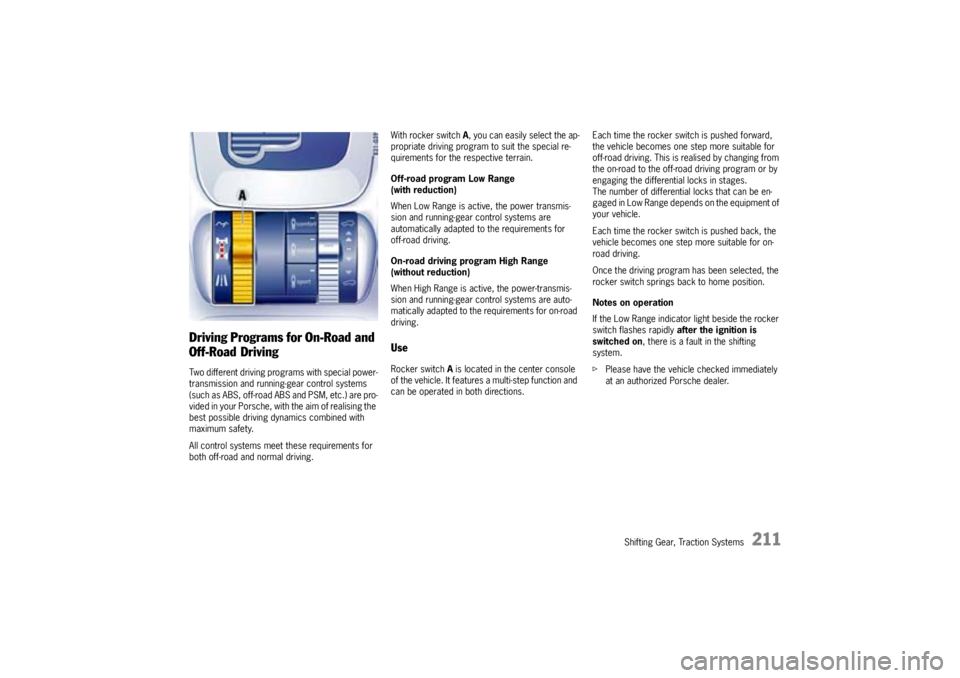
both off-road and normal driving.With rocker switch A, you can easily select the ap-
propriate driving program to suit the special re-
quirements for the respective terrain.
Off-road program Low Range
(with reduction)
When Low Range is active, the power transmis-
sion and running-gear control systems are
automatically adapted to the requirements for
off-road driving.
On-road driving program High Range
(without reduction)
When High Range is active, the power-transmis-
sion and running-gear control systems are auto-
matically adapted to the requirements for on-road
driving.
UseRocker switch A is located in the center console
of the vehicle. It features a multi-step function and
can be operated in both directions. Each time the rocker switch is pushed forward,
the vehicle becomes one step more suitable for
off-road driving. This is realised by changing from
the on-road to the off-road driving program or by
engaging the differential locks in stages.
The number of differential locks that can be en-
gaged in Low Range depends on the equipment of
your vehicle.
Each time the rocker switch is pushed back, the
vehicle becomes one step more suitable for on-
road driving.
Once the driving program has been selected, the
rocker switch springs back to home position.
Notes on operation
If the Low Range indicator light beside the rocker
switch flashes rapidly after the ignition is
switched on, there is a fault in the shifting
system.
fPlease have the vehicle checked immediately
at an authorized Porsche dealer.
Page 217 of 380

Shifting Gear, Traction Systems
217
Power-Transmission and Running-Gear Control SystemsA complex interconnection of all control systems acting in power transmission and in the running gear has been realised in your Porsche.
All control systems have been linked with the aim of combining the best possible driving performance with maximum safety.
The following systems are involved:
System/designation Scope
PTM
Porsche Traction Management– Full-time all-wheel drive
– Electronically controlled center differential lock
– Automatic brake differential (ABD)
– Traction control system (TCS)
– Reduction gear/Low Range
PTM Plus
Porsche Traction ManagementIn addition to the PTM features, PTM Plus also includes:
– Electronically controlled rear differential lock
– Hydraulically disengageable anti-roll bars
PSM
Porsche Stability Management– Stability management system
– Anti-lock brake system (ABS)
– Traction control system (TCS)
– Automatic brake differential (ABD)
– Engine drag torque control (MSR)
Air suspension
with level control and height adjustment– Fully load bearing air spring struts with integral shock absorbers
– Air supply system with pressure accumulator
PAS M
Porsche Active Suspension Management– Shock absorber system with adaptive, continuous shock absorber control
Page 218 of 380

218
Shifting Gear, Traction Systems
Porsche Traction Management (PTM)Porsche Traction Management is a full-time all-
wheel control system designed to influence the
longitudinal and lateral dynamics. It is closely
linked with the Porsche Stability Management
(PSM) system:
PTM ensures the best possible power distribution
to the four driven wheels at the front and rear ax-
les. The system realises this optimal traction by in-
tervening in the lock control function of the trans-
fer case and rear differential. PTM is active at all
times and, unlike the PSM, cannot be switched off.Advantages of PTM
– Obvious improvement in traction, driving stabil-
ity and steering ability of the car.
– Vehicle is more manageable when driven at its
performance limits.
– Improved straight-ahead tracking and stability.
– The aforementioned features allow for a sport-
ier setup of the running gear.
– The TCS and ABD provide even better traction
for all wheels.
Safety notes!
In spite of the advantages of PTM, it is still the driv-
er’s responsibility to adapt his driving style and
maneuvres in line with road and weather condi-
tions, as well as the traffic situation.
The increased safety that is provided should not in-
duce you to take greater risks with your safety.
The limits set by the physics of driving cannot be
overcome, even with PTM.
Risks of accident due to inappropriate speed
cannot be reduced by PTM.
Page 220 of 380

220
Shifting Gear, Traction Systems
Porsche Stability Management (PSM)PSM is an active control system for stabilisation of
the vehicle during extreme driving maneuvres. It
operates together with the Porsche Traction
Management (PTM) system.
PSM makes use of both the ABD and TCS sys-
tems, as well as the known functions of the anti-
lock brake system (ABS) and engine drag torque
control system (MSR).
Safety notes!
In spite of the advantages of PSM, it is still the driv-
er’s responsibility to adapt his driving style and
maneuvres in line with road and weather condi-
tions, as well as the traffic situation.
The increased safety that is provided should not in-
duce you to take greater risks with your safety.
The limits set by the physics of driving cannot be
overcome, even with PSM.
Risks of accident due to inappropriate speed
cannot be reduced by PSM.Advantages of PSM
– Best possible traction and lane-holding ability
in all driving situations – even on road surfaces
with varying friction.
– The system compensates for undesired vehi-
cle reactions (Ferraria effect) when the driver
releases the accelerator pedal or brakes on
bends. This compensation functions up to the
maximum lateral acceleration.
– PSM actively stabilises the vehicle in the event
of under and oversteering during dynamic
driving maneuvres (e.g. rapid steering move-
ments, during lane changes or on alternating
bends).
– Improved braking stability on bends and on dif-
ferent or varying road surfaces.Readiness for operation
PSM is switched on automatically every time you
start the engine.
Function
Sensors at the wheels, brakes, steering system
and engine continuously measure:
–Driving speed
– Direction of travel
– Lateral acceleration
– Longitudinal acceleration
– Rate of turn about the vertical axis
PSM uses these values to determine the direction
of travel desired by the driver.
PSM intervenes and corrects the course if the ac-
tual direction of motion deviates from the desired
course (steering-wheel position):
It brakes individual wheels as needed. If neces-
sary, PSM additionally influences the engine power
or the gear-changing characteristic of the Tiptron-
ic in order to stabilise the vehicle.