light PORSCHE CAYNNE S 2006 1.G Owners Manual
[x] Cancel search | Manufacturer: PORSCHE, Model Year: 2006, Model line: CAYENNE S, Model: PORSCHE CAYENNE S 2006 1.GPages: 420, PDF Size: 3.81 MB
Page 256 of 420
256
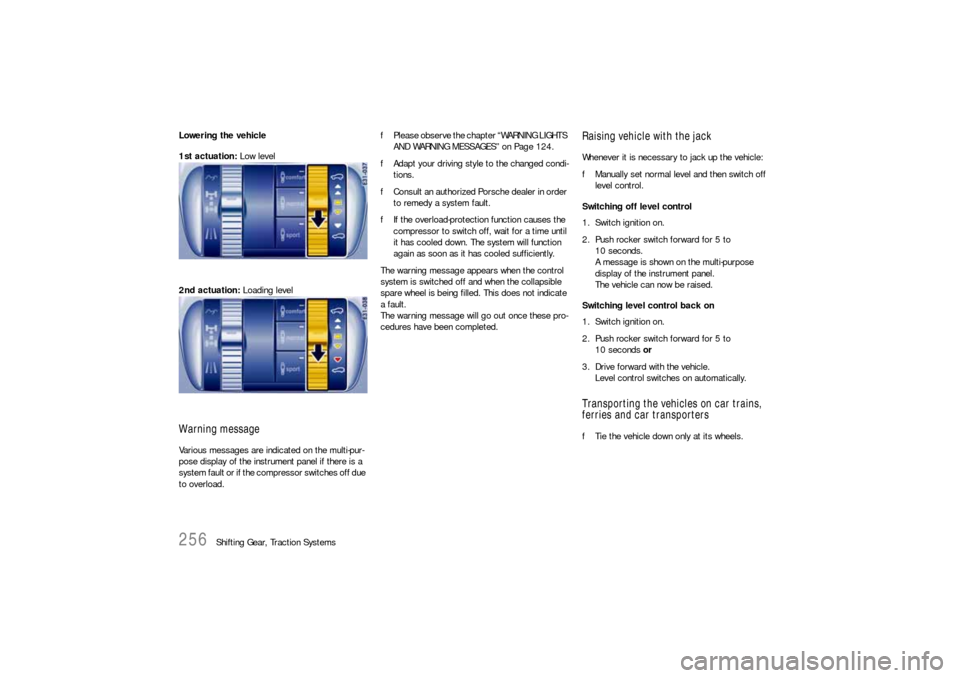
Shifting Gear, Traction Systems Lowering the vehicle
1st actuation: Low level
2nd actuation: Loading level
Warning messageVarious messages are indicated on the multi-pur-
pose display of the instrument panel if there is a
system fault or if the compressor switches off due
to overload.fPlease observe the chapter “WARNING LIGHTS
AND WARNING MESSAGES” on Page 124.
fAdapt your driving style to the changed condi-
tions.
fConsult an authorized Porsche dealer in order
to remedy a system fault.
fIf the overload-protection function causes the
compressor to switch off, wait for a time until
it has cooled down. The system will function
again as soon as it has cooled sufficiently.
The warning message appears when the control
system is switched off and when the collapsible
spare wheel is being filled. This does not indicate
a fault.
The warning message will go out once these pro-
cedures have been completed.
Raising vehicle with the jackWhenever it is necessary to jack up the vehicle:
fManually set normal level and then switch off
level control.
Switching off level control
1. Switch ignition on.
2. Push rocker switch forward for 5 to
10 seconds.
A message is shown on the multi-purpose
display of the instrument panel.
The vehicle can now be raised.
Switching level control back on
1. Switch ignition on.
2. Push rocker switch forward for 5 to
10 seconds or
3. Drive forward with the vehicle.
Level control switches on automatically.Transporting the vehicles on car trains,
ferries and car transportersfTie the vehicle down only at its wheels.
Page 257 of 420
Shifting Gear, Traction Systems
257
Porsche Active Suspension
Management (PASM)Various messages are shown on the multi-purpose
display of the instrument panel.
fPlease observe the chapter “WARNING LIGHTS
AND WARNING MESSAGES” on Page 124.
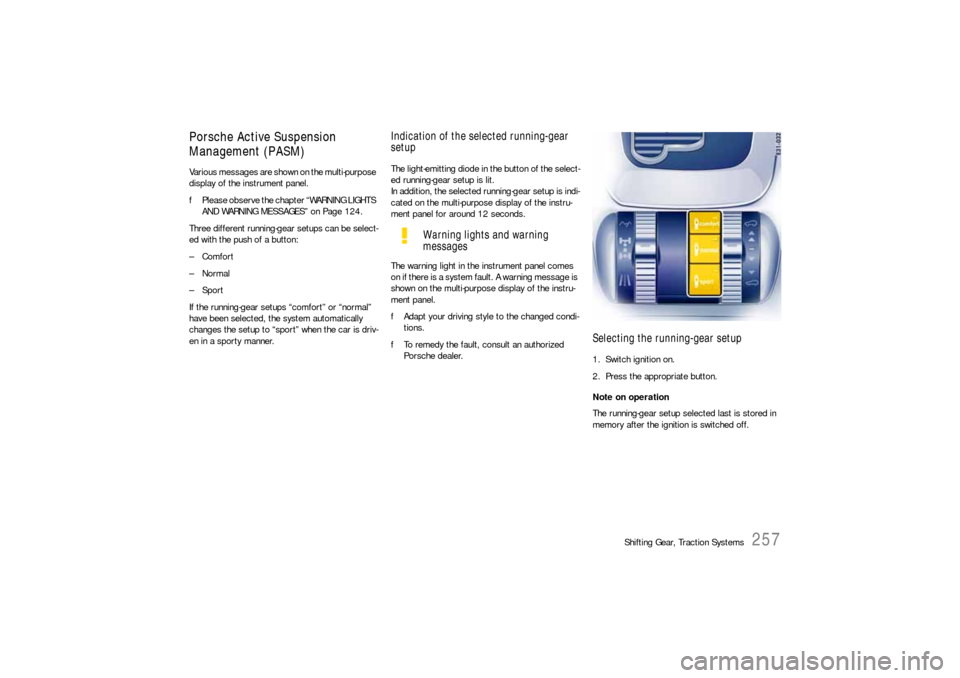
Three different running-gear setups can be select-
ed with the push of a button:
–Comfort
–Normal
–Sport
If the running-gear setups “comfort” or “normal”
have been selected, the system automatically
changes the setup to “sport” when the car is driv-
en in a sporty manner.
Indication of the selected running-gear
setupThe light-emitting diode in the button of the select-
ed running-gear setup is lit.
In addition, the selected running-gear setup is indi-
cated on the multi-purpose display of the instru-
ment panel for around 12 seconds.
The warning light in the instrument panel comes
on if there is a system fault. A warning message is
shown on the multi-purpose display of the instru-
ment panel.
fAdapt your driving style to the changed condi-
tions.
fTo remedy the fault, consult an authorized
Porsche dealer.
Selecting the running-gear setup1. Switch ignition on.
2. Press the appropriate button.
Note on operation
The running-gear setup selected last is stored in
memory after the ignition is switched off.
Warning lights and warning
messages
Page 261 of 420

Maintenance, Car Care
261
Radiator fansThe radiator and radiator fans are in the front of
the car.
Warning!
Danger of injury. The fans can start running
as a function of temperature, even with the
engine switched off.
fExercise extreme caution when working in the area of the radiator fans.
Engine OilEngine oil consumption
It is normal for your engine to consume oil.
The rate of oil consumption depends on the quality
and viscosity of oil, the speed at which the engine
is operated, the climate, road conditions as well
as the amount of dilution and oxidation of the lubri-
cant.
If the vehicle is used for repeated short trips, and
consumes a normal amount of oil, the engine oil
measurement may not show any drop in the oil lev-
el at all, even after 600 miles (1000 km) or more.
This is because the oil is gradually becoming dilut-
ed with fuel or moisture, making it appear that the
oil level has not changed.
The diluting ingredients evaporate out when the
vehicle is driven at high speeds, as on an express-
way, making it then appear that oil is excessively
consumed after driving at high speeds.
If the conditions you drive your vehicle in are
dusty, humid, or hot, the frequency of the oil
change intervals should be greater.If the vehicle is driven at a high rate of speed, cli-
matic conditions are warm, and the load is high,
the oil should be checked more frequently, as driv-
ing conditions will determine the rate of oil con-
sumption.
– The engine in your vehicle depends on oil to lu-
bricate and cool all of its moving parts. There-
fore, the engine oil should be checked regular-
ly and kept at the required level.
– Make it a habit to have the engine oil level
checked with every fuel filling.
– The oil pressure warning light is not an oil level
indicator.
The oil pressure warning light indicates serious
engine damage may be occuring when lit, if en-
gine rpm is above idle speed.
Page 262 of 420

262
Maintenance, Car Care
Engine Oil LevelfCheck the oil level regularly. I t i s b e s t t o d o t h i s
when refuelling and before extended journeys.
Further important information concerning “mainte-
nance” can be found in a separate chapter.
fPlease observe the chapter “EXERCISE
EXTREME CAUTION WHEN WORKING ON YOUR
VEHICLE” on Page 260.
fPlease observe the chapter “WARNING LIGHTS
AND WARNING MESSAGES” on Page 124.
Warning!
Engine oil is hazardous to your health and
may be fatal if swallowed.
fKeep engine oil out of children's reach.
Used engine oil contains chemicals that have
caused cancer in laboratory animals.
fAlways protect your skin by washing thorough-ly with soap and water.If the oil level is too low, this is indicated by the oil-
level warning light lighting up on the multi-purpose
display.
fCheck the oil level using the oil dipstick as
soon as possible and add engine oil if neces-
sary.
Note on operation
fIf the engine compartment lid is opened and oil
is not added, the warning message appears
again after approximately 100 km.
Checking the oil level
Warning!
Danger of injury. The radiator fans can start
running as a function of temperature, even
with the engine switched off.
Risk of burning from hot parts in engine com-
partment.
fExercise extreme caution when working on the engine compartment.Conditions for measuring the oil level
correctly
– Vehicle must be level.
– Engine must be switched off and at operating
temperature.
– Before the oil-level measurement, allow the en-
gine oil to flow back into the oil pan for around
3 minutes.
Checking oil level with the oil dipstick
1. Withdraw oil dipstick and wipe it with a clean,
lint-free cloth.
2. Push oil dipstick fully home, withdraw again
and read off the oil level.
The oil level must never fall below or ex-
ceed the “Min.” and “Max.” marks on the
dipstick.
The difference between the marks is approx.
1.6 qt. (1.5 liters).
3. Push oil dipstick in as far as the stop.
Oil-level warning
Page 269 of 420
Maintenance, Car Care
269
Brake-Fluid LevelfUse only new (unused) Original Porsche brake
fluid.
Further important information concerning “mainte-
nance” can be found in a separate chapter.
fPlease observe the chapter “EXERCISE
EXTREME CAUTION WHEN WORKING ON YOUR
VEHICLE” on Page 260.
Warning!
Brake fluid is hazardous to your health, and
may be fatal if swallowed.
Brake fluid also attacks paintwork.
fKeep brake fluid out of children's reach.
fImmediately rinse off spilled brake fluid with
clean water.
fIf brake fluid gets into your eye, immediately
rinse with clean water for a few minutes. Then
see a doctor immediately.
fPlease note all the information on the refill container of the brake fluid.
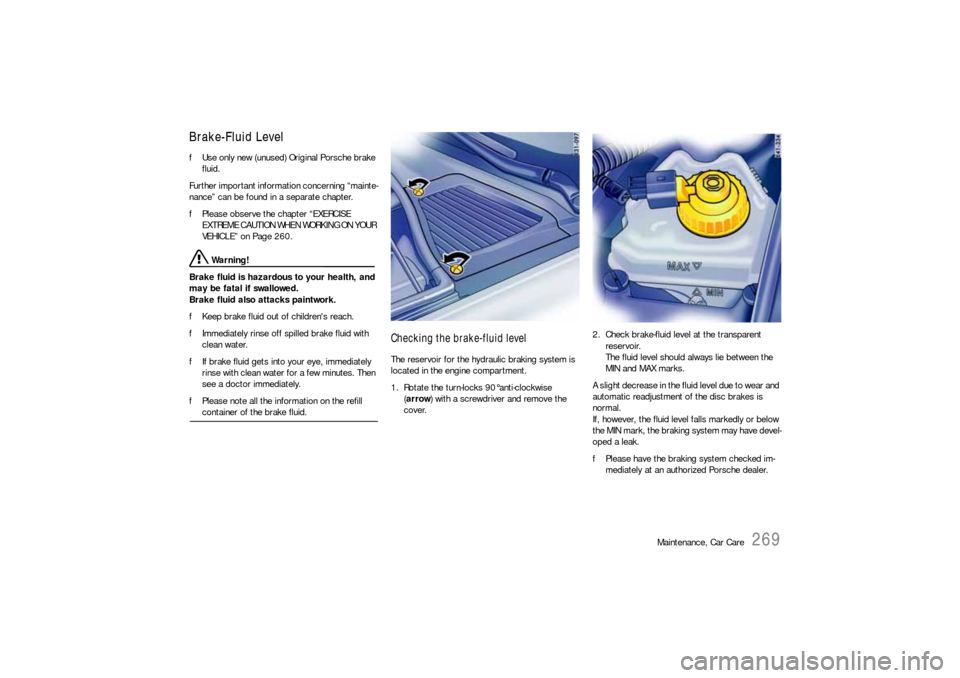
Checking the brake-fluid levelThe reservoir for the hydraulic braking system is
located in the engine compartment.
1. Rotate the turn-locks 90°anti-clockwise
(arrow) with a screwdriver and remove the
cover.2. Check brake-fluid level at the transparent
reservoir.
The fluid level should always lie between the
MIN and MAX marks.
A slight decrease in the fluid level due to wear and
automatic readjustment of the disc brakes is
normal.
If, however, the fluid level falls markedly or below
the MIN mark, the braking system may have devel-
oped a leak.
fPlease have the braking system checked im-
mediately at an authorized Porsche dealer.
Page 270 of 420
270
Maintenance, Car Care
Changing the brake fluidBrake fluid absorbs moisture from the air over
time. This accumulation of water lowers the boil-
ing point and, under certain operating conditions,
can affect the braking action.
fTherefore, have the brake fluid changed in ac-
cordance with the change intervals stated in
the booklet “Guarantee and Maintenance”.
The warning light in the instrument panel and the
warning message on the multi-purpose display of
the instrument panel indicate
– indicate the brake level fluid is too low or,
– in conjunction with large pedal travel could in-
dicate a braking-circuit failure.
Note on operation
If the warning lights should light up while driving:
fStop immediately in a suitable place.
fDo not continue driving.
Please have the fault remedied at your nearest
authorized Porsche dealer.
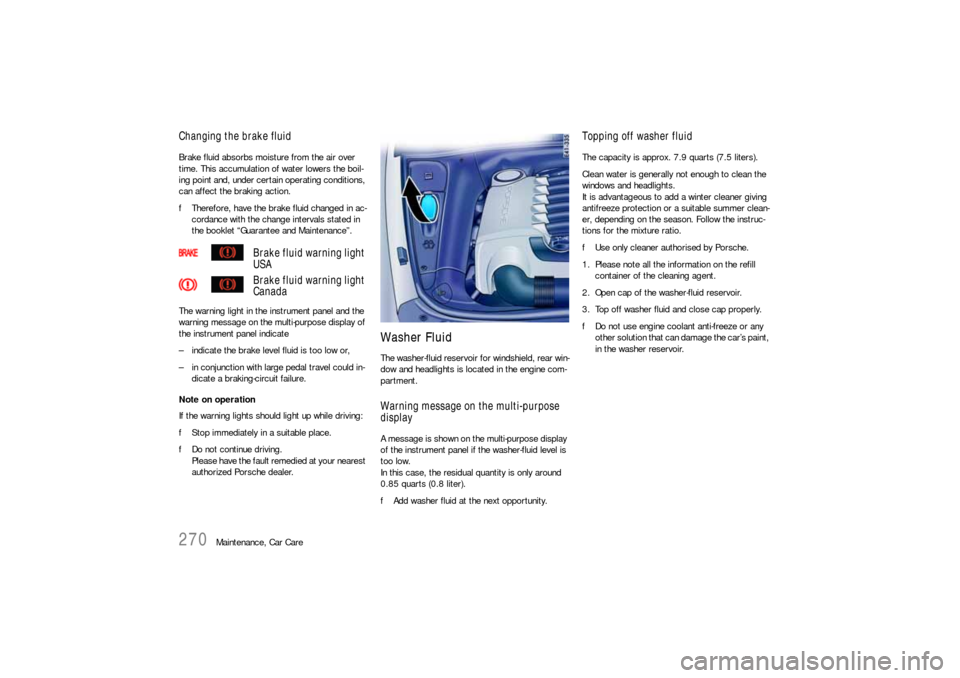
Washer FluidThe washer-fluid reservoir for windshield, rear win-
dow and headlights is located in the engine com-
partment.Warning message on the multi-purpose
displayA message is shown on the multi-purpose display
of the instrument panel if the washer-fluid level is
too low.
In this case, the residual quantity is only around
0.85 quarts (0.8 liter).
fAdd washer fluid at the next opportunity.
Topping off washer fluidThe capacity is approx. 7.9 quarts (7.5 liters).
Clean water is generally not enough to clean the
windows and headlights.
It is advantageous to add a winter cleaner giving
antifreeze protection or a suitable summer clean-
er, depending on the season. Follow the instruc-
tions for the mixture ratio.
fUse only cleaner authorised by Porsche.
1. Please note all the information on the refill
container of the cleaning agent.
2. Open cap of the washer-fluid reservoir.
3. Top off washer fluid and close cap properly.
fDo not use engine coolant anti-freeze or any
other solution that can damage the car’s paint,
in the washer reservoir.
Brake fluid warning light
USA
Brake fluid warning light
Canada
Page 277 of 420

Maintenance, Car Care
277
Fuel
Warning!
Fuel is highly flammable and harmful to
health.
fFire, open flame and smoking are prohibited
when handling fuel.
fAvoid contact with skin or clothing.
fDo not inhale fuel vapours.
To prevent damage to the emission control
system and engine:
fNever drive the tank completely out of fuel.
fAvoid high cornering speeds after the warning lights have come on.To avoid permanent damage to the functionality of
the catalytic converters and oxygen sensors, use
only unleaded fuel.
The engine is designed to provide optimum
performance and fuel consumption if unleaded
premium fuel with 98 RON/88 MON is used.
If unleaded premium fuels with octane numbers of
at least 95 RON/85 MON are used, the en-
gine's knock control automatically adapts the igni-
tion timing.
The emission control system can be damaged in
various ways (e.g. fuelling incorrectly, shortage of
fuel, tow-starting).
fPlease observe the chapter “HOW EMISSION
CONTROL WORKS” on Page 283.
fPlease observe the chapter “LEVEL GAUGE”
on Page 88.
f f f
Page 281 of 420

Maintenance, Car Care
281
Fuels containing MMTSome North American fuels contain an octane en-
hancing additive called methylcyclopentadienyl
manganese tricarbonyl (MMT).
If such fuels are used, your emission control sys-
tem performance may be negatively affected.
The check engine warning light on your instrument
panel may turn on.
If this occurs, Porsche recommends you stop us-
ing fuels containing MMT.
Portable Fuel Containers
Danger!
Portable fuel containers, full or partially
empty, may leak causing an explosion, or re-
sult in fire in case of an accident.
fNever carry additional fuel in portable contain-ers in your vehicle.
Fuel Evaporation ControlFuel tank ventingThe evaporation chamber and the carbon canister
prevent fuel from escaping to the atmosphere at
extreme high outside temperatures, when driving
abruptly around curves and when the car is parked
at an incline or in any other nonlevel position.Vapor control system and storageWhen the fuel tank is filled, vapors are collected in
the evaporation chamber by a vent line leading the
vapors to the carbon canister where they are
stored as long as the engine does not run.Purge systemWhen the engine is running, the fuel vapors from
the canister will be mixed with fresh air from the
ambient air of the canister. This mixture will be di-
rected to the intake air housing by the tank vent
line, mixed with the intake air and burned during
normal combustion.
Page 285 of 420

Maintenance, Car Care
285
High-pressure cleaning units
Warning!
High-pressure cleaning units can damage
the following components:
–Tires
– Logos, emblems
– Painted surfaces
– Widened fenders
– Lock and latch of the removable towing attach-
ment
– Seals of the electrically retractable ball hitch
– Alternator, valve covers
– ParkAssist sensors
fPlease observe the operating instructions from
the unit manufacturer.
fAlways cover the lid over the brake fluid reser-
voir prior to cleaning. Never point the cleaning
jet directly at the lid.
fWhen cleaning with a flat-jet nozzle or the like,
maintain a minimum distance of 21 in.
(50 cm).fNever use high-pressure cleaning units with a
round-jet nozzle.
A high-pressure cleaning unit with round nozzle
will damage your vehicle. The tires are particu-
larly susceptible to damage.
fDo not point the cleaning jet directly at any of
the aforementioned components.
WashingThe best protection for the car from the damaging
effects of the environment is frequent washing and
preservation. The underside of the car should also
be thoroughly washed for cinders, salt or sanding
at winter‘s end.
The longer salt, road dust, industrial dust, insect
remains, bird excrement, and tree exudations (res-
in, pollen), etc. are allowed to remain on the body-
work, the more serious is their harmful effect.
New cars should be washed carefully with plenty
of clear water to protect the new paint work.
Dark paint finishes show up the smallest of sur-
face damage (e.g. scratches) more readily than
lighter colors.
Dark colors are also more susceptible to scratch-
ing because of the composition of their pigments
and require particularly careful paint care.fDo not wash your car in bright sunlight or while
the bodywork is still hot.
fWhen washing by hand, use abundant water, a
soft sponge or wash brush and Porsche car
shampoo.
fBegin by spraying the body thoroughly with wa-
ter to rinse away loose dirt.
fAfter washing, rinse the car with plenty of wa-
ter and then dry with a chamois leather.
Do not use the same chamois leather for dry-
ing as you use for cleaning the windshield and
windows.
Warning!
Moisture which gets on the brakes during a
car wash can reduce braking efficiency or
make the brake pull unevenly which could in-
crease the danger of an accident, causing
serious personal injuries or death.
fAlways apply the brakes a few times after
washing the car to test braking efficiency and
dry the brake discs.
When doing this, take care not to hamper other
road users behind you (traffic conditions per-mitting).
Page 287 of 420

Maintenance, Car Care
287
PaintfNever rub a dusty car with a dry cloth since
dust particles are abrasive and could dull and
damage the surface finish.
The paintwork of your car is exposed to all types
of mechanical and chemical conditions, particular-
ly climatic ones such as bright sunlight, rain, frost
and snow. Ultraviolet light, rapid changes in tem-
perature, rain, snow, industrial dust and chemical
deposits constantly attack the paint which is only
able to withstand such exposure in the long term
if it is given regular care and attention.
fDo not treat matt-painted components with
preservatives or polishes, otherwise the matt
effect will be lost.Preservation
The paint surface becomes dull over time due to
weathering. It is therefore necessary to preserve
the paint regularly.
This keeps the paint shiny and elastic. Dirt is pre-
vented from adhering to the paint surface and in-
dustrial dust is prevented from penetrating the
paint.
Provided it is washed and treated with preserva-
tive regularly, the brand new finish of your car will
be retained for years to come.
fSimply apply paint preservative after washing
the car and polish it smooth.
Polishing
fDo not resort to using Porsche polish until it
becomes evident that the normal preserva-
tives no longer produce the desired finish.Removing spots and stains
fRemove tar stains, grease, oil spots and dead
insects etc. as soon as possible with Insect Re-
mover. They can cause discoloration if allowed
to remain on the paintwork.
fWash the affected area immediately after treat-
ing it.
Minor paint damage
fHave minor paint damage, such as scratches,
scores or chips caused by flying stones, re-
paired immediately by your authorized
Porsche dealer before corrosion begins.
However, if there are already traces of corrosion,
they must first be removed carefully and thorough-
ly. Coat the area with a rust-proofing primer and
finish off with a top coat. The paint code and color
number are found on the vehicle’s paint data plate.
fPlease observe the chapter “DATA BANK” on
Page 378.