light PORSCHE CAYNNE S 2006 1.G Owners Manual
[x] Cancel search | Manufacturer: PORSCHE, Model Year: 2006, Model line: CAYENNE S, Model: PORSCHE CAYENNE S 2006 1.GPages: 420, PDF Size: 3.81 MB
Page 233 of 420

Shifting Gear, Traction Systems
233
Disengaging
fPress button E.
Disengagement of the anti-roll bars is indicated
on the multi-purpose display of the instrument
panel and by illumination of light-emitting diode
F.
The light-emitting diode on the button flashes
several times during the disengagement
process.
The anti-roll bars are disengaged.
Note on operation
The anti-roll bars cannot be disengaged manually
at speeds above 25 mph (40 km/h).
Engaging
fPress button E.
Light-emitting diode F on the button flashes
several times during the engagement
process and then goes out.
The anti-roll bars are engaged.Note on operation
The anti-roll bars are engaged automatically when
a speed of 30 mph (50 km/h) is exceeded or
when the lateral acceleration value is high.
Notes
Engagement of the anti-roll bars is audible.
At temperatures below –4°F (–20°C), the anti-roll
bars take somewhat longer to engage.Indication of a fault by:
– Continuous illumination of the light-emitting
diode in the button
– Illumination of the warning light on the
instrument panel
– A message on the multi-purpose display of the
instrument panel
fAdapt your driving behavior to the changed
conditions.
Drive slowly to the nearest authorized Porsche
dealer and have the fault remedied.
fPlease observe the chapter “WARNING LIGHTS
AND WARNING MESSAGES” on Page 124.
Indicator light and warnings
Page 234 of 420

234
Shifting Gear, Traction Systems
Changing from off-road driving program
to on-road driving programVehicles with manual transmission
fStop the vehicle.
fApply the brake.
fPut the gearshift lever in neutral.
fPull rocker switch A back in stages until light-
emitting diodes B, C and if necessary, D are
out.
The Low Range indicator light on the instru-
ment panel and light-emitting diode B beside
the rocker switch flash several times during
the shifting process.
High Range is active.Vehicles with Tiptronic S
fReduce speed to below 19 mph (30 km / h) or
stop vehicle.
fMove selector lever to position N.
fPull rocker switch A back in stages until light-
emitting diodes B, C and if necessary, D are
out.
The Low Range indicator light on the instru-
ment panel and light-emitting diode B beside
the rocker switch flash several times during
the shifting process.
High Range is active.
Danger!
Serious risk of injury or death. Risk of
accident due to uncontrolled vehicle
movement. The selector lever is blocked
during the shifting procedure. Shifting when
driving uphill can cause the vehicle to stand
still or even roll backwards, if the shifting
procedure has not yet been completed.
When driving downhill, the vehicle can accel-
erate unintentionally while shifting.
fIncreased brake readiness is required.
fPlease observe the chapter “POWER-TRANS-
MISSION AND RUNNING-GEAR CONTROL SYS-
TEMS” on Page 235.
Page 239 of 420

Shifting Gear, Traction Systems
239
The events below inform the driver of PSM control
operations and warn him to adapt his driving style
to the road conditions:
– The multi-functional information light in the in-
strument panel lights up.
– Hydraulic noises can be heard.
– The vehicle decelerates and steering-wheel
forces are altered as the PSM controls the
brakes.
– Reduced engine power.
– The brake pedal pulsates and its position is
changed during braking.
However, it is possible at any time to achieve
full vehicle deceleration by increasing the foot
pressure slightly.
Examples of PSM control operations
–Vehicle understeers:
If the front wheels of the vehicle drift on a cor-
ner, engine power is reduced and the rear
wheel on the inside of the corner is braked if
necessary.
–Vehicle oversteers:
If the rear of the vehicle swings out on a cor-
ner, the front wheel on the outside of the cor-
ner is braked.Combined use of PSM and PTM/PTM Plus
In order to ensure optimal stabilisation of the
vehicle, the center differential lock (PTM) and
possibly the rear differential lock (PTM Plus) are
also opened when PSM interventions occur.
Tip on driving
When PSM is switched off, wheel-specific brake
interventions and the traction control system
(TCS) are also inactive.
The automatic brake differential (ABD) remains on.Off-road PSM
(PSM in Low Range program)
When Low Range is active, an off-road PSM
specially matched to off-road driving is activated
to enhance traction.
At a speed below 22 mph (35 km/h), the terrain
PSM intervenes later if the vehicle should unders-
teer and thereby improves steerability in Low
Range.
If the brakes are highly stressed, the automatic
brake differential (ABD) switches itself off to
protect the brakes. It remains deactivated until the
brake system has cooled sufficiently.
Engine drag torque control
In conditions of excessive slip, the engine drag
torque control system prevents all driven wheels
from locking up when the car is overrunning. This
is also the case for downshifts on a slippery road.
Page 240 of 420
240
Shifting Gear, Traction Systems
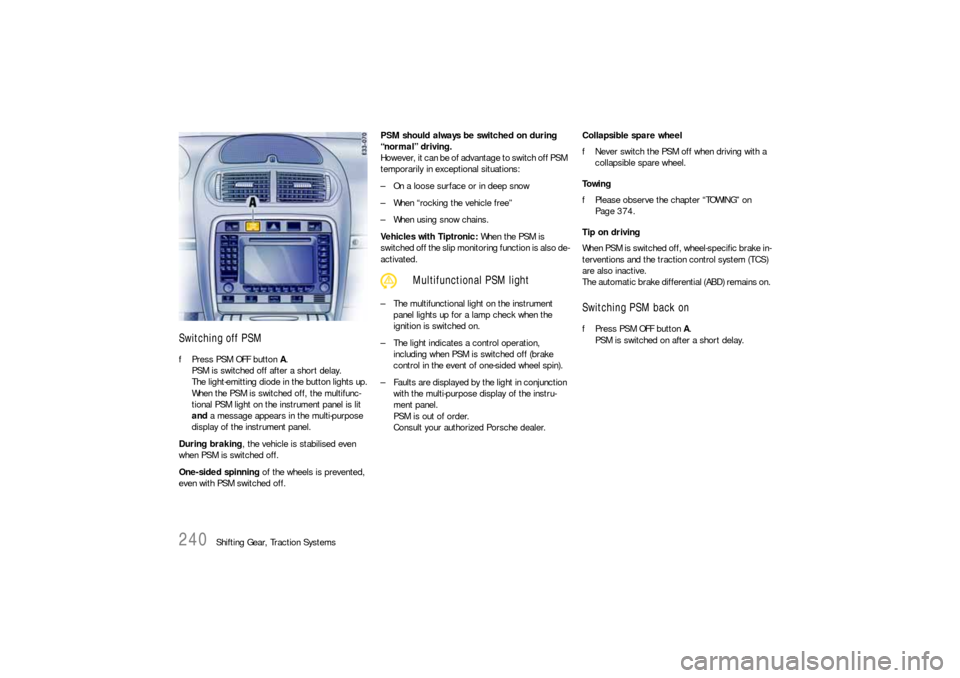
Switching off PSMfPress PSM OFF button A.
PSM is switched off after a short delay.
The light-emitting diode in the button lights up.
When the PSM is switched off, the multifunc-
tional PSM light on the instrument panel is lit
and a message appears in the multi-purpose
display of the instrument panel.
During braking, the vehicle is stabilised even
when PSM is switched off.
One-sided spinning of the wheels is prevented,
even with PSM switched off.PSM should always be switched on during
“normal” driving.
H o w e v e r, i t c a n b e o f a d v a n t a g e t o s w i t c h o f f P S M
temporarily in exceptional situations:
– On a loose surface or in deep snow
– When “rocking the vehicle free”
– When using snow chains.
Vehicles with Tiptronic: When the PSM is
switched off the slip monitoring function is also de-
activated.
– The multifunctional light on the instrument
panel lights up for a lamp check when the
ignition is switched on.
– The light indicates a control operation,
including when PSM is switched off (brake
control in the event of one-sided wheel spin).
– Faults are displayed by the light in conjunction
with the multi-purpose display of the instru-
ment panel.
PSM is out of order.
Consult your authorized Porsche dealer.Collapsible spare wheel
fNever switch the PSM off when driving with a
collapsible spare wheel.
To w i n g
fPlease observe the chapter “TOWING” on
Page 374.
Tip on driving
When PSM is switched off, wheel-specific brake in-
terventions and the traction control system (TCS)
are also inactive.
The automatic brake differential (ABD) remains on.
Switching PSM back onfPress PSM OFF button A.
PSM is switched on after a short delay.
Multifunctional PSM light
Page 241 of 420

Shifting Gear, Traction Systems
241
ABS
(Anti-lock Brake System)
Warning!
In spite of the advantages of ABS, it is still the driv-
er’s responsibility to adapt his driving style and
maneuvres in line with road and weather condi-
tions, as well as the traffic situation.
The increased safety that is provided should not in-
duce you to take greater risks with your safety.
The limits set by the physics of driving cannot be
overcome, even with ABS.
Risks of accident due to inappropriate speed can-
not be reduced by ABS.
ABS ensures:
–Full steering control
The vehicle remains steerable
–Good driving stability
No skidding due to locked wheels
–Optimum braking distance
Shorter stopping distances in most cases
–Lock prevention
No flat spots on the tiresFunction
The decisive advantage of ABS is in the driving
stability and maneuvrability of the vehicle in
hazardous situations, even during heavy braking
while cornering.
ABS prevents locking of the wheels during full
braking, on almost all road surfaces, until shortly
before the vehicle stops.
The ABS begins to control the braking process as
soon as a wheel shows a tendency to lock.
This controlled braking process is comparable to
extremely rapid cadence braking.
The pulsating brake pedal and a “rattling noise”
warn the driver to adapt his driving speed to the
road conditions.Warning light
If the ABS warning lights light up in the instrument
panel and on the multi-purpose display of the in-
strument panel while the engine is running, the
ABS has switched off because of a fault.
In this event, the braking system will operate with-
out lock prevention,as in cars without ABS.
fAdapt your driving style to the changed brak-
ing behavior.
fThe ABS must be checked immediately at an
authorized Porsche dealer. This is necessary
in order to prevent the occurrence of further
faults whose effects cannot be defined.
The ABS control unit is adjusted for the approved
tire dimensions.
The use of tires with non-approved dimensions can
lead to different wheel speeds, causing the ABS to
switch off.
f f f
Page 247 of 420

Shifting Gear, Traction Systems
247
Recommended procedure
fDeactivate Low Range.
fClean headlights and tail lights and check them
for signs of damage.
fClean the front and rear lincense plates.
fClean the tire tread with a jet of water and re-
move any foreign objects.
fClean wheels, wheel housings and the under-
body with a jet of water.
fCheck whether the car has picked up plant
parts or branches.
These materials increase the risk of fire and
can damage fuel lines, brake hoses, boots of
the axle joints and drive shafts.
fAfter off-road driving, always check the entire
floor assembly, tires, body structure, steering
system, running gear and exhaust system for
signs of damage.fAfter driving for an extended period through
mud, sand, water or substances with a similar
soiling effect, check the brake discs, brake
pads, wheels and axle joints and have them
cleaned.
fIf you experience severe vibrations after
driving off road, check the wheels for foreign
substances.
These substances can produce an imbalance
which might be responsible for the vibrations.
Removing these deposits may remedy the
problem.
Page 250 of 420
250
Shifting Gear, Traction Systems
Water crossingfPlease observe the chapter “GROUND CLEA-
RANCE” on Page 390.
Danger!
Danger of drowning if water enters the vehi-
cle. Risk of damage to the engine and acces-
sories if water penetrates.
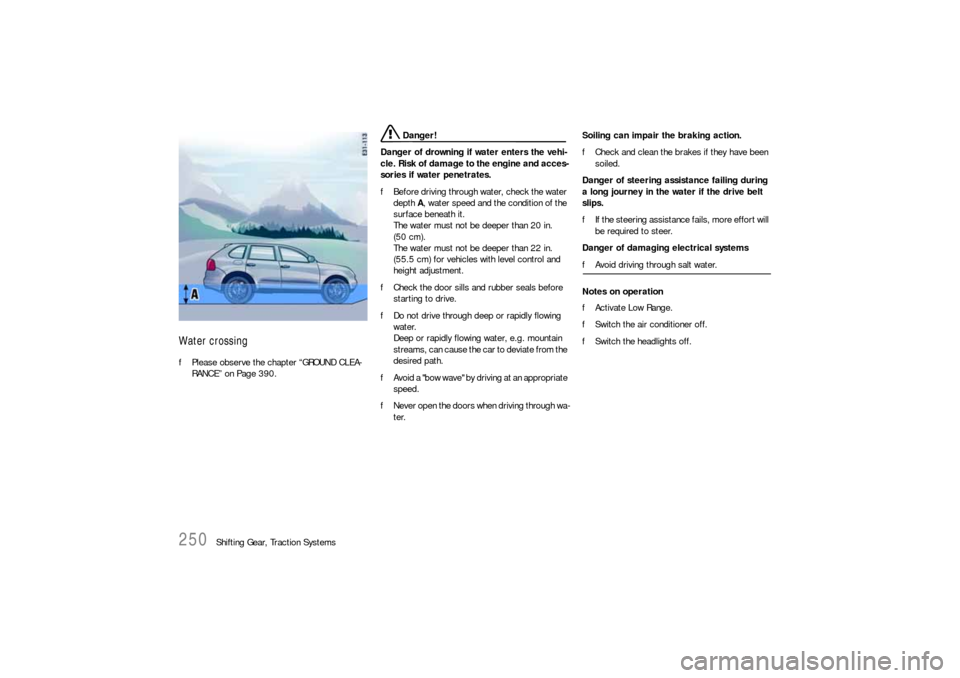
fBefore driving through water, check the water
depth A, water speed and the condition of the
surface beneath it.
The water must not be deeper than 20 in.
(50 cm).
The water must not be deeper than 22 in.
(55.5 cm) for vehicles with level control and
height adjustment.
fCheck the door sills and rubber seals before
starting to drive.
fDo not drive through deep or rapidly flowing
water.
Deep or rapidly flowing water, e.g. mountain
streams, can cause the car to deviate from the
desired path.
fAvoid a "bow wave" by driving at an appropriate
speed.
fNever open the doors when driving through wa-
ter.Soiling can impair the braking action.
fCheck and clean the brakes if they have been
soiled.
Danger of steering assistance failing during
a long journey in the water if the drive belt
slips.
fIf the steering assistance fails, more effort will
be required to steer.
Danger of damaging electrical systems
fAvoid driving through salt water.
Notes on operation
fActivate Low Range.
fSwitch the air conditioner off.
fSwitch the headlights off.
Page 251 of 420

Shifting Gear, Traction Systems
251
Tips on driving
fAvoid high engine speeds (max. 2,500 rpm).
fDo not perform manual gear changes when
driving, and try to avoid stopping.
Moving off in the water can be difficult due to
the high resistance and the loose surface in-
volved.
fStart the water crossing at a shallow place at
walking speed.
fAfter checking the body of water, take the
shortest path through it.
fNever drive into the water at high speed. The
resulting “bow wave” could damage the engine
and its accessories.
fAdjust your driving style to the unfamiliar sur-
roundings.
fCross the body of water slowly and at a con-
stant speed.
fNever turn around when crossing a body of wa-
ter.
fIf it is not possible to cross the body of water,
the car must be backed out of it in reverse
gear.
The servo pump and alternator can fail if the car is
driven through water for an extended period.
fIf the servo pump fails, substantially more
force will have to be exerted in order to steer. Maintenance note
The car requires a special check after the water
crossing.
fRemove mud from the tire tread.
fBriefly apply the brakes in order to dry them af-
ter driving through the water.
ObstaclesfPlease observe the chapter “GROUND CLEA-
RANCE” on Page 390.
Note on operation
fActivate Low Range and engage differential
locks if necessary.
Tips on driving
fJust before reaching the obstacle, ease off the
accelerator slightly and use the car's momen-
tum to cross the obstacle. This will prevent the
car from jumping over the obstacle and landing
on the following downward slope at an exces-
sive speed.
fAvoid high engine speeds (max. 2,500 rpm).
Page 254 of 420
254
Shifting Gear, Traction Systems
Air Suspension with Level Control
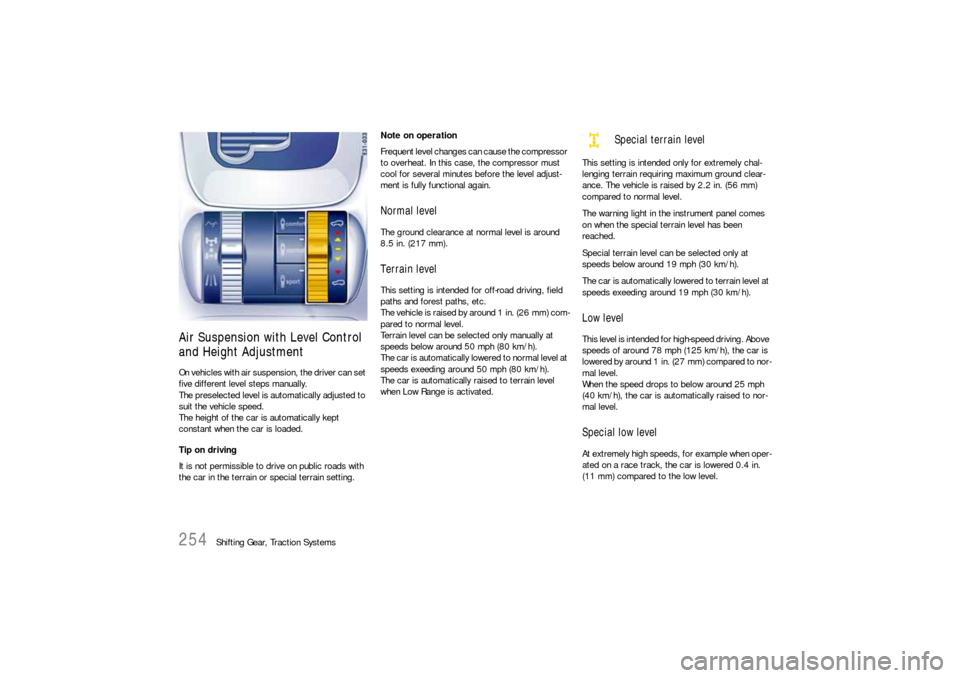
and Height AdjustmentOn vehicles with air suspension, the driver can set
five different level steps manually.
The preselected level is automatically adjusted to
suit the vehicle speed.
The height of the car is automatically kept
constant when the car is loaded.
Tip on driving
It is not permissible to drive on public roads with
the car in the terrain or special terrain setting.Note on operation
Frequent level changes can cause the compressor
to overheat. In this case, the compressor must
cool for several minutes before the level adjust-
ment is fully functional again.
Normal levelThe ground clearance at normal level is around
8.5 in. (217 mm).Terrain levelThis setting is intended for off-road driving, field
paths and forest paths, etc.
The vehicle is raised by around 1 in. (26 mm) com-
pared to normal level.
Terrain level can be selected only manually at
speeds below around 50 mph (80 km/h).
The car is automatically lowered to normal level at
speeds exeeding around 50 mph (80 km/h).
The car is automatically raised to terrain level
when Low Range is activated.This setting is intended only for extremely chal-
lenging terrain requiring maximum ground clear-
ance. The vehicle is raised by 2.2 in. (56 mm)
compared to normal level.
The warning light in the instrument panel comes
on when the special terrain level has been
reached.
Special terrain level can be selected only at
speeds below around 19 mph (30 km/h).
The car is automatically lowered to terrain level at
speeds exeeding around 19 mph (30 km/h).
Low levelThis level is intended for high-speed driving. Above
speeds of around 78 mph (125 km/h), the car is
lowered by around 1 in. (27 mm) compared to nor-
mal level.
When the speed drops to below around 25 mph
(40 km/h), the car is automatically raised to nor-
mal level.Special low levelAt extremely high speeds, for example when oper-
ated on a race track, the car is lowered 0.4 in.
(11 mm) compared to the low level.
Special terrain level
Page 255 of 420
Shifting Gear, Traction Systems
255
Loading level
Caution!
Risk of damage to running-gear parts, units
and the vehicle underbody.
If the car is driven off a curb when at loading level,
for example, insufficent ground clearance can
cause it to bottom out.
fAlways switch to normal level before moving off.
This setting makes it easier for you to load the lug-
gage compartment.
The vehicle is lowered by around 2.4 in. (60 mm)
compared to normal level.
The car is automatically raised to normal level at
speeds exceeding around 3 mph (5 km/h).
Setting level manuallyPreconditions
–Ignition on.
– Doors are closed.
Setting
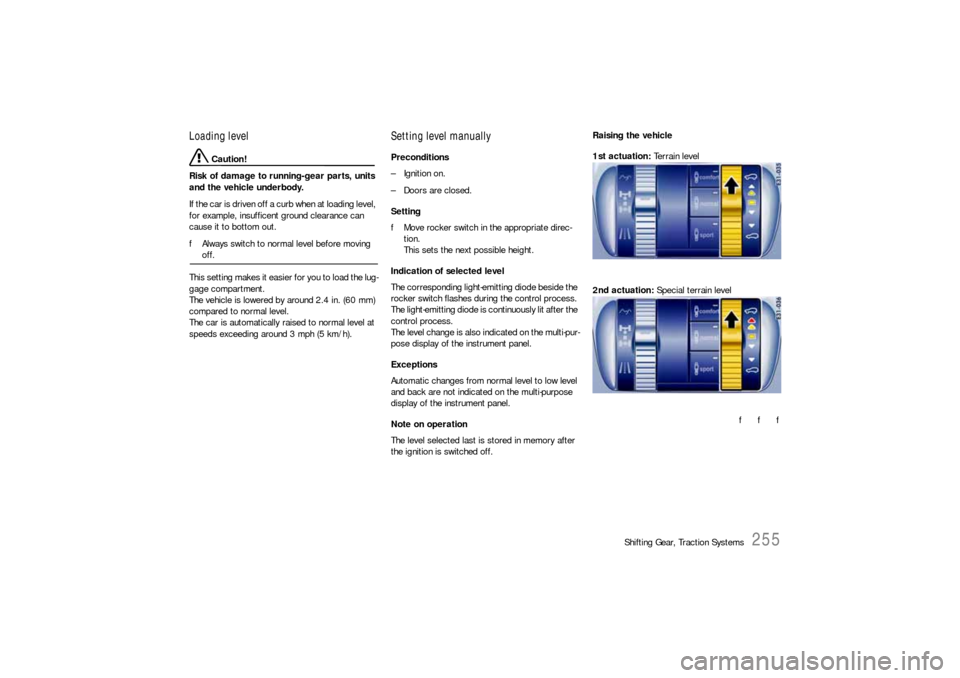
fMove rocker switch in the appropriate direc-
tion.
This sets the next possible height.
Indication of selected level
The corresponding light-emitting diode beside the
rocker switch flashes during the control process.
The light-emitting diode is continuously lit after the
control process.
The level change is also indicated on the multi-pur-
pose display of the instrument panel.
Exceptions
Automatic changes from normal level to low level
and back are not indicated on the multi-purpose
display of the instrument panel.
Note on operation
The level selected last is stored in memory after
the ignition is switched off.Raising the vehicle
1st actuation: Terrain level
2nd actuation: Special terrain level
f f f