light PORSCHE CAYNNE S 2006 1.G Owner's Manual
[x] Cancel search | Manufacturer: PORSCHE, Model Year: 2006, Model line: CAYENNE S, Model: PORSCHE CAYENNE S 2006 1.GPages: 420, PDF Size: 3.81 MB
Page 54 of 420

54
Controls, Safety, Instruments PASSENGER AIRBAG OFF indicator lamp
does not light up
– The passenger's airbag is active and ready for
operation.
– If the passenger's seat is not occupied, the
PASSENGER AIRBAG OFF indicator lamp will
also not light up, even though the passenger's
airbag is switched off. Danger!
Risk of serious or mortal injury due to the
passenger airbag triggering unintentionally.
When the ignition is on and the up to one-
year old child is seated in the child restraint
system on the passenger seat the indicator
lamp „PASSENGER AIRBAG OFF“ must be on.
If the “PASSENGER AIRBAG OFF” indicator
lamp does not light up, it could indicate a
fault in the system.
In this case:
fFasten the child restraint system on the rear
bench immediately.
fHave the fault remedied at your nearest author-ized Porsche dealer.Faults are indicated by a warning light on the ta-
chometer and a message on the instrument
panel’s multi-purpose display.
fPlease observe the chapter “WARNING LIGHTS
AND WARNING MESSAGES” on Page 124.
fIn the following cases you should immedi-
ately consult an authorized Porsche
dealer in order to assure the airbag sys-
tem is functioning properly:
– If the warning light does not light up when the
ignition is switched on or
– If the warning light does not go out once the
engine is running or
– If the warning light appears while driving.
Airbag maintenanceIn order to ensure long-term functioning, the air-
bag system must be inspected by an authorized
Porsche dealer at the intervals recommended in
your Maintenance Booklet.
Important information
If you sell your Porsche, notify the purchaser that
the vehicle is equipped with airbags, and refer
them to the chapter, “Airbag Systems“, in the
owner's manual (safety and disposal rules).
Further information on the airbag system can be
found on stickers attached to the sun visors, as
well as on all airbag components.
For special recommendations on the use of child
restraints:
fPlease observe the chapter “CHILD RES-
TRAINT SYSTEMS” on Page 55.
Warning lights and warning
messages
Page 56 of 420

56
Controls, Safety, Instruments
Using child restraint systems in the front
passenger seat
Danger!
The use of a child restraint system in the
front passenger seat can result in serious
personal injury or death to the child from an
airbag deployment.
To reduce risk of injury from an inflating air-
bag in an accident, Porsche strongly recom-
mends:
fUnder all normal circumstances, the child seat
must be placed in the rear.
Do not use a child restraint system in the front passenger seat.However, there may be serious situations where it
might be necessary to place a child in the front
seat so that he/she can be kept under direct ob-
servation to prevent an immediate risk to the child
(for example, while driving to the doctor or hospi-
tal). The following instructions are provided to you
solely for that purpose.
fSeek appropriate advice from your authorized
Porsche dealer about the possible installation
of a Porsche child restraint system.
fIf a child restraint system must be fastened to
the passenger's seat, adjust the passenger's
seat as far away from the airbag as possible.
fIf emergency or other serious conditions re-
quire a child to be placed in the front seat, ex-
ercise extreme caution and defensive driving
of your vehicle. You must recognize that any
substantial frontal impact could result in the
deployment of the passenger airbag, which
could lead to serious injury or death of the
child.Child restraint system for up to one-year old
children
If the child restraint system must be fastened to
the passenger's seat in exceptional cases:
– make sure that the PASSENGER AIRBAG OFF
indicator lamp lights up.
– adjust the passenger's seat as far away from
the airbag as possible
Danger!
Risk of serious personal injury or death due
to the passenger airbag triggering uninten-
tionally.
When the ignition is on and the up to one-
year old child is seated in the child restraint
system on the passenger seat the indicator
lamp “PASSENGER AIRBAG OFF” must be on.
If the “PASSENGER AIRBAG OFF” indicator
lamp does not light up, it could indicate a
fault in the system.
In this case:
fFasten the child restraint system on the rear
bench immediately.
fHave the fault remedied at your nearest author-ized Porsche dealer.
Page 57 of 420

Controls, Safety, Instruments
57
Child restraint system for children older than
one year
Your vehicle is equipped with weight sensing for
the passenger's seat in accordance with U.S. Fed-
eral Motor Vehicle Safety Standard 208. Depend-
ing on the weight acting on the passenger's seat,
the passenger's airbag will automatically be
switched on or off.
fIn case of doubt, fasten the child restraint sys-
tem on the rear bench.Small adult passengers
fMake sure that the PASSENGER AIRBAG OFF
indicator lamp does not light up.
Danger!
Risk of serious or mortal injury due to the
passenger airbag not triggering.
When the ignition is on and the small adult
passenger is seated on the passenger seat,
the indicator lamp “PASSENGER AIRBAG
OFF” must be off.
If the “PASSENGER AIRBAG OFF” indicator
lamp lights up, it could indicate a fault in the
system.
In this case:
fCarry the passenger on the rear bench.
fHave the fault remedied at your nearest author-ized Porsche dealer.
Page 65 of 420
Controls, Safety, Instruments
65
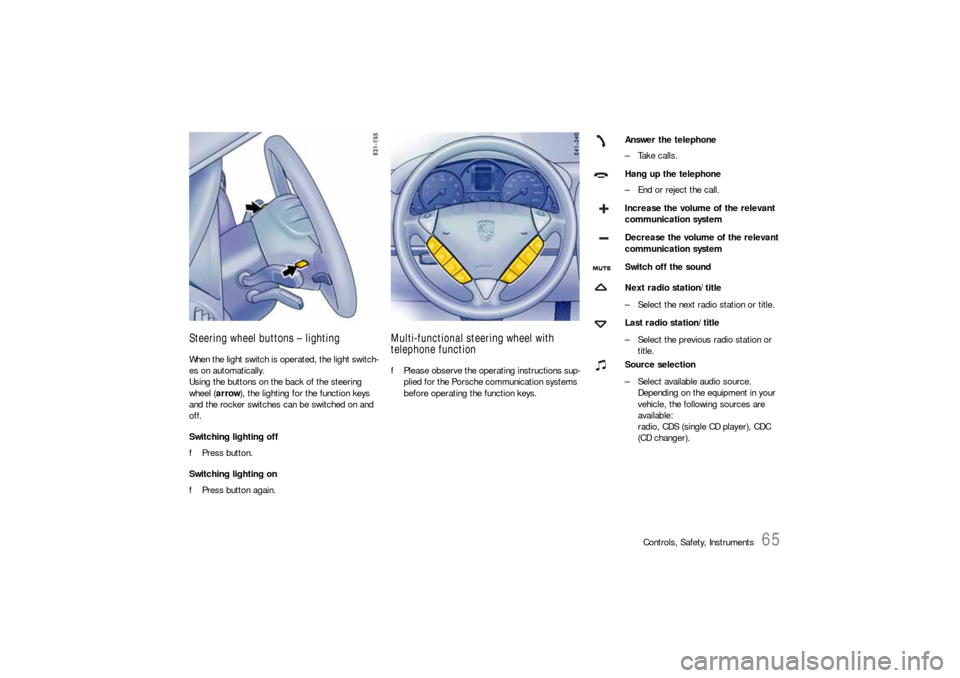
Steering wheel buttons – lightingWhen the light switch is operated, the light switch-
es on automatically.
Using the buttons on the back of the steering
wheel (arrow), the lighting for the function keys
and the rocker switches can be switched on and
off.
Switching lighting off
fPress button.
Switching lighting on
fPress button again.
Multi-functional steering wheel with
telephone functionfPlease observe the operating instructions sup-
plied for the Porsche communication systems
before operating the function keys.
Answer the telephone
–Take calls.
Hang up the telephone
– End or reject the call.
Increase the volume of the relevant
communication system
Decrease the volume of the relevant
communication system
Switch off the sound
Next radio station/title
– Select the next radio station or title.
Last radio station/title
– Select the previous radio station or
title.
Source selection
– Select available audio source.
Depending on the equipment in your
vehicle, the following sources are
available:
radio, CDS (single CD player), CDC
(CD changer).
Page 68 of 420
68
Controls, Safety, Instruments
Door mirror heatingThe door mirror heater is ready for operation
when the ignition is switched on.
Switching on
fTurn control switch to B.
Both door mirrors are heated.
Switching off
fChange the position of the control switch.Storing door mirror settingsOn vehicles with seat memory, individual door mir-
ror settings can be stored on the person buttons
of the seat memory and vehicle keys and recalled
with these.
fPlease observe the chapter “FRONT SEAT
WITH MEMORY” on Page 37.
fPlease observe the chapter “STORING PAS-
SENGER MIRROR SETTING AS A PARKING AID”
on Page 38.
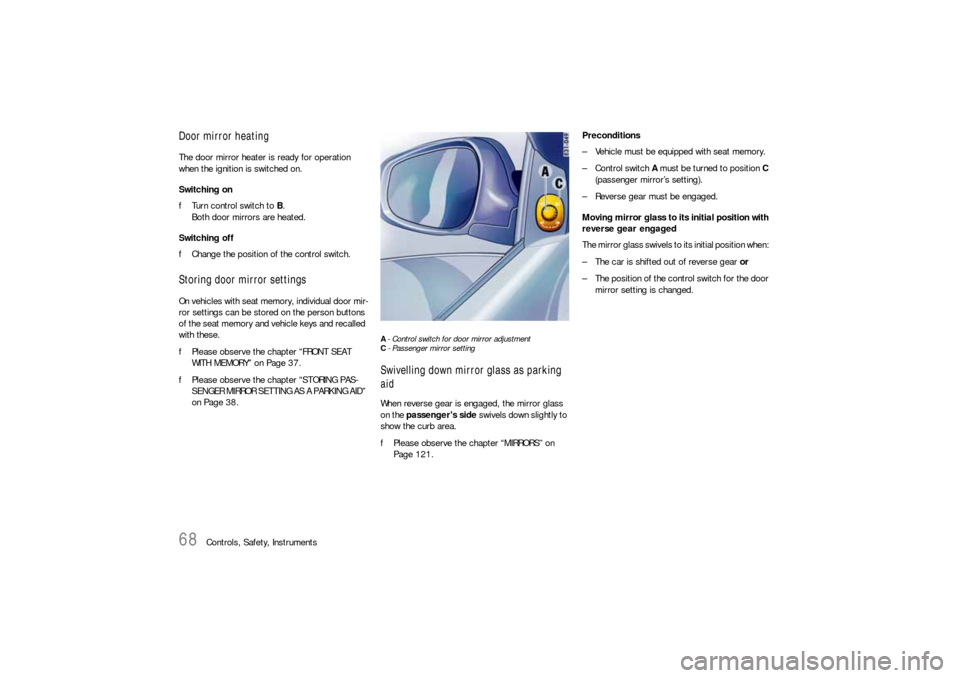
A-Control switch for door mirror adjustment
C- Passenger mirror settingSwivelling down mirror glass as parking
aidWhen reverse gear is engaged, the mirror glass
on the passenger's side swivels down slightly to
show the curb area.
fPlease observe the chapter “MIRRORS” on
Page 121.Preconditions
– Vehicle must be equipped with seat memory.
– Control switch A must be turned to position C
(passenger mirror’s setting).
– Reverse gear must be engaged.
Moving mirror glass to its initial position with
reverse gear engaged
The mirror glass swivels to its initial position when:
– The car is shifted out of reverse gear or
– The position of the control switch for the door
mirror setting is changed.
Page 69 of 420

Controls, Safety, Instruments
69
E- Light-emitting diodes (LED)
F- Button for automatic anti-dazzle operation
G- Light sensorsAutomatic Anti-Dazzle MirrorSensors on the front and rear sides of the interior
mirror measure the incident light. The mirrors au-
tomatically change to anti-dazzle position or revert
to their normal state, depending on the light inten-
sity.
Warning!
Danger of injury. Electrolyte fluid can
emerge from broken mirror glass. This fluid
irritates the skin and eyes.
fIf the electrolyte fluid should come into contact
with the skin or eyes, immediately rinse it off
with clean water.
See a doctor if necessary.
Risk of damage to paintwork and leather and
plastic parts, and clothing. Electrolyte fluid
can be removed only while it is still wet.
fClean the affected parts with water.Note on operation
The incident light in the area of light sensors G
must not be restricted (e.g. by stickers on the
windshield).
Switching off automatic anti-dazzle
operation
fPress button F.
Light-emitting diode E goes out.
Note on operation
Anti-dazzle operation switches off automatically,
if:
– Reverse gear is engaged or
– Interior lighting and/or
reading lights in the front are switched on.
Switching on automatic anti-dazzle
operation
fPress button F.
Light-emitting diode E lights up.
Page 71 of 420

Controls, Safety, Instruments
71
Ignition lock position 1Ignition on
fTurn ignition key to position 1.
Ignition is switched on.
Note on operation
All electrical equipment can be switched on.
The warning lights light up for a lamp check.
fPlease observe the chapter “INSTRUMENT PA-
NEL USA MODELS” on Page 82.
If a load is not switched on for 10 minutes after
switching on the ignition, the ignition must be
switched on again.
Turn the ignition key to ignition lock position 3 (ig-
nition off) first.Ignition lock position 2Starting engine
fOperate footbrake.
fFully depress and hold the clutch pedal or on
vehicles with Tiptronic S:
move the selector lever to position P or N.
fDo not press the accelerator pedal.
The engine control module will provide the
correct starting mixture.
fTurn ignition key to ignition lock position 2.fDo not operate the starter longer than approx.
10 seconds.
If necessary, repeat the starting procedure af-
ter a pause of approx. 10 seconds.
Turn the ignition key to ignition lock position 3
(ignition off) first.
fDo not warm up the engine when stationary.
Drive off immediately.
Avoid high revolutions and full throttle until the
engine has reached operating temperature.
fIf battery output is insufficient, jump leads can
be used to start the engine.
Please observe the chapter “EMERGENCY
STARTING WITH JUMPER CABLES” on
Page 355.
Notes on operation
The first operation of the starter is ended
automatically when the engine starts.
If the engine does not start, subsequent starter
operations will not be ended automatically.
When the engine is started, the warning lights
must go out.
Ignition lock position 3Ignition off
fTurn ignition key to ignition lock position 3.
Locking the steering column Vehicles without Porsche Entry & Drive
The steering column is automatically locked
when the ignition key is withdrawn from the
ignition lock.
The steering column is automatically unlocked
when the ignition key is inserted into the ignition
lock.
Vehicles with Porsche Entry & Drive
The steering column is automatically locked
when the ignition is switched off and the vehicle is
locked.
Manually locking the steering column on
vehicles with Porsche Entry & Drive
fDepress the clutch on vehicles with manual
transmission.
fOnce the ignition is switched off, turn the con-
trol unit again to ignition lock position 3 and
hold it there for 2seconds.
The steering column is locked.
The steering column is automatically unlocked
by turning the control unit from ignition lock
position 0.
Page 72 of 420

72
Controls, Safety, Instruments
Starting and Stopping the EnginefPlease observe the chapter “IMMOBILIZER” on
Page 21.
fPlease observe the chapter “EMISSION
CONTROL SYSTEM” on Page 282.
Danger!
Risk of poisoning. Exhaust gas contains
colorless and odorless carbon monoxide
(CO), which is toxic even in low concentra-
tion. Carbon monoxide can cause uncon-
sciousness and even death if inhaled.
fNever start or let the engine run in an en-
closed, unventilated area. It is not recommend-
ed to sit in your car for prolonged periods with
the engine on and the car not moving.
An unattended vehicle with a running engine
is potentially hazardous. If warning lights
should come on to indicate improper opera-
tion, they would go unnoticed.
fNever leave the engine idling unattended.
Danger of fire.
fDo not drive or park your car where combusti-
ble materials, such as dry grass or leaves,
can come into contact with the hot exhaust
system.
fIf your car catches on fire for any reason, call
the fire department. Do not endanger your life by attempting to put out the fire.
Starting vehicles with manual
transmissionfOperate footbrake.
fFully depress and hold the clutch pedal.
fPut the gearshift lever in neutral.
fDo not press the accelerator pedal. The engine
control module will provide the correct starting
mixture.
fTurn ignition key to ignition lock position 2.
fDo not operate the starter longer than approx.
10 seconds. If necessary, repeat the starting
procedure after a pause of approx.
10 seconds. Turn the ignition key back to
ignition lock position 3 first.
The first operation of the starter is ended automat-
ically when the engine starts.
If the engine does not start, subsequent starter
operations will not be ended automatically.fDo not warm up the engine when stationary.
Drive off immediately.
Avoid high revolutions and full throttle until the
engine has reached operating temperature.
fIf battery output is insufficient, jump leads can
be used to start the engine.
fPlease observe the chapter “EMERGENCY
STARTING WITH JUMPER CABLES” on
Page 355.
Note on operation
To ensure a good charge condition for the battery
and thus its ability to start the engine, all electrical
accessories which are not required should be
switched off when the ignition is switched on and
when engine revolutions are low (in stop and go
traffic).
Page 75 of 420
Controls, Safety, Instruments
75
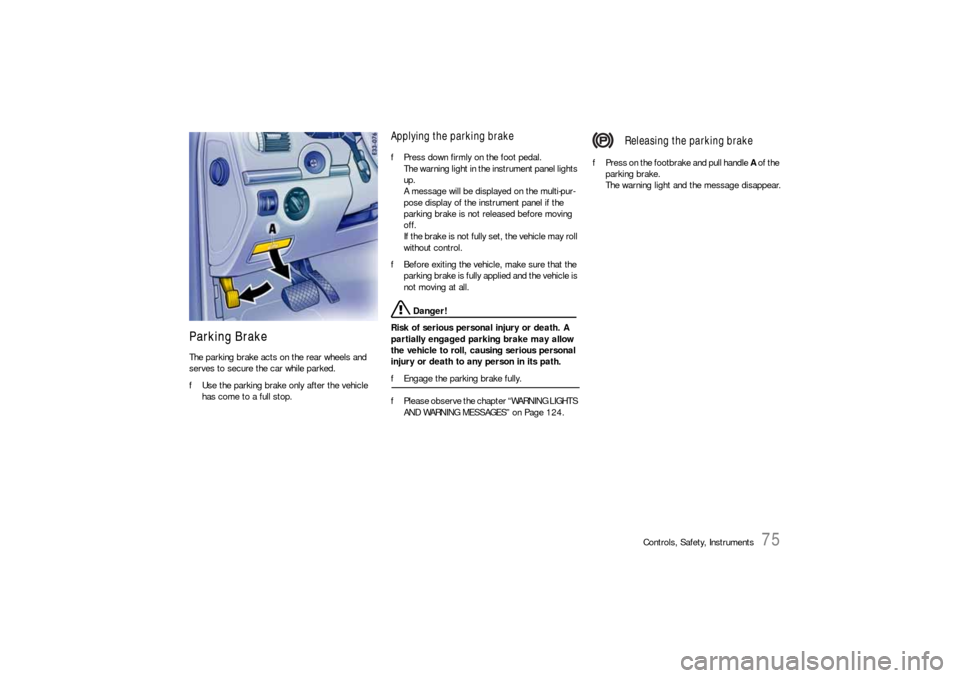
Parking BrakeThe parking brake acts on the rear wheels and
serves to secure the car while parked.
fUse the parking brake only after the vehicle
has come to a full stop.
Applying the parking brakefPress down firmly on the foot pedal.
The warning light in the instrument panel lights
up.
A message will be displayed on the multi-pur-
pose display of the instrument panel if the
parking brake is not released before moving
off.
If the brake is not fully set, the vehicle may roll
without control.
fBefore exiting the vehicle, make sure that the
parking brake is fully applied and the vehicle is
not moving at all.
Danger!
Risk of serious personal injury or death. A
partially engaged parking brake may allow
the vehicle to roll, causing serious personal
injury or death to any person in its path.
fEngage the parking brake fully.
fPlease observe the chapter “WARNING LIGHTS
AND WARNING MESSAGES” on Page 124.fPress on the footbrake and pull handle A of the
parking brake.
The warning light and the message disappear.
Releasing the parking brake
Page 76 of 420

76
Controls, Safety, Instruments The warning lights will go out after the parking
brake is fully released.
The warning lights are not an indicator that the
parking brake is fully applied; it is only intended to
be a warning to release the parking brake before
driving the car. Caution!
A partially engaged brake will overheat the
rear brakes, reduce their effectiveness and
cause excessive wear.
fRelease the parking brake fully.
fWhen parking your car, press down firmly on
the foot pedal.
fMove the selector lever to “P“ (Tiptronic) or
move the gearshift lever to reverse or first
gear (Manual transmission).
fOn hills also turn the front wheels towards the
curb.
BrakesfMake it a habit to check the operation of your
brakes before driving.
Keep in mind that the braking distance increases
very rapidly as the speed increases. At 60 mph
(100 km/h), for example, it is not twice but four
times longer than 30 mph (50 km/h). Tire traction
is also less effective when the roads are wet or
slippery.
fTherefore, always maintain a safe distance
from the car in front of you.Note
Even though the brake discs consist of alloyed
grey cast iron, they will unavoidably start to cor-
rode if your car is parked for an extended period.
The brakes will tend to “rub“ as a result.
The nature, extent and effects of corrosion de-
pend on the amount of time the vehicle was
parked, whether road salt or grit was spread and
whether grease-dissolving agents were used in
car washes.
If the braking comfort is noticeably impaired, we
recommend having the brake system checked by
experts at an authorized Porsche dealer.
Parking Brake warning
light USA
Parking Brake warning
light Canada