traction control PORSCHE CAYNNE S 2006 1.G Owner's Manual
[x] Cancel search | Manufacturer: PORSCHE, Model Year: 2006, Model line: CAYENNE S, Model: PORSCHE CAYENNE S 2006 1.GPages: 420, PDF Size: 3.81 MB
Page 241 of 420

Shifting Gear, Traction Systems
241
ABS
(Anti-lock Brake System)
Warning!
In spite of the advantages of ABS, it is still the driv-
er’s responsibility to adapt his driving style and
maneuvres in line with road and weather condi-
tions, as well as the traffic situation.
The increased safety that is provided should not in-
duce you to take greater risks with your safety.
The limits set by the physics of driving cannot be
overcome, even with ABS.
Risks of accident due to inappropriate speed can-
not be reduced by ABS.
ABS ensures:
–Full steering control
The vehicle remains steerable
–Good driving stability
No skidding due to locked wheels
–Optimum braking distance
Shorter stopping distances in most cases
–Lock prevention
No flat spots on the tiresFunction
The decisive advantage of ABS is in the driving
stability and maneuvrability of the vehicle in
hazardous situations, even during heavy braking
while cornering.
ABS prevents locking of the wheels during full
braking, on almost all road surfaces, until shortly
before the vehicle stops.
The ABS begins to control the braking process as
soon as a wheel shows a tendency to lock.
This controlled braking process is comparable to
extremely rapid cadence braking.
The pulsating brake pedal and a “rattling noise”
warn the driver to adapt his driving speed to the
road conditions.Warning light
If the ABS warning lights light up in the instrument
panel and on the multi-purpose display of the in-
strument panel while the engine is running, the
ABS has switched off because of a fault.
In this event, the braking system will operate with-
out lock prevention,as in cars without ABS.
fAdapt your driving style to the changed brak-
ing behavior.
fThe ABS must be checked immediately at an
authorized Porsche dealer. This is necessary
in order to prevent the occurrence of further
faults whose effects cannot be defined.
The ABS control unit is adjusted for the approved
tire dimensions.
The use of tires with non-approved dimensions can
lead to different wheel speeds, causing the ABS to
switch off.
f f f
Page 246 of 420

246
Shifting Gear, Traction Systems
Driving systems for off-road drivingSpecially adapted driving programs or power-
transmission and running-gear control systems
are available for off-road driving:
– Off-road program Low Range
–Off-road PSM
–Off-road ABS
– Center differential lock
– Rear differential lock
fPlease observe the chapter “POWER-TRANS-
MISSION AND RUNNING-GEAR CONTROL SYS-
TEMS” on Page 235.
Before driving offTires
fCheck tread depth and tire pressure.
fCheck for damage and remove any foreign ob-
jects (e.g. stones) from the tread.
fReplace missing valve caps.
Rims
fReplace dented or damaged rims before
driving off road.
After driving off roadOff-road driving places a greater burden on the ve-
hicle than does normal driving on roads.
We recommend inspecting the vehicle after off-
road driving. Potential damage poses an accident
risk and impairs driving comfort. Damage on the
car is recognised in good time if the car is
checked.
Warning!
Car damage poses an accident risk for the
vehicle occupants and other road users.
fIn cases of doubt, have your vehicle checked
by your authorized Porsche dealer.
fExamine tires for signs of damage such as
cuts, tears, bulges or foreign objects stuck in
the tread. Replace a damaged tire if neces-
sary.
fHave any damage to your vehicle repaired by an authorized Porsche dealer without delay.
Page 250 of 420
250
Shifting Gear, Traction Systems
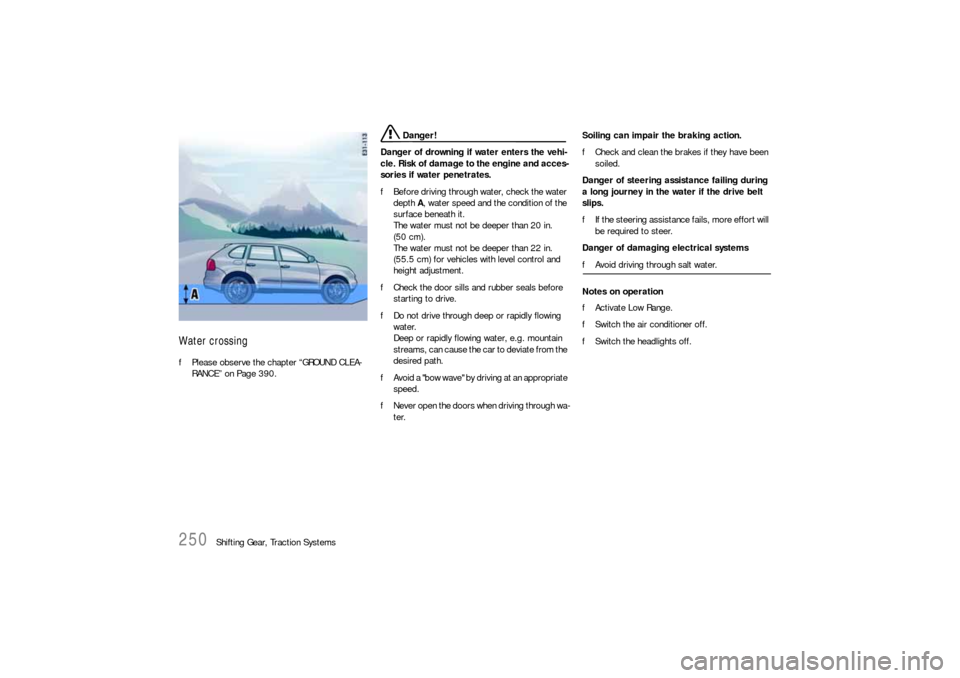
Water crossingfPlease observe the chapter “GROUND CLEA-
RANCE” on Page 390.
Danger!
Danger of drowning if water enters the vehi-
cle. Risk of damage to the engine and acces-
sories if water penetrates.
fBefore driving through water, check the water
depth A, water speed and the condition of the
surface beneath it.
The water must not be deeper than 20 in.
(50 cm).
The water must not be deeper than 22 in.
(55.5 cm) for vehicles with level control and
height adjustment.
fCheck the door sills and rubber seals before
starting to drive.
fDo not drive through deep or rapidly flowing
water.
Deep or rapidly flowing water, e.g. mountain
streams, can cause the car to deviate from the
desired path.
fAvoid a "bow wave" by driving at an appropriate
speed.
fNever open the doors when driving through wa-
ter.Soiling can impair the braking action.
fCheck and clean the brakes if they have been
soiled.
Danger of steering assistance failing during
a long journey in the water if the drive belt
slips.
fIf the steering assistance fails, more effort will
be required to steer.
Danger of damaging electrical systems
fAvoid driving through salt water.
Notes on operation
fActivate Low Range.
fSwitch the air conditioner off.
fSwitch the headlights off.
Page 254 of 420
254
Shifting Gear, Traction Systems
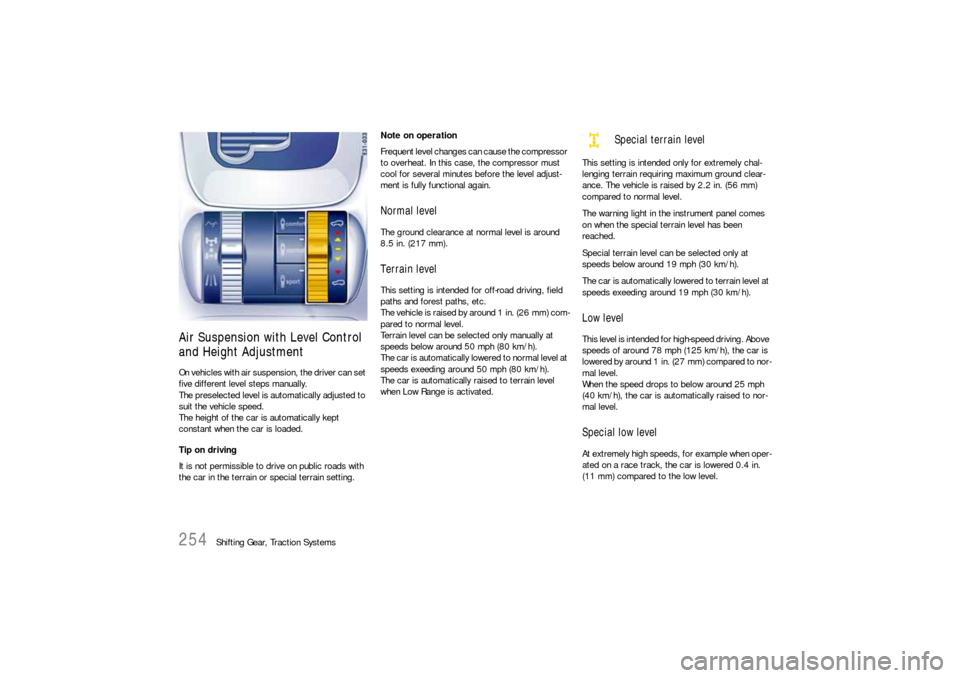
Air Suspension with Level Control
and Height AdjustmentOn vehicles with air suspension, the driver can set
five different level steps manually.
The preselected level is automatically adjusted to
suit the vehicle speed.
The height of the car is automatically kept
constant when the car is loaded.
Tip on driving
It is not permissible to drive on public roads with
the car in the terrain or special terrain setting.Note on operation
Frequent level changes can cause the compressor
to overheat. In this case, the compressor must
cool for several minutes before the level adjust-
ment is fully functional again.
Normal levelThe ground clearance at normal level is around
8.5 in. (217 mm).Terrain levelThis setting is intended for off-road driving, field
paths and forest paths, etc.
The vehicle is raised by around 1 in. (26 mm) com-
pared to normal level.
Terrain level can be selected only manually at
speeds below around 50 mph (80 km/h).
The car is automatically lowered to normal level at
speeds exeeding around 50 mph (80 km/h).
The car is automatically raised to terrain level
when Low Range is activated.This setting is intended only for extremely chal-
lenging terrain requiring maximum ground clear-
ance. The vehicle is raised by 2.2 in. (56 mm)
compared to normal level.
The warning light in the instrument panel comes
on when the special terrain level has been
reached.
Special terrain level can be selected only at
speeds below around 19 mph (30 km/h).
The car is automatically lowered to terrain level at
speeds exeeding around 19 mph (30 km/h).
Low levelThis level is intended for high-speed driving. Above
speeds of around 78 mph (125 km/h), the car is
lowered by around 1 in. (27 mm) compared to nor-
mal level.
When the speed drops to below around 25 mph
(40 km/h), the car is automatically raised to nor-
mal level.Special low levelAt extremely high speeds, for example when oper-
ated on a race track, the car is lowered 0.4 in.
(11 mm) compared to the low level.
Special terrain level
Page 255 of 420
Shifting Gear, Traction Systems
255
Loading level
Caution!
Risk of damage to running-gear parts, units
and the vehicle underbody.
If the car is driven off a curb when at loading level,
for example, insufficent ground clearance can
cause it to bottom out.
fAlways switch to normal level before moving off.
This setting makes it easier for you to load the lug-
gage compartment.
The vehicle is lowered by around 2.4 in. (60 mm)
compared to normal level.
The car is automatically raised to normal level at
speeds exceeding around 3 mph (5 km/h).
Setting level manuallyPreconditions
–Ignition on.
– Doors are closed.
Setting
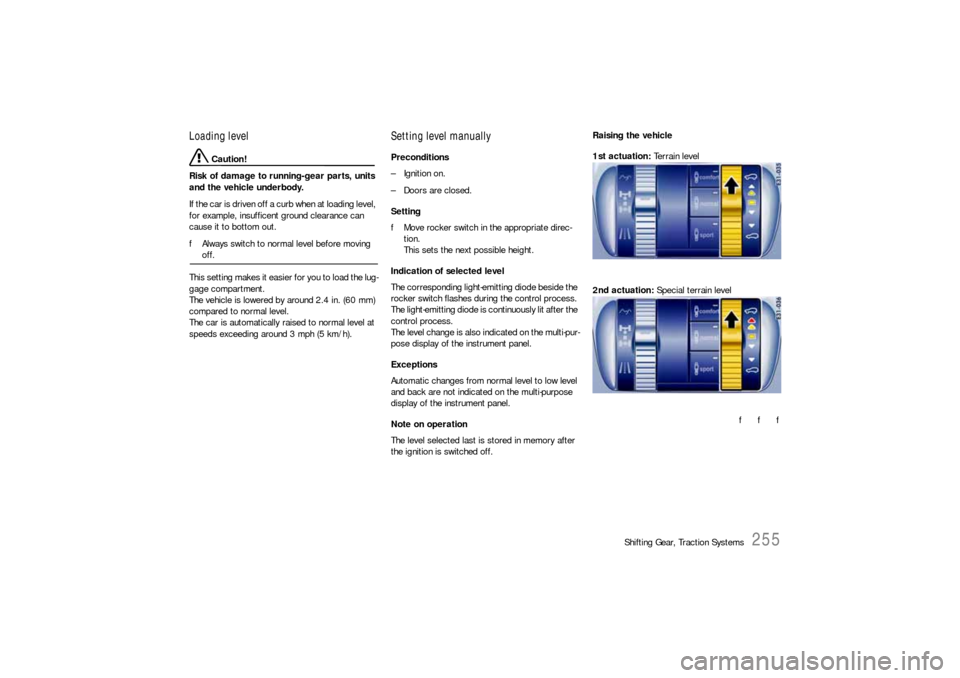
fMove rocker switch in the appropriate direc-
tion.
This sets the next possible height.
Indication of selected level
The corresponding light-emitting diode beside the
rocker switch flashes during the control process.
The light-emitting diode is continuously lit after the
control process.
The level change is also indicated on the multi-pur-
pose display of the instrument panel.
Exceptions
Automatic changes from normal level to low level
and back are not indicated on the multi-purpose
display of the instrument panel.
Note on operation
The level selected last is stored in memory after
the ignition is switched off.Raising the vehicle
1st actuation: Terrain level
2nd actuation: Special terrain level
f f f
Page 256 of 420
256
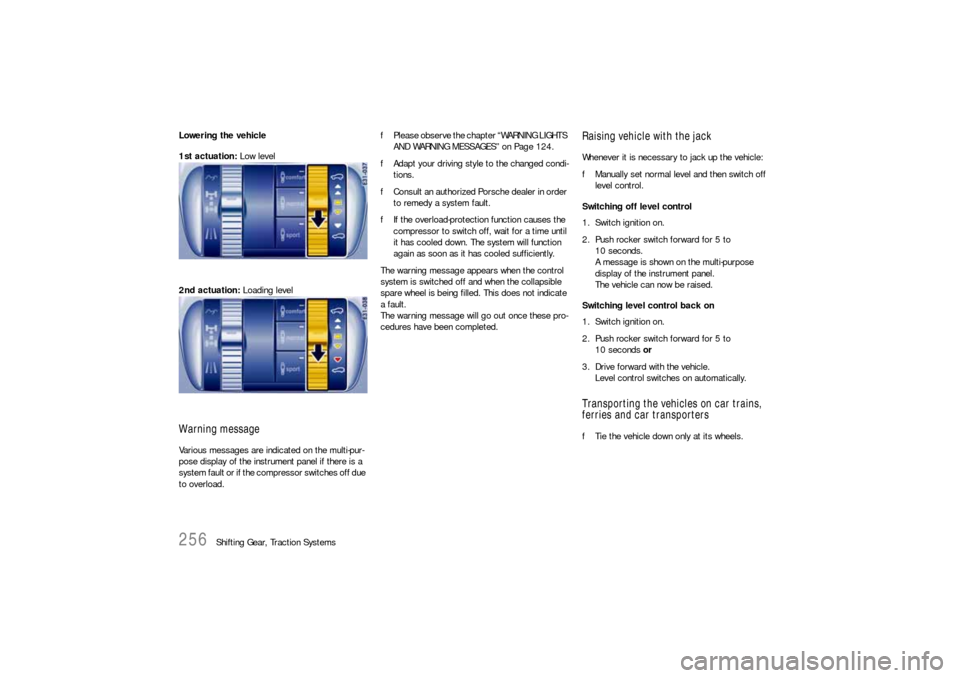
Shifting Gear, Traction Systems Lowering the vehicle
1st actuation: Low level
2nd actuation: Loading level
Warning messageVarious messages are indicated on the multi-pur-
pose display of the instrument panel if there is a
system fault or if the compressor switches off due
to overload.fPlease observe the chapter “WARNING LIGHTS
AND WARNING MESSAGES” on Page 124.
fAdapt your driving style to the changed condi-
tions.
fConsult an authorized Porsche dealer in order
to remedy a system fault.
fIf the overload-protection function causes the
compressor to switch off, wait for a time until
it has cooled down. The system will function
again as soon as it has cooled sufficiently.
The warning message appears when the control
system is switched off and when the collapsible
spare wheel is being filled. This does not indicate
a fault.
The warning message will go out once these pro-
cedures have been completed.
Raising vehicle with the jackWhenever it is necessary to jack up the vehicle:
fManually set normal level and then switch off
level control.
Switching off level control
1. Switch ignition on.
2. Push rocker switch forward for 5 to
10 seconds.
A message is shown on the multi-purpose
display of the instrument panel.
The vehicle can now be raised.
Switching level control back on
1. Switch ignition on.
2. Push rocker switch forward for 5 to
10 seconds or
3. Drive forward with the vehicle.
Level control switches on automatically.Transporting the vehicles on car trains,
ferries and car transportersfTie the vehicle down only at its wheels.
Page 299 of 420

Practical Tips, Minor Repairs
299
Traction AA, A, B, C
The traction grades, from highest to lowest, are
AA, A, B, and C and they represent the tire's ability
to stop on wet pavement as measured under con-
trolled conditions on specified government test
surfaces of asphalt and concrete. A tire marked C
may have poor traction performance.
Warning!
The traction grade assigned to this is based
on braking (straight-ahead) traction tests
and does not include cornering (turned) trac-
tion, acceleration, hydroplaning or peak
traction characteristics.Temperature A, B, C
The temperature grades are A (the highest), B and
C, representing the tire's resistance to the gener-
ation of heat and its ability to dissipate heat when
tested under controlled conditions on a specified
indoor laboratory test wheel.
Sustained high temperatures can cause the mate-
rial of the tire to degenerate and reduce tire life,
and excessive temperature can lead to sudden
tire failure.
The grade C corresponds to a level of perform-
ance which all passenger car tires must meet
under the Federal Motor Vehicle Safety Standard
No. 109.
Grades B and A represent higher levels of per-
formance on the laboratory test wheel than the
minimum required by law.
Warning!
The temperature grade for this tire is estab-
lished for a tire that is properly inflated and
not overloaded. Excessive speed, underinfla-
tion, or excessive loading, either separately
or in combination, can cause heat buildup
and possible tire failure.
Page 302 of 420

302
Practical Tips, Minor Repairs
Tire traction
Warning!
When driving on wet or slushy roads, a
wedge of water may build up between the
tires and the road. This phenomenon is
known as “hydroplane“ and may cause par-
tial or complete loss of traction, vehicle con-
trol or stopping ability.
fReduce speed on wet surfaces to prevent this.Tire lifeTire life depends on various factors, i.e., road sur-
faces, traffic and weather conditions, driving hab-
its, type of tires and tire care.
fInspect your tires for wear and damage before
driving off. If you notice uneven or substantial
wear, wheels might need alignment or tires
should be balanced or replaced.
Tire wearThe original equipment tires on your Porsche have
built-in tire wear indicators. They are molded into
the bottom of the tread grooves and will appear as
approximately 1/2 in. (12 mm) bands when the
tire tread depth is down to 1/16 of an in (1.6 mm).
When the indicators appear in two or more adja-
cent grooves, it is time to replace the tires. We
recommend, however, that you do not let the tires
wear down to this extent.
Worn tires cannot grip the road surface properly
and are even less effective on wet roads.
In the United States, state laws may govern the
minimum tread depth permissible. Follow all such
laws.
Danger!
Driving on worn tires can result in loss of con-
trol of the vehicle and could cause serious
personal injuries or death.
fDo not drive with worn tires or tires showing
cuts or bruises as they may lead to sudden
deflation and loss of control which could cause
severe personal injury.
fSpecialized high performance tires on high
performance sport utility vehicles exhibit more
wear than those on a family sedan, or even a
high performance sedan.
Therefore, it is important to check your tire
pressure and condition at least every two weeks.
fIf you notice that tires are wearing unevenly,
consult your Porsche dealer.
Uneven wear may not always be due to improper
wheel alignment. It can be the result of individual
driving habits such as cornering at high speeds. If
the tire pressure is not checked and adjusted reg-
ularly, abnormal tire wear can also occur.
Page 398 of 420

398
Index Porsche Active
Suspension Management.................... 235
, 257
Display ............................................... 257
Indicator light...................................... 129
Warning light ...................................... 257
Porsche Communication Management .......... 191
Porsche Down-Hill Assistant ......................... 244
Porsche Drive-Off Assistant ......................... 243
Porsche Entry & Drive .......................... 22, 199
Immobilizer........................................... 23
Opening/locking rear window ................. 22
Opening/locking spare wheel bracket ..... 22
Porsche Stability Management ... 235
, 238
, 325
Deactivating ....................................... 240
Deactivating/switching on .................... 240
Indicator light...................................... 128
Multifunctional light ............................. 240
Off road ............................................. 239
Warning light ........................ 82
, 84, 128
Porsche Traction Management ............ 235, 236
Power measurement ................................... 260
Power steering ........................................... 271
Power windows .............................. 33
, 34, 35
Comfort function (windows)............. 34, 35
One-touch operation.............................. 34
Opening/closing windows ...................... 33
Readiness for operation......................... 33
Storing end position.............................. 35
Switching off (rear)......................... 25, 35
Power-transmission ..................................... 235
Preservation ............................................... 287
Pressure tester........................................... 330
PSM ........................................ 235
, 238
, 325
Deactivating ....................................... 240Deactivating/switching on .................... 240
Indicator light ...................................... 128
Multifunctional light.............................. 240
Off road ............................................. 239
Warning light......................... 82
, 84, 128
PTM ........................................................... 235
RRadiator fans .............................................. 261
Radio
Tips ................................................... 189
Radio remote control..................................... 17
Changing the battery........................... 358
Rain sensor ................................................ 137
Rain sensor operation ................................. 138
Reading light
Front .................................................. 166
Rear................................................... 167
Rear .......................................................... 370
Rear differential lock................................... 232
Rear fog light..................................... 132
, 370
Rear lid ...................................................... 199
Locking ................................................ 22
Opening ............................................... 22
Unlocking ............................................. 20
Rear light ................................................... 369
Rear seats.................................................... 41
Folding forward ..................................... 41
Positioning............................................ 43
Rear window ............................................... 201
Locking ................................................ 22
Opening ........................................ 20, 22
Unlocking ............................................. 20
Rear window wiper ...................................... 139Rear-axle load .............................................213
Reduction ...................................................101
Reflector ....................................................369
Refuelling ...................................................279
Relays ........................................................334
Release button ............................................221
Relocking, automatic.....................................24
Remote control .............................................17
Changing the battery ...........................358
Removing spots and stains ..........................287
Reserve......................................................279
REST button .............................145
, 148
, 152
REST mode .......................................151, 157
Reverse gear ..............................68
, 183
, 220
Reversing light ............................................370
Rims ..........................................................246
Diameter ............................................310
Rim width ...........................................310
Rocker switches .........................................223
Roof console .....................................168, 193
Roof Transport System ..............210
, 387
, 389
Running in
Tires ....................................................14
Running-gear control systems ......................235
Running-gear setup......................................257
Indicator light ......................................129
Warning light .......................................257