lights PORSCHE CAYNNE TURBO 2005 1.G Service Manual
[x] Cancel search | Manufacturer: PORSCHE, Model Year: 2005, Model line: CAYENNE TURBO, Model: PORSCHE CAYENNE TURBO 2005 1.GPages: 369, PDF Size: 3.17 MB
Page 146 of 369
146
Controls, Safety, Instruments
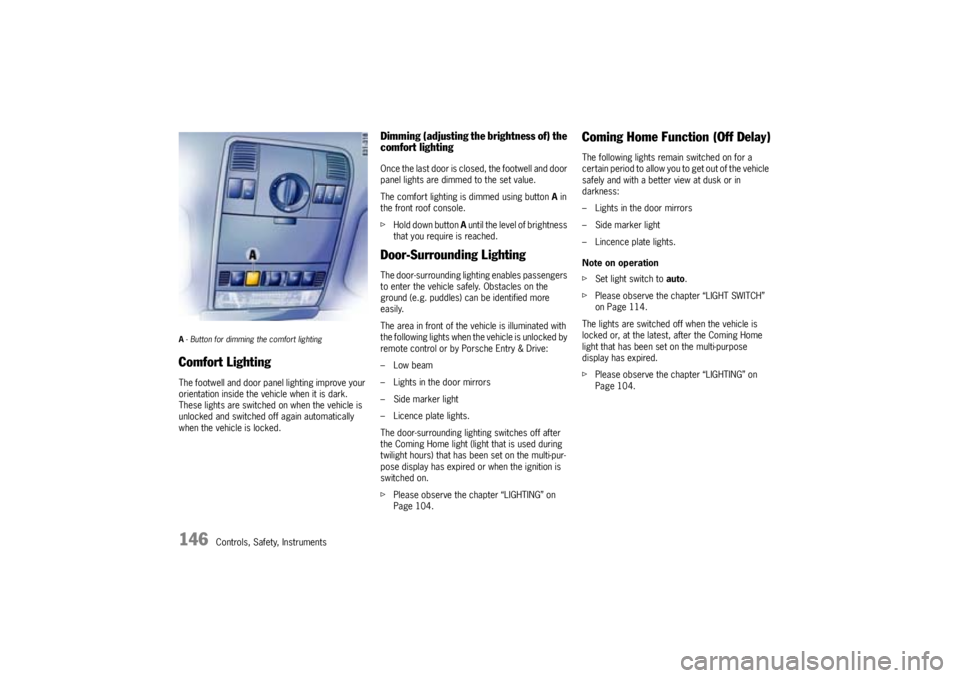
A- Button for dimming the comfort lighting Comfort LightingThe footwell and door panel lighting improve your
orientation inside the vehicle when it is dark.
These lights are switched on when the vehicle is
unlocked and switched off again automatically
when the vehicle is locked.
Dimming (adjusting the brightness of) the
comfort lightingOnce the last door is closed, the footwell and door
panel lights are dimmed to the set value.
The comfort lighting is dimmed using button A in
the front roof console.
fHold down button A until the level of brightness
that you require is reached.Door-Surrounding LightingThe door-surrounding lighting enables passengers
to enter the vehicle safely. Obstacles on the
ground (e.g. puddles) can be identified more
easily.
The area in front of the vehicle is illuminated with
the following lights when the vehicle is unlocked by
remote control or by Porsche Entry & Drive:
–Low beam
– Lights in the door mirrors
– Side marker light
– Licence plate lights.
The door-surrounding lighting switches off after
the Coming Home light (light that is used during
twilight hours) that has been set on the multi-pur-
pose display has expired or when the ignition is
switched on.
fPlease observe the chapter “LIGHTING” on
Page 104.
Coming Home Function (Off Delay)The following lights remain switched on for a
certain period to allow you to get out of the vehicle
safely and with a better view at dusk or in
darkness:
– Lights in the door mirrors
– Side marker light
– Lincence plate lights.
Note on operation
fSet light switch to auto.
fPlease observe the chapter “LIGHT SWITCH”
on Page 114.
The lights are switched off when the vehicle is
locked or, at the latest, after the Coming Home
light that has been set on the multi-purpose
display has expired.
fPlease observe the chapter “LIGHTING” on
Page 104.
Page 157 of 369

Controls, Safety, Instruments
157
Parking AidsParkAssistParkAssist provides a visual and acoustic indica-
tion to the driver of the distance between the
vehicle and a large obstacle.
ParkAssist is switched on automatically when the
engine is started and remains active up to a speed
of approx. 9 mph (14 km/h).
ParkAssist is switched off automatically at high
speed. ParkAssist is switched on again auto-
matically when the speed drops below approx.
9 mph (14 km/h).
The selector lever position determines activation
levels for ParkAssist and the corresponding area
that is monitored.
Selector lever position:
–P – ParkAssist is not activated.
–R, N – ParkAssist is activated for the front and
rear areas.
–D, M – ParkAssist is activated for the front ar-
ea.
Danger!
Risk of serious personal injury or death.
ParkAssist cannot detect small objects such
as children and pets.
Even when using ParkAssist, the driver is still
responsible for taking due care when park-
ing and when assessing obstacles.
fMake sure that no persons especially small
children, animals or obstacles are within the maneuvering area.
Switching ParkAssist on and off
fSwitch ParkAssist on and off using button A in
the roof console.
When ParkAssist is switched off, the indicator
light in the button lights up.
Note on operation
It is a good idea to switch off ParkAssist when
driving off-road and on unpaved surfaces.
f f f
Page 159 of 369

Controls, Safety, Instruments
159
A- Front display – left monitoring area
B- Front display – right monitoring areaWarning indicators, signal tones, distances
The warning indicator for the front area is located
on the dashboard.
The warning indicator for the rear area is located
in the rooflining at the rear of the loadspace.
The warning indicators for the various monitoring
areas (left and right) are subdivided respectively
into one green, 4 yellow and 2 red light segments.
C- Rear display – right monitoring area
D- Rear display – left monitoring areaIf ParkAssist is activated, the green light seg-
ments of the active warning indicators are lit up
continuously.
If the vehicle approaches an obstacle that has
been detected by the sensors, one or more of the
yellow or red light segments lights up, depending
on the distance to the obstacle.If the first yellow light segment lights up, the ob-
stacle is still 48 in. or 120 cm (to the front) or
48 in. to 59 in. or 120 to 150 cm (to the rear)
away.
A brief signal tone sounds when reversing.
Anintermittent tone sounds when the distance
becomes less than approx. 24 in. or 60 cm. The
fourth yellow light segment lights up.
Acontinuous tone sounds when the distance be-
comes less than approx. 10 in. or 25 cm (on vehi-
cles with trailer coupling: approx. 14 in. or
35 cm). The second red light segment lights
up.
If the obstacle is approached even closer, the sys-
tem may not be able to recognize the obstacle any
longer.
fSet the radio volume so that the signal tones
are not drowned out.
You can have the volume of the signal tones ad-
justed to your own requirements at your autho-
rized Porsche dealer.
Note on operation
If the obstacle is approached even closer after the
continuous tone sounds and the second red light
segment lights up, the system may not be able to
recognize the obstacle any longer.
Page 160 of 369

160
Controls, Safety, Instruments Limits of ultrasonic measurement
– ParkAssist cannot detect sound-absorbing ob-
stacles (e.g. powder snow),
– Sound-reflecting obstacles (e.g. glass surfac-
es, flat painted surfaces),
– And very thin obstacles.
Other ultrasound sources (e.g. pneumatic brakes
of other vehicles, jackhammers) can interfere with
detection of obstacles.
Fault indication without warning tone
All red light segments of the active warning indica-
tors light up when there is a temporary fault in
ParkAssist.
Note
Correct operation is no longer ensured if there is
a temporary fault (e.g. caused by ice formation or
heavy soiling on the sensors).
The system detects the temporary fault.
All light segments light up until a speed of
9 mph (14 km/h) is reached.
ParkAssist is ready for operation again when the
interference has been eliminated.Fault indication with warning tone
In the event of a long-lasting fault in ParkAssist,
the red light segments of the active warning indi-
cators light up and a continuous tone sounds for
three seconds after a transmission range has
been selected.
Possible causes
– Defect or system fault.
fSwitch ParkAssist off.
When ParkAssist is switched off, the indicator
light in the button lights up.
fPlease have the fault remedied at an autho-
rized Porsche dealer.Driving with a trailer
The ParkAssist rear monitoring area is switched
off when the trailer’s power supply is plugged in.
Page 162 of 369

162
Controls, Safety, Instruments
A- Programmable keypad
B- Light-emitting diode for status identificationGarage Door OpenerThe programmable garage door opener in your
Porsche replaces up to three original hand-held
transmitters used to operate a variety of devices
(e.g. garage door, gate to the property, alarm
system).
You have the option of programming each individ-
ual key in key pad Awith an original hand-held
transmitter frequency.
Warning!
Risk of accident when using the garage door
opener if persons, animals or objects are
within the range of movement of the equip-
ment that is being operated.
fWhen using the garage door opener, ensure
that no persons, animals or objects are within
the range of movement of the equipment that
is being operated.
fObserve the safety notes for the original hand-held transmitter.
To operate the device in question
(e.g. garage door, gate to the property,
alarm system):
fPress the relevant button in keypad A.
Light-emitting diode B lights up during the
signal transfer.Notes on operation
fAlways use the garage door opener in the di-
rection of travel.
Otherwise, range restrictions cannot be ruled
out.
fBefore selling the vehicle, delete the
programed signals in keypad A of the garage
door opener.
fPlease read the instructions for the original
hand-held transmitter to find out whether the
original transmitter is equipped with fixed or
changeable code.
Page 169 of 369
Controls, Safety, Instruments
169
Car Telephone and Aftermarket Alarms Important legal and safety information re-
garding the use of cellular telephones
Some states may prohibit the use of cellular tele-
phones while driving a vehicle. Check the laws and
regulations on the use of cellular telephones in the
areas where you drive.
Danger!
Risk of an accident.
Severe personal injury or death can result in
the event of an accident.
Looking away from the road or turning your
attention away from your driving can cause
an accident and serious personal injury or
death.
When using your cellular telephone, you should al-
ways:
fGive full attention to your driving - pull off the
road and park before making or answering a
call if traffic conditions so require; and
fKeep both hands on the steering wheel - use
hands-free operation (if available) - pull off the
road and park before using a hand-held tele-phone.It is essential to observe the instructions of
the telephone manufacturer before putting
the telephone into operation.
Any portable telephone or radio transmitter which
is used in a Porsche must be properly installed in
accordance with the technical requirements of
Porsche.
The transmission power must not exceed
10 W.
The devices must possess a type approval for
your vehicle and have an “e“ symbol.
If you should require equipment with transmission
power values greater than 10 W, please consult
your authorized Porsche dealer for this purpose.
He is familiar with the technical requirements for
installing devices of this kind.
The antennas for all radios and telephones with a
transmitting antenna must be externally mounted.
The improper installation of radios or telephones
or use of a radio or telephone with a transmitting
antenna inside the car may cause the warning
lights to come on.
Improper installation of such equipment can cre-
ate a discharged battery or excessive current
draw from added equipment.If aftermarket systems are installed by non-dealer-
ship technicians or outside the selling dealer,
problems may result. Installation of aftermarket
equipment is not covered under the New Car War-
ranty.
fConsult your authorized Porsche dealer about
the installation of non Porsche approved equip-
ment.
Reception quality
The reception quality of your car telephone will
change constantly when you are driving. Interfer-
ence caused by buildings, landscape and weather
is unavoidable. It may become particularly difficult
to hear when using the hands-free function due to
external noise such as engine and wind noise.
Automatic car-wash
fUnscrew external antennas before using an au-
tomatic car-wash.
Page 194 of 369
194
Controls, Safety, Instruments
Towing a trailer
Warning!
Driving with a trailer
fAlways observe the permissible towing capac-
ity, vertical coupling load and rear-axle load.
Please observe the chapter “WEIGHTS” on
Page 352.
fWhen connected, the trailer must always be
horizontal behind the towing vehicle. If neces-
sary, use a trailer with an adjustable drawbar.
fWhen the vehicle is driven in the mountains, the
engine output decreases as altitude increases.
The maximum weights stated are the values at
sea level. The total weight of the car-trailer
combination must therefore be reduced by
10% for each increment of 3,280 ft. or
1,000 metres altitude. A fractional increment
counts as the full 1,000 metres. Please take
this into consideration when planning your
route.Distributing the load
fDistribute the load in the trailer so that heavy
objects are as close to the axle as possible.
Always safeguard all objects against slipping
and tie them down securely.
fYou should make the best possible use of the
trailer coupling's rated vertical coupling load
when loading the trailer, but never exceed it.
Tire pressure
fSelect the vehicle tire pressure for full load
when towing a trailer.
fPlease observe the chapter “Tire pressure ta-
bles”.
fCheck the tire pressure of the trailer's wheels
according to the manufacturer's instructions.Door mirrors
fIf the width of the trailer obstructs your view of
the traffic behind the trailer, you must have ad-
ditional door mirrors fitted.
Headlights, lights
fCheck whether the plug of the trailer is
plugged into the towing vehicle and whether all
lights function.
Page 210 of 369

210
Shifting Gear, Traction Systems Indication of a fault by:
– Continuous illumination of the light-emitting
diode in the button
– Illumination of the warning light on the
instrument panel
– A message on the multi-purpose display of the
instrument panel
fAdapt your driving behavior to the changed
conditions.
Drive slowly to the nearest authorized Porsche
delaer and have the fault remedied.
fPlease observe the chapter “WARNING LIGHTS
AND WARNING MESSAGES” on Page 106.
Changing from off-road driving program
to on-road driving programfReduce speed to below 19 mph (30 km / h) or
stop vehicle.
fMove selector lever to position N.
fPull rocker switch A back in stages until light-
emitting diodes B, C and if necessary, D are
out.
The Low Range indicator light on the instru-
ment panel and light-emitting diode B beside
the rocker switch flash several times during
the shifting process.
High Range is active.
Danger!
Serious risk of injury or death. Risk of
accident due to uncontrolled vehicle
movement. The selector lever is blocked
during the shifting procedure. Shifting when
driving uphill can cause the vehicle to stand
still or even roll backwards, if the shifting
procedure has not yet been completed.
When driving downhill, the vehicle can accel-
erate unintentionally while shifting.
fIncreased brake readiness is required.
fPlease observe the chapter “POWER-TRANS-
MISSION AND RUNNING-GEAR CONTROL SYS-
TEMS” on Page 211.
Indicator light and warnings
Page 215 of 369

Shifting Gear, Traction Systems
215
The events below inform the driver of PSM control
operations and warn him to adapt his driving style
to the road conditions:
– The information light in the instrument panel
lights up.
– Hydraulic noises can be heard.
– The vehicle decelerates and steering-wheel
forces are altered as the PSM controls the
brakes.
– Reduced engine power.
– The brake pedal pulsates and its position is
changed during braking.
However, it is possible at any time to achieve
full vehicle deceleration by increasing the foot
pressure slightly.
Examples of PSM control operations
–Vehicle understeers:
If the front wheels of the vehicle drift on a
bend, engine power is reduced and the rear
wheel on the inside of the bend is braked if
necessary.
–Vehicle oversteers:
If the rear of the vehicle swings out on a bend,
the front wheel on the outside of the bend is
braked.Combined use of PSM and PTM/PTM Plus
In order to ensure optimal stabilisation of the
vehicle, the center differential lock (PTM) and
possibly the rear differential lock (PTM Plus) are
also opened when PSM interventions occur.
Tip on driving
When PSM is switched off, wheel-specific brake
interventions and the traction control system
(TCS) are also inactive.
The automatic brake differential (ABD) remains on.Off-road PSM
(PSM in Low Range program)
When Low Range is active, an off-road PSM
specially matched to off-road driving is activated
to enhance traction.
At a speed below 22 mph (35 km/h), the terrain
PSM intervenes later if the vehicle should under-
steer and thereby improves steerability in Low
Range.
If the brakes are highly stressed, the automatic
brake differential (ABD) switches itself off to
protect the brakes. It remains deactivated until the
brake system has cooled sufficiently.
Engine drag torque control
In conditions of excessive slip, the engine drag
torque control system prevents all driven wheels
from locking up when the car is overrunning. This
is also the case for downshifts on a slippery road.
Page 216 of 369

216
Shifting Gear, Traction Systems
Switching off PSMfPress button A.
PSM is switched off after a short delay.
With PSM switched off, the PSM warning light
in the instrument panel and the information
light in the button are lit.
During braking, the vehicle is stabilised even
when PSM is switched off.
One-sided spinning of the wheels is prevented,
even with PSM switched off.PSM should always be switched on during
“normal” driving.
H o w e v e r, i t c a n b e o f a d v a n t a g e t o s w i t c h o f f P S M
temporarily in exceptional situations:
– On a loose surface or in deep snow
– When “rocking the vehicle free”
– When using snow chains.
When the PSM is switched off the slip monitoring
function of the Tiptronic is also deactivated.
Information light
– The light indicates a control operation, includ-
ing when PSM is switched off (brake control in
the event of one-sided wheel spin).
Warning light
– The warning light in the instrument panel lights
up in combination with the indicator light in the
button for a lamp check when the ignition is
switched on.
– Together with the information light in the
button, the warning light indicates that PSM is
switched off.
– A fault is indicated by the warning light in the
instrument panel and an indication on the multi-
purpose display of the instrument panel. PSM
is out of order.
Please have the fault remedied at an autho-
rized Porsche dealer.Collapsible spare wheel
fNever switch the PSM off when driving with a
collapsible spare wheel.
To w i n g
fPlease observe the chapter “TOWING” on
Page 340.
Tip on driving
When PSM is switched off, wheel-specific brake in-
terventions and the traction control system (TCS)
are also inactive.
The automatic brake differential (ABD) remains on.
Switching on PSMfPress button A.
PSM is switched on after a short delay.