steering wheel PORSCHE CAYNNE TURBO 2005 1.G Owners Manual
[x] Cancel search | Manufacturer: PORSCHE, Model Year: 2005, Model line: CAYENNE TURBO, Model: PORSCHE CAYENNE TURBO 2005 1.GPages: 369, PDF Size: 3.17 MB
Page 11 of 369
Controls, Safety, Instruments
11 Controls, Safety, Instruments
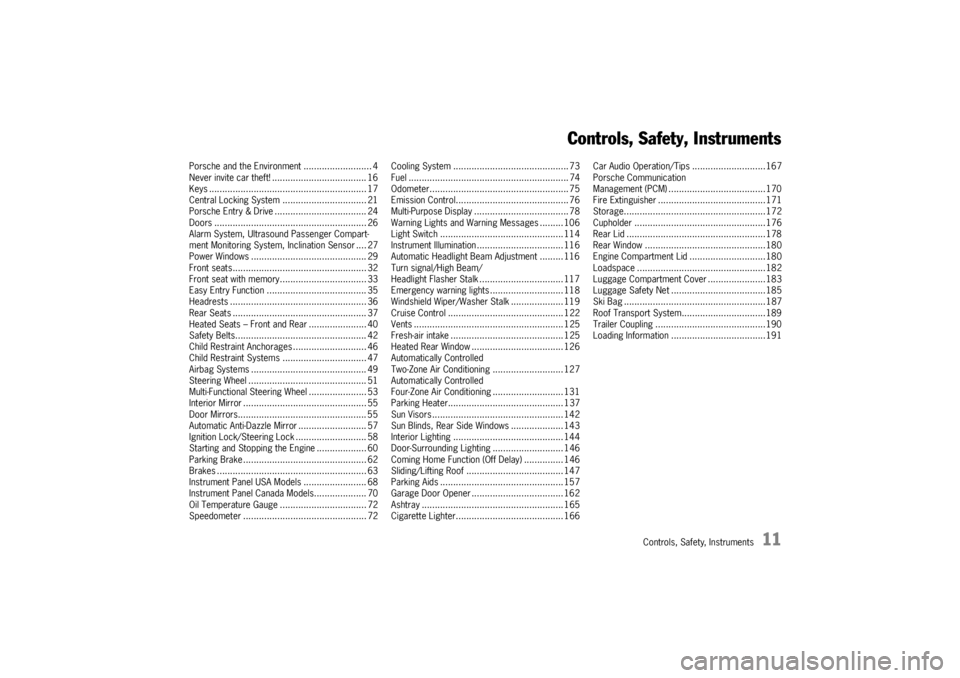
Porsche and the Environment .......................... 4
Never invite car theft! .................................... 16
Keys ............................................................ 17
Central Locking System ................................ 21
Porsche Entry & Drive ................................... 24
Doors .......................................................... 26
Alarm System, Ultrasound Passenger Compart-
ment Monitoring System, Inclination Sensor .... 27
Power Windows ............................................ 29
Front seats................................................... 32
Front seat with memory................................. 33
Easy Entry Function ...................................... 35
Headrests .................................................... 36
Rear Seats ................................................... 37
Heated Seats – Front and Rear ...................... 40
Safety Belts.................................................. 42
Child Restraint Anchorages ............................ 46
Child Restraint Systems ................................ 47
Airbag Systems ............................................ 49
Steering Wheel ............................................. 51
Multi-Functional Steering Wheel ...................... 53
Interior Mirror ............................................... 55
Door Mirrors................................................. 55
Automatic Anti-Dazzle Mirror .......................... 57
Ignition Lock/Steering Lock ........................... 58
Starting and Stopping the Engine ................... 60
Parking Brake ............................................... 62
Brakes ......................................................... 63
Instrument Panel USA Models ........................ 68
Instrument Panel Canada Models.................... 70
Oil Temperature Gauge ................................. 72
Speedometer ............................................... 72Cooling System ............................................ 73
Fuel ............................................................. 74
Odometer..................................................... 75
Emission Control........................................... 76
Multi-Purpose Display .................................... 78
Warning Lights and Warning Messages ......... 106
Light Switch ............................................... 114
Instrument Illumination ................................. 116
Automatic Headlight Beam Adjustment ......... 116
Turn signal/High Beam/
Headlight Flasher Stalk ................................ 117
Emergency warning lights............................ 118
Windshield Wiper/Washer Stalk .................... 119
Cruise Control ............................................ 122
Vents ......................................................... 125
Fresh-air intake ........................................... 125
Heated Rear Window ................................... 126
Automatically Controlled
Two-Zone Air Conditioning ........................... 127
Automatically Controlled
Four-Zone Air Conditioning ........................... 131
Parking Heater............................................ 137
Sun Visors .................................................. 142
Sun Blinds, Rear Side Windows .................... 143
Interior Lighting .......................................... 144
Door-Surrounding Lighting ........................... 146
Coming Home Function (Off Delay) ............... 146
Sliding/Lifting Roof ..................................... 147
Parking Aids ............................................... 157
Garage Door Opener ................................... 162
Ashtray ...................................................... 165
Cigarette Lighter......................................... 166Car Audio Operation/Tips ............................ 167
Porsche Communication
Management (PCM) ..................................... 170
Fire Extinguisher ......................................... 171
Storage...................................................... 172
Cupholder .................................................. 176
Rear Lid ..................................................... 178
Rear Window .............................................. 180
Engine Compartment Lid ............................. 180
Loadspace ................................................. 182
Luggage Compartment Cover ...................... 183
Luggage Safety Net ....................................185
Ski Bag ...................................................... 187
Roof Transport System................................ 189
Trailer Coupling .......................................... 190
Loading Information ....................................191
Page 13 of 369

Controls, Safety, Instruments
13
In the driver's seat...fCheck operation of the horn.
fPosition seat for easy reach of foot pedals and
controls.To reduce the possibility of injury from
the airbag deployment, you should always sit
back as far from the steering wheel as is prac-
tical, while still maintaining full vehicle control.
fAdjust the inside and outside rear view mirrors.
fBuckle your safety belts.
fCheck operation of the foot and parking brake.
fCheck all warning and indicator lights with igni-
tion on and engine not running.
fStart engine and check all warning displays for
warning symbols.
fNever leave an idling car unattended.
fLock doors from inside, especially with chil-
dren in the car to prevent inadvertent opening
of doors from inside or outside. Drive with
doors locked.
On the road...fNever drive after you have consumed alcohol
or drugs.
fAlways have your safety belt fastened.
fAlways drive defensively.
Expect the unexpected.
fUse signals to indicate turns and lane changes.
fTurn on headlights at dusk or when the driving
conditions warrant it.
fAlways keep a safe distance from the vehicle in
front of you, depending on traffic, road and
weather conditions.
fReduce speed at night and during inclement
weather.
Driving in wet weather requires caution and re-
duced speeds, particularly on roads with
standing water, as the handling characteristics
of the vehicle may be impaired due to hydro-
planing of the tires.
fAlways observe speed limits and obey road
signs and traffic laws.
fWhen tired, get well off the road, stop and take
a rest. Turn the engine off. Do not sit in the ve-
hicle with engine idling.
Please observe the chapter “ENGINE EX-
HAUST” on Page 6.fWhen parked, always set the parking brake.
Move the Tiptronic selector lever to “P“.
On hills also turn the front wheels toward the
curb.
fWhen emergency repairs become necessary,
move the vehicle well off the road. Turn on the
emergency flasher and use other warning de-
vices to alert other motorists. Do not park or
operate the vehicle in areas where the hot ex-
haust system may come in contact with dry
grass, brush, fuel spill or other flammable ma-
terial.
fMake it a habit to have the engine oil checked
with every fuel filling.
Page 15 of 369

Controls, Safety, Instruments
15
1 Filler flap release
2 Rear lid release
3 Power windows
4 Inner door handle
5 Door mirror adjustment
6 Engine compartment lid release
7 Parking brake
8 Diagnostic socket
9 Parking brake release
10 Ignition lock/steering lock
11 Steering wheel adjustment
12 Seat adjustment
13 Instrument lighting knob
14 Light switch
15 Turn signal/high, low beam/headlight flasher
stalk
16 Operating lever for cruise control
17 Rocker switches for Tiptronic
18 Horn
19 Hazard warning light switch
20 Glove compartment
Page 16 of 369

16
Controls, Safety, Instruments
Never invite car theft!An unlocked car with the key in the ignition lock in-
vites car theft.
A steering wheel lock and a gong alarm are stan-
dard equipment in your Porsche. The gong alarm
will sound if you open the driver's door while the
key is still in the ignition lock. It is your reminder to
pull the key out of the ignition lock and to lock the
doors.
Warning!
Any uncontrolled movement of the vehicle
may result in serious personal injury and
property damage.
Never leave your vehicle unattended with the
key in the ignition lock, especially if children
and/or pets are left unattended in the vehi-
cle. They can operate power windows and
other controls. If the engine is left running,
they may accidentally engage the shift lever.
fAlways remove the ignition key.
fAlways set the parking brake.
fLock the doors with the key or with the remote control.
Warning!
Risk of a serious accident.
The steering column will lock when you re-
move the key while you are driving or as the
car is rolling to a stop. You will not be able to
steer the car.
fNever remove the key from the steering lock while you are driving.To protect your vehicle and your possessions
from theft, you should always proceed as fol-
lows when leaving your vehicle:
fClose windows.
fClose sliding/lifting roof or Panorama Roof
System.
fRemove ignition key (switch ignition off in vehi-
cles that have Porsche Entry & Drive).
fEngage steering lock.
fLock storage tray between the front seats and
glove compartment.
fRemove valuables (e.g. car documents, radio
control module, telephone, house keys) from
the car.
fLock doors.
fLock the glove compartment.
fClose oddment trays.
fCover luggage compartment with the luggage
compartment cover.
fClose rear lid and rear window.
Page 32 of 369

32
Controls, Safety, Instruments
Front seats
Danger!
The seat may move unexpectedly if you at-
tempt to adjust while driving. This could
cause sudden loss of control or personal in-
jury.
fDo not adjust seats while the vehicle is in mo-
tion.The backrest locks must be engaged at all
times while the vehicle is in motion.
Safety belts only offer protection when the
backrest is upright and the belts are properly
positioned on the body. Improperly posi-
tioned safety belts can cause serious person-
al injury or death in an accident.
fDo not operate the car with the driver or pas-
senger backrests excessively reclined.
fPorsche recommends the use of L.A.T.C.H.
(Lower A
nchorage and T
ether for Ch
ildren)
equipped Porsche child seat
Seat positionA correct sitting position is important for safe and
fatigue-free driving. We recommend the following
procedure for adjusting the driver’s seat to suit
individual requirements:
1. Adjust the seat height to give yourself enough
headroom and a good overview of the vehicle.
2. Adjust the seat until, with the accelerator pedal
fully depressed, your leg is straight but your
entire foot still rests on the accelerator pedal.
3. Grip the top half of the steering wheel. Set the
backrest angle and steering wheel position so
that your arms are almost outstretched.
However, your shoulders must still rest on the
backrest.
4. If necessary, correct the seat fore-and-aft
adjustment.
5. Adjust the height of the headrest so that the
upper edge is at eye level or higher.
Adjusting the seatA Front seat height adjustment.
B Rear seat height adjustment.
C Fore and aft adjustment.
D Backrest angle adjustment.
E Lumbar support adjustment.
To permit a relaxed sitting posture, the back-
rest curvature is infinitely adjustable in vertical
and horizontal directions for individual pelvis
and spinal column support.
fPress the switch in the direction indicated by
the arrows until the desired setting is reached.
Page 33 of 369

Controls, Safety, Instruments
33
Front seat with memoryPersonal seat, door mirror, steering wheel and
safety belt height adjustments can be stored on
the person buttons A and car keys and recalled
with these.
fPlease observe the chapter “EASY ENTRY
FUNCTION” on Page 35.
Warning!
Risk of crushing due to uncontrolled recall of
settings.
fCancel automatic adjustment by pressing any
of the seat adjustment buttons.
fDo not leave children in the car unattended.Memory options–Seat adjustment
– Door mirror adjustmentComfort memory options–Seat adjustment
– Door mirror adjustment
– Steering wheel and safety belt height adjust-
ment
Recalling the settings using the
vehicle key or in vehicles that have
Porsche Entry & DrivefOpen the driver’s door.
The stored settings of the driver's seat are re-
called automatically.
Cancelling setting
Automatic settings can be cancelled immediately
by pressing any driver’s seat setting button.Recalling the settings with person buttons
1 - 3 (driver’s and passenger’s seat)1. Unlock vehicle and open the driver’s door.
2. Press the relevant person button until the
stored positions have been reached
or
Briefly touch the person button if the ignition
key is inserted or if the ignition is switched on
(in vehicles that have Porsche Entry & Drive).
The stored positions for each seat are recalled
automatically.
Cancelling setting
Automatic settings can be cancelled immediately
by pressing any seat adjustment button.
Page 34 of 369

34
Controls, Safety, Instruments
Storing driver’s seat settingsStoring settings on a person button and a car
key
1. Apply the parking brake.
2. Switch ignition on.
3. Close doors.
4. Make the required adjustments to the seat,
mirror, steering wheel and safety belt.
5. Briefly press the SET memory button and,
within 10 seconds, hold down one of the per-
son buttons (1, 2 or 3) until an acknowledge
tone is obtained.
The settings are now stored on the desired
person button.
6. Withdraw car key or switch ignition off in vehi-
cles that have Porsche Entry & Drive.
7. Press the SET memory button within
10 seconds and keep the button depressed
until an acknowledge tone is obtained.
The settings are now assigned to the car key.
A- Mirror adjustmentStoring passenger mirror setting as a
parking aidIf the passenger’s mirror is supposed to swivel
downwards when reversing, this can also be
stored in the driver’s seat setting.
1. Apply the parking brake.
2. Switch ignition on.
3. Press the relevant person button.
4. Engage reverse gear.5. Set the control switch Afor the mirror setting
to the passenger’s side.
The passenger’s mirror swivels downwards.
6. Adjust the passenger’s mirror to the required
setting.
7. Briefly press the SET memory button and,
within 10 seconds, hold down the person but-
ton on which the setting is to be stored until an
acknowledge tone is obtained.
Storing passenger seat settings1. Apply the parking brake.
2. Switch ignition on.
3. Adjust seat position and belt height.
4. Briefly press the SET memory button and,
within 10 seconds, hold down one of the per-
son buttons (1, 2 or 3) until an acknowledge
tone is obtained.Automatic storage – driver’s seatIf settings were changed after the driver’s door
was opened, these new settings are automatically
stored when the vehicle is locked. This storage is
deleted if the vehicle is unlocked with a programed
key and the driver’s door is opened.
Page 35 of 369
Controls, Safety, Instruments
35
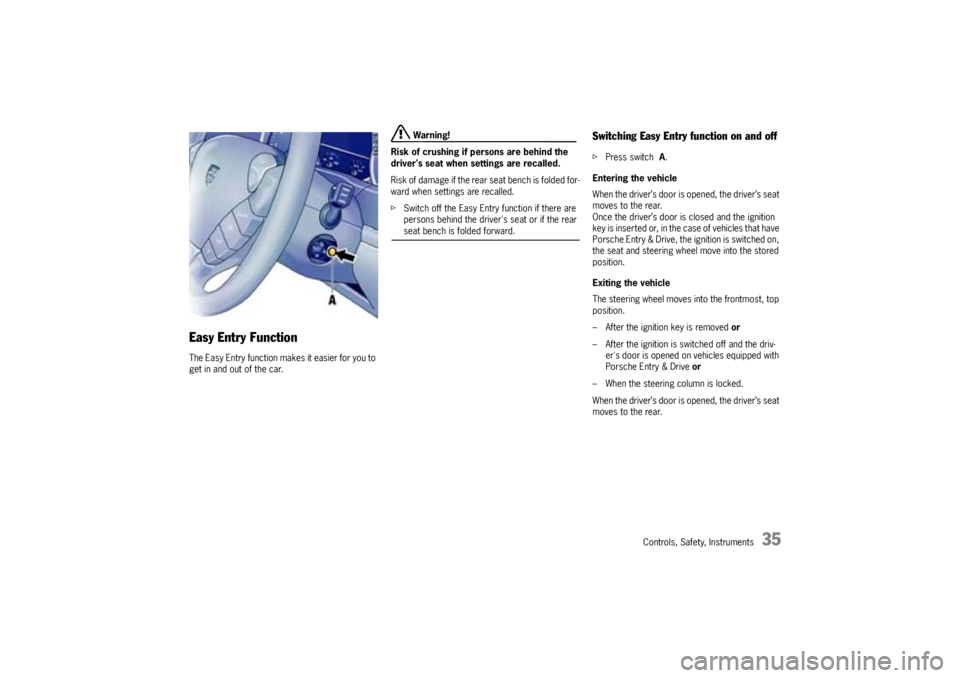
Easy Entry Function The Easy Entry function makes it easier for you to
get in and out of the car.
Warning!
Risk of crushing if persons are behind the
driver's seat when settings are recalled.
Risk of damage if the rear seat bench is folded for-
ward when settings are recalled.
fSwitch off the Easy Entry function if there are
persons behind the driver's seat or if the rear seat bench is folded forward.
Switching Easy Entry function on and offfPress switch A.
Entering the vehicle
When the driver’s door is opened, the driver’s seat
moves to the rear.
Once the driver’s door is closed and the ignition
key is inserted or, in the case of vehicles that have
Porsche Entry & Drive, the ignition is switched on,
the seat and steering wheel move into the stored
position.
Exiting the vehicle
The steering wheel moves into the frontmost, top
position.
– After the ignition key is removed or
– After the ignition is switched off and the driv-
er's door is opened on vehicles equipped with
Porsche Entry & Drive or
– When the steering column is locked.
When the driver’s door is opened, the driver’s seat
moves to the rear.
Page 49 of 369

Controls, Safety, Instruments
49
Airbag SystemsThe Airbags in combination with the safety belts
makes up a safety system which offers the driver
and the passenger the best known protection
from injuries in case of accident.
Even if your vehicle is equipped with airbags, the
safety belts must be worn at all times,
because the front airbag system is only actuated
by frontal collisions with an impact of sufficient se-
verity.
Below the actuation threshold of the airbag sys-
tem, and during types of collisions which do not
cause the actuation of the system, the safety belts
provide the primary protection to the occupants
when correctly worn.
Therefore, all persons within the vehicle
must wear safety belts at all times (in many
states, state law requires the use of safety belts).
fPlease observe the chapter “SAFETY BELTS”
on Page 42.
Thefront airbags are located under the padded
steering wheel panel on the driver’s side and, on
the passenger's side, in the dashboard.
Theside airbags for the front seats are installed
on the side in the seat backrests.
Thehead airbags are installed above the doors
in the roof area.
FunctionThe front airbags are triggered during a frontal col-
lision of sufficient force.
In the event of a side impact of corresponding
force, the side airbag on the impact side is trig-
gered.
The inflation process generates the amount of gas
required to fill the airbags at the necessary pres-
sure in fractions of a second.
Airbags protect the face and upper body, while si-
multaneously damping the motion of the driver
and passenger in the impact direction in the event
of a frontal impact or side impact.
Your vehicle is equipped with a crash sensing and
diagnostic module. This module will record the
use of the seat belt restraint system by the driver
and front passenger when the side airbags and
head airbags are inflated.
Danger!
To provide optimal occupant protection, air-
bags must inflate at very high speed. If you
are not wearing your safety belt or are too
close to the airbag when its deployed, inflat-
ing airbags can result in serious personal in-
jury or death.
fMake sure there are no people, animals or ob-
jects between the driver or passenger and the
area into which the airbag inflates.
fSit back as far from the dashboard or steering
wheel as is practical, while still maintaining full
vehicle control.
fDo not lean against the inside of the doors.
fAlways hold the steering wheel by the outer
rim. Never rest your hands on the airbag panel.
fNever transport heavy or sharp objects on or
in front of the passenger seat.
fAlways keep the lid of the door storage com-
partment closed. Objects must not protrude
out of the door storage compartment.
fGive your passenger all of the information in
this chapter.
fNo changes must be made to the wiring or
components of the airbag system.
f f f
Page 50 of 369

50
Controls, Safety, Instruments fDo not add any additional coverings or stickers
to the steering wheel or in the area of the pas-
senger airbag and side airbags. Doing so may
adversely affect the functioning of the airbag
system or cause harm to the occupants if the
airbag system should deploy.
fDo not undertake any wiring for electrical ac-
cessory equipment in the vicinity of the airbag
wiring harnesses. Doing so may disable the air-
bag system or inadvertant inflation.
fIf the warning light comes on, the airbag sys-
tem should be repaired immediately by your
authorized Porsche dealer.
fAlways keep feet in the footwell while driving.
Do not put feet on the dashboard or the seat
area.
Note
Airbag components (e.g. steering wheel, door
trim) may be disassembled only by an authorized
Porsche dealer.
When disposing of a used airbag unit, our safety
instructions must be followed. These instructions
can be obtained at any authorized Porsche dealer.Faults are indicated by a warning light on the ta-
chometer and a message on the instrument
panel’s multi-purpose display.
fIn the following cases you should immedi-
ately consult an authorized Porsche
dealer in order to assure the airbag sys-
tem is functioning properly:
– If the warning light does not light up when the
ignition is switched on or
– If the warning light does not go out once the
engine is running or
– If the warning light appears while driving.
fPlease observe the chapter “WARNING LIGHTS
AND WARNING MESSAGES” on Page 106.
Airbag maintenanceIn order to ensure long-term functioning, the air-
bag system must be inspected by an authorized
Porsche dealer at the intervals recommended in
your Maintenance Booklet.
Important information
If you sell your Porsche, notify the purchaser that
the vehicle is equipped with airbags, and refer
them to the chapter, “Airbag Systems“, in the
owner's manual (safety and disposal rules).
Further information on the airbag system can be
found on stickers attached to the sun visors, as
well as on all airbag components.
For special recommendations on the use of child
restraints:
fPlease observe the chapter “CHILD RES-
TRAINT SYSTEMS” on Page 47.DisposalfNon-ignited gas alternators, or whole vehicles
or subassemblies with airbag units, must not
be disposed of as “normal” scrap or waste or
put into any other form of end storage.
Your authorized Porsche dealer will be able to
give you details about disposal.
Warning lights and warning
messages