tailgate PORSCHE PANAMERA 2009 1.G Information Manual
[x] Cancel search | Manufacturer: PORSCHE, Model Year: 2009, Model line: PANAMERA, Model: PORSCHE PANAMERA 2009 1.GPages: 343, PDF Size: 7.96 MB
Page 160 of 343
158
Instrument Panel and Multi-Function Display
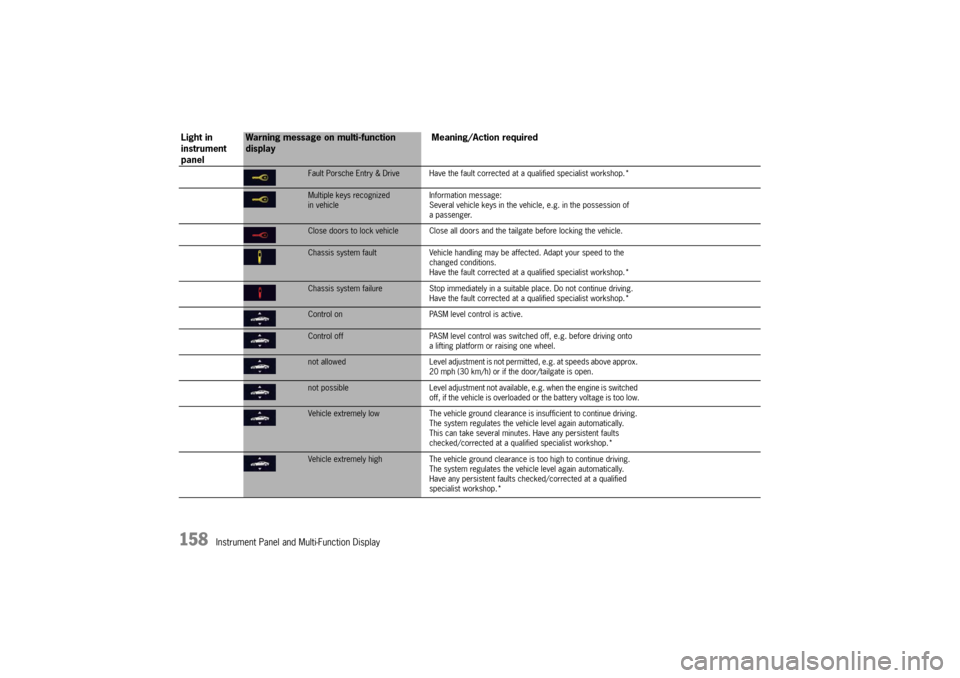
Fault Porsche Entry & Drive Have the fault corrected at a qualified specialist workshop.*Multiple keys recognized
in vehicleInformation message:
Several vehicle keys in the vehicle, e.g. in the possession of
a passenger.Close doors to lock vehicle Close all doors
and the tailgate before locking the vehicle.Chassis system faultVehicle handling may be affected. Adapt your speed to the
changed conditions.
Have the fault corrected at a qualified specialist workshop.*Chassis system failure Stop immediately in a suitable place. Do not continue driving.
Have the fault corrected at a qualified specialist workshop.*Control on PASM level control is active.Control offPASM level control was switched off, e.g. before driving onto
a lifting platform or raising one wheel. not allowed Level adjustment is not permitted, e.g. at speeds above approx.
20 mph (30 km/h) or if the door/tailgate is open.not possible Level adjustment not available, e.g. when the engine is switched
off, if the vehicle is overloaded or the battery voltage is too low.Vehicle extremely low The vehicle ground clearance is insufficient to continue driving.
The system regulates the vehi cle level again automatically.
This can take several minutes. Have any persistent faults
checked/corrected at a qualif ied specialist workshop.*Vehicle extremely high The vehicle ground clearance is too high to continue driving.
The system regulates the vehicl e level again automatically.
Have any persistent faults ch ecked/corrected at a qualified
specialist workshop.*
Light in
instrument
panel
Warning message on multi-function
display Meaning/Action required
Page 163 of 343
Instrument Panel and Multi-Function Display
161
flashes
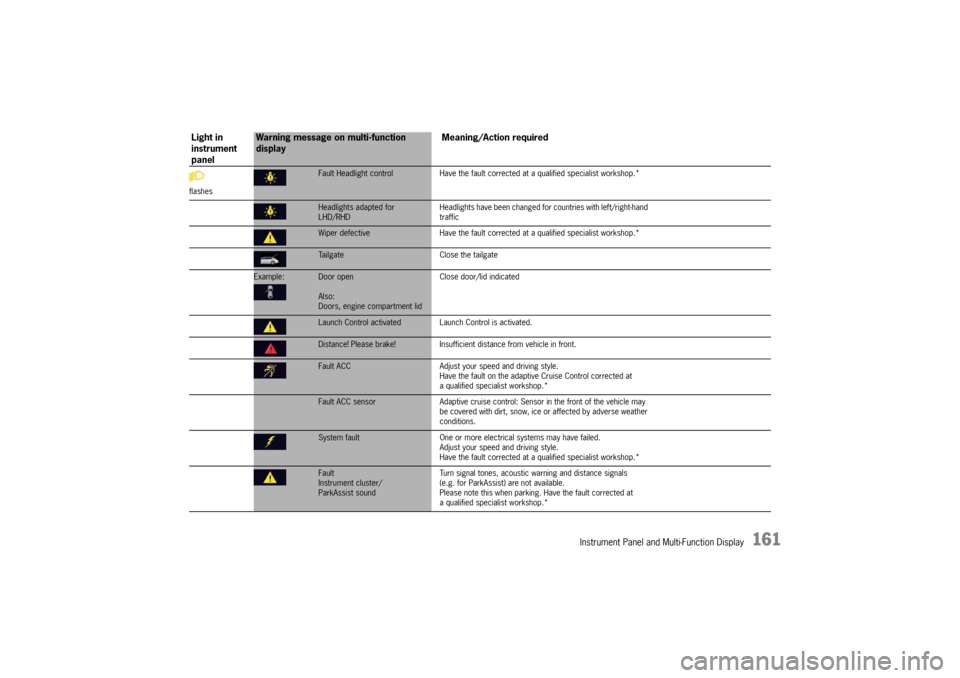
Fault Headlight controlHave the fault corrected at a qualified sp ecialist workshop.*Headlights adapted for
LHD/RHD Headlights have been changed for
countries with left/right-hand
trafficWiper defective Have the fault corrected at a qualified specialist workshop.*Tailgate Close the tailgate
Example:
Door open
Also:
Doors, engine compartment lidClose door/lid indicatedLaunch Control activated Lau
nch Control is activated.Distance! Please brake!Insufficient distance from vehicle in front.Fault ACC Adjust your speed and driving style.
Have the fault on the adaptive Cruise Control corrected at
a qualified specialist workshop.*Fault ACC sensor Adaptive cruise control: Sensor in the front of the vehicle may
be covered with dirt, snow, ice or affected by adverse weather
conditions.System fault One or more electrical systems may have failed.
Adjust your speed and driving style.
Have the fault corrected at a q ualified specialist workshop.*Fault
Instrument cluster/
ParkAssist sound Turn signal tones, acoustic
warning and distance signals
(e.g. for ParkAssist) are not available.
Please note this when parking. Have the fault corrected at
a qualified specialist workshop.*
Light in
instrument
panel
Warning message on multi-function
display Meaning/Action required
Page 211 of 343
Driving and Driving Safety
209
Porsche Active Suspension
Management (PASM) with Air
Suspension and Level ControlPASM with air suspension is an active shock
absorber adjustment and ride height balancing
system. The adjustable damper system selects
the appropriate damping level for each wheel
according to the driving situation and driving
conditions. The level control system automatically
balances load changes and maintains a constant
ride height. Driving safety , agility and comfort are
optimised.
Three different chassis setups can be selected at
the push of a button:
– “PASM Comfort”
– “PASM Sport”
– “PASM Sport Plus”
Comfort mode ensures comfortable chassis
tuning.
The “PASM Sport” chassis setup offers very
sporty shock absorber tuning.
“PASM Sport Plus” mode offers particularly sporty
shock absorber tuning (e.g. for driving on the race
circuit). The vehicle is also lowered by
approx. 1 in. (25 mm) compared with the normal
level and the spring rate is increased.
In addition to manual mode selection, PASM also
adjusts shock absorber tuning for either sporty
or comfort driving, depending on the driving
situation.
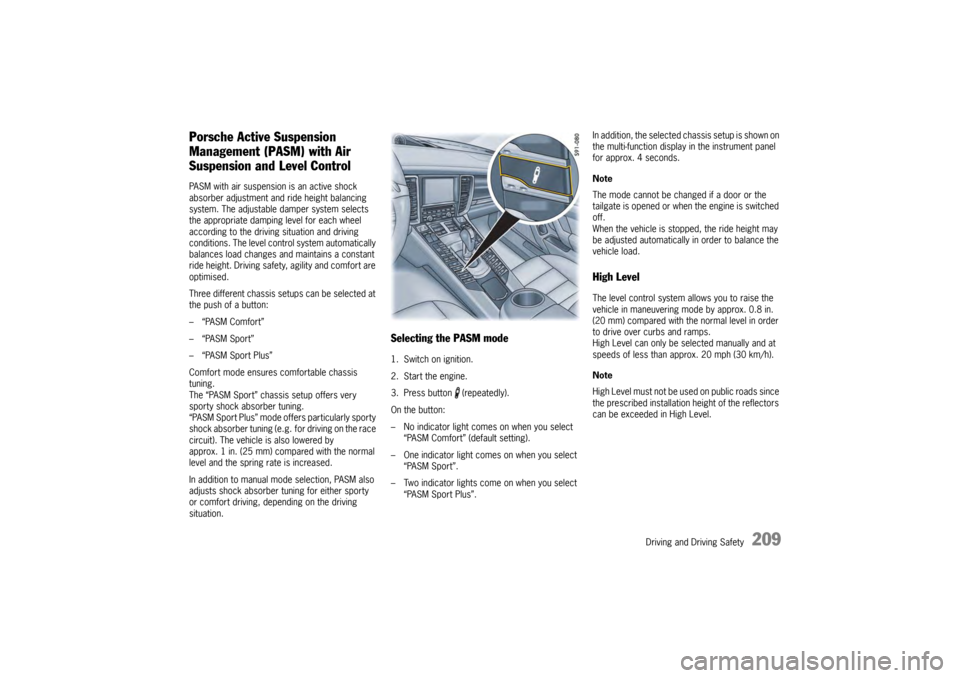
Selecting the PASM mode1. Switch on ignition.
2. Start the engine.
3. Press button (repeatedly).
On the button:
– No indicator light come s on when you select
“PASM Comfort” (default setting).
– One indicator light comes on when you select “PASM Sport”.
– Two indicator lights come on when you select
“PASM Sport Plus”. In addition, the selected chassis setup is shown on
the multi-function display in the instrument panel
for approx. 4 seconds.
Note
The mode cannot be changed if a door or the
tailgate is opened or when the engine is switched
off.
When the vehicle is stopped, the ride height may
be adjusted automatically
in order to balance the
vehicle load.
High LevelThe level control system al lows you to raise the
vehicle in maneuvering mode by approx. 0.8 in.
(20 mm) compared with the normal level in order
to drive over curbs and ramps.
High Level can only be selected manually and at
speeds of less than approx. 20 mph (30 km/h).
Note
High Level must not be us ed on public roads since
the prescribed installation height of the reflectors
can be exceeded in High Level.
Page 230 of 343

228
Storage, Luggage Compartment and Roof Transport System
Stowing Loads
Danger!
Danger of injury. An unsecured or incorrectly
positioned load can slip out of place or
endanger the vehicle occupants during
braking, direction changes or in accidents.
Never transport objects that are not secured.
f Always transport loads in the luggage
compartment, never in the passenger
compartment (e.g. on or in front of the seats).
f Support the load against the seat backrests
wherever possible. Always lock the backrests
into place.
f Only transport heavy objects with the rear seat
backrests upright and engaged.
f Place the load behind unoccupied seats
whenever possible.
f Stow heavy objects as far forward as possible
on the floor, with lightweight objects behind
them.
f Never load the vehicle higher than the top
edge of the seat backrest.
f Always protect the passenger compartment
with a luggage compartment cover. Do not
drive with objects on top of the luggage
compartment cover. f
If the rear seats are not occupied, the
backrests can be addition ally secured with the
seat belts. Simply cro ss the outer seat belts
and insert each into the opposite buckle.
f Make sure that the load cannot damage the
heating filaments and the TV antenna in the
rear window.
Tie-down belts
f Do not use elastic belt s or straps to tie
down a load.
f Do not route belts and straps over
sharp edges.
f Observe the directions for use and information
for the tie-down equipment.
f Use only belts with a tear strength of at least
1543 lbs (700 kg) and a maximum width of
1 in. (25 mm).
f Cross the belts over the load. Driving
f
Vehicle handling changes depending on the
vehicle load. Adapt your driving style to the
changed driving behavior.
f Do not exceed the maximum gross weight
and axle load.
This information can be found under “Technical
data” in this Owner’s Manual:
f Please see the chapter “WEIGHTS” on
page 328.
f Never drive with the tailgate open. Exhaust
gases can enter the passenger compartment.
f Adapt the tire pressure to the load.
After you change the tire pressure, you must
also update the setting for Tire Pressure
Monitoring.
For information on setting Tire Pressure
Monitoring on the multi-function display:
f Please see the chapter “OVERVIEW OF
WARNING MESSAGES” on page 152.
Information on tire pressures for partially and fully
loaded vehicles can be found under “Technical
data” in this Owner’s Manual:
f Please see the chapter “TIRE PRESSURE FOR
COLD TIRES (68 °F/20 °C)” on page 326.
Page 231 of 343
Storage, Luggage Compartment and Roof Transport System
229
Luggage Compartment Cover
Warning!
Risk of injury. In the event of braking,
direction changes or in an accident, objects
can slide into the passenger compartment
and endanger the occupants.
f Do not place objects on the retractable
luggage compartment cover or on the fixed luggage compartment cover.
Retractable luggage compartment coverLuggage can be protected against prying eyes
with the retractable luggage compartment cover.
fAlways pull out the retractable luggage
compartment cover when transporting objects
in the luggage compartment.
The retractable luggage compartment cover is
not designed to carry objects.
Pulling out retractable luggage
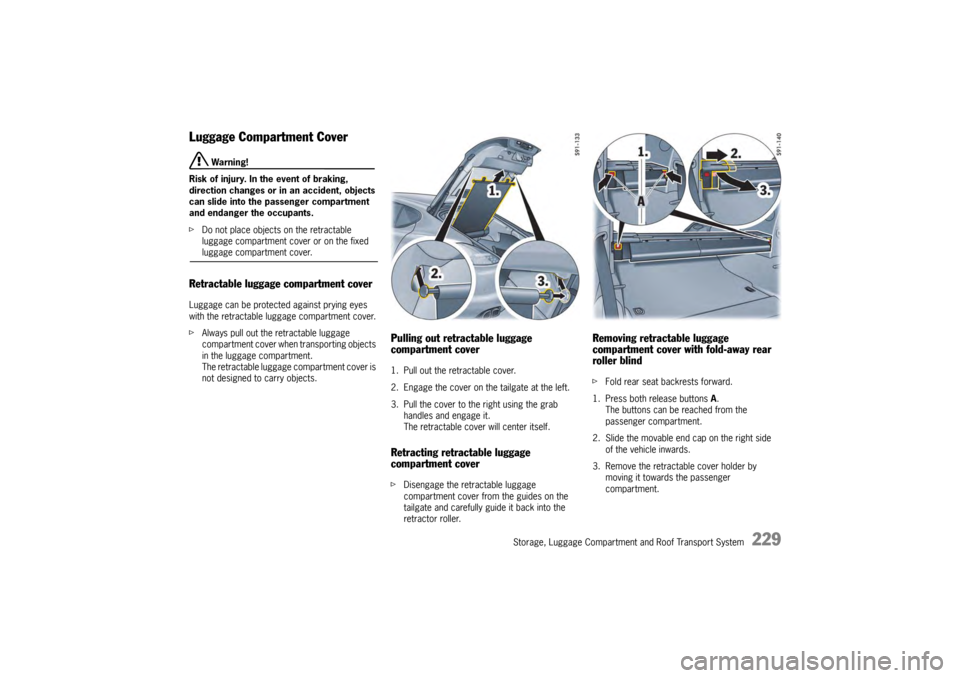
compartment cover1. Pull out the retractable cover.
2. Engage the cover on the tailgate at the left.
3. Pull the cover to the right using the grab
handles and engage it.
The retractable cove r will center itself.Retracting retractable luggage
compartment coverfDisengage the retractable luggage
compartment cover from the guides on the
tailgate and carefully guide it back into the
retractor roller.
Removing retractable luggage
compartment cover with fold-away rear
roller blindf Fold rear seat backrests forward.
1. Press both release buttons A.
The buttons can be reached from the
passenger compartment.
2. Slide the movable end cap on the right side of the vehicle inwards.
3. Remove the retractable cover holder by moving it towards the passenger
compartment.
Page 233 of 343
Storage, Luggage Compartment and Roof Transport System
231
Fixed Luggage Compartment
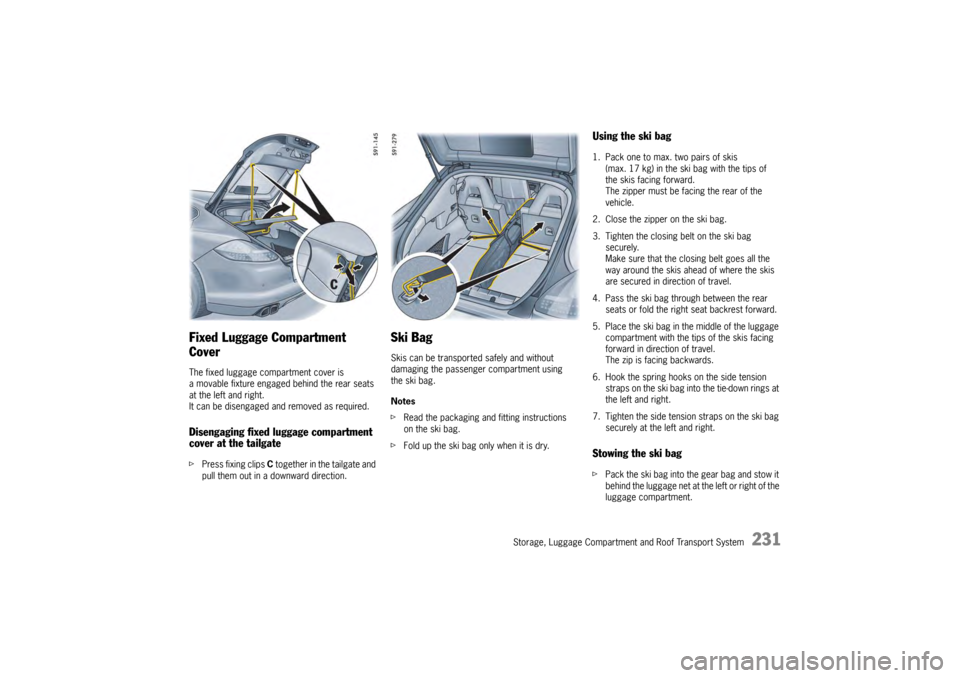
CoverThe fixed luggage compartment cover is
a movable fixture engaged behind the rear seats
at the left and right.
It can be disengaged and removed as required.Disengaging fixed luggage compartment
cover at the tailgatefPress fixing clips C together in the tailgate and
pull them out in a downward direction.
Ski BagSkis can be transported safely and without
damaging the passenger compartment using
the ski bag.
Notes
f Read the packaging and fitting instructions
on the ski bag.
f Fold up the ski bag only when it is dry.
Using the ski bag1. Pack one to max. two pairs of skis
(max. 17 kg) in the ski bag with the tips of
the skis facing forward.
The zipper must be facing the rear of the
vehicle.
2. Close the zipper on the ski bag.
3. Tighten the closing belt on the ski bag securely.
Make sure that the closing belt goes all the
way around the skis ahead of where the skis
are secured in direction of travel.
4. Pass the ski bag through between the rear seats or fold the right seat backrest forward.
5. Place the ski bag in the middle of the luggage compartment with the tips of the skis facing
forward in direction of travel.
The zip is facing backwards.
6. Hook the spring hooks on the side tension straps on the ski bag into the tie-down rings at
the left and right.
7. Tighten the side tension straps on the ski bag securely at the left and right.Stowing the ski bagfPack the ski bag into the gear bag and stow it
behind the luggage net at the left or right of the
luggage compartment.
Page 249 of 343

Alarm System and Theft Protection
247
Alarm System and Passenger
Compartment MonitoringThis device complies with:
Part 15 of the FCC Rules
RSS-210 of Industry Canada.
Operation of this device is subject to the following
two conditions:
– It may not cause harmful interference, and
– it must accept any interference received including interference that may cause
undesired operation.
Note
The manufacturer is not responsible for any radio
or TV interference caused by unauthorized
modifications to this equipment.
Such modification could void the user's authority
to operate the equipment.
Warning!
Any changes or modifications not expressly ap-
proved by Porsche could void the user’s authority
to operate this equipment.
The alarm system monitors the following alarm
contacts:
– Alarm contacts in doors, tailgate, engine compartment lid and headlights
– Interior surveillance: Movement in the interior when the vehicle is locked, e.g. attempted
theft after breaking a window.
– Inclination sensor: Tilting of the vehicle (e.g. attempt to tow away the vehicle).
If one of these alarm contacts is interrupted,
the alarm horn sounds for approx. 30 seconds
and the emergency flasher flashes on and off.
After 5 seconds of interruption, the alarm is
triggered again. This cycle is repeated ten times.Switching onf The alarm system is activated when the vehicle
is locked. Switching offfThe alarm system is deactivated when the
vehicle is unlocked. Note on operation
f
If you unlock the vehicle with the emergency
key in the door lock, you must switch the
ignition on (ignition lock position 1) within
10 seconds of opening the door in order to
prevent the alarm system from being
triggered.
The vehicle is locked ag ain automatically after
20 seconds if no doors are opened.
Switching off the alarm system if it is
triggeredf Unlock vehicle doors with the remote control
or
Switch on ignition.Switching off interior surveillance and
inclination sensorIf people or animals are remaining in the locked
vehicle or the vehicle is being transported on
a train or ship, for example, the interior
surveillance system and inclination sensor must
be switched off temporarily.
f Inform any persons remaining in the vehicle
that the alarm system will be triggered if the
door is opened.
USA: KR55WK50138
Canada: 7812D-5WK50138
Page 252 of 343

250
Alarm System and Theft Protection
ImmobilizerThere is a transponder (an electronic component),
containing a stored code, in each key.
Before the ignition is switched on, the ignition lock
checks the code.
The immobiliser can be deactivated and
the engine started only using an authorised
ignition key.
Locking the Steering ColumnVehicles without Porsche Entry & Drive Unlocking the steering column automatically
f Insert the ignition key into the ignition lock.
Locking the steering column automatically
f Remove the ignition key.Vehicles with Porsche Entry & DriveUnlocking the steering column automatically
f Turn the control unit out of ignition lock
position 0 .
Locking the steering column automatically
f Open the driver’s door (with the ignition
switched off).
Locking the steering column manually
f Once the ignition is sw itched off, turn the
control unit to ignition lock position 3 again
and hold it there for 2seconds.
The steering column locks with an
audible click.
Theft ProtectionWhen leaving the vehicle, always:
f Close all door windows.
f Close the slide/tilt roof.
f Remove the ignition key (or switch ignition off
on vehicles with Porsche Entry & Drive).
f Lock the glove box.
f Close all storage compartments.
f Remove valuables, vehicle registration
documents, telephone and house keys from
the vehicle.
f Cover the luggage compartment with the
retractable luggage compartment cover.
f Close the tailgate.
f Lock all doors.
Page 303 of 343

Minor Repairs
301
Fuse and relay carriers
in the luggage compartment
34Right-hand drive vehicles only:
Turn signal, rear left
Marker light, front right
Low beam headlight, left
High beam headlight, left
Cornering light, front right
Engine compartment lid light
Shutter elements, right/left
Active brake ventilation
open/closed
Heatable washer jets
Engine compartment lid
Headlight beam adjustment 30
35 Right-hand drive vehicles only:
Steering column lock
Filler flap closed/open
Windshield washer pump,
front/rear 15
36 RHD, headlight cleaning system 30
37 Not used
38 Not used
39 PSM control unit 25
40 LHD, central locking for front/rear
right door 10
41 Power windows, front right 25
42 Power windows, rear right 25
43 Alarm horn 5
44 Vehicle Tracking System VTS 5
45 Not used
46 Not used
No.
Designation A
47 Fuel pump control unit 25
48 Horn (two-tone horns) 15
49 Diagnostic socket 5
50 RHD, ignition lock, light switch 5
51 RHD, central locking for front right
door 10
52 RHD, steering column lock 5
53 Not used
54 Not used
55 Not used
56 Not used
57 PSM pump control unit 40
No.
Designation A
No. Fuse carrier A A
1Not used
2 Spoiler flap (Turbo) 10
3 Audio amplifier (Burmester
®)
Audio amplifier (ASK Sound, Bose) 30
25
4 Start/Stop control unit 30
5 Start/Stop control unit 30
6 Differential lock 10
7 Differential lock 30
8 Subwoofer (Bose, Burmester®)30
9 Powerlift tailgate 25
10 PASM control unit 25
11 Luggage compartment lights 5
12 PDCC control unit 10
Page 304 of 343

302
Minor RepairsLHD = Left-hand drive vehicles
RHD = Right-hand drive vehicles
Note
f
Use the plastic gripper D when replacing the
fuses. This can be found in the fuse box cover
on the dashboard.
f Spare fuses can be found in both fuse box
covers on the dashboard (left: 7.5 and 10 A;
right: 20 and 25 A).
No. Fuse carrier B
A
1 Daytime driving lights, right
Tail light, right
Reversing light, right
Rear fog light, left
Brake light, right
Raised brake light
Sun blind
Electric steering column lock
Rear wiper
Heated rear window
Interior surveillance/inclination
sensor
PA S M
Engine control unit
Safety/curb lights, front doors
Interior light/reading light, front
Interior light, rear
Orientation light
Licence plate light
Engine speed hall senders 1+3
Interior light 15
2 Daytime driving lights, left
Tail light, left
Reversing light, left
Rear fog light, right
Brake light, left
Safety/curb lights, rear doors
Exhaust flap control
Filler flap closed
Extend/retract spoiler 15
3
Tailgate closing mechanism
Filler flap open
Retract/extend rear spoiler
Sun blind 30
4 Alarm horn 15
5 Gateway control unit 5
6 Heated rear window 20
7 PASM control unit 5
8 Gateway control unit 5
9 Electric parking brake 5
10 Differential lock 10
11 PDCC control unit 10
12 Rear wiper 15
No. Fuse carrier B
A
No.Relay carrier C
1 Heated rear window
2 Not used
3 Spoiler flap (Turbo)
4 Spoiler flap (Turbo)
5 PASM/LF compressor