change wheel PORSCHE PANAMERA 2009 1.G Information Manual
[x] Cancel search | Manufacturer: PORSCHE, Model Year: 2009, Model line: PANAMERA, Model: PORSCHE PANAMERA 2009 1.GPages: 343, PDF Size: 7.96 MB
Page 200 of 343
198
Driving and Driving Safety
Upshift prompt for fuel-economy-optimised
driving
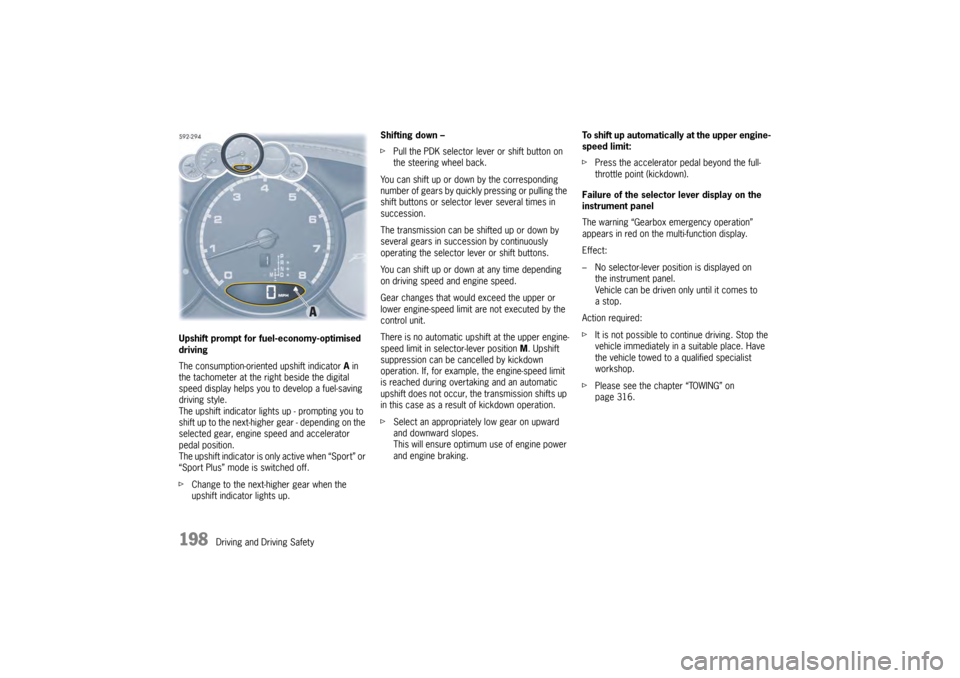
The consumption-oriente
d upshift indicator A in
the tachometer at the ri ght beside the digital
speed display helps you to develop a fuel-saving
driving style.
The upshift indicator lights up - prompting you to
shift up to the next-higher gear - depending on the
selected gear, engine speed and accelerator
pedal position.
The upshift indicator is only active when “Sport” or
“Sport Plus” mode is switched off.
f Change to the next-higher gear when the
upshift indicator lights up. Shifting down –
f
Pull the PDK selector lever or shift button on
the steering wheel back.
You can shift up or down by the corresponding
number of gears by quickly pressing or pulling the
shift buttons or selector lever several times in
succession.
The transmission can be shifted up or down by
several gears in succession by continuously
operating the selector lever or shift buttons.
You can shift up or down at any time depending
on driving speed and engine speed.
Gear changes that would exceed the upper or
lower engine-speed limit are not executed by the
control unit.
There is no automatic upshift at the upper engine-
speed limit in selector-lever position M. Upshift
suppression can be cancelled by kickdown
operation. If, for example, the engine-speed limit
is reached during overtaking and an automatic
upshift does not occur, the transmission shifts up
in this case as a result of kickdown operation.
f Select an appropriately low gear on upward
and downward slopes.
This will ensure optimum use of engine power
and engine braking. To shift up automatically
at the upper engine-
speed limit:
f Press the accelerator pedal beyond the full-
throttle point (kickdown).
Failure of the selector lever display on the
instrument panel
The warning “Gearbox emergency operation”
appears in red on the multi-function display.
Effect:
– No selector-lever position is displayed on the instrument panel.
Vehicle can be driven only until it comes to
astop.
Action required:
f It is not possible to continue driving. Stop the
vehicle immediately in a suitable place. Have
the vehicle towed to a qualified specialist
workshop.
f Please see the chapter “TOWING” on
page 316.
Page 201 of 343

Driving and Driving Safety
199
StoppingfFor a brief stop, e.g. at traffic lights, leave the
selector lever in drive position and hold the
vehicle with the brake pedal.
f Do not hold the vehicle on a slope using the
accelerator. Use the brake pedal or the
electric parking brake instead.
f Before leaving the vehicle, always apply the
electric parking brake and move the selector
lever to position P.Parkingf Go easy on the accelerator!
f When parking or maneuvering in a small
space, control the speed by careful use of
the footbrake.Driving in winterIn wintry road conditions, it is advisable to take
steep inclines in manual mode. This prevents gear
changes occurring that could cause wheel spin.Tow-starting, towingfPlease see the chapter “TOWING” on
page 316.
Reduced driving programIf there is a fault in the transmission
– Depending on priority, either the “Gearbox
emergency operation” warning in yellow or red
or the warning “Gearbox temperature too high”
will appear on the multi-function display.
“Gearbox emergency operation” warning in
yellow
Effects:
– Restricted gearshift comfort, reverse gear may not function.
Action required:
f Have the fault corrected immediately.
Please contact a qualified specialist workshop.
We recommend that you have an authorized
Porsche dealer to do this work as they have
trained workshop personnel and the necessary
parts and tools. “Gearbox emergency operation” warning in red
Effect:
– Vehicle can be driven
only until it comes to
astop.
Action required:
f It is not possible to continue driving. Stop the
vehicle immediately in a suitable place. Have
the vehicle towed to a qualified specialist
workshop.
f Please see the chapter “TOWING” on
page 316.
Warning “Gearbox temperature too high”
–Effects: “Warning jerks” can be fe lt when driving off and
the engine power may be restricted.
Action required:
Do not hold the vehicle with the accelerator on
a hill, for example. Hold the vehicle with the
brake. Reduce engine load. Stop the vehicle in
a suitable place if possib le. Allow the engine to
run in selector-lever position P or N until the
warning disappears.
Page 205 of 343

Driving and Driving Safety
203
Advantages of PSM
– Best possible traction and lane-holding ability
in all driving situations – even on road surfaces
with varying friction.
– The system compensates for undesired vehicle reactions (Ferraria effect) when the
driver releases the accelerator pedal or brakes
on bends. This compensation functions up to
the maximum lateral acceleration.
– PSM actively stabilises the vehicle if necessary during dynamic driving maneuvers (e.g. rapid
steering movements, during lane changes, or
on alternating bends).
– Improved braking stability on bends and on different or varying road surfaces.
– Improved brake function and shorter stopping distance in the event of emergency braking. Readiness for operation
PSM is switched on automatically every time you
start the engine.
Function
Sensors at the wheels, brakes, steering system
and engine continuously measure:
–Speed
– Direction of travel (steering angle)
– Lateral acceleration
– Axial acceleration
– Rate of turn about the vertical axis
PSM uses these values to determine the direction
of travel desired by the driver.
PSM intervenes and corrects the course if the
actual direction of motion deviates from the
desired course (steering-wheel position):
It brakes individual wheels as required.
If necessary, PSM also influences the engine
power or the gear-changing characteristic of
Porsche Doppelkupplung (PDK) in order to
stabilise the vehicle. The events below inform the driver of PSM control
operations and warn him to adapt his driving style
to the road conditions:
– PSM warning light on the instrument panel
flashes.
– Hydraulic noises can be heard.
– The vehicle decelerates and steering-wheel forces are altered as PSM controls the brakes.
– Reduced engine power.
– The brake pedal pulsates and its position is changed during braking.
In order to achieve full vehicle deceleration,
foot pressure must be increased after the
brake pedal has begun vibrating.
Examples of PSM control operations
– If the “front wheels of the vehicle drift” on
a bend, the engine power is reduced and the
rear wheel on the inside of the bend is braked
if necessary.
– If the rear of the vehicle swings out on a bend, the front wheel on the outside of the bend is
braked.
Page 207 of 343

Driving and Driving Safety
205
When you brake in the ABS control range,
the vehicle is stabilised even when PSM is
switched off.
One-sided spinning of the wheels is prevented,
even with PSM switched off.
PSM should always be switched on during
“normal” driving.
H o w e v e r, i t m a y b e a g o o d i d e a to s w it c h o f f P S M
temporarily in exceptional situations:
– On a loose surface and in deep snow.
– When “rocking the vehicle free”.
– When using snow chains.
Tip on driving
The vehicle retains its enhanced braking readiness
through prefilling of the br ake system even when
PSM is switched off.
When PSM is switched off, wheel-specific brake
interventions and the anti-slip control system (ASR)
are also switched off.
The automatic brake differential (ABD) remains on.
Adaptive cruise control is deactivated when PSM
is switched off.
When PSM is switched off, the slip monitoring
function of Porsche Doppelkupplung (PDK) is also
deactivated.
Switching PSM back onf Press button .
PSM is active immediately.
The indicator light on the button and the
PSM OFF warning light on the instrument
panel go out.
The message “PSM switched on” appears on
the multi-function disp lay in the instrument
panel.“Sport Plus” modeA sportier setup is obtained when “Sport Plus”
mode is switched on.
PSM interventions occur later than in Normal
mode. The vehicle can be maneuvered with
greater agility at its pe rformance limits, without
having to dispense with th e assistance of PSM in
emergency situations. This helps to achieve
optimal lap times, particular ly on race circuits and
on a dry road surface. – The PSM warning light on the instrument panel
lights up for a lamp check when the ignition is
switched on.
– The light indicates a control operation, even when PSM is switched off, e.g. brake control in
the event of one-sided wheel spin.
– The light - in conjunction with the multi-function display - indicates a fault.
The warning message “PSM failure” appears
on the multi-function display in the instrument
panel.
For information on warning messages on the multi-
function display:
f Please see the chapter “OVERVIEW OF
WARNING MESSAGES” on page 152.
f Adapt your driving style according to the
changed conditions.
f Contact a qualified spec ialist workshop in
order to correct the fault. We recommend that
you have an authorized Porsche dealer to do
this work, as they have the trained workshop
personnel and the necessary parts and tools
for this type of work.
To w i n g
For information on towing:
f Please see the chapter “TOWING” on
page 316.
PSM warning light
Page 209 of 343

Driving and Driving Safety
207
ABS Brake System
(Anti-Lock Brake System)
Warning!
In spite of the advantages of ABS, it is still the
driver’s responsibility to adapt his driving style and
maneuvers in line with road and weather
conditions, as well as the traffic situation.
The increased safety that is provided should not
induce you to take greater risks with your safety.
The limits set by the physic s of driving cannot be
overcome, even with ABS.
Risk of accidents due to inappropriate speed
cannot be reduced by ABS.
ABS ensures
– Full steering control
The vehicle remains steerable
– Good driving stability
No skidding due to locked wheels
– Optimum braking distance
Shorter stopping distance in most cases
– Prevention of wheel locking
No flat spots on the tires Function
The decisive advantage of ABS lies in the driving
stability and maneuverability of the vehicle in
hazardous situations.
ABS prevents locking of
the wheels during full
braking, on almost all road surfaces, until just
before the vehicle stops.
ABS begins to control the braking process as
soon as a wheel shows a tendency to lock.
This controlled braking process is comparable
with extremely rapid cadence braking.
The pulsating brake pedal and a “juddering noise”
warn the driver to adapt his driving speed to the
road conditions.
f If full braking is necessary, press the brake
pedal fully during the whole braking operation,
even though the pedal is pulsating. Do not
reduce brake pressure. If the ABS warning light lig
hts up on the instrument
panel while the engine is running, the ABS has
switched off because of a fault.
The warning message “ABS failure” appears on
the multi-function display in the instrument panel.
For information on warning messages on the
multi-function display:
f Please see the chapter “OVERVIEW OF
WARNING MESSAGES” on page 152.
In this case, the brake system will operate without
lock prevention, as on vehicles without ABS.
f Adapt your driving style to the changed
braking behavior.
The ABS must be checked by your authorized
Porsche dealer in order to prevent the
occurrence of further faults with unpredictable
consequences.
Please contact a qualified specialist workshop.
We recommend that you have an authorized
Porsche dealer to do this work as they have
trained workshop personnel and the necessary
parts and tools.
The ABS control unit is adjusted for the approved
tire dimensions.
The use of tires with no n-approved dimensions can
lead to different wheel speeds, causing ABS to
switch off. Warning light USA
Warning light Canada
Page 210 of 343
208
Driving and Driving Safety
Porsche Active Suspension
Management (PASM)The PASM system actively adjusts the shock
absorbers. The adjustable damper system selects
the appropriate damping level for each wheel
according to the driving situation and driving
conditions. Driving safety, agility and comfort are
optimised.
Three different chassis setu ps can be selected at
the push of a button:
– “PASM Comfort”
– “PASM Sport”
– “PASM Sport Plus”
Comfort mode ensures comfortable chassis
tuning.
The “PASM Sport” chassis setup offers very
sporty shock absorber tuning.
“PASM Sport Plus” mode offers particularly
sporty shock absorber tuning (e.g. for driving on
the race circuit).
In addition to manual mode selection, PASM
also adjusts shock absorber tuning for either
sporty or comfort driving, depending on the
driving situation.
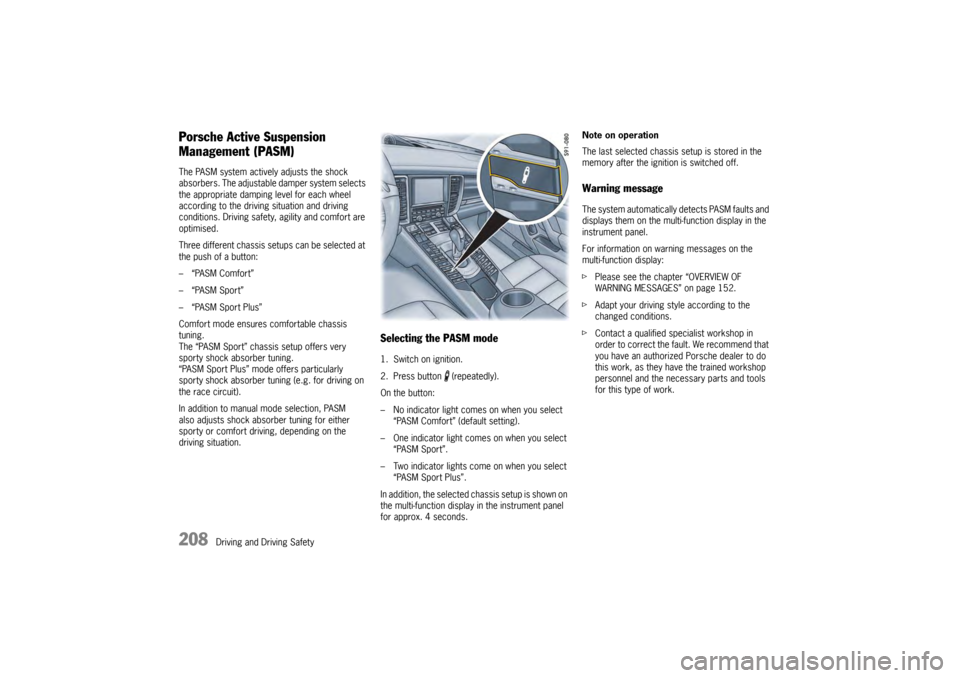
Selecting the PASM mode1. Switch on ignition.
2. Press button (repeatedly).
On the button:
– No indicator light comes on when you select “PASM Comfort” (default setting).
– One indicator light come s on when you select
“PASM Sport”.
– Two indicator lights come on when you select “PASM Sport Plus”.
In addition, the selected chassis setup is shown on
the multi-function display in the instrument panel
for approx. 4 seconds. Note on operation
The last selected chassis setup is stored in the
memory after the ignition is switched off.
Warning messageThe system automatically
detects PASM faults and
displays them on the multi-function display in the
instrument panel.
For information on warning messages on the
multi-function display:
f Please see the chapter “OVERVIEW OF
WARNING MESSAGES” on page 152.
f Adapt your driving style according to the
changed conditions.
f Contact a qualified specialist workshop in
order to correct the fault. We recommend that
you have an authorized Porsche dealer to do
this work, as they have the trained workshop
personnel and the necessary parts and tools
for this type of work.
Page 211 of 343
Driving and Driving Safety
209
Porsche Active Suspension
Management (PASM) with Air
Suspension and Level ControlPASM with air suspension is an active shock
absorber adjustment and ride height balancing
system. The adjustable damper system selects
the appropriate damping level for each wheel
according to the driving situation and driving
conditions. The level control system automatically
balances load changes and maintains a constant
ride height. Driving safety , agility and comfort are
optimised.
Three different chassis setups can be selected at
the push of a button:
– “PASM Comfort”
– “PASM Sport”
– “PASM Sport Plus”
Comfort mode ensures comfortable chassis
tuning.
The “PASM Sport” chassis setup offers very
sporty shock absorber tuning.
“PASM Sport Plus” mode offers particularly sporty
shock absorber tuning (e.g. for driving on the race
circuit). The vehicle is also lowered by
approx. 1 in. (25 mm) compared with the normal
level and the spring rate is increased.
In addition to manual mode selection, PASM also
adjusts shock absorber tuning for either sporty
or comfort driving, depending on the driving
situation.
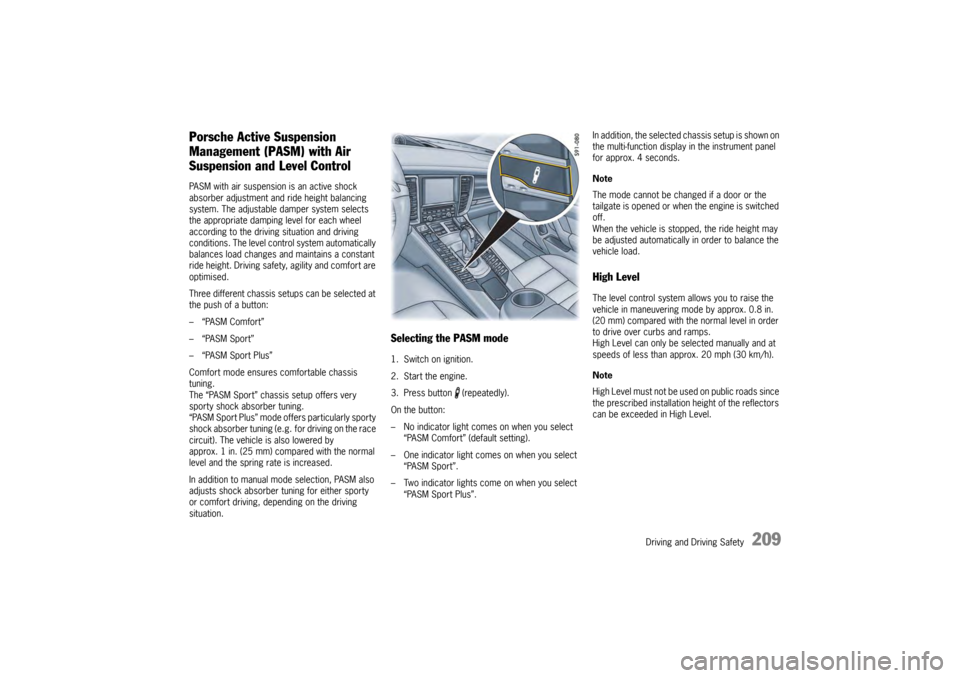
Selecting the PASM mode1. Switch on ignition.
2. Start the engine.
3. Press button (repeatedly).
On the button:
– No indicator light come s on when you select
“PASM Comfort” (default setting).
– One indicator light comes on when you select “PASM Sport”.
– Two indicator lights come on when you select
“PASM Sport Plus”. In addition, the selected chassis setup is shown on
the multi-function display in the instrument panel
for approx. 4 seconds.
Note
The mode cannot be changed if a door or the
tailgate is opened or when the engine is switched
off.
When the vehicle is stopped, the ride height may
be adjusted automatically
in order to balance the
vehicle load.
High LevelThe level control system al lows you to raise the
vehicle in maneuvering mode by approx. 0.8 in.
(20 mm) compared with the normal level in order
to drive over curbs and ramps.
High Level can only be selected manually and at
speeds of less than approx. 20 mph (30 km/h).
Note
High Level must not be us ed on public roads since
the prescribed installation height of the reflectors
can be exceeded in High Level.
Page 212 of 343
210
Driving and Driving Safety
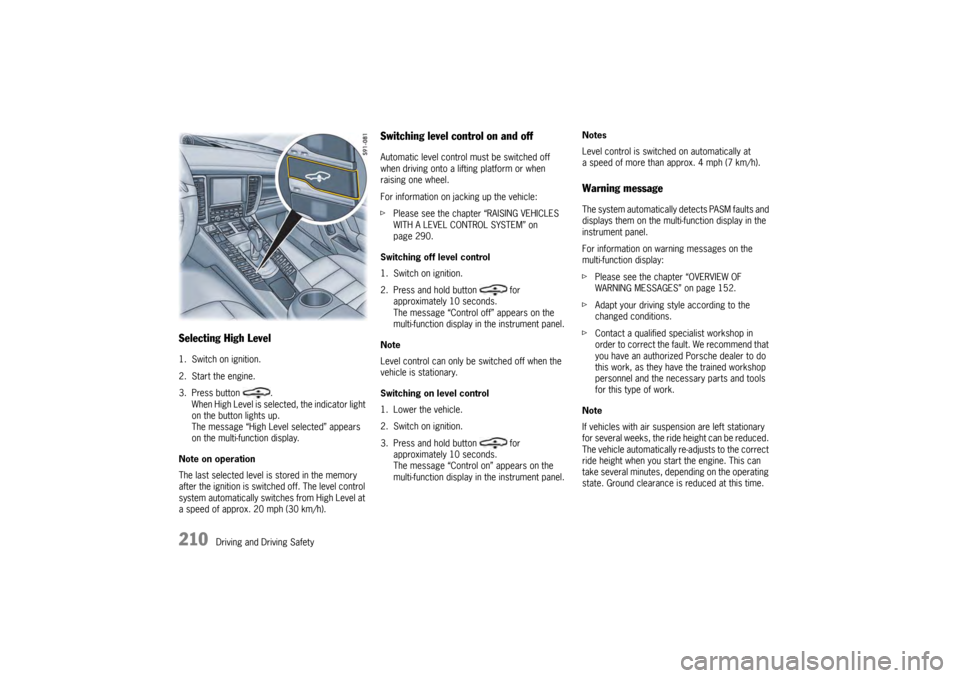
Selecting High Level1. Switch on ignition.
2. Start the engine.
3. Press button .When High Level is selected, the indicator light
on the button lights up.
The message “High Level selected” appears
on the multi-function display.
Note on operation
The last selected level is stored in the memory
after the ignition is switched off. The level control
system automatically switches from High Level at
a speed of approx. 20 mph (30 km/h).
Switching level control on and offAutomatic level control must be switched off
when driving onto a lifting platform or when
raising one wheel.
For information on ja cking up the vehicle:
f Please see the chapter “RAISING VEHICLES
WITH A LEVEL CONTROL SYSTEM” on
page 290.
Switching off level control
1. Switch on ignition.
2. Press and hold button for approximately 10 seconds.
The message “Control off” appears on the
multi-function display in the instrument panel.
Note
Level control can only be switched off when the
vehicle is stationary.
Switching on level control
1. Lower the vehicle.
2. Switch on ignition.
3. Press and hold button for approximately 10 seconds.
The message “Control on” appears on the
multi-function display in the instrument panel. Notes
Level control is switched on automatically at
a speed of more than approx. 4 mph (7 km/h).
Warning messageThe system automatically
detects PASM faults and
displays them on the multi-function display in the
instrument panel.
For information on warning messages on the
multi-function display:
f Please see the chapter “OVERVIEW OF
WARNING MESSAGES” on page 152.
f Adapt your driving style according to the
changed conditions.
f Contact a qualified specialist workshop in
order to correct the fault. We recommend that
you have an authorized Porsche dealer to do
this work, as they have the trained workshop
personnel and the necessary parts and tools
for this type of work.
Note
If vehicles with air suspension are left stationary
for several weeks, the ride height can be reduced.
The vehicle automatically re-adjusts to the correct
ride height when you start the engine. This can
take several minutes, depending on the operating
state. Ground clearance is reduced at this time.
Page 266 of 343

264
Maintenance and Car Care
Fuel EconomyFuel economy will vary depending on where,
when and how you drive, optional equipment
installed, and the general condition of your
car.
A car tuned to specifications and correctly
maintained, will help you to achieve optimal
fuel economy.
fHave your vehicle tuned to specifications. Air
cleaner should be dirt free to allow proper
engine “breathing”.
Battery should be fully charged.
Wheels should be properly aligned.
Tires should be inflated to the correct
pressure.
f Always monitor your fuel consumption.
f Drive smoothly, avoid abrupt changes in speed
as much as possible.
f Avoid jack rabbit starts and sudden stops.
f Do not drive longer than necessary in the lower
gears. Shifting into a higher gear early without
lugging the engine will help save fuel.
f Prolonged “warm up” idling wastes gas. Start
the vehicle just before you are ready to drive.
Accelerate slowly and smoothly.
f Switch off the engine if stationary for longer
periods.
f Any additional weight carried in the vehicle
reduces fuel economy. Always keep cargo to
a minimum and remove all unnecessary items. f
Organize your trips to take in several errands
in one trip.
f All electrical accessories contribute to
increased fuel consumption.
f Only switch on the air conditioning when
necessary.
f Do not drive with the Ro of Transport System
mounted unless you need it.
The EPA estimated miles per gallon (mpg) is
to be used for comparison purposes, actual
mileage may be different from the estimated
mpg, depending on your driving speed,
weather conditions and trip length. Your
actual highway mileage may be less than the
estimated mpg.
f Please observe all local and national speed
limits.
Operating Your Porsche in other
CountriesGovernment regulations in the United States and
Canada require that automobiles meet specific
emission regulations and safety standards.
Therefore, cars built for the U.S. and Canada differ
from vehicles sold in other countries.
If you plan to take your Porsche outside the
continental limits of the United States or Canada,
there is the possibility that
– unleaded fuel may not be available;
– unleaded fuel may have a considerably lower
octane rating. Excessi ve engine knock and
serious damage to both engine and catalytic
converters could result;
– service may be inadequate due to lack of proper service facilities, tools or diagnostic
equipment;
– replacement parts may not be available or very difficult to get.
Porsche cannot be responsible for the
mechanical damage that could result
because of inadequate fuel, service or parts
availability.
If you purchased your Porsche abroad and want to
bring it back home, be sure to find out about
shipping and forwarding requirements, as well as
current import and customs regulations.
Page 278 of 343

276
Maintenance and Car Care
Cleaning air bag covers
Danger!
Risk of serious or fatal injury from impaired
operation of the air bag system caused by
incorrect cleaning.
f While it is appropriate to use normal surface
cleaning methods on the interior of your
vehicle, do not undertake deep cleaning of air
bag-related components, such as the
padded covers on the steering wheel,
the underside of the instrument panel,
front seats, roof pillars, roof liners and the
rear interior trim panels, and around the
seat backrest.
f Have your authorized Porsche dealer to clean these components.
Cleaning fabric liningsfFabric linings on pillars, roofliner and sun
blinds, etc. must be cleaned only using
suitable cleaning agents or a suitable dry
foam and a soft brush.
Alcantara careDo not use leather care products to
clean Alcantara.
For regular care, it is sufficient to clean the
cover with a soft brush.
Strong abrasion or rubbing when cleaning will
produce a lasting change to the surface.
Cleaning when lightly soiled
f Wet a soft cloth with water or a neutral
soap solution and wipe off the dirt.
Cleaning when heavily soiled
f Wet a soft cloth with lukewarm water or diluted
white spirit and dab the dirt from the outside
in.Cleaning the seat beltsfUse mild detergent to clean soiled belts.
f When drying, avoid direct sunlight.
f Only use suitable cleaning agents.
f Do not tint or bleach the belts.
The belt fabric could be weakened,
thus affecting safety.
Storing your PorscheIf you wish to keep your Porsche off the road for
a lengthy period, we recommend that you contact
your authorized Porsche dealer.
They will be glad to advise you about the
necessary measures, e.g. corrosion prevention,
care, maintenance and storage.
Further important information on laying up your
Porsche can be found in other sections.
fPlease see the chapter “BATTERY” on
page 303.
For information on locking the vehicle when
the battery is disconnected:
f Please see the chapter “NOT ALL VEHICLE
DOORS ARE LOCKED” on page 36.