engine PORSCHE PANAMERA 2010 1.G Information Manual
[x] Cancel search | Manufacturer: PORSCHE, Model Year: 2010, Model line: PANAMERA, Model: PORSCHE PANAMERA 2010 1.GPages: 80, PDF Size: 6.26 MB
Page 22 of 80
· 52 ·· 53 ·
Performance | Engines
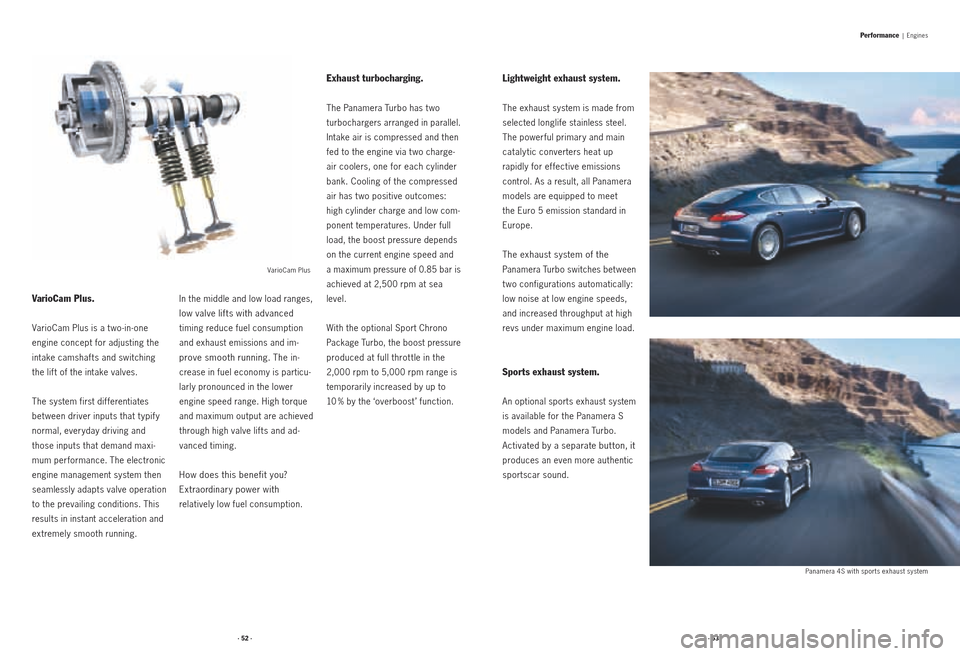
VarioCam Plus.
VarioCam Plus is a t wo -in - one
engine concept for adjusting the
intake camshaf ts and switching
the lif t of the intake valves.
The system first dif ferentiates
bet ween driver inputs that t ypif y
normal, everyday driving and
those inputs that demand maxi -
mum performance. The electronic
engine management system then
seamlessly adapts valve operation
to the prevailing conditions. This
results in instant acceleration and
extremely smooth running. In the middle and low load ranges,
low valve lifts with advanced
timing reduce fuel consumption
and exhaust emissions and im -
prove smooth running. The i n -
crease in fuel economy is particu -
larly pronounced in the lower
engine speed range. High torque
and maximum output are achieved
through high valve lifts and ad -
vanced timing.
How does this benefit you?
Extraordinary power with
relatively low fuel consumption.
Exhaust turbocharging.
The Panamera Turbo has t wo
turbochargers arranged in parallel.
Intake air is compressed and then
fed to the engine via t wo charge-
air coolers, one for each cylinder
bank. Cooling of the compressed
air has t wo positive outcomes:
high cylinder charge and low com -
ponent temperatures. Under full
load, the boost pressure depends
on the current engine speed and
a maximum pressure of 0.85 bar is
achieved at 2,500 rpm at sea
level.
With the optional Sport Chrono
Package Turbo, the boost pressure
produced at full throt tle in the
2,000 rpm to 5,000 rpm range is
temporarily increased by up to
10 % by the ‘overboost ’ function.
VarioCam Plus
Lightweight exhaust system.
The exhaust system is made from
selected longlife stainless steel.
The powerful primary and main
cataly tic converters heat up
rapidly for ef fective emissions
control. As a result, all Panamera
models are equipped to meet
the Euro 5 emission standard in
Europe.
The exhaust system of the
Panamera Turbo switches bet ween
t wo configurations automatically:
low noise at low engine speeds,
and increased throughput at high
revs under maximum engine load.
Sports exhaust system.
An optional sports exhaust system
is available for the Panamera S
models and Panamera Turbo.
Acti
vated by a separate but ton, it
produces an even more authentic
sportscar sound.
Panamera 4S with sports exhaust system
Page 23 of 80
· 54 ·· 55 ·
Performance | Transmission
You don’t always want to hand over control, sometimes you prefer to get involved.
Transmission.
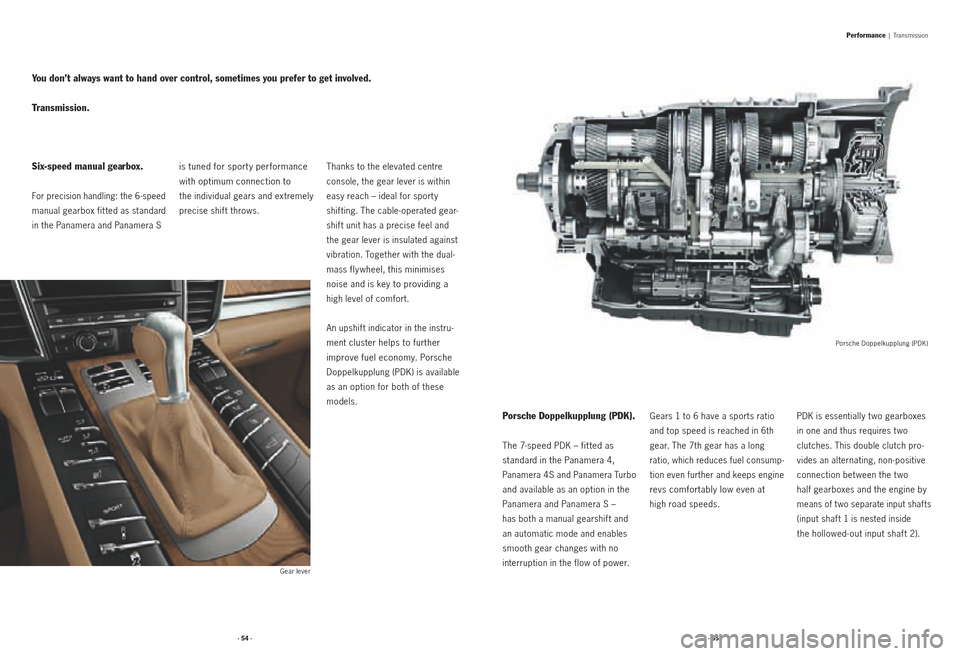
Porsche Doppelkupplung (PDK).
The 7-speed PDK – fit ted as
standard in the Panamera 4,
Panamera 4S and Panamera Turbo
and available as an option in the
Panamera and Panamera S –
has both a manual gearshif t and
an automatic mode and enables
smooth gear changes with no
interruption in the flow of power.
Porsche Doppelkupplung (PDK)
Gear lever
Six-speed manual gearbox.
For precision handling: the 6-speed
manual gearbox fit ted as standard
in the Panamera and Panamera S
is tuned for sport y performance
with optimum connection to
the individual gears and extremely
precise shif t throws. Thanks to the elevated centre
console, the gear lever is within
easy reach – ideal for sport y
shifting. The cable-operated gear
-
shif t unit has a precise feel and
the gear lever is insulated against
vibration. Together with the dual-
mass fly wheel, this minimises
noise and is key to providing a
high level of comfort.
An upshift indicator in the instru -
ment cluster helps to further
improve fuel economy. Porsche
Doppelkupplung (PDK) is available
as an option for both of these
models.
Gears 1 to 6 have a sports ratio
and top speed is reached in 6th
gear. The 7th gear has a long
ratio, which reduces fuel consump-
tion even further and keeps engine
revs comfortably low even at
high road speeds. PDK is essentially t wo gearboxes
in one and thus requires t wo
clutches. This double clutch pro
-
vides an alternating, non-positive
connection bet ween the t wo
half gearboxes and the engine by means of t wo separate input shaf ts
(input shaf t 1 is nested inside
the hollowed - out input shaf t 2).
Page 24 of 80

· 56 ·· 57 ·
Performance | Transmission
Power flow in 1st gear
Power flow in 2nd gear
The flow of power from the
engine is transmit ted through one
half gearbox and one clutch at a
time, while the next gear is pre -
selected in the other half gearbox.
During a gear change, therefore,
a complete shif t no longer takes
place. Instead, one clutch simply
opens and the other closes at the
same time. Gear changes can
therefore take place within a few
hundredths of a second.
Clutch 1 controls the first half
gearbox, which contains the odd
gears (1, 3, 5 and 7). Clutch 2
controls the second, which con -
tains the even gears (2, 4, 6 and
R). The gear which is engaged
is displayed on the instrument
cluster.
PDK has distinct benefits. A high
level of driving comfort and
very rapid gearshifts, with no
interruption in the flow of power,
produces faster acceleration.
Driving feels even sportier and
more dynamic, and agilit y is
increased. Depending on the gear -
shif t programme (SPORT but ton
activated or deactivated), the gear
change is optimised for comfort
or for sport y driving. Its high level
of ef ficiency combined with the
long-ratio 7th gear helps to
achieve reduced fuel consumption
and emission figures even when
compared with a standard manual
gearbox.
In conjunction with either the
optional Sport Chrono Package
Plus (p. 74) for all Panamera
models with a naturally aspirated
engine or the optional Sport
Chrono Package Turbo for the
Panamera Turbo (p. 76), PDK is
enhanced by a Launch Control
function which offers a sportier
acceleration and gearshift
strategy in automatic mode and
extremely smooth gear changes
in manual mode.
PDK offers sportiness with
efficiency and comfort. A new
definition of driving in the
pre
mium class from Porsche.
Page 29 of 80
· 66 ·· 67 ·
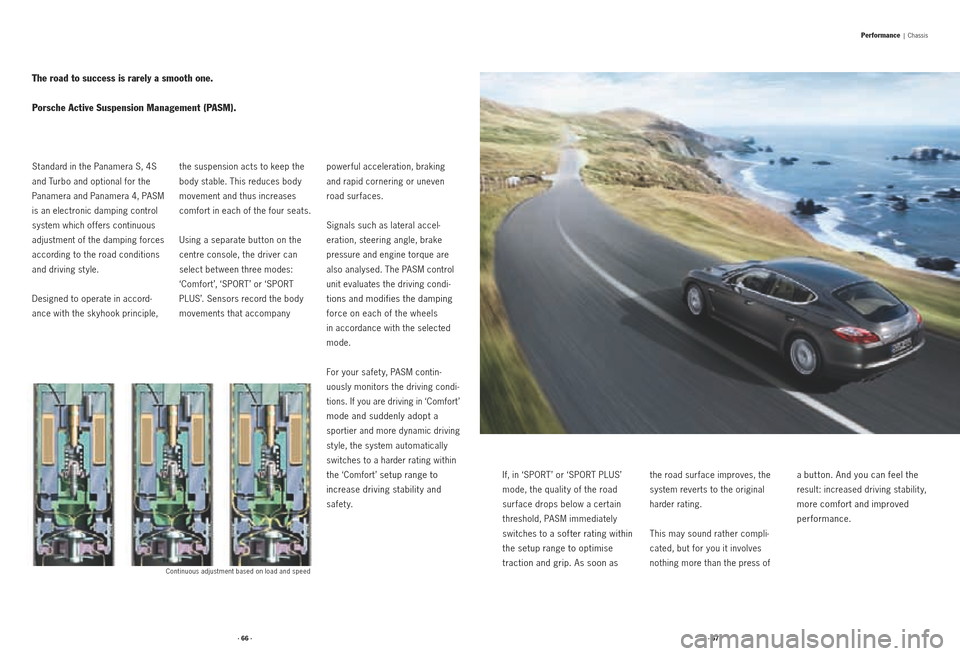
Standard in the Panamera S, 4S
and Turbo and optional for the
Panamera and Panamera 4, PASM
is an electronic damping control
system which of fers continuous
adjustment of the damping forces
according to the road conditions
and driving st yle.
Designed to operate in accord-
ance with the skyhook principle, the suspension acts to keep the
body stable. This reduces body
movement and thus increases
comfort in each of the four seats.
Using a separate but ton on the
centre console, the driver can
select bet ween three modes:
‘Comfort ’, ‘SPORT’ or ‘SPORT
PLUS’. Sensors record the body
movements that accompany powerful acceleration, braking
and rapid cornering or uneven
road surfaces.
Signals such as lateral accel-
eration, steering angle, brake
pressure and engine torque are
also analysed. The PASM control
unit evaluates the driving condi
-
tions and modifies the damping
force on each of the wheels
in accordance with the selected
mode.
For your safet y, PASM contin -
uously monitors the driving condi -
tions. If you are driving in ‘Comfort ’
mode and suddenly adopt a
sportier and more dynamic driving
st yle, the system automatically
switches to a harder rating within
the ‘Comfort ’ setup range to
increase driving stabilit y and
safet y. If, in ‘SPORT’ or ‘SPORT PLUS’
mode, the qualit y of the road
sur face drops below a certain
threshold, PASM immediately
switches to
a softer rating within
the setup range to optimise
traction and grip. As soon as
the road surface improves, the
system reverts to the original
harder rating.
This may sound rather compli
-
cated, but for you it involves
nothing more than the press of a
but ton. And you can feel the
result: increased driving stabilit y,
more comfort and improved
performance.
Performance
| Chassis
The road to success is rarely a smooth one.
Porsche Active Suspension Management (PASM).
Continuous adjustment based on load and speed
Page 32 of 80
· 72 ·· 73 ·
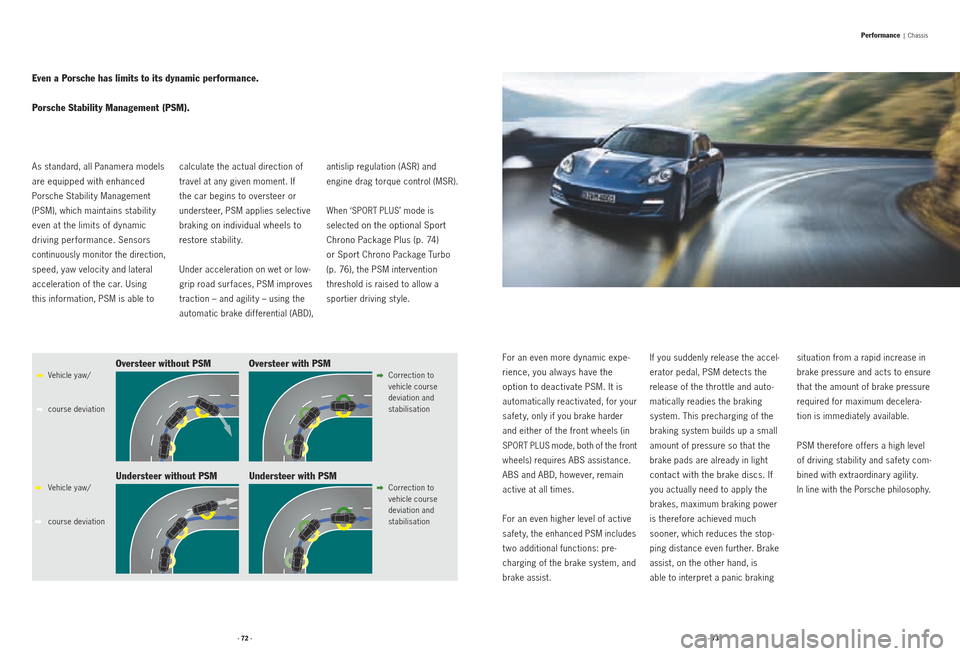
Vehicle yaw/
course deviation
Vehicle yaw/
course deviationCorrection to
vehicle course
deviation and
stabilisation
Correction to
vehicle course
deviation and
stabilisationOversteer without PSM Oversteer with PSM
Understeer with PSM
Understeer without PSM
Performance | Chassis
As standard, all Panamera models
are equipped with enhanced
Porsche Stabilit y Management
(PSM), which maintains stabilit y
even at the limits of dynamic
driving per formance. Sensors
continuously monitor the direction,
speed, yaw velocit y and lateral
acceleration of the car. Using
this information, PSM is able to calculate the actual direction of
travel at any given moment. If
the car be gins to oversteer or
understeer, PSM applies selective
braking
on individual wheels to
restore
stabilit y.
Under acceleration on wet or low-
grip road surfaces, PSM improves
traction – and agilit y – using the
automatic brake dif ferential (ABD), antislip regulation (ASR) and
engine drag torque control (MSR).
When ‘SPORT PLUS’ mode is
selected
on the optional Sport
Chrono Package Plus (p. 74)
or Sport
Chrono Package Turbo
(p. 76), the PSM intervention
threshold is raised to allow a
sportier driving st yle.
For an even more dynamic expe-
rience, you always have the
option to deactivate PSM. It is
automatically reactivated, for your
safet y, only if you brake harder
and either of the front wheels (in
SPORT PLUS mode, both of the front
wheels) requires ABS assistance.
ABS and ABD, however, remain
active at all times.
For an even higher level of active
safet y, the enhanced PSM includes
t wo additional functions: pre -
charging of the brake system, and
brake assist. If you suddenly release the accel
-
erator pedal, PSM detects the
release of the throt tle and auto -
matically readies the braking
system. This precharging of the
braking system builds up a small
amount of pressure so that the
brake pads are already in light
contact with the brake discs. If
you actually need to apply the
brakes, maximum braking power
is therefore achieved much
sooner, which reduces the stop -
ping distance even further. Brake
assist, on the other hand, is
able to interpret a panic braking situation from a rapid increase in
brake pressure and acts to ensure
that the amount of brake pressure
required for maximum decelera
-
tion is immediately available.
PSM therefore of fers a high level
of driving stabilit y and safet y com -
bined with extraordinary agil
it y.
In line with the Porsche philosophy.
Even a Porsche has limits to its dynamic performance.
Porsche Stability Management (PSM).
Page 33 of 80
· 74 ·· 75 ·
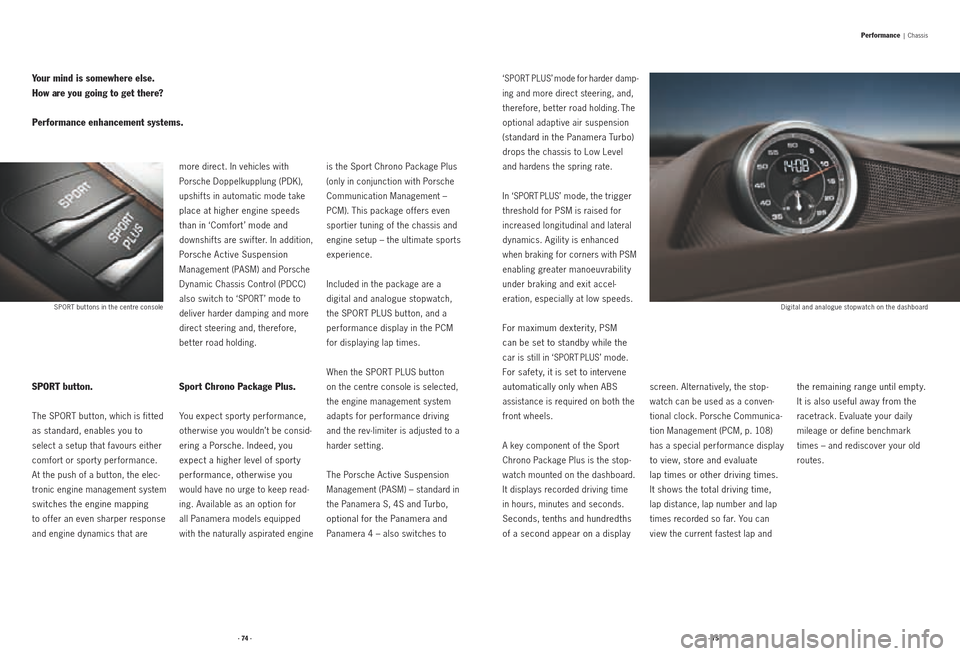
SPORT button.
The SPORT but ton, which is fit ted
as standard, enables you to
select a setup that favours either
comfort or sport y performance.
At the push of a but ton, the elec -
tronic engine management system
switches the engine mapping
to of fer an even sharper response
and engine dynamics that are more direct. In vehicles with
Porsche Doppelkupplung (PDK),
upshif ts in automatic mode take
place at higher engine speeds
than in ‘Comfort ’ mode and
downshifts are swifter. In addition,
Porsche Active Suspension
Management (PASM) and Porsche
Dynamic Chassis Control (PDCC)
also switch to ‘
SPORT’ mode to
deliver harder damping and more
direct steering and, therefore,
bet ter road holding.
Sport Chrono Package Plus.
You expect sport y performance,
otherwise you wouldn’t be consid -
ering a Porsche. Indeed, you
expect a higher level of sport y
performance, otherwise you
would have no urge to keep read-
ing. Available as an option for
all Panamera models equipped
with the naturally aspirated engine is the Sport Chrono Package Plus
(only in conjunction with Porsche
Communication Management –
PCM). This package of fers even
sportier tuning of the chassis and
engine setup – the ultimate sports
experience.
Included in the package are a
digital and analogue stopwatch,
the SPORT PLUS but ton, and a
per formance display in the PCM
for displaying lap times.
When the SPORT PLUS but ton
on the centre console is selected,
the engine management system
adapts for performance driving
and the rev-limiter is adjusted to a
harder set ting.
The Porsche Active Suspension
Management (PASM) – standard in
the Panamera S, 4S and Turbo,
optional for the Panamera and
Panamera 4 – also switches to ‘
SPORT PLUS’ mode for harder d a m p
-
ing
and more direct steering, and,
therefore, bet ter road holding. The
optional adaptive air suspension
(standard in the Panamera Turbo)
drops the chassis to Low Level
and hardens the spring rate.
In ‘
SPORT PLUS’ mode, the trigger
threshold for PSM is raised for
increased longitudinal and lateral
dynamics. Agilit y is enhanced
when braking for corners with PSM
enabling greater manoeuvrabilit y
under braking and exit accel-
eration, especially at low speeds.
For maximum dexterit y, PSM
can be set to standby while the
car is still in ‘SPORT PLUS’ mode.
For safet y, it is set to intervene
automatically only when ABS
assistance is required on both the
front wheels.
A key component of the Sport
Chrono Package Plus is the stop -
watch mounted on the dashboard.
It displays recorded driving time
in hours, minutes and seconds.
Seconds, tenths and hundredths
of a second appear on a display
screen. Alternatively, the stop -
watch can be used as a conven -
tional clock. Porsche Communica -
tion Management (PCM, p. 108)
has a special performance display
to view, store and evaluate
lap times or other driving times.
It shows the total driving time,
lap distance, lap number and lap
times recorded so far. You can
view the current fastest lap and
the remaining range until empt y.
It is also useful away from the
racetrack. Evaluate your daily
mileage or define benchmark
times – and rediscover your old
routes.
SPORT but tons in the centre console Digital and analogue stopwatch on the dashboard
Performance | Chassis
Your mind is somewhere else.
How are you going to get there?
Performance enhancement systems.
Page 34 of 80
· 76 ·· 77 ·
For the Panamera 4 and 4S, and
for the Panamera and Panamera S
when fit ted in combination with
Porsche Doppelkupplung
(PDK),
the optional Sport Chrono Package
Plus contains even more functions.
The shift times in ‘SPORT PLUS’
mode are shorter, the gear
changes sportier. In automatic
mode and at low rates of decel -
eration – even with high engine
speeds – the system initiates a
swif ter brake-induced downshif t.
In manual mode, gear changes
are faster, more dynamic and
more direct.
A special feature of this package
that further enhances sport y
performance is Launch Control,
which is designed to produce opti -
mum acceleration from a standing
start. This function is operated via
the SPORT PLUS but ton with the
‘D’ or ‘M’ drive position selected.
With the left foot depressing
the brake pedal, the driver fully
depresses the accelerator for
maximum throt tle. The engine is
rev ved to an optimum speed of
around 5,500 rpm and the clutch
is already held in slight contact.
The message ‘Launch Control active’ appears in the display on
the steering wheel for PDK* or
optional three-spoke sports steer
-
ing wheel with gearshif t paddles*.
Now, the driver simply releases
the brake pedal, and prepares for
maximum acceleration.
Sport Chrono Package Turbo.
For the Panamera Turbo, increased
power output is a mat ter of prin -
ciple. The same applies to the
optional Sport Chrono Package
Turbo. Typifying the Turbo philos -
ophy, it not only combines all the
functions of Sport Chrono Package
Plus, it adds one more: Overboost.
Imagine you are accelerating
at full throt tle with the SPORT or
SPORT PLUS but ton selected.
Boost pressure is temporarily
increased by 10 %, which considerably increases the maxi -
mum torque that the engine is
able to produce. Instead of the
normal 700 Nm, the overboost
function
generates a torque of up
to 770 Nm for a limited period
and
a feeling of satisfaction that
lasts even longer.
Performance | Chassis
* For Panamera S, Panamera 4S and
Panamera Turbo, available from
09/2010 at the earliest.
Page 38 of 80
· 84 ·· 85 ·
Porsche brakes are renowned
for their stopping power, set ting
the standards for deceleration
and stabilit y. They are designed to
cope with extreme forces such
as those experienced during hard
braking.
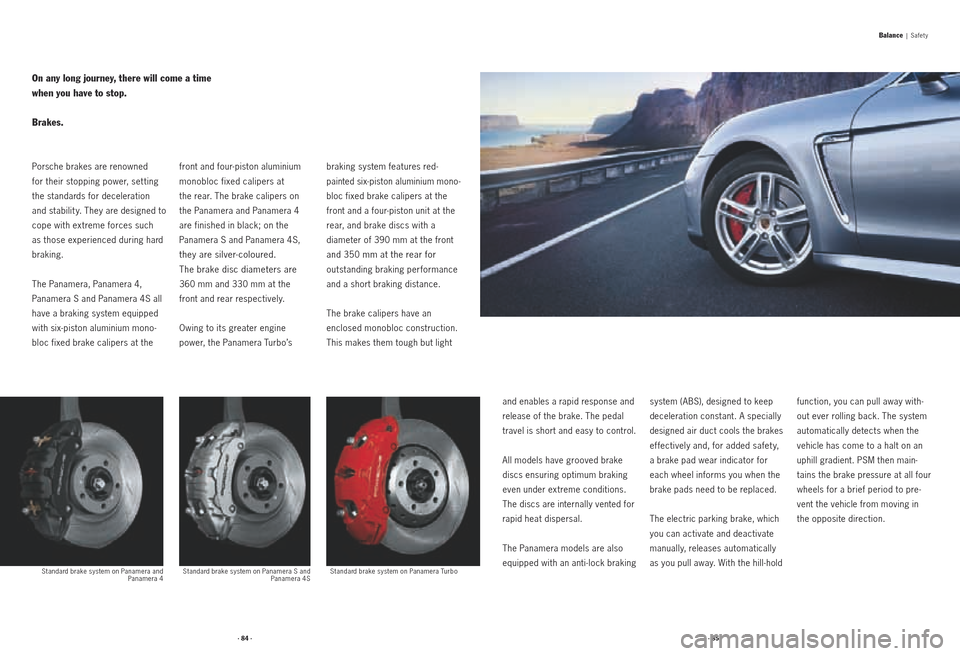
The Panamera, Panamera 4,
Panamera S and Panamera 4S all
have a braking system equipped
with six-piston aluminium mono -
bloc fixed brake calipers at the front and four-piston aluminium
monobloc fixed calipers at
the rear. The brake calipers on
the Panamera and Panamera 4
are finished in black; on the
Panamera S and Panamera 4S,
they are silver-coloured.
The brake disc diameters are
360 mm and 330 mm at the
front and rear respectively.
Owing to its greater engine
power, the Panamera Turbo’s braking system features red-
painted six-piston aluminium mono
-
bloc
fixed brake calipers at the
front and a four-piston unit at the
rear, and brake discs with a
diameter of 390 mm at the front
and 350 mm at the rear for
outstanding braking performance
and a short braking distance.
The brake calipers have an
enclosed monobloc construction.
This makes them tough but light
and enables a rapid response and
release of the brake. The pedal
travel is short and easy to control.
All models have grooved brake
discs ensuring optimum braking
even under extreme conditions.
The discs are internally vented for
rapid heat dispersal.
The Panamera models are also
equipped with an anti-lock braking system (ABS), designed to keep
deceleration constant. A specially
designed air duct cools the brakes
effectively and, for added safet y,
a brake pad wear indicator for
each wheel informs you when the
brake pads need to be replaced.
The electric parking brake, which
you can activate and deactivate
manually, releases automatically
as you pull away. With the hill-hold function, you can pull away with
-
out ever rolling back. The system
automatically detects when the
vehicle has come to a halt on an
uphill gradient. PSM then main -
tains the brake pressure at all four
wheels for a brief period to pre -
vent the vehicle from moving in
the opposite direction.
Standard brake system on Panamera and Panamera 4Standard brake system on Panamera S and
Panamera 4SStandard brake system on Panamera Turbo
Balance
| Safet y
On any long journey, there will come a time
when you have to stop.
Brakes.
Page 40 of 80
· 88 ·· 89 ·
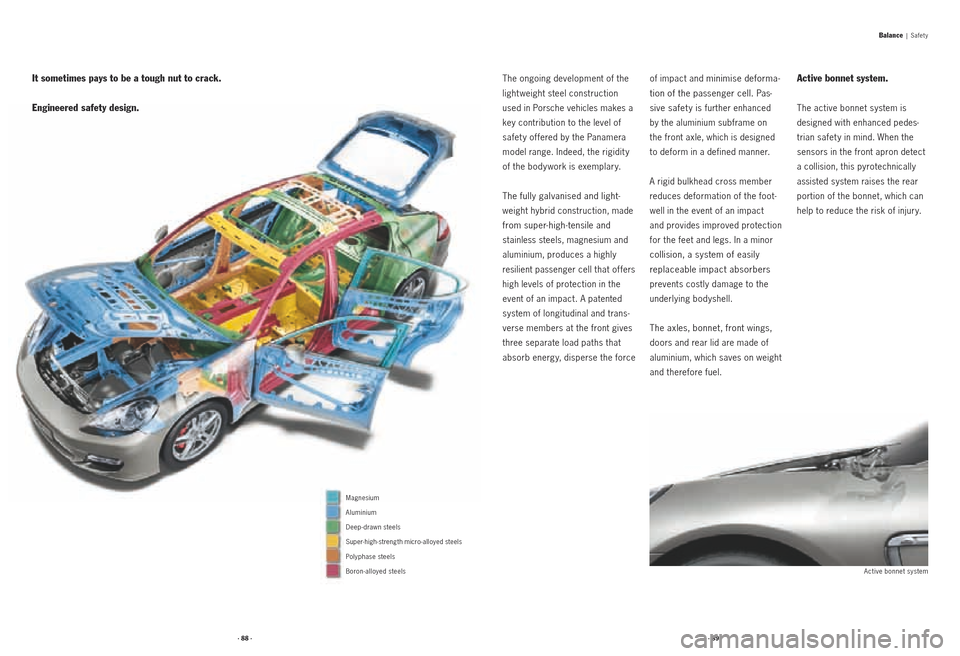
of impact and minimise deforma-
tion of the passenger cell. Pas -
sive safet y is
further enhanced
by the aluminium
subframe on
the front axle, which is designed
to deform in a defined manner.
A rigid bulkhead cross member
reduces deformation of the foot -
well in the event of an impact
and provides improved protection
for the feet and legs. In a minor
collision, a system of easily
replaceable impact absorbers
prevents costly damage to the
underlying bodyshell.
The axles, bonnet, front wings,
doors and rear lid are made of
aluminium, which saves on weight
and therefore fuel.
Active bonnet system.
The active bonnet system is
designed with enhanced pedes-
trian safet y in mind. When the
sensors in the front apron detect
a collision, this pyrotechnically
assisted system raises the rear
portion of the bonnet, which can
help to reduce the risk of injury.
The ongoing development of the
light weight steel construction
used in Porsche vehicles makes a
key contribution to the level of
safet y of fered by the Panamera
model range. Indeed, the rigidit y
of the body work is exemplary.
The fully galvanised and light
-
weight hybrid construction, made
from super- high -tensile and
stainless steels, magnesium and
aluminium, produces a highly
resilient passenger cell that of fers
high levels of protection in the
event of an impact. A patented
system of longitudinal and trans -
verse members at the front gives
three separate load paths that
absorb energy, disperse the force
Magnesium
Aluminium
Deep-drawn steels
Super- high -streng th micro -alloyed steels
Polyphase steels
Boron-alloyed steels
Balance | Safet y
It sometimes pays to be a tough nut to crack.
Engineered safety design.
Active bonnet system
Page 42 of 80
· 92 ·· 93 ·
concerned, we are already among
those manufacturers achieving
the lowest CO2 em issio ns. T h is
has been achieved through the
new ef ficient engine technology
(e.g. by DFI and VarioCam Plus),
light weight construction, optimum
aerodynamics and low rolling
resistance. This high level of environmental
responsibilit y is clearly demon
-
strated by our approach to envi -
ronmental management at the
Porsche Development Centre in
Weissach. Here, all technological
developments are carried out
with environmental protection in
mind. The goal is pure perform -
ance – but not at the expense of
the environment. A goal achieved
by the Panamera.
Fuel economy and emission
control.
Vehicles manufactured by Porsche
demonstrate that even high-
performance sportscars can
achieve moderate fuel consump -
tion and
exhaust emission values
in their
respective categor y.
The balance is exemplary: the
Panamera, Panamera 4 and
Panamera Turbo comply with the
Euro 5 emission standard in
Europe and the LEV regulations in
the USA, the Panamera S and
Panamera 4S meet the require -
ments of EU 5 and ULEV.
This is achieved through the use
of fuel- ef ficient technologies such
as direct fuel injection (DFI, p. 51)
and VarioCam Plus (p. 52).
Efficient emission control is
achieved by a t wo -stage cascade-
t ype cataly tic converter, which
comprises t wo monoliths arranged
in series. These specially coated
substrates contain ultra-fine honey -
comb
channels in which pollutants
are converted as exhaust gas
passes through.
The stereo Lambda control circuitr y
controls and monitors each cylin -
der bank separately. For each
exhaust tract, oxygen sensors
regulate the composition of the
exhaust gas, while another Lambda
s
ensor on each cylinder bank
monitors pollutant conversion in
the respective cataly tic converter.**
Environmental protection.
In an era of intensif ying debate
about global climate change and
CO
2 emissions, every automotive manufacturer is asking what it has
to of fer in terms of environmental
protection. Our answer has long
been the same: maximum effi
-
ciency. Porsche has been reducing the
CO
2 emissions of its vehicles
by an average of around 1.7 %*
every year for the past 15 years.
As far as engine output is
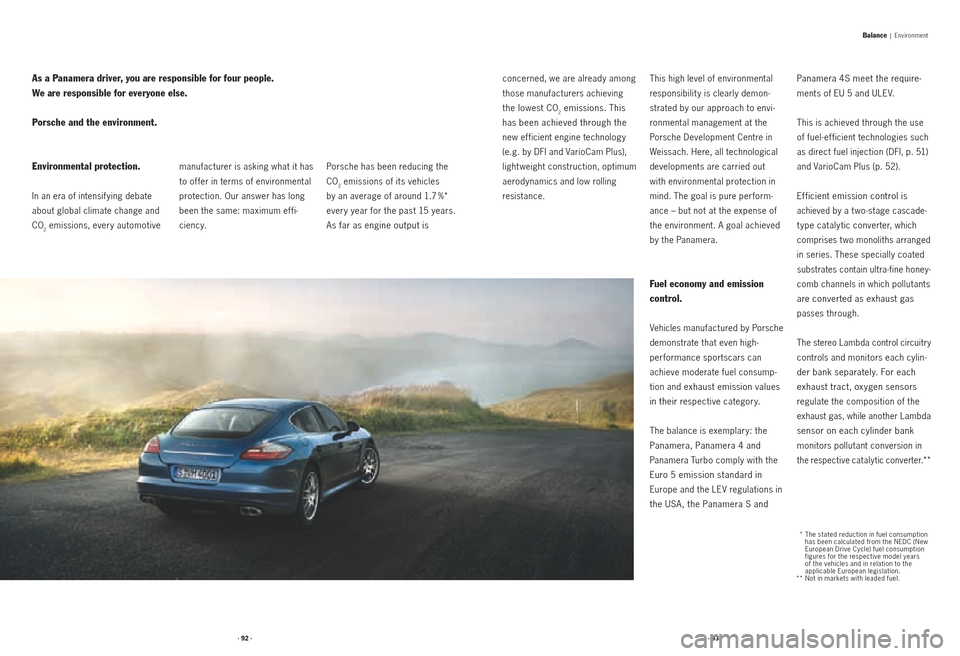
As a Panamera driver, you are responsible for four people.
We are responsible for everyone else.
Porsche and the environment.
Balance | Environment
* The stated reduction in fuel consumption
has been calculated from the NEDC (New
European Drive Cycle) fuel consumption
figures for the respective model years
of the vehicles and in relation to the
applicable European legislation.
** Not in markets with leaded fuel.