light PORSCHE PANAMERA 2010 1.G Information Manual
[x] Cancel search | Manufacturer: PORSCHE, Model Year: 2010, Model line: PANAMERA, Model: PORSCHE PANAMERA 2010 1.GPages: 80, PDF Size: 6.26 MB
Page 21 of 80
· 50 ·· 51 ·
SPORT button.
All Panamera models are
equipped with the SPORT but ton
as standard. This feature enables
the driver to vary the engine
characteristics and, in vehicles
with PASM, the suspension setup.
In vehicles with Porsche Doppel-
kupplung (PDK), the SPORT
but ton can be used to select a
sportier gearshif t strategy. For
more information, please refer
to page 74.
Auto start/stop function (only
in conjunction with Porsche
Doppelkupplung, PDK).
Silence: the t ypical stationary
noise. If, for example, you stop at
traf fic lights with your foot on
the brake pedal, the Auto start /
stop function will automatically
stop the engine. This fuel -saving
system restarts the engine as
soon as you release the brakes.
A key advantage is that there is
no need for you to change your
driving habits. You can simply
carry on as normal. All audio and
communication systems remain
switched on and the climate
control continues to maintain your
selected temperature, despite the
engine being switched of f. The
engine restarts if more power or
extra cooling output is required.
The Auto start /stop function
can be activated and deactivated
using a separate but ton. The
function may remain inactive under
particular circumstances, e.g.
very high outside temperatures,
on extreme uphill gradients, or if
bat tery charge is low.
The starter has been modified to
meet the increased requirements
demanded by this function and the bat tery is continuously moni
-
tored for the level of charge and
condition. The bat tery and starter
are consumable components and
are subject to an increased rate
of wear in the event of frequent
engine stopping.
Fuel economy is further improved
by electrical system recuperation,
whereby the bat tery is charged
predominantly under braking.
Under acceleration, on the other
hand, the alternator’s charging
current is reduced so that the
engine does not need to work as
hard to charge the bat tery.
Performance | Engines
With millisecond precision, DFI
injects fuel at up to 120 bar di rect -
l y
into the combustion chamber
by means of electromagnetically
actuated injection valves.
The spray and cone angles have
been optimised for torque, power
output, fuel consumption and
emissions by enabling a homoge -
neous distribution of the air/fuel
mixture, and, therefore, ef fective combustion. At up to 3,500 rpm,
the engine operates with dual
injection for faster heating of the
cataly tic converters af ter a cold
start and for greater torque in the
upper load range.
DFI improves the internal cooling
of the combustion chamber by
having the mixture prepared
direct
ly in the cylinder. This allows
for a higher compression ratio, which helps to deliver more out
-
put at the same time as enhanced
engine ef ficiency. Injection is
regulated by the electronic engine
management system and emis-
sions are monitored by the stereo
Lambda sensors, thus helping to
protect the environment.
A sense of relaxation is felt especially
after a period of intense pressure.
Direct fuel injection (DFI).
Page 22 of 80
· 52 ·· 53 ·
Performance | Engines
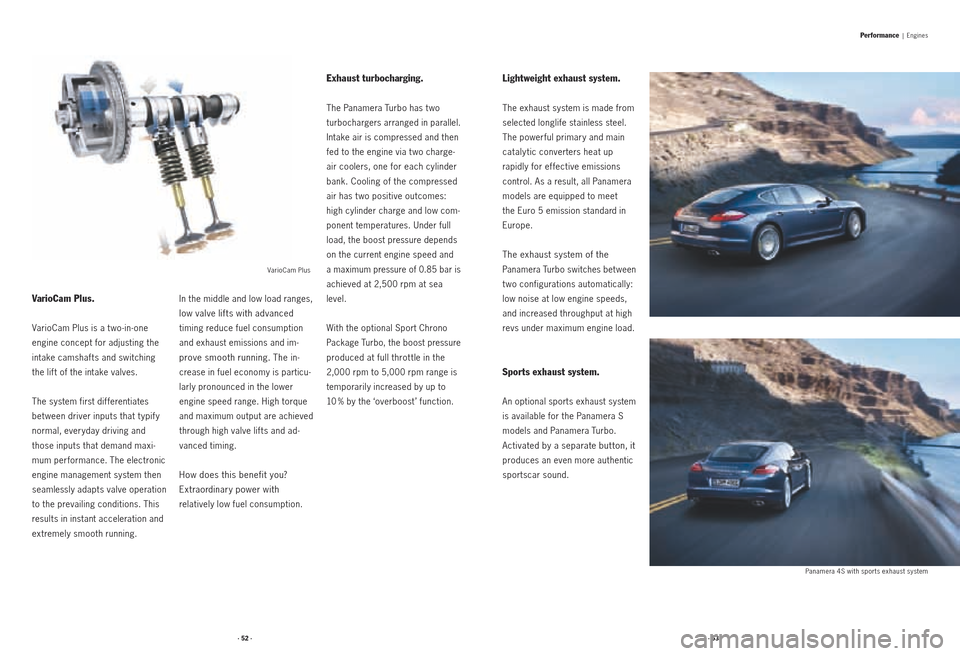
VarioCam Plus.
VarioCam Plus is a t wo -in - one
engine concept for adjusting the
intake camshaf ts and switching
the lif t of the intake valves.
The system first dif ferentiates
bet ween driver inputs that t ypif y
normal, everyday driving and
those inputs that demand maxi -
mum performance. The electronic
engine management system then
seamlessly adapts valve operation
to the prevailing conditions. This
results in instant acceleration and
extremely smooth running. In the middle and low load ranges,
low valve lifts with advanced
timing reduce fuel consumption
and exhaust emissions and im -
prove smooth running. The i n -
crease in fuel economy is particu -
larly pronounced in the lower
engine speed range. High torque
and maximum output are achieved
through high valve lifts and ad -
vanced timing.
How does this benefit you?
Extraordinary power with
relatively low fuel consumption.
Exhaust turbocharging.
The Panamera Turbo has t wo
turbochargers arranged in parallel.
Intake air is compressed and then
fed to the engine via t wo charge-
air coolers, one for each cylinder
bank. Cooling of the compressed
air has t wo positive outcomes:
high cylinder charge and low com -
ponent temperatures. Under full
load, the boost pressure depends
on the current engine speed and
a maximum pressure of 0.85 bar is
achieved at 2,500 rpm at sea
level.
With the optional Sport Chrono
Package Turbo, the boost pressure
produced at full throt tle in the
2,000 rpm to 5,000 rpm range is
temporarily increased by up to
10 % by the ‘overboost ’ function.
VarioCam Plus
Lightweight exhaust system.
The exhaust system is made from
selected longlife stainless steel.
The powerful primary and main
cataly tic converters heat up
rapidly for ef fective emissions
control. As a result, all Panamera
models are equipped to meet
the Euro 5 emission standard in
Europe.
The exhaust system of the
Panamera Turbo switches bet ween
t wo configurations automatically:
low noise at low engine speeds,
and increased throughput at high
revs under maximum engine load.
Sports exhaust system.
An optional sports exhaust system
is available for the Panamera S
models and Panamera Turbo.
Acti
vated by a separate but ton, it
produces an even more authentic
sportscar sound.
Panamera 4S with sports exhaust system
Page 27 of 80
· 62 ·· 63 ·
4
7
9
4
6
10
1
23
5
8
11
2
3
12
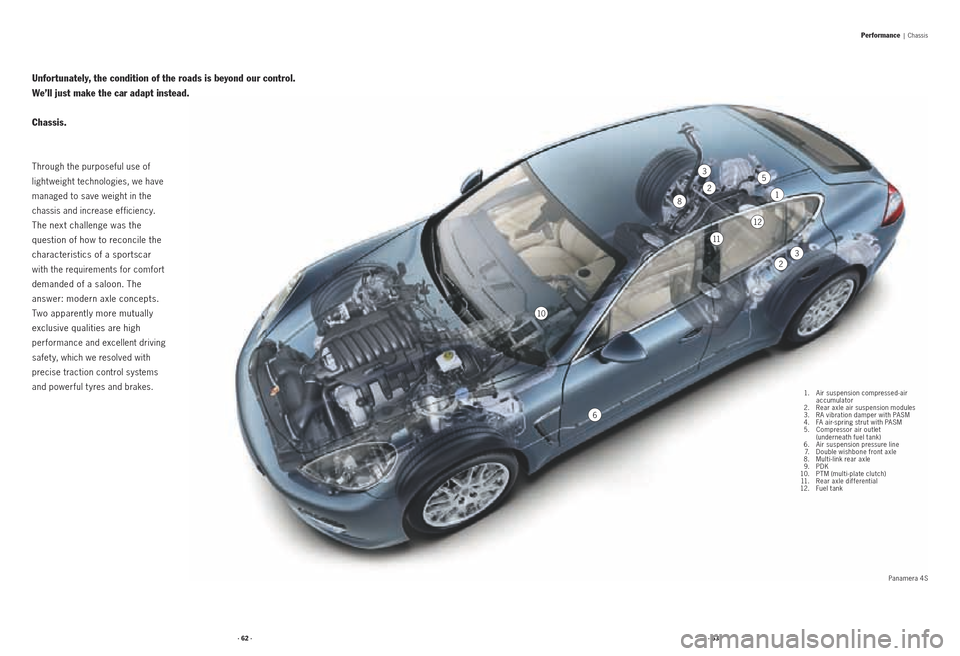
Through the purposeful use of
light weight technologies, we have
managed to save weight in the
chassis and increase ef ficiency.
The next challenge was the
question of how to reconcile the
characteristics of a sportscar
with the requirements for comfort
demanded of a saloon. The
answer: modern axle concepts.
Two apparently more mutually
exclusive qualities are high
performance and excellent driving
safet y, which we resolved with
precise traction control systems
and powerful t yres and brakes.
Panamera 4S
Performance | Chassis
Unfortunately, the condition of the roads is beyond our control.
We’ll just make the car adapt instead.
Chassis.
1. Air suspension compressed -air
accumulator
2. Rear axle air suspension modules
3. RA vibration damper with PASM
4. FA air-spring strut with PASM
5. Compressor air outlet
(underneath fuel tank)
6. Air suspension pressure line
7. Double wishbone front axle
8. Multi - link rear axle
9. PDK
10. PTM (multi - plate clutch)
11. Rear axle dif ferential
12. Fuel tank
Page 28 of 80
· 64 ·· 65 ·
Performance | Chassis
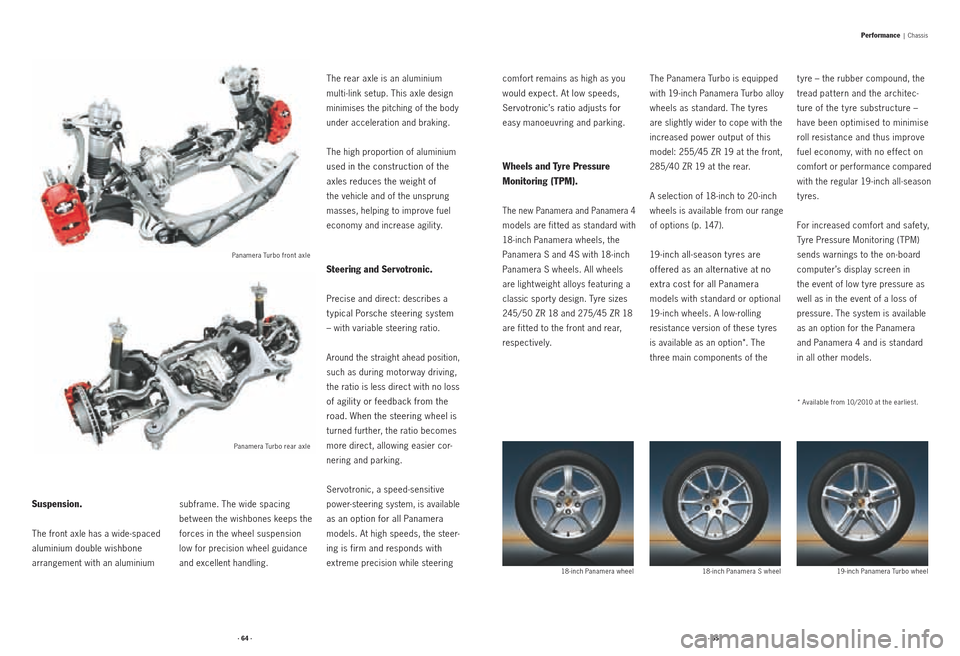
Suspension.
The front axle has a wide-spaced
aluminium double wishbone
arrangement with an aluminium subframe. The wide spacing
bet ween the wishbones keeps the
forces in the wheel suspension
low for precision wheel guidance
and excellent handling. The rear axle is an aluminium
multi-link setup. This axle design
minimises the pitching of the body
under acceleration and braking.
The high proportion of aluminium
used in the construction of the
axles reduces the weight of
the vehicle and of the unsprung
masses, helping to improve fuel
economy and increase agilit y.
Steering and Servotronic.
Precise and direct: describes a
t ypical Porsche steering system
–
with variable steering ratio.
Around the straight ahead position,
such as during motorway driving,
the ratio is less direct with no loss
of agilit y or feedback from the
road. When the steering wheel is
turned further, the ratio becomes
more direct, allowing easier cor -
nering and parking.
Servotronic, a speed-sensitive
power-steering system, is available
as an option for all Panamera
models. At high speeds, the steer -
ing is firm and responds with
extreme precision while steering comfort remains as high as you
would expect. At low speeds,
Servotronic’s ratio adjusts for
easy manoeuvring and parking.
Wheels and Tyre Pressure
Monitoring (TPM).
The new Panamera and Panamera 4
models are fit ted as standard with
18-inch Panamera wheels, the
Panamera S and 4S with 18-inch
Panamera S wheels. All wheels
are light weight alloys featuring a
classic sport y design. Tyre sizes
245/50 ZR 18 and 275/45 ZR 18
are fit ted to the front and rear,
respectively. The Panamera Turbo is equipped
with 19 -inch Panamera Turbo alloy
wheels as standard. The t yres
are slightly wider to cope with the
increased power output of this
model: 255/45 ZR 19 at the front,
285/40 ZR 19 at the rear.
A selection of 18-inch to 20 -inch
wheels is available from our range
of options (p. 147).
19-inch all-season t yres are
offered as an alternative at no
extra cost for all Panamera
models with standard or optional
19-inch wheels. A low-rolling
resistance version of these t yres
is available as an option*. The
three
main components of the
Panamera Turbo front axle
Panamera Turbo rear axle 19 - inch Panamera Turbo wheel
18 - inch Panamera S wheel
18 - inch Panamera wheel
t yre – the rubber compound, the
tread pat tern and the architec -
ture of the t yre substructure –
have been optimised to minimise
roll resistance and thus improve
fuel economy, with no ef fect on
comfort or performance compared
with the regular 19 -inch all-season
t yres.
For increased comfort and safet y,
Tyre Pressure Monitoring (TPM)
sends warnings to the on -board
computer’s display screen in
the event of low t yre pressure as
well as in the event of a loss of
pressure. The system is available
as an option for the Panamera
and Panamera 4 and is standard
in all other models.
* Available from 10/2010 at the earliest.
Page 32 of 80
· 72 ·· 73 ·
Vehicle yaw/
course deviation
Vehicle yaw/
course deviationCorrection to
vehicle course
deviation and
stabilisation
Correction to
vehicle course
deviation and
stabilisationOversteer without PSM Oversteer with PSM
Understeer with PSM
Understeer without PSM
Performance | Chassis
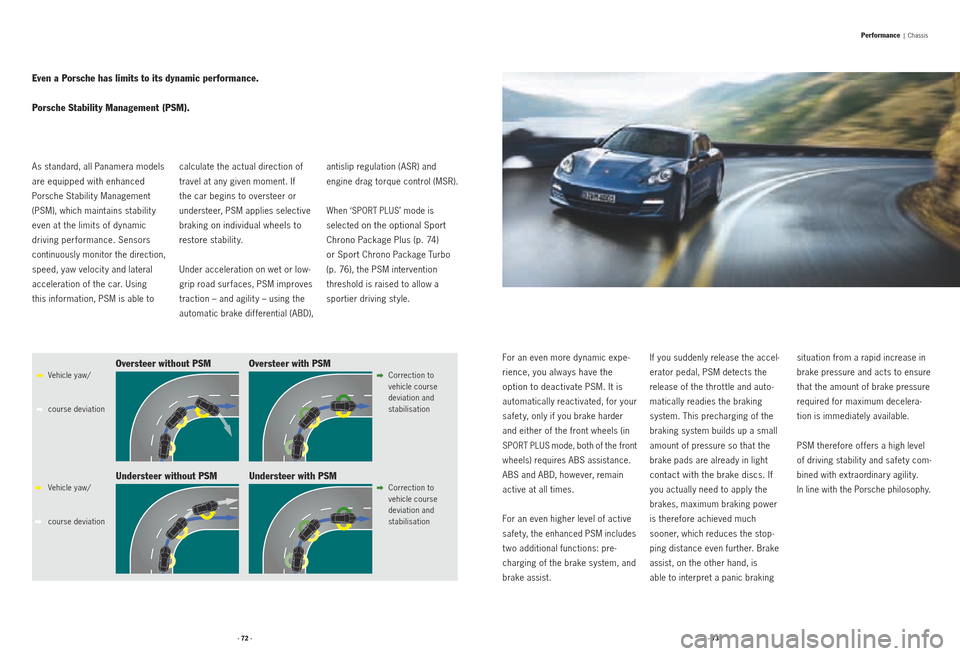
As standard, all Panamera models
are equipped with enhanced
Porsche Stabilit y Management
(PSM), which maintains stabilit y
even at the limits of dynamic
driving per formance. Sensors
continuously monitor the direction,
speed, yaw velocit y and lateral
acceleration of the car. Using
this information, PSM is able to calculate the actual direction of
travel at any given moment. If
the car be gins to oversteer or
understeer, PSM applies selective
braking
on individual wheels to
restore
stabilit y.
Under acceleration on wet or low-
grip road surfaces, PSM improves
traction – and agilit y – using the
automatic brake dif ferential (ABD), antislip regulation (ASR) and
engine drag torque control (MSR).
When ‘SPORT PLUS’ mode is
selected
on the optional Sport
Chrono Package Plus (p. 74)
or Sport
Chrono Package Turbo
(p. 76), the PSM intervention
threshold is raised to allow a
sportier driving st yle.
For an even more dynamic expe-
rience, you always have the
option to deactivate PSM. It is
automatically reactivated, for your
safet y, only if you brake harder
and either of the front wheels (in
SPORT PLUS mode, both of the front
wheels) requires ABS assistance.
ABS and ABD, however, remain
active at all times.
For an even higher level of active
safet y, the enhanced PSM includes
t wo additional functions: pre -
charging of the brake system, and
brake assist. If you suddenly release the accel
-
erator pedal, PSM detects the
release of the throt tle and auto -
matically readies the braking
system. This precharging of the
braking system builds up a small
amount of pressure so that the
brake pads are already in light
contact with the brake discs. If
you actually need to apply the
brakes, maximum braking power
is therefore achieved much
sooner, which reduces the stop -
ping distance even further. Brake
assist, on the other hand, is
able to interpret a panic braking situation from a rapid increase in
brake pressure and acts to ensure
that the amount of brake pressure
required for maximum decelera
-
tion is immediately available.
PSM therefore of fers a high level
of driving stabilit y and safet y com -
bined with extraordinary agil
it y.
In line with the Porsche philosophy.
Even a Porsche has limits to its dynamic performance.
Porsche Stability Management (PSM).
Page 34 of 80
· 76 ·· 77 ·
For the Panamera 4 and 4S, and
for the Panamera and Panamera S
when fit ted in combination with
Porsche Doppelkupplung
(PDK),
the optional Sport Chrono Package
Plus contains even more functions.
The shift times in ‘SPORT PLUS’
mode are shorter, the gear
changes sportier. In automatic
mode and at low rates of decel -
eration – even with high engine
speeds – the system initiates a
swif ter brake-induced downshif t.
In manual mode, gear changes
are faster, more dynamic and
more direct.
A special feature of this package
that further enhances sport y
performance is Launch Control,
which is designed to produce opti -
mum acceleration from a standing
start. This function is operated via
the SPORT PLUS but ton with the
‘D’ or ‘M’ drive position selected.
With the left foot depressing
the brake pedal, the driver fully
depresses the accelerator for
maximum throt tle. The engine is
rev ved to an optimum speed of
around 5,500 rpm and the clutch
is already held in slight contact.
The message ‘Launch Control active’ appears in the display on
the steering wheel for PDK* or
optional three-spoke sports steer
-
ing wheel with gearshif t paddles*.
Now, the driver simply releases
the brake pedal, and prepares for
maximum acceleration.
Sport Chrono Package Turbo.
For the Panamera Turbo, increased
power output is a mat ter of prin -
ciple. The same applies to the
optional Sport Chrono Package
Turbo. Typifying the Turbo philos -
ophy, it not only combines all the
functions of Sport Chrono Package
Plus, it adds one more: Overboost.
Imagine you are accelerating
at full throt tle with the SPORT or
SPORT PLUS but ton selected.
Boost pressure is temporarily
increased by 10 %, which considerably increases the maxi -
mum torque that the engine is
able to produce. Instead of the
normal 700 Nm, the overboost
function
generates a torque of up
to 770 Nm for a limited period
and
a feeling of satisfaction that
lasts even longer.
Performance | Chassis
* For Panamera S, Panamera 4S and
Panamera Turbo, available from
09/2010 at the earliest.
Page 36 of 80
· 80 ·· 81 ·
Do you leave chasing af ter the
latest technological fad to others?
Do you instead place value on
that which is useful, sensible, and
reliable? We’re on the same wave-
length.Lighting concept.
All models are equipped with a
driving light assistant, which
switches the lights on auto -
matically when it gets dark. As standard, all Panamera models
feature Bi-Xenon headlights with
dynamic range adjustment and
a headlight cleaning system.
With dipped or main beam, the
road ahead is illuminated more uniformly. The lighting system
features an automatic switch - of f
and the ‘Welcome Home’ function
– a customisable delayed switch-
of f timer that keeps the day time
running lights, the taillights and,
where applicable, the courtesy
lights (p. 83) switched on until
you reach your front door.
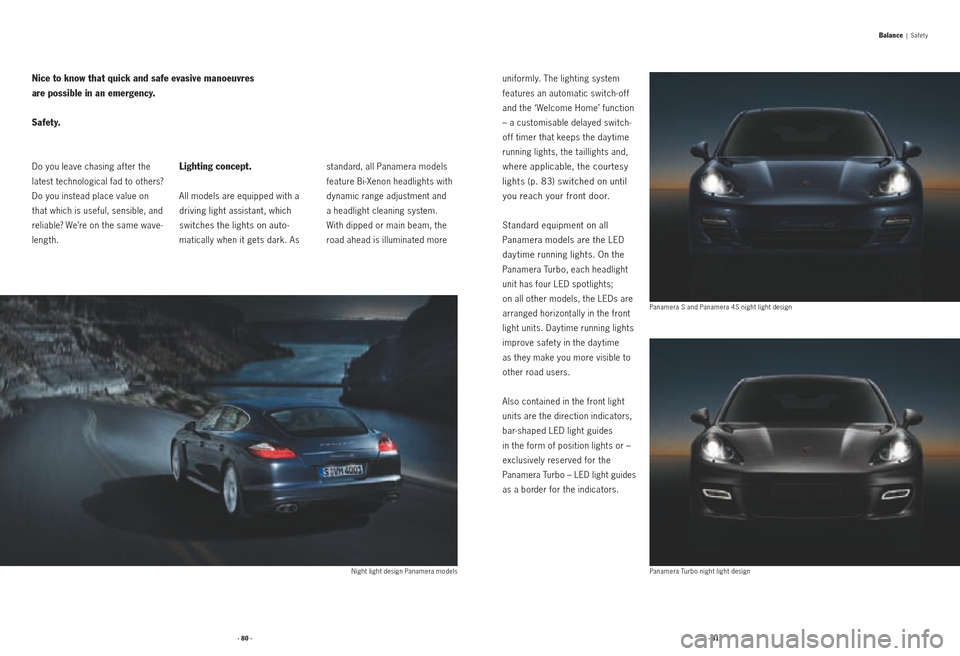
Standard equipment on all
Panamera models are the LED
day time running lights. On the
Panamera Turbo, each headlight
unit has four LED spotlights;
on all other models, the LEDs are
arranged horizontally in the front
light units. Day time running lights
improve safet y in the day time
as they make you more visible to
other road users.
Also contained in the front light
units are the direction indicators,
bar-shaped LED light guides
in the form of position lights or –
exclusively reserved for the
Panamera Turbo – LED light guides
as a border for the indicators.
Nice to know that quick and safe evasive manoeuvres
are possible in an emergency.
Safety.
Night light design Panamera models Panamera Turbo night light design Panamera S and Panamera 4S night light design
Balance | Safet y
Page 37 of 80
· 82 ·· 83 ·
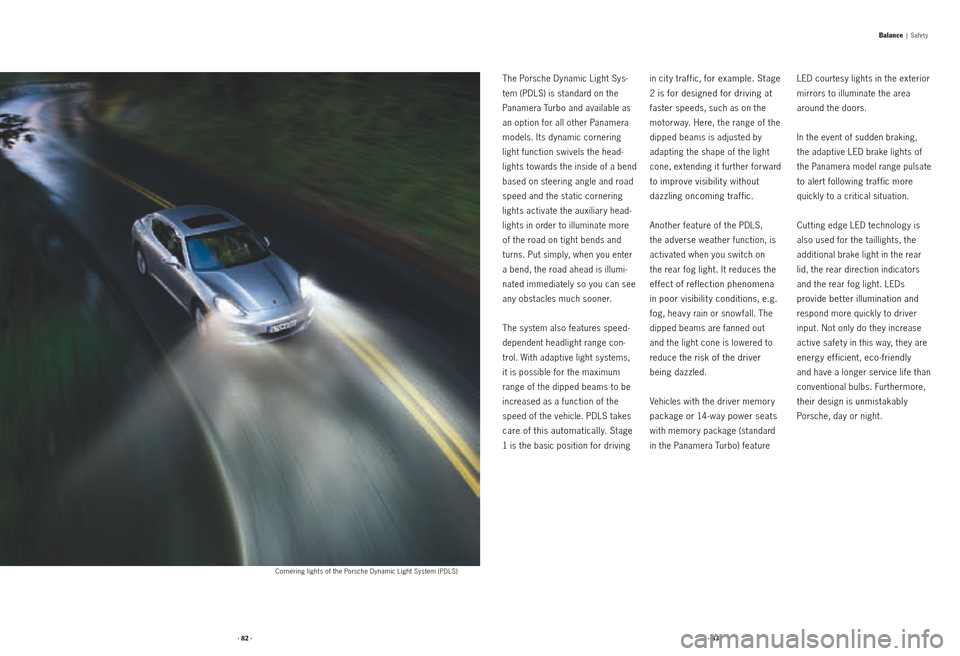
The Porsche Dynamic Light Sys-
tem (PDLS) is standard on the
Panamera Turbo and available as
an option for all other Panamera
models. Its dynamic cornering
light function swivels the head -
lights towards the inside of a bend
based on steering angle and road
speed and the static cornering
lights activate the auxiliary head -
lights in order to illuminate more
of the road on tight bends and
turns. Put simply, when you enter
a bend, the road ahead is illumi -
nated immediately so you can see
any obstacles much sooner.
The system also features speed-
dependent headlight range con -
trol. With adaptive light systems,
it is possible for the maximum
range of the dipped beams to be
increased as a function of the
speed of the vehicle. PDLS takes
care of this automatically. Stage
1 is the basic position for driving in cit y traffic,
for example. Stage
2 is for designed for driving at
faster
speeds, such as on the
motorway. Here, the range of the
dipped beams is adjusted by
adapting the shape of the light
cone, extending it further forward
to improve visibilit y without
dazzling oncoming traffic.
Another feature of the PDLS,
the adverse weather function, is
activated when you switch on
the rear fog
light. It reduces the
effect of reflection phenomena
in poor visibility conditions, e.g.
fog,
heav y rain or snow fall. The
dipped beams are fanned out
and the light cone is lowered to
reduce
the risk of the driver
being
dazzled.
Vehicles with the driver memory
package or 14-way power seats
with memory package (standard
in the Panamera Turbo) feature LED courtesy lights in the exterior
mirrors to illuminate the area
around the doors.
In the event of sudden braking,
the adaptive LED brake lights of
the Panamera model range pulsate
to alert following traffic more
quickly to a critical situation.
Cut ting edge LED technology is
also used for the taillights, the
additional brake light in the rear
lid, the rear direction indicators
and the rear fog light. LEDs
provide bet ter illumination and
respond more quickly to driver
input. Not only do they increase
active safet y in this way, they are
energy ef ficient, eco -friendly
and have a longer service life than
conventional bulbs. Furthermore,
their design is unmistakably
Porsche, day or night.
Cornering lights of the Porsche Dynamic Light System (PDLS)
Balance | Safet y
Page 38 of 80
· 84 ·· 85 ·
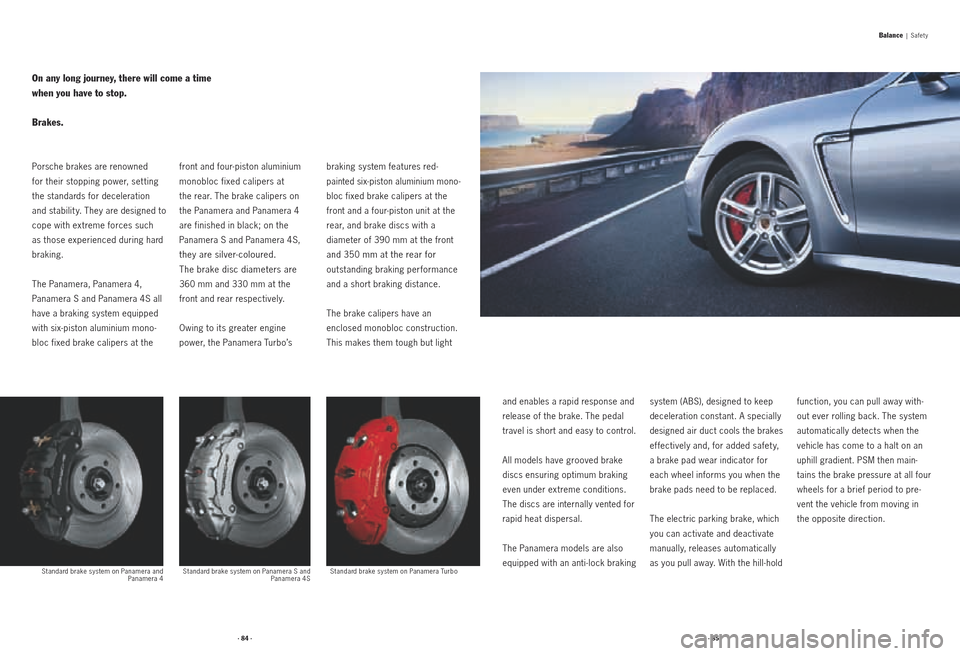
Porsche brakes are renowned
for their stopping power, set ting
the standards for deceleration
and stabilit y. They are designed to
cope with extreme forces such
as those experienced during hard
braking.
The Panamera, Panamera 4,
Panamera S and Panamera 4S all
have a braking system equipped
with six-piston aluminium mono -
bloc fixed brake calipers at the front and four-piston aluminium
monobloc fixed calipers at
the rear. The brake calipers on
the Panamera and Panamera 4
are finished in black; on the
Panamera S and Panamera 4S,
they are silver-coloured.
The brake disc diameters are
360 mm and 330 mm at the
front and rear respectively.
Owing to its greater engine
power, the Panamera Turbo’s braking system features red-
painted six-piston aluminium mono
-
bloc
fixed brake calipers at the
front and a four-piston unit at the
rear, and brake discs with a
diameter of 390 mm at the front
and 350 mm at the rear for
outstanding braking performance
and a short braking distance.
The brake calipers have an
enclosed monobloc construction.
This makes them tough but light
and enables a rapid response and
release of the brake. The pedal
travel is short and easy to control.
All models have grooved brake
discs ensuring optimum braking
even under extreme conditions.
The discs are internally vented for
rapid heat dispersal.
The Panamera models are also
equipped with an anti-lock braking system (ABS), designed to keep
deceleration constant. A specially
designed air duct cools the brakes
effectively and, for added safet y,
a brake pad wear indicator for
each wheel informs you when the
brake pads need to be replaced.
The electric parking brake, which
you can activate and deactivate
manually, releases automatically
as you pull away. With the hill-hold function, you can pull away with
-
out ever rolling back. The system
automatically detects when the
vehicle has come to a halt on an
uphill gradient. PSM then main -
tains the brake pressure at all four
wheels for a brief period to pre -
vent the vehicle from moving in
the opposite direction.
Standard brake system on Panamera and Panamera 4Standard brake system on Panamera S and
Panamera 4SStandard brake system on Panamera Turbo
Balance
| Safet y
On any long journey, there will come a time
when you have to stop.
Brakes.
Page 39 of 80
· 86 ·· 87 ·
Balance | Safet y
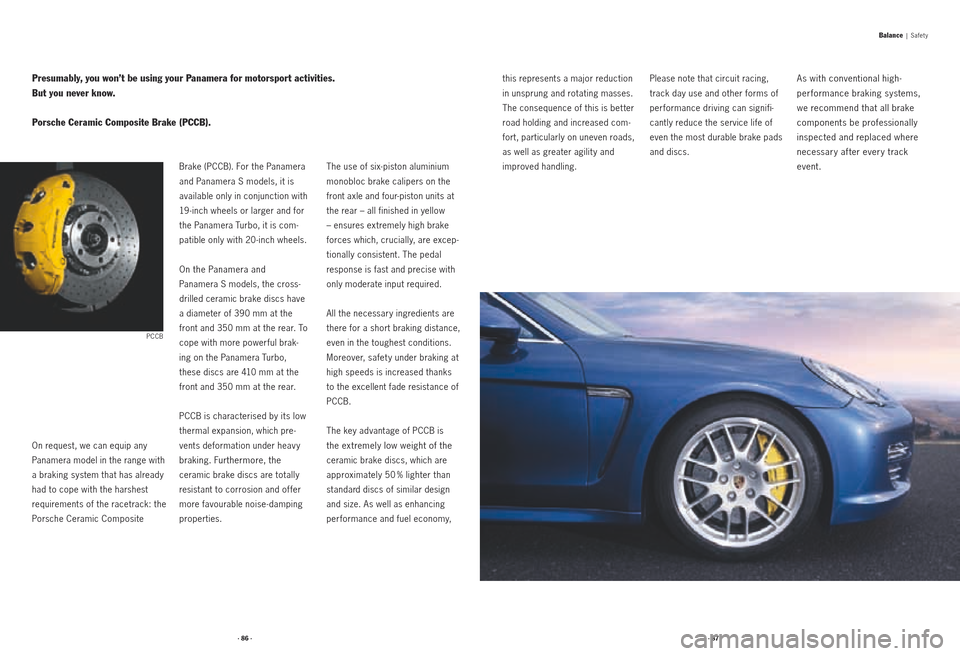
On request, we can equip any
Panamera model in the range with
a braking system that has already
had to cope with the harshest
requirements of the racetrack: the
Porsche Ceramic Composite Brake (PCCB). For the Panamera
and Panamera S models, it is
available only in conjunction with
19 -inch wheels or larger and for
the Panamera Turbo, it is com
-
patible only with 20 -inch wheels.
On the Panamera and
Panamera S models, the cross-
drilled ceramic brake discs have
a diameter of 390 mm at the
front and 350 mm at the rear. To
cope with more powerful brak -
ing on the Panamera Turbo,
these discs are 410 mm at the
front and 350 mm at the rear.
PCCB is characterised by its low
thermal expansion, which pre -
vents deformation under heav y
braking. Furthermore, the
ceramic brake discs are totally
resistant to corrosion and offer
more favourable noise- damping
properties. The use of six-piston aluminium
monobloc brake calipers on the
front axle and four-piston units at
the rear – all finished in yellow
– ensures extremely high brake
forces which, crucially, are excep
-
tionally consistent. The pedal
response is fast and precise with
only moderate input required.
All the necessary ingredients are
there for a short braking distance,
even in the toughest conditions.
Moreover, safet y under braking at
high speeds is increased thanks
to the excellent fade resistance of
PCCB.
The key advantage of PCCB is
the extremely low weight of the
ceramic brake discs, which are
approximately 50 % lighter than
standard discs of similar design
and size. As well as enhancing
performance and fuel economy, this represents a major reduction
in unsprung and rotating masses.
The consequence of this is bet ter
road holding and increased com
-
fort, particularly on uneven roads,
as well as greater agilit y and
improved handling. Please note that circuit racing,
track day use and other forms of
performance driving can signifi
-
cantly reduce the service life of
even the most durable brake pads
and discs.
As with conventional high-
performance braking systems,
we recommend that all brake
components be professionally
inspected and replaced where
necessary after every track
event.
PCCB
Presumably, you won’t be using your Panamera for motorsport activities.
But you never know.
Porsche Ceramic Composite Brake (PCCB).