Air PORSCHE PANAMERA 2010 1.G Owners Manual
[x] Cancel search | Manufacturer: PORSCHE, Model Year: 2010, Model line: PANAMERA, Model: PORSCHE PANAMERA 2010 1.GPages: 343, PDF Size: 7.96 MB
Page 308 of 343
306
Minor Repairs
External Power Supply,
Jump-Lead StartingIf the battery is flat, the battery of another vehicle
can be used for starting or as an external power
supply with the help of jump leads.
Both batteries must be 12 V batteries.
The capacity (Ah) of the do nor battery must not be
substantially less than that of the flat battery.
The flat battery must be connected correctly to
the vehicle’s electrical system.
Warning!
Risk of short circuit, damage and explosion,
resulting in serious personal injury or death.
f Use only jumper cables of adequate diameter
cross-section and fitted with completely
insulated alligator clips.
f Follow all warnings and instructions of the
jumper cable manufacturer.
f When connecting jumper cables, make sure
that they cannot get ca ught in any moving
parts in the engine compartment.
The jumper cables must be long enough so
that neither vehicles nor cables touch another.
f The vehicles must not be in contact, otherwise
current might flow as soon as the positive
terminals are connected.
f The cable clamps must not be allowed to
contact each other when one end of the
jumper cables are connected to a battery. f
Carefully ensure that tools or conductive
jewelery (rings, chains, watch straps) do not
come into contact with the positive jumper
cable or the positive battery post.
f Improper hook-up of jumper cables can ruin
the alternator.
Danger of caustic burns.
f Do not lean over the battery.
Danger of gas explosion.
f Improper use of booster battery to start a
vehicle may cause an explosion, resulting in
serious personal injury or death.
f Keep sources of ignition away from the
battery, e.g. open flame, burning cigarettes or
sparking due to cable contact or welding work.
f A discharged battery can freeze even at
14 °F ( −10 °C). Before connecting jumper
cables, a frozen battery must be thawed out.
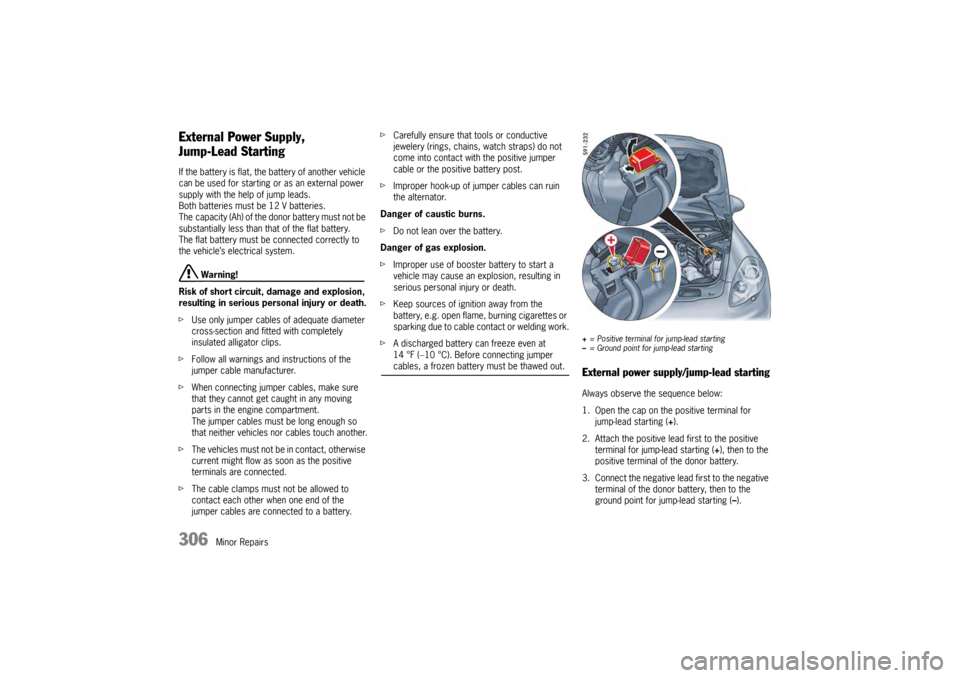
+ = Positive terminal for jump-lead starting
– = Ground point for jump-lead startingExternal power supply/jump-lead startingAlways observe the sequence below:
1. Open the cap on the positive terminal for
jump-lead starting ( +).
2. Attach the positive lead first to the positive terminal for jump-lead starting ( +), then to the
positive terminal of the donor battery.
3. Connect the negative lead first to the negative
terminal of the donor battery, then to the
ground point for jump-lead starting ( –).
Page 309 of 343
Minor Repairs
307
4. Leave the engine of the donor vehicle running at a higher engine speed.
5. Start the engine. An attempted start using jump leads should
not last more than 15 seconds. Then wait for
at least one minute.
6. Disconnect the negative lead from the ground
point for jump-lead starting ( –) first, then from
the negative terminal of the donor battery.
7. Disconnect the positive lead from the positive terminal of the donor ba ttery first, then from
the positive terminal for jump-lead starting ( +).
8. Close the cap on the posi tive terminal for jump-
lead starting ( +).Charging the batteryAutomotive batteries loose their efficiency when
not in use. The charge available in your battery can
be measured with a battery hydrometer. We
recommend that the battery voltage be tested by
your Porsche dealer who has the appropriate
equipment.
If the car is not driven for prolonged periods, the
battery must be charged at least every 6 weeks.
A discharged battery allo ws rapid formation of
sulfates, leading to premature deterioration of the
plates.
Danger!
Hydrogen gas genera ted by the battery
could cause an explosion, resulting in
serious personal injury or death.
f Charge battery in a well ventilated area.
f Never charge a frozen battery. It may explode
because of gas trapped in the ice. Allow a
frozen battery to thaw out first.
f If you get electrolyte, which is an acid, in your
eyes or on your skin, immediately rinse with
cold water for several minutes and call a doctor.
Your authorized Porsche dealer will be pleased to
advise you about a suitable charger.
f Always observe the instructions provided by
the charger manufacturer.
1. Connect the charger to the jump-lead starting terminals.
Only plug into the mains and switch the
charger on when it is connected up correctly.
2. Switch on the charger.
3. After charging the battery, first switch off the charger and then disconnect it.
f Please see the chapter “PUTTING VEHICLE
INTO OPERATION” on page 305.
Changing the Remote Control
BatteryNote
f Please observe the regulations for disposing
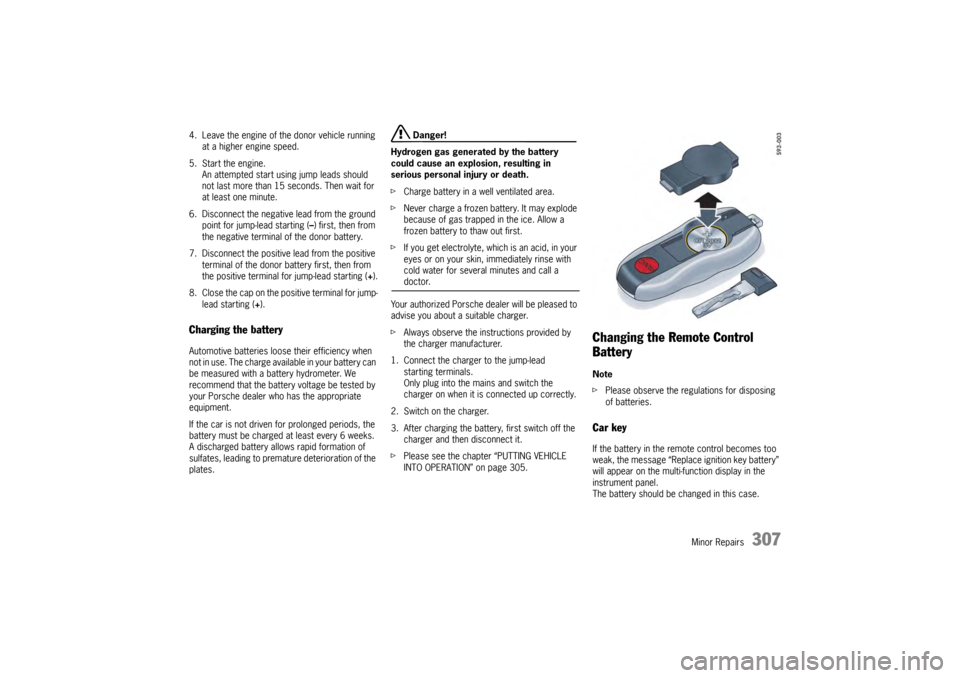
of batteries.Car keyIf the battery in the remote control becomes too
weak, the message “Replace ignition key battery”
will appear on the multi-function display in the
instrument panel.
The battery should be changed in this case.
Page 310 of 343
308
Minor Repairs
Changing the battery (CR 2032, 3V)
1. Remove the emergency key.
2. Lever off the cover on the back of the key
housing using a small screwdriver.
3. Change the battery (check polarity).
4. Re-fit cover and press together firmly.
5. Insert the emergency key.
Replacing Bulbs
Warning!
Risk of serious personal injury or death. The
headlights are under high voltage when
installed.
f Exercise extreme care when working close to
the headlights.
Risk of short circuit.
f Always switch off the relevant load when
changing bulbs.
Risk of damage. Bulbs of a high wattage can
damage the housing.
f Only use the bulbs specified in the bulb chart.
f Bulbs must be clean and free from grease.
f Never touch bulbs with your bare hands.
Use a cloth or soft paper when
replacing bulbs.
f Always carry spare bulbs with you.
In certain countries, it is mandatory to
carry spare bulbs.
Headlights
Caution!
Risk of damage to headlights due to abrasion
and excessive temperatures.
f Do not affix any coverings (e.g. “stone guards”
or films) on or around the headlights.
f Use soapy water only to clean light lenses and
plastic headlight lenses. In no case may
chemical cleaners or other volatile cleaning
fluids be used.
f To prevent scratches, do not rub with a dry or merely moist cloth, tissue or insect sponges.
Note
The headlights can mist up due to temperature
and humidity.
f To ensure optimum ventilation, do not cover
the gap between headlight and body.
Page 311 of 343
Minor Repairs
309
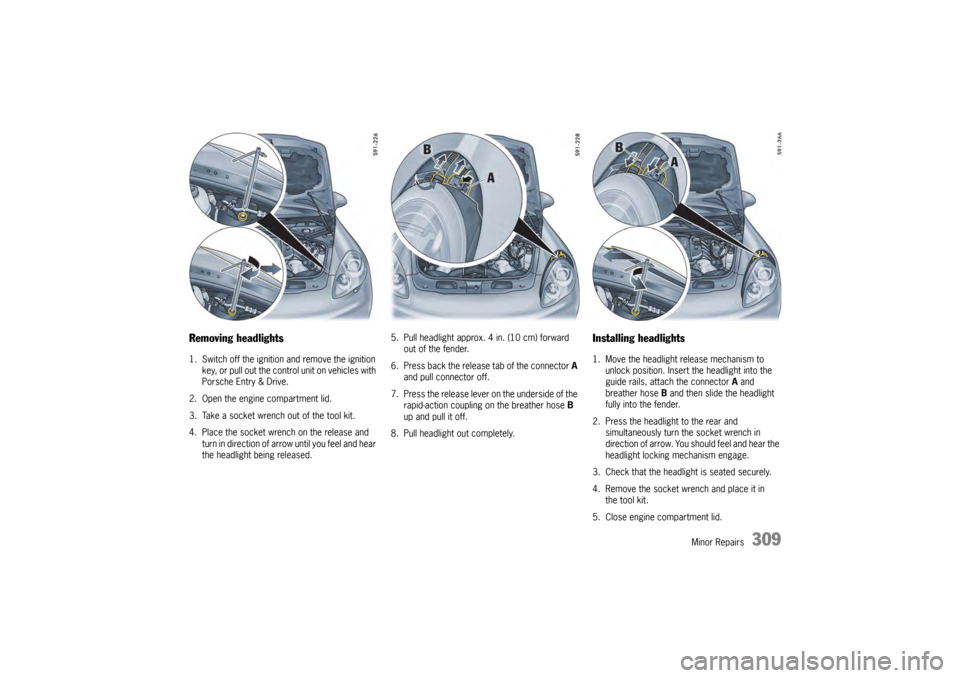
Removing headlights1. Switch off the ignition and remove the ignition
key, or pull out the control unit on vehicles with
Porsche Entry & Drive.
2. Open the engine compartment lid.
3. Take a socket wrench out of the tool kit.
4. Place the socket wrench on the release and turn in direction of arrow until you feel and hear
the headlight being released. 5. Pull headlight approx. 4 in. (10 cm) forward
out of the fender.
6. Press back the releas e tab of the connector A
and pull connector off.
7. Press the release lever on the underside of the rapid-action coupling on the breather hose B
up and pull it off.
8. Pull headlight out completely.
Installing headlights1. Move the headlight release mechanism to unlock position. Insert the headlight into the
guide rails, attach the connector A and
breather hose B and then slide the headlight
fully into the fender.
2. Press the headlight to the rear and simultaneously turn the socket wrench in
direction of arrow. You should feel and hear the
headlight locking mechanism engage.
3. Check that the headlight is seated securely.
4. Remove the socket wrench and place it in the tool kit.
5. Close engine compartment lid.
Page 312 of 343
310
Minor Repairs
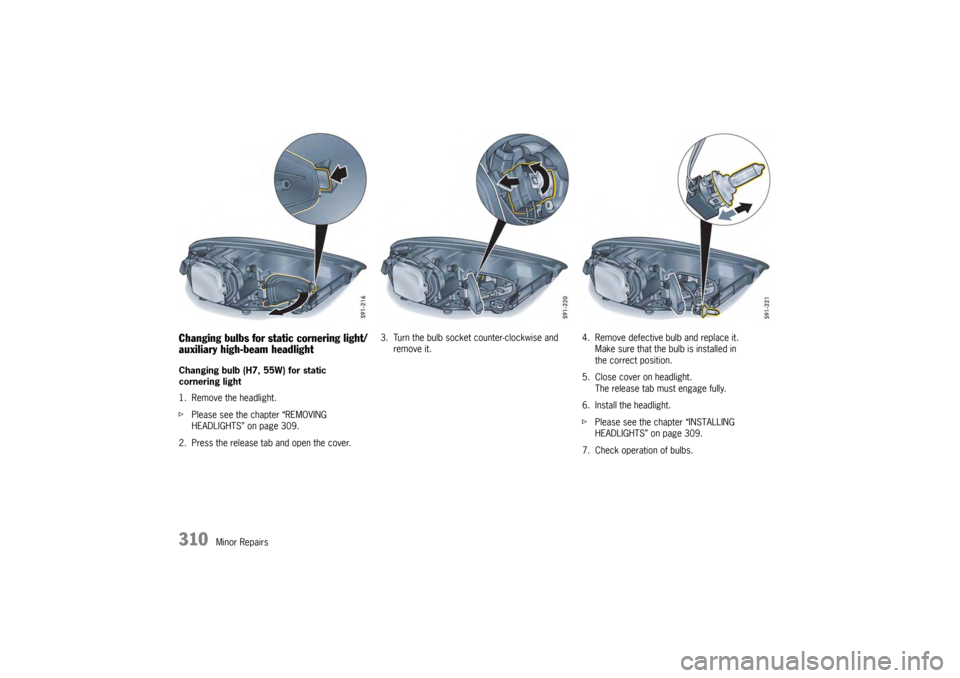
Changing bulbs for static cornering light/
auxiliary high-beam headlight Changing bulb (H7, 55W) for static
cornering light
1. Remove the headlight.
fPlease see the chapter “REMOVING
HEADLIGHTS” on page 309.
2. Press the release tab and open the cover. 3. Turn the bulb socket counter-clockwise and
remove it. 4. Remove defective bulb and replace it.
Make sure that the bulb is installed in
the correct position.
5. Close cover on headlight. The release tab must engage fully.
6. Install the headlight.
f Please see the chapter “INSTALLING
HEADLIGHTS” on page 309.
7. Check operation of bulbs.
Page 313 of 343
Minor Repairs
311
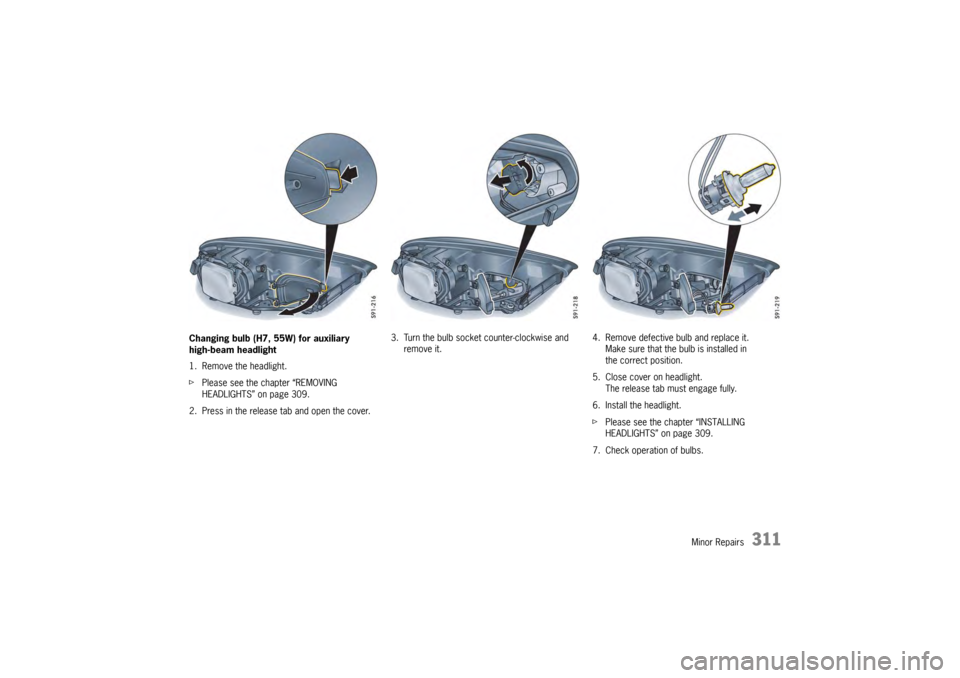
Changing bulb (H7, 55W) for auxiliary
high-beam headlight
1. Remove the headlight.
fPlease see the chapter “REMOVING
HEADLIGHTS” on page 309.
2. Press in the release tab and open the cover. 3. Turn the bulb socket counter-clockwise and
remove it. 4. Remove defective bulb and replace it.
Make sure that the bulb is installed in
the correct position.
5. Close cover on headlight. The release tab must engage fully.
6. Install the headlight.
f Please see the chapter “INSTALLING
HEADLIGHTS” on page 309.
7. Check operation of bulbs.
Page 314 of 343
312
Minor Repairs
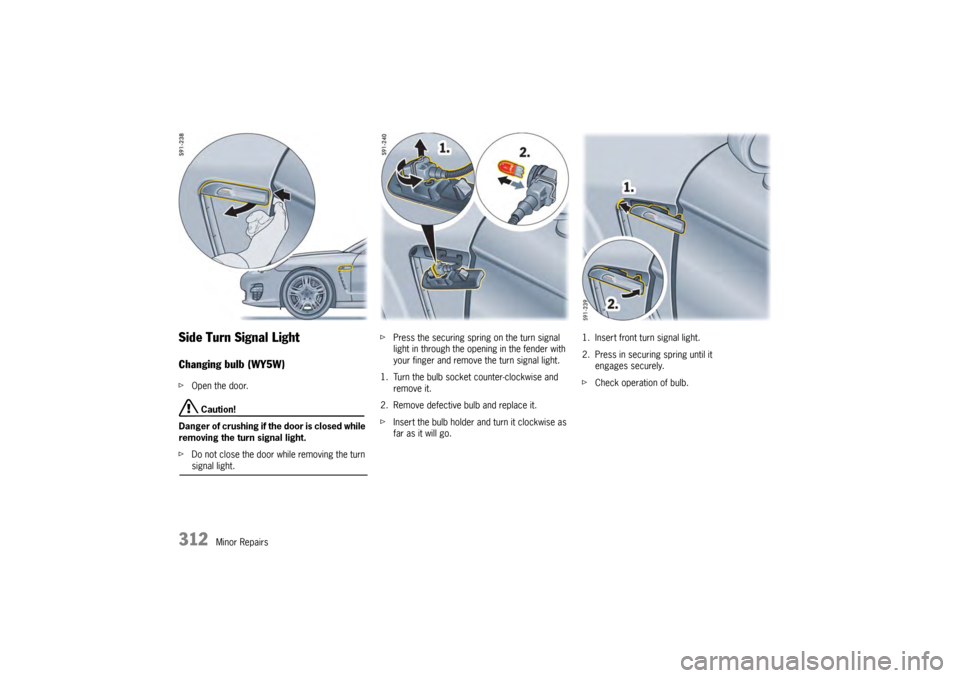
Side Turn Signal LightChanging bulb (WY5W)fOpen the door.
Caution!
Danger of crushing if th e door is closed while
removing the turn signal light.
f Do not close the door while removing the turn signal light. f
Press the securing spring on the turn signal
light in through the opening in the fender with
your finger and remove the turn signal light.
1. Turn the bulb socket counter-clockwise and remove it.
2. Remove defective bulb and replace it.
f Insert the bulb holder and turn it clockwise as
far as it will go. 1. Insert front turn signal light.
2. Press in securing spring until it
engages securely.
f Check operation of bulb.
Page 315 of 343
Minor Repairs
313
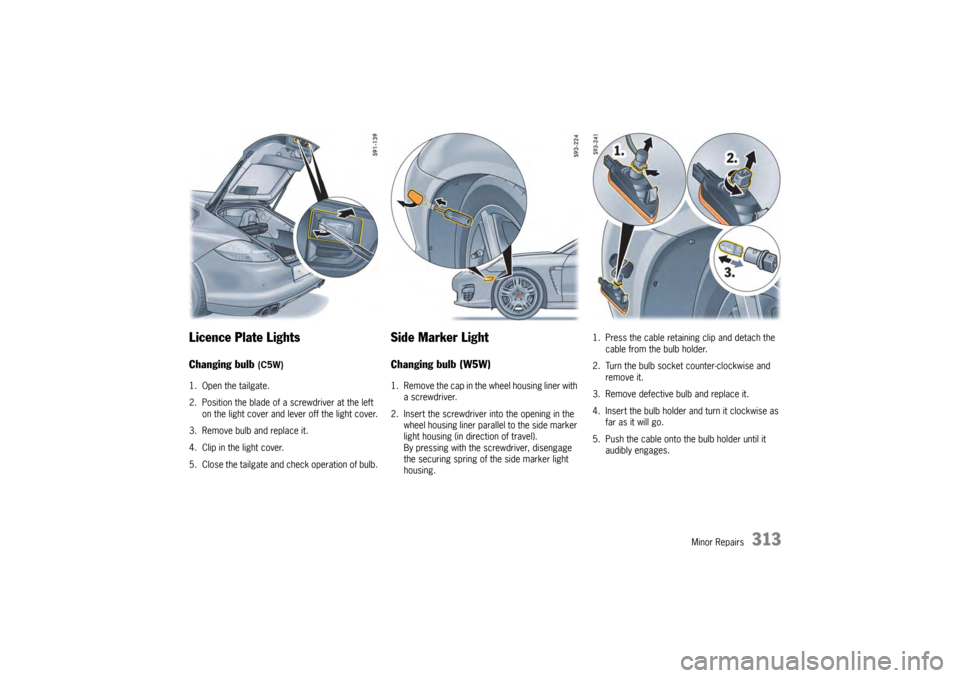
Licence Plate LightsChanging bulb
(C5W)
1. Open the tailgate.
2. Position the blade of a screwdriver at the left on the light cover and lever off the light cover.
3. Remove bulb and replace it.
4. Clip in the light cover.
5. Close the tailgate and check operation of bulb.
Side Marker LightChanging bulb (W5W)1. Remove the cap in the wheel housing liner with
a screwdriver.
2. Insert the screwdriver into the opening in the wheel housing liner parallel to the side marker
light housing (in direction of travel).
By pressing with the screwdriver, disengage
the securing spring of the side marker light
housing. 1. Press the cable retaining clip and detach the
cable from the bulb holder.
2. Turn the bulb socket counter-clockwise and remove it.
3. Remove defective bulb and replace it.
4. Insert the bulb holder and turn it clockwise as far as it will go.
5. Push the cable onto the bulb holder until it audibly engages.
Page 316 of 343
314
Minor Repairs
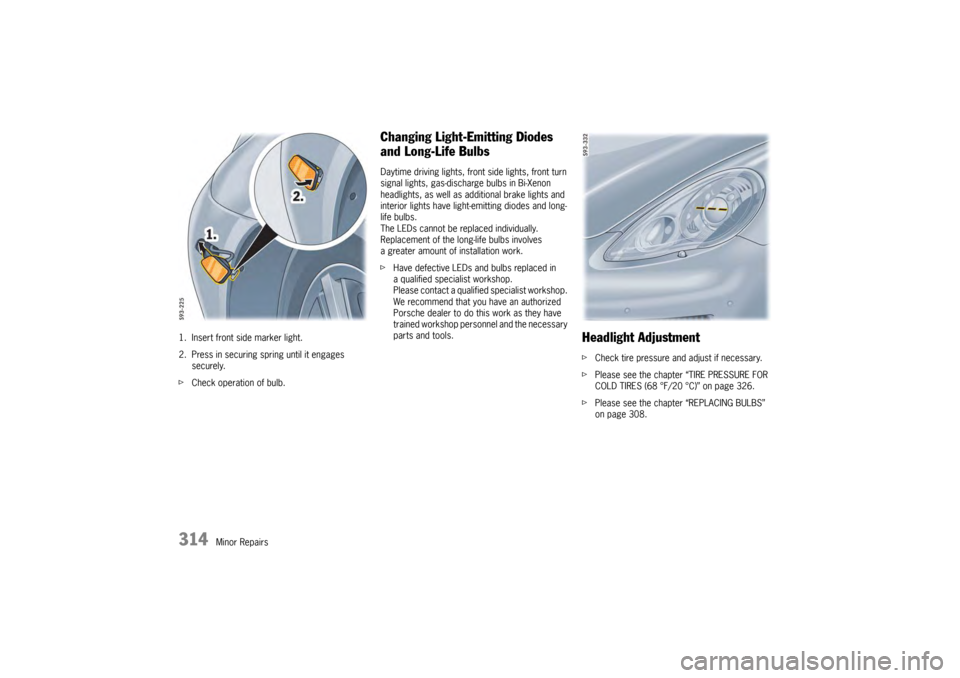
1. Insert front side marker light.
2. Press in securing spring until it engages
securely.
f Check operation of bulb.
Changing Light-Emitting Diodes
and Long-Life BulbsDaytime driving lights, front side lights, front turn
signal lights, gas-discharge bulbs in Bi-Xenon
headlights, as well as additional brake lights and
interior lights have light-emitting diodes and long-
life bulbs.
The LEDs cannot be replaced individually.
Replacement of the long-life bulbs involves
a greater amount of installation work.
fHave defective LEDs and bulbs replaced in
a qualified specialist workshop.
Please contact a qualified specialist workshop.
We recommend that you have an authorized
Porsche dealer to do this work as they have
trained workshop personnel and the necessary
parts and tools.
Headlight AdjustmentfCheck tire pressure and adjust if necessary.
f Please see the chapter “TIRE PRESSURE FOR
COLD TIRES (68 °F/20 °C)” on page 326.
f Please see the chapter “REPLACING BULBS”
on page 308.
Page 317 of 343
Minor Repairs
315
Adjustment
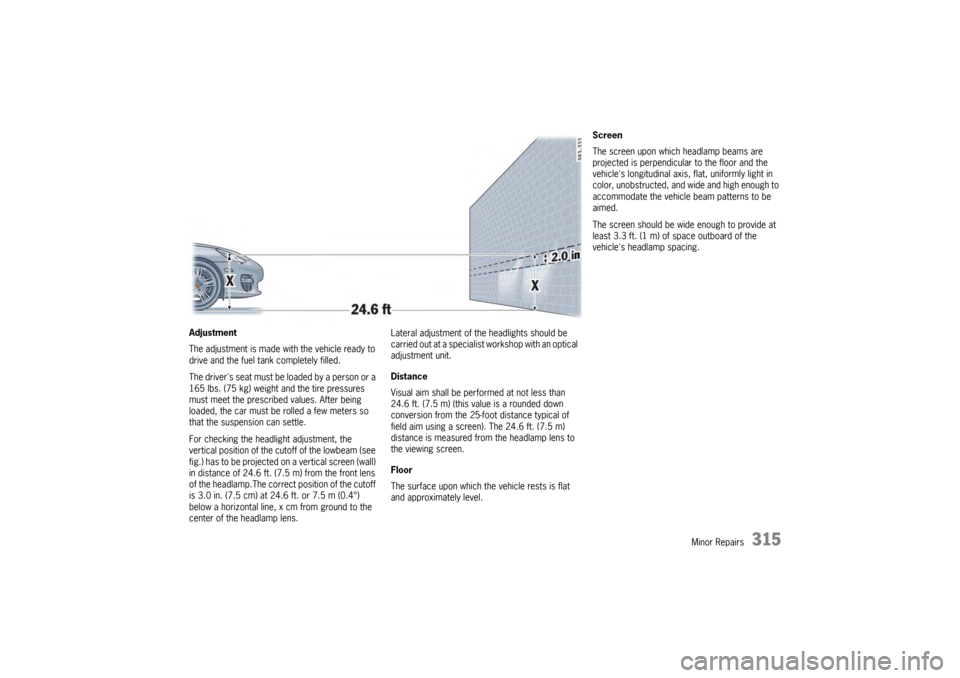
The adjustment is made with the vehicle ready to
drive and the fuel tank completely filled.
The driver's seat must be loaded by a person or a
165 lbs. (75 kg) weight and the tire pressures
must meet the prescribed values. After being
loaded, the car must be rolled a few meters so
that the suspension can settle.
For checking the headlight adjustment, the
vertical position of the cutoff of the lowbeam (see
fig.) has to be projected on a vertical screen (wall)
in distance of 24.6 ft. (7.5 m) from the front lens
of the headlamp.The correc t position of the cutoff
is 3.0 in. (7.5 cm) at 24.6 ft. or 7.5 m (0.4°)
below a horizontal line, x cm from ground to the
center of the headlamp lens. Lateral adjustment of the headlights should be
carried out at a specialist workshop with an optical
adjustment unit.
Distance
Visual aim shall be performed at not less than
24.6 ft. (7.5 m) (this value is a rounded down
conversion from the 25-f
oot distance typical of
field aim using a screen). The 24.6 ft. (7.5 m)
distance is measured from the headlamp lens to
the viewing screen.
Floor
The surface upon which the vehicle rests is flat
and approximately level.
Screen
The screen upon which headlamp beams are
projected is perpendicular to the floor and the
vehicle's longitudinal axis, flat, uniformly light in
color, unobstructed, and wide and high enough to
accommodate the vehicle beam patterns to be
aimed.
The screen should be wide enough to provide at
least 3.3 ft. (1 m) of space outboard of the
vehicle's headlamp spacing.