Psm PORSCHE PANAMERA 2010 1.G User Guide
[x] Cancel search | Manufacturer: PORSCHE, Model Year: 2010, Model line: PANAMERA, Model: PORSCHE PANAMERA 2010 1.GPages: 343, PDF Size: 7.96 MB
Page 188 of 343

186
Driving and Driving Safety
Exceptions for adaptive cruise control
Adaptive cruise control is
not available in the
following situations:
– If the ignition is switched off.
– When PSM is off.
– If the driver’s door is opened and the driver’s seat belt is not fastened.
– When parking or maneuvering in very tight spaces.
– If the PDK selector lever is at position N, R or
P .
– On upward or downward slopes of more than 20 %.
– When the electric parking brake is activated.
If one of these exception situations occurs when
adaptive cruise control is switched on, adaptive
cruise control will be switched off.
A message to this effect will appear on the
multi-function display. Messages on the multi-function display
If adaptive cruise control was deactivated
automatically or if an action cannot be performed,
a message to this effect in blue appears on the
multi-function display.
–“
ACC not available! ”
Adaptive cruise control is not available,
e.g. when maneuvering.
–“ ABS/PSM intervention!”
Adaptive cruise control was deactivated
because ABS or PSM intervened as a control
mechanism.
–“ Electric parking brake! ”
Adaptive cruise control was deactivated
because the electric parking brake was
activated.
–“ Selector position!”
Adaptive cruise control was deactivated
because the PDK select or lever is not in
position D or manual position M.
–“ Impossible while parked ”
The required action is not possible because
your vehicle is stationary, e.g. when setting
a desired speed.
–“ Speed! ”
Adaptive cruise control was deactivated
because the rpm limit of the engine was
reached in manual position M of the PDK
selector lever. –“
Gradient too steep! ”
The desired distance or the desired speed
cannot be set because the gradient on the
road is too steep.
–“ Stationary object ”
The action is not possi ble because a stationary
object was detected ahead.
–“ PSM off! ”
Adaptive cruise control is not available
because PSM was switched off.
For information on Porsche Stability
Management (PSM):
f Please see the chapter “PORSCHE STABILITY
MANAGEMENT (PSM)” on page 202.
General information“Sport” and “Sport Plus” mode
Adaptive cruise control regulates your driving
more dynamically in “Sport” and “Sport Plus”
mode.
Page 203 of 343

Driving and Driving Safety
201
Transmission and Chassis Control SystemsYour Porsche features a complex integrated system made up of all control systems acting in power transmission and in the chassis.
All control systems are networked with the aim of combining the best possible driving performance with maximum safety.
The following systems are invo lved, depending on equipment:
System/designation Scope
PTM
Porsche Traction Management – Active all-wheel drive with electronically
regulated map-controlled multiple-disc clutch
PSM
Porsche Stability Management – Driving stability control
– Anti-lock brake system (ABS)
– Brake system prefilling
– Brake booster (Hydraulic Brake Assist)
– Automatic brake differential (ABD)
– Anti-slip control (ASR)
– Engine drag torque control (MSR)
– HOLD function: standstill management
Air suspension
with level control and height adjustment – Full load-bearing air-spring stru
ts with integrated shock absorbers
– Height adjustment with Low Level setting in “S port Plus” mode and High Level setting for
maneuvering
PAS M
Porsche Active Suspension Management – Shock absorber system with adaptive, continuous shock absorber control
PDCC
Porsche Dynamic Chassis Control – Active chassis control system to stabilise
roll tendency of vehicle body when driving
– Controlled rear differential lock
Page 204 of 343
202
Driving and Driving Safety
Porsche Traction Management
(PTM)Porsche Traction Management is an active all-
wheel control system designed to influence
longitudinal and lateral dynamics. It is closely
linked with the Porsche Stability Management
(PSM) system.
The permanently driven rear axle enhances the
vehicle’s sporty features. Drive power is
distributed fully variably to the front axle,
depending on the driving situation.
In conjunction with PSM, the PTM system ensures
perfect distribution of power among all four
wheels in every driving situation. This improves
traction and driving stabil ity and ensures the same
high level of agility and dynamic response.
Warning!
In spite of the advantages of PTM and four-wheel
drive, it is still the driver’s responsibility to adapt
his driving style and maneuvers in line with road
and weather conditions, as well as the traffic
situation.
The increased safety that is provided should not
induce you to take greate r risks with your safety.
The limits set by the physics of driving cannot be
overcome, even with PTM or four-wheel drive.
Risk of accidents due to inappropriate speed
cannot be reduced by PTM or four-wheel drive. Advantages of PTM
– Clearly perceptible improvement in traction,
driving stability and steering ability of the
vehicle.
– Vehicle is more manageable when driven at its performance limits.
– Improved straight-ahead tracking and greater stability.
– More sporty vehicle setup while making full use of all the advantages of four-wheel drive.
– ASR and ABD further enhance traction for all wheels.
For information on ASR and ABD:
f Please see the chapter “PORSCHE STABILITY
MANAGEMENT (PSM)” on page 202.
Porsche Stability Management
(PSM)PSM is an active control system for stabilisation of
the vehicle during extreme driving maneuvers.
It operates together with the Porsche Traction
Management (PTM) system provided the vehicle is
fitted with the relevant equipment.
PSM makes use of both the ABD and ASR
systems, as well as the known functions of the
anti-lock brake system (ABS) and engine drag
torque control system (MSR).
Warning!
In spite of the advantages of PSM, it is still the
driver’s responsibility to adapt his driving style and
maneuvers in line with road and weather
conditions, as well as the traffic situation.
The increased safety that is provided should not
induce you to take greater risks with your safety.
The limits set by the physics of driving cannot be
overcome, even with PSM.
Risk of accidents due to inappropriate speed
cannot be reduced by PSM.
Page 205 of 343

Driving and Driving Safety
203
Advantages of PSM
– Best possible traction and lane-holding ability
in all driving situations – even on road surfaces
with varying friction.
– The system compensates for undesired vehicle reactions (Ferraria effect) when the
driver releases the accelerator pedal or brakes
on bends. This compensation functions up to
the maximum lateral acceleration.
– PSM actively stabilises the vehicle if necessary during dynamic driving maneuvers (e.g. rapid
steering movements, during lane changes, or
on alternating bends).
– Improved braking stability on bends and on different or varying road surfaces.
– Improved brake function and shorter stopping distance in the event of emergency braking. Readiness for operation
PSM is switched on automatically every time you
start the engine.
Function
Sensors at the wheels, brakes, steering system
and engine continuously measure:
–Speed
– Direction of travel (steering angle)
– Lateral acceleration
– Axial acceleration
– Rate of turn about the vertical axis
PSM uses these values to determine the direction
of travel desired by the driver.
PSM intervenes and corrects the course if the
actual direction of motion deviates from the
desired course (steering-wheel position):
It brakes individual wheels as required.
If necessary, PSM also influences the engine
power or the gear-changing characteristic of
Porsche Doppelkupplung (PDK) in order to
stabilise the vehicle. The events below inform the driver of PSM control
operations and warn him to adapt his driving style
to the road conditions:
– PSM warning light on the instrument panel
flashes.
– Hydraulic noises can be heard.
– The vehicle decelerates and steering-wheel forces are altered as PSM controls the brakes.
– Reduced engine power.
– The brake pedal pulsates and its position is changed during braking.
In order to achieve full vehicle deceleration,
foot pressure must be increased after the
brake pedal has begun vibrating.
Examples of PSM control operations
– If the “front wheels of the vehicle drift” on
a bend, the engine power is reduced and the
rear wheel on the inside of the bend is braked
if necessary.
– If the rear of the vehicle swings out on a bend, the front wheel on the outside of the bend is
braked.
Page 206 of 343
204
Driving and Driving Safety
– Brake system prefilling:
The brake system is prepared for possible
subsequent emergency braking if the
accelerator pedal is released suddenly and
quickly. The brake system is prefilled and the
brake pads are already applied gently to the
brake discs.
– Brake booster (Hydraulic Brake Assist): In the event of an emergency braking operation
where the pedal force is insufficient, a brake
booster provides the braking pressure
necessary for maximum deceleration at all
4wheels.
Combined operation of PSM and PTM
In order to ensure optimum stabilisation of the
vehicle, torque distribution between the front and
rear wheels is adapted and the rear differential
lock is controlled on vehicles with PDCC.
In the event of a PTM fault, PSM cannot be
switched off.
If PSM is switched off, it is switched on again
automatically. Automatic brake differential (ABD)
The ABD system controls the front and rear axles
separately. If one wheel of an axle starts to spin,
it is braked so that the other wheel on the same
axle can be driven.
ABD recognizes different driving states, and it
features control strategies adapted to these
states. In situations in which little propulsive power
is required, such as when the vehicle moves off on
a level gravel surface, traction control already
becomes active at low engine speeds. If a large
amount of propulsive power is required, e.g. when
driving off on an uph
ill slope or for rapid
acceleration, the ABD system is adapted
accordingly.
Anti-slip control (ASR)
The anti-slip control system prevents the wheels
from spinning by adjusting the engine power,
thereby ensuring good lane-holding ability and
stable handling.
Engine drag torque control (MSR)
In conditions of excessive slip, the engine
drag torque control system prevents all driven
wheels from locking up when the vehicle is
overrunning. This is also the case for downshifts
on a slippery road.
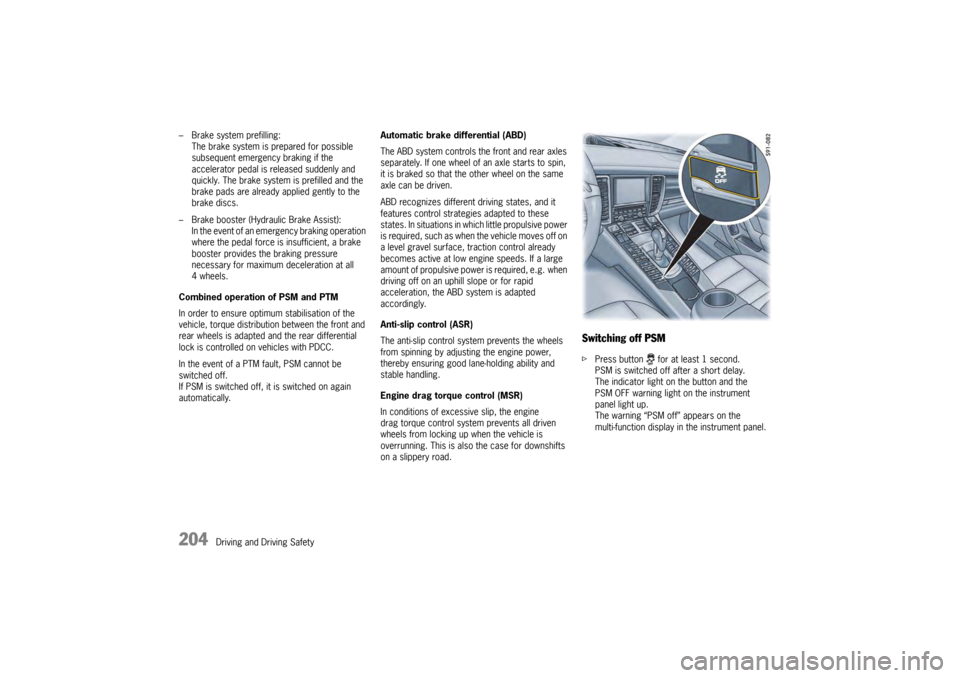
Switching off PSMf Press button for at least 1 second.
PSM is switched off after a short delay.
The indicator light on the button and the
PSM OFF warning light on the instrument
panel light up.
The warning “PSM off” appears on the
multi-function display in the instrument panel.
Page 207 of 343

Driving and Driving Safety
205
When you brake in the ABS control range,
the vehicle is stabilised even when PSM is
switched off.
One-sided spinning of the wheels is prevented,
even with PSM switched off.
PSM should always be switched on during
“normal” driving.
H o w e v e r, i t m a y b e a g o o d i d e a to s w it c h o f f P S M
temporarily in exceptional situations:
– On a loose surface and in deep snow.
– When “rocking the vehicle free”.
– When using snow chains.
Tip on driving
The vehicle retains its enhanced braking readiness
through prefilling of the br ake system even when
PSM is switched off.
When PSM is switched off, wheel-specific brake
interventions and the anti-slip control system (ASR)
are also switched off.
The automatic brake differential (ABD) remains on.
Adaptive cruise control is deactivated when PSM
is switched off.
When PSM is switched off, the slip monitoring
function of Porsche Doppelkupplung (PDK) is also
deactivated.
Switching PSM back onf Press button .
PSM is active immediately.
The indicator light on the button and the
PSM OFF warning light on the instrument
panel go out.
The message “PSM switched on” appears on
the multi-function disp lay in the instrument
panel.“Sport Plus” modeA sportier setup is obtained when “Sport Plus”
mode is switched on.
PSM interventions occur later than in Normal
mode. The vehicle can be maneuvered with
greater agility at its pe rformance limits, without
having to dispense with th e assistance of PSM in
emergency situations. This helps to achieve
optimal lap times, particular ly on race circuits and
on a dry road surface. – The PSM warning light on the instrument panel
lights up for a lamp check when the ignition is
switched on.
– The light indicates a control operation, even when PSM is switched off, e.g. brake control in
the event of one-sided wheel spin.
– The light - in conjunction with the multi-function display - indicates a fault.
The warning message “PSM failure” appears
on the multi-function display in the instrument
panel.
For information on warning messages on the multi-
function display:
f Please see the chapter “OVERVIEW OF
WARNING MESSAGES” on page 152.
f Adapt your driving style according to the
changed conditions.
f Contact a qualified spec ialist workshop in
order to correct the fault. We recommend that
you have an authorized Porsche dealer to do
this work, as they have the trained workshop
personnel and the necessary parts and tools
for this type of work.
To w i n g
For information on towing:
f Please see the chapter “TOWING” on
page 316.
PSM warning light
Page 214 of 343

212
Driving and Driving Safety
“Sport” and “Sport Plus” Mode FunctionThe selectable chassis settings mean that the
vehicle can offer various modes for a sportier
overall setup.
When “Sport” or “Sport Plus” mode is selected, all
the vehicle’s control systems are intentionally
shifted towards greater agility and driving
performance:
– PASM (Porsche Active Suspension Management) is automa tically changed to
“PASM Sport” or “PASM Sport Plus” mode,
resulting in a stiffer suspension setup.
The vehicle switches to Low Level in “PASM
Sport Plus” mode.
f Please see the chapter “PORSCHE ACTIVE
SUSPENSION MANAGEMENT (PASM)” on
page 208.
– Just like PASM, PDCC is switched to the corresponding “Sport” or “Sport Plus” mode,
whereby the rolling movements of the vehicle
are reduced further, depending on the
selected mode.
f Please see the chapter “PORSCHE DYNAMIC
CHASSIS CONTROL (PDCC)” on page 211.
– The PDK transmission switches to a sporty gear-changing map and shortens the gear
shifting times when Sport mode is activated.
Gear changes take place faster. f
Please see the chapter ““SPORT” AND “SPORT
PLUS” MODE” on page 195.
– The electronic accelerator pedal reacts sooner, and the engine is more responsive to
throttle inputs. When Sport mode is switched
on and the vehicle is travelling at a speed of
less than 25 mph (40 km/h), this function is
activated only after the driver has floored the
accelerator pedal or released it briefly.
– The rpm limiter characteristic is “harder”. In other words: the engine is immediately
throttled when the performance limits are
reached (only in manual selection mode on
vehicles with PDK).
– The turbo overboost briefly increases the engine boost pressure in the engine speed
range from 2,500 rpm to approx. 4,000 rpm.
As a result, torque in this speed range is
increased by 70 Nm (52 ftlb.). This
considerably improves acceleration and
flexibility, particularly in the medium engine
speed range. This does not affect the
maximum power. Quickly flooring the
accelerator pedal acti vates turbo overboost
in the engine control system. Overboost has
an effective operating time of approx.
10 seconds. After this time, it can be re-
activated by quickly flooring the accelerator
pedal again. – PSM (Porsche Stability Management) control is
more sporty in “Sport Plus” mode. PSM
interventions are later than in Normal mode.
The driver can maneuver the vehicle with
greater agility at it s performance limits,
without having to dispense with the assistance
of PSM in emergency situations. This helps to
achieve optimal lap times, particularly on race
circuits with a dry road surface.
f Please see the chapter “PORSCHE STABILITY
MANAGEMENT (PSM)” on page 202.
– Adaptive cruise control regulates speed and distance more dynamically.
– The Auto Start Stop function is deactivated.
f Please see the chapter “AUTO START STOP
FUNCTION” on page 169.
– The rear spoiler extends earlier and retracts later (“Sport Plus” mode only).
f Please see the chapter “RETRACTABLE REAR
SPOILER” on page 214.
– The system switches from High Level.
f Please see the chapter “HIGH LEVEL” on
page 209.
Page 301 of 343

Minor Repairs
299
Fuse box in left side of dashboardNo.Designation A
1 Steering column switch 7.5
2 Instrument cluster 7.5
3PCM 3.1 10
4 Additional instrument 5
5 Air conditioning, front + rear 10
6 Rearview camera 5
7 LHD, electric parking brake button 5
8 LHD, central locking for rear left
door
RHD, central locking for left doors 10
9 LHD, steering column adjustment 15
10 LHD, PDK control unit 25
11 Power windows, rear left 25
12 Power windows, front left 25
13 ParkAssist 5
14 Xenon headlight, left 15
15 Interior mirror,
LHD, diagnostic socket 5
16 LHD, PDK control unit,
clutch sensor
RHD, air conditioning, sun sensor 5
17 Not used
18 Not used
19 Not used
20 LHD, ignition lock control unit, light
switch 5
21LHD, central locking for front
left door
RHD, mobile phone charger 10
5
22 Steering column lock 5
23 Left-hand drive vehicles only:
Turn signal, rear right
Marker light, front left
Low beam headlight, right
High beam headlight, right
Side turn signals, front
Cornering light, front left
Ignition lock
Two-tone horns
PSM
Starter relay
Emergency flasher switch LED
Ignition lock lighting
Turn signal, front left/right
Footwell lights
Ignition lock anti-removal lock
Power steering control valves 30
No.
Designation A
24Left-hand drive vehicles only:
Turn signal, rear left
Marker light, front right
Low beam headlight, left
High beam headlight, left
Cornering light, front right
Engine compartment lid light
Shutter elements, right/left
Active brake ventilation
open/closed
Heatable washer jets
Engine compartment lid
Headlight beam adjustment 30
25 Left-hand drive vehicles only:
Steering column lock
Filler flap closed/open
Windshield washer pump,
front/rear 15
26 LHD, headlight cleaning system 30
27 Ignition coils 15
28 Not used
29 Oil level sensor, camshaft sensor 7.5
30 Oxygen sensors behind catalytic
converter 7.5
31 Electric control valves for engine 15
32 Engine control unit 20
33 Fan activation,
tank leakage detection 10
34 Valves for engine 10
35 Oxygen sensors ahead of catalytic
converter 10
No.
Designation A
Page 302 of 343

300
Minor Repairs
Fuse box in right side of dashboard
36 Not used
37 Not used
38Front cigarette lighter,
luggage compartment socket 20
39 Seat adjustment, front left
without memory 30
40 RHD, center console sockets,
glove box 20
41 PSM control unit 10
42 Interior light in roof console 7.5
43 Not used
44 Not used
45 Not used
46 Not used
47 Slide/tilt roof 30
48 Windshield wipers 30
49 Engine control unit 5
50 Not used
51 Seat adjustment, front left
with memory 30
52 Seat adjustment, rear left 20
53 Circulating pump 10
54 Rain sensor 5
55 Not used
56 Not used
57 Air-conditioning system fan 40
No.
Designation A
No.Designation A
1 Tire Pressure Monitoring control unit 5
2 Not used
3 Seat heating, front 30
4 Seat heating, rear 30
5 Seat adjustment, rear right 20
6 Not used
7 Not used
8 Seat adjustment, front right
with memory 30
9 RHD, electric parking brake button 5
10 LHD, handset, mobile phone charger
RHD, steering column adjustment 5
15
11 RHD, PDK control unit 25
12 LHD, telephone 5
13 Not used
14 Xenon headlight, right 15
15 Not used
16 RHD, diagnostic socket 5
17 PSM control unit 5
18 LHD, air conditioning, sun sensor
RHD, PDK control unit,
clutch sensor 5
19 Garage door opener 5
20 Air bag control unit 7.5
21 Advanced air bag, occupant sensing 5
22 Steering column switch 5
23 Adaptive cruise control (ACC) 5
24 Seat ventilation, front seats 7.5
25 Seat ventilation, rear seats 7.5
26 Not used
27Front center console socket,
Rear cigarette lighter 20
28 Seat adjustment, front right
without memory 30
29 LHD, rear center console socket,
socket in glove box,
socket in large rear center console 20
30 Not used
31 Coolbox 15
32 Rear Seat Entertainment 7.5
33 Right-hand drive vehicles only:
Turn signal, rear right
Marker light, front left
Low beam headlight, right
High beam headlight, right
Side turn signals, front
Cornering light, front left
Ignition lock
Two-tone horns
PSM
Starter relay
Emergency flasher switch LED
Ignition lock lighting
Turn signal, front left/right
Footwell lights
Ignition lock anti-removal lock
Power steering control valves 30
No.
Designation A
Page 303 of 343

Minor Repairs
301
Fuse and relay carriers
in the luggage compartment
34Right-hand drive vehicles only:
Turn signal, rear left
Marker light, front right
Low beam headlight, left
High beam headlight, left
Cornering light, front right
Engine compartment lid light
Shutter elements, right/left
Active brake ventilation
open/closed
Heatable washer jets
Engine compartment lid
Headlight beam adjustment 30
35 Right-hand drive vehicles only:
Steering column lock
Filler flap closed/open
Windshield washer pump,
front/rear 15
36 RHD, headlight cleaning system 30
37 Not used
38 Not used
39 PSM control unit 25
40 LHD, central locking for front/rear
right door 10
41 Power windows, front right 25
42 Power windows, rear right 25
43 Alarm horn 5
44 Vehicle Tracking System VTS 5
45 Not used
46 Not used
No.
Designation A
47 Fuel pump control unit 25
48 Horn (two-tone horns) 15
49 Diagnostic socket 5
50 RHD, ignition lock, light switch 5
51 RHD, central locking for front right
door 10
52 RHD, steering column lock 5
53 Not used
54 Not used
55 Not used
56 Not used
57 PSM pump control unit 40
No.
Designation A
No. Fuse carrier A A
1Not used
2 Spoiler flap (Turbo) 10
3 Audio amplifier (Burmester
®)
Audio amplifier (ASK Sound, Bose) 30
25
4 Start/Stop control unit 30
5 Start/Stop control unit 30
6 Differential lock 10
7 Differential lock 30
8 Subwoofer (Bose, Burmester®)30
9 Powerlift tailgate 25
10 PASM control unit 25
11 Luggage compartment lights 5
12 PDCC control unit 10