ECO mode Ram 1500 2009 Workshop Manual
[x] Cancel search | Manufacturer: RAM, Model Year: 2009, Model line: 1500, Model: Ram 1500 2009Pages: 543, PDF Size: 7.75 MB
Page 303 of 543
Floor ModeAir comes from the floor outlets. A slight amount of
air is directed through the defrost and side window
demister outlets.
Mix Mode Air comes from the floor, defrost and side window
demist outlets. This mode works best in cold or
snowy conditions. It allows you to stay comfortable
while keeping the windshield clear.
Defrost Mode Air comes from the windshield and side window
demist outlets. Use Defrost mode with maximum
blower and temperature settings for best windshield and
side window defrosting.
NOTE: While operating in the other modes, the system
will not automatically sense the presence of fog, mist or
ice on the windshield. Defrost mode must be manually
selected to clear the windshield and side glass. The Air Conditioning (A/C) button allows the
operator to manually activate or deactivate the air
conditioning system. When in A/C mode and the
ATC is set to a cool temperature, dehumidified air flows
through the air outlets. If Economy mode is desired, press
the A/C button to turn off the A/C mode in the ATC
display and deactivate the A/C system.
NOTE:
•If the system is in Mix, Bi-Level or Defrost Mode, the
A/C can be turned off, but the A/C system shall
remain active to prevent fogging of the windows.
•If fog or mist appears on the windshield or side glass,
select Defrost mode and increase blower speed.
4
UNDERSTANDING YOUR INSTRUMENT PANEL 301
Page 304 of 543
Recirculation Control
When outside air contains smoke, odors, or
high humidity, or if rapid cooling is desired,
you may wish to recirculate interior air by
pressing the RECIRCULATION control button.
Recirculation mode should only be used temporarily. The
recirculation LED will illuminate on the blower control
knob when this button is selected. Push the button a
second time to turn off the Recirculation mode LED and
allow outside air into the vehicle.
NOTE: In cold weather, use of Recirculation mode may
lead to excessive window fogging. The Recirculation
mode is not allowed in the Floor, Mix and Defrost modes
to improve window clearing operation. Recirculation will
be disabled automatically if these modes are selected.
Summer Operation
The engine cooling system in air conditioned vehicles
must be protected with a high-quality antifreeze coolant
to provide proper corrosion protection and to protect
against engine overheating. A solution of 50% ethylene
glycol antifreeze coolant and 50% water is recommended.
Refer to “Maintenance Procedures” in Section 7 of this
manual for proper coolant selection.
Winter Operation
To ensure the best possible heater and defroster perfor-
mance, make sure the engine cooling system is function-
ing properly and the proper amount, type, and concen-
tration of coolant is used. Refer to “Maintenance
Procedures” in section 7 of this manual for proper coolant
selection. Use of the air Recirculation mode during
Winter months is not recommended because it may cause
window fogging.
302 UNDERSTANDING YOUR INSTRUMENT PANEL
Page 318 of 543
REVERSE
This range is for moving the vehicle rearward. Use this
range only after the vehicle has come to a complete stop.
NEUTRAL
This range is used when the vehicle is standing for
prolonged periods with the engine running. The engine
may be started in this range. Set the parking brake if you
must leave the vehicle.
NOTE:Towing the vehicle, coasting, or driving for any
other reason with shift lever in NEUTRAL can result in
severe transmission damage. Refer to “Recreational Tow-
ing” in Section 5 and “Towing a Disabled Vehicle” in
Section 6 of this manual. DRIVE
This range is for most city and highway driving.
2 (Second)
This range is for moderate grades and to assist braking
on dry pavement or in mud and snow. Begins at a stop in
low gear with automatic upshift to second gear. Will not
shift to third gear.
1 (First)
This range is for hard pulling at low speeds in mud, sand,
snow, or on steep grades. Begins and stays in low gear
with no upshift. Provides engine compression braking at
low speeds.
316 STARTING AND OPERATING
Page 320 of 543
When To Use TOW/HAUL Mode
When driving in hilly areas, towing a trailer, carrying a
heavy load, etc., and frequent transmission shifting oc-
curs, press the TOW/HAUL switch. This will improve
performance and reduce the potential for transmission
overheating or failure due to excessive shifting. When
operating in TOW/HAUL mode, the transmission will
shift to third gear and fourth gear will be enabled under
steady cruise conditions.The “TOW/HAUL Indicator Light” will illuminate in the
instrument cluster to indicate when the switch has been
activated. Pressing the switch a second time restores
normal operation. If the TOW/HAUL mode is desired,
the switch must be pressed each time the engine is
started.
TOW/HAUL Switch
318 STARTING AND OPERATING
Page 321 of 543
Transmission Limp Home Mode
Transmission function is monitored for abnormal condi-
tions. If a condition is detected that could result in
transmission damage, the Transmission Limp Home
Mode will be engaged. In this mode, the transmission
will remain in the current gear until the vehicle is
brought to a stop.
To reset the transmission, use the following procedure:
1. Stop the vehicle.
2. Move the shift lever to the PARK position.
3. Turn OFF the engine and be sure to turn the key to the
LOCK position.
4. Wait approximately 10 seconds, then restart the en-
gine.
5. Move the shift lever to the desired gear range.If the problem is no longer detected, the transmission will
return to normal operation. If the problem persists,
PARK, REVERSE, and NEUTRAL will continue to oper-
ate. Only second gear will operate in the DRIVE position.
Have the transmission checked at your authorized dealer
as soon as possible.
Torque Converter Clutch
A feature designed to improve fuel economy has been
added to the automatic transmission of this vehicle. A
clutch within the torque converter engages automatically
at calibrated speeds. This may result in a slightly differ-
ent feeling or response during normal operation in high
gear. When the vehicle speed drops or during accelera-
tion, the clutch automatically and smoothly disengages.
5
STARTING AND OPERATING 319
Page 326 of 543
Overdrive Operation
The Overdrive automatic transmission contains an elec-
tronically controlled fourth and fifth gear (Overdrive).
The transmission will automatically shift from DRIVE to
Overdrive if the following conditions are present:
•the shift lever is in DRIVE;
•the engine coolant (antifreeze) has reached normal
operating temperature;
•vehicle speed is above approximately 30 mph
(48 km/h);
•the TOW/HAUL switch has not been activated;
•transmission has reached normal operating
temperature.
NOTE: If the vehicle is started in extremely cold tem-
peratures, the transmission may not shift into Overdrive
and will automatically select the most desirable gear for operation at this temperature. Normal operation will
resume when the transmission fluid temperature has
risen to a suitable level.
If the transmission temperature gets extremely hot, the
transmission will automatically select the most desirable
gear for operation at this temperature. If the transmission
temperature becomes hot enough, the “Transmission
Temperature Warning Light” may illuminate and the
transmission may downshift out of Overdrive until the
transmission cools down. After cool down, the transmis-
sion will resume normal operation.
The transmission will downshift from Overdrive to
DRIVE if the accelerator pedal is fully depressed at
vehicle speeds above approximately 35 mph (56 km/h).
When To Use TOW/HAUL Mode
When driving in hilly areas, towing a trailer, carrying a
heavy load, etc., and frequent transmission shifting oc-
curs, press the TOW/HAUL switch. This will improve
324 STARTING AND OPERATING
Page 327 of 543
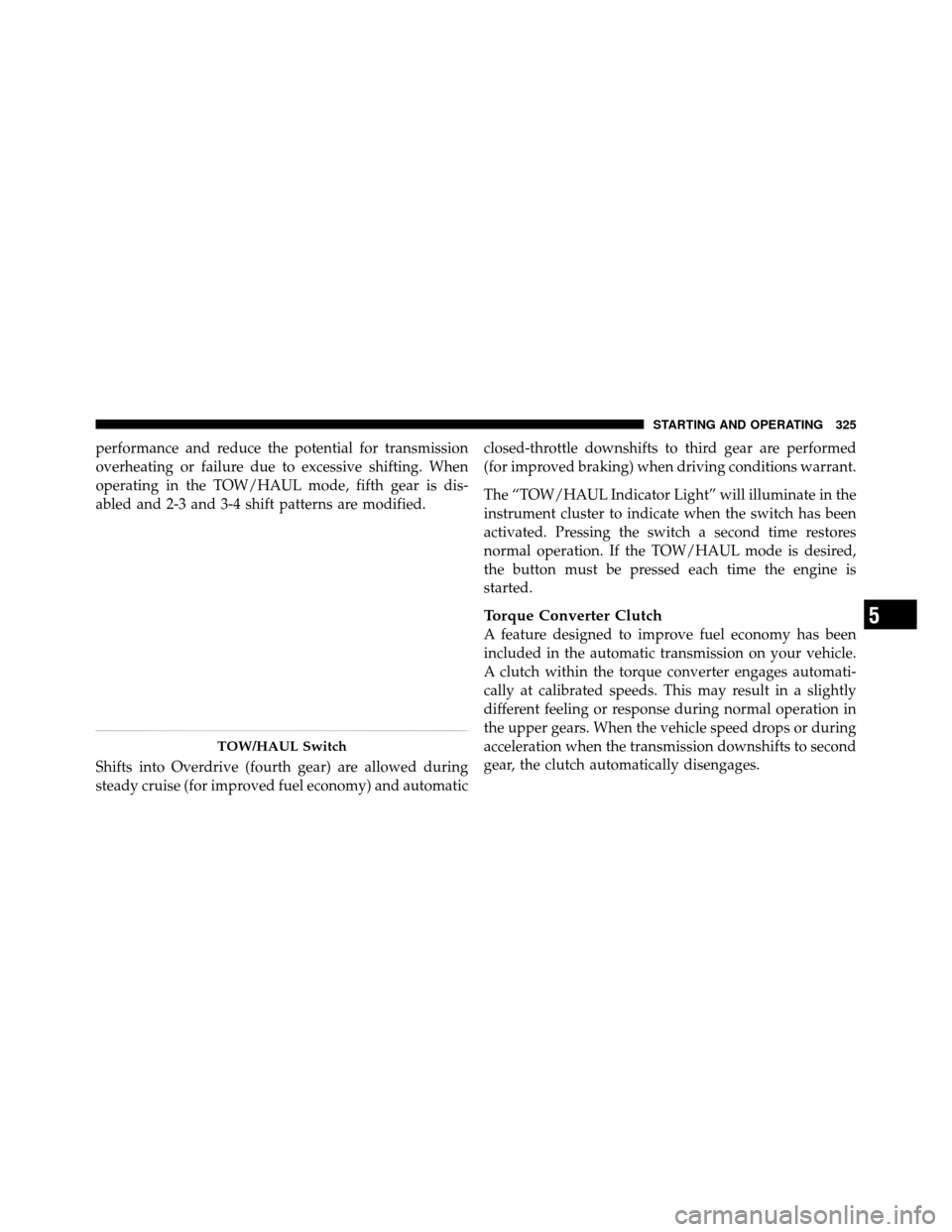
performance and reduce the potential for transmission
overheating or failure due to excessive shifting. When
operating in the TOW/HAUL mode, fifth gear is dis-
abled and 2-3 and 3-4 shift patterns are modified.
Shifts into Overdrive (fourth gear) are allowed during
steady cruise (for improved fuel economy) and automaticclosed-throttle downshifts to third gear are performed
(for improved braking) when driving conditions warrant.
The “TOW/HAUL Indicator Light” will illuminate in the
instrument cluster to indicate when the switch has been
activated. Pressing the switch a second time restores
normal operation. If the TOW/HAUL mode is desired,
the button must be pressed each time the engine is
started.
Torque Converter Clutch
A feature designed to improve fuel economy has been
included in the automatic transmission on your vehicle.
A clutch within the torque converter engages automati-
cally at calibrated speeds. This may result in a slightly
different feeling or response during normal operation in
the upper gears. When the vehicle speed drops or during
acceleration when the transmission downshifts to second
gear, the clutch automatically disengages.
TOW/HAUL Switch
5
STARTING AND OPERATING 325
Page 336 of 543
•Four-wheel drive low range (4WD LOW)
•Neutral (NEUTRAL)
This electronically shifted transfer case is designed to be
driven in the two–wheel drive position (2WD) or four-
wheel drive position (4WD AUTO) for normal street and
highway conditions on dry hard surfaced roads). Driving
the vehicle in 2WD will have greater fuel economy
benefits as the front axle is not engaged in 2WD.
For variable driving conditions, the 4WD AUTO mode
can be used. In this mode, the front axle is engaged, but
the vehicle’s power is sent to the rear wheels. Four-wheel
drive will be automatically engaged when the vehicle
senses a loss of traction. Because the front axle is en-
gaged, this mode will result in lower fuel economy than
the 2WD mode.
When additional traction is required, the transfer case
4WD LOCK and 4WD LOW positions can be used to lock the front and rear driveshafts together forcing the front
and rear wheels to rotate at the same speed. This is
accomplished by rotating the 4WD Control Switch to the
desired position. Refer to “Shifting Procedure” for spe-
cific shifting instructions. The 4WD LOCK and 4WD
LOW positions are designed for loose, slippery road
surfaces only. Driving in the 4WD LOCK and 4WD LOW
positions on dry hard surfaced roads may cause in-
creased tire wear and damage to the driveline compo-
nents.
NOTE:
The transfer case NEUTRAL position is selected
by depressing the recessed button located on the lower
left hand corner of the 4WD Control Switch. The transfer
case NEUTRAL position is to be used for recreational
towing only. Refer to “Recreational Towing” in this
section.
334 STARTING AND OPERATING
Page 361 of 543
NOTE:To improve the vehicle’s traction when driving
with snow chains or starting off in deep snow, sand or
gravel, it may be desirable to switch to the “Partial Off”
mode by pressing the ESP OFF switch. Once the situation
requiring ESP to be switched to the “Partial Off” mode is
overcome, turn ESP back on by momentarily pressing the
ESP OFF switch. This may be done while the vehicle is in
motion.
WARNING!
In the “Partial Off” mode, the engine torque reduc-
tion and stability features are desensitized. There-
fore, the enhanced vehicle stability offered by ESP is
unavailable.
All Four-Wheel Drive Vehicles in 4WD AUTO and
4WD LOCK Modes Can Also Choose the
Following ESP Operating Mode. This is the Only
ESP Operating Mode in 4WD LOW:
Full Off
This mode is intended for off-road use when ESP stability
features could inhibit vehicle maneuverability due to trail
conditions. This mode is entered by pressing and holding
the ESP OFF switch for five seconds when the vehicle is
stopped and the engine is running. After five seconds, the
“ESP/TCS Indicator Light” will illuminate and the “ESP
Off” message will appear in the odometer. Press and
release the trip odometer button located on the instru-
ment cluster to clear this message.
NOTE: The “ESP OFF” message will display and the
audible chime will sound when the shift lever is placed
5
STARTING AND OPERATING 359
Page 363 of 543
running. If the “ESP/BAS Warning Light” comes on
continuously with the engine running, a malfunction has
been detected in either the ESP or BAS system or both. If
this light remains on after several ignition cycles and the
vehicle has been driven several miles/kilometers at
speeds greater than 30 mph (48 km/h), see your autho-
rized dealer as soon as possible to have the problem
diagnosed and corrected.
NOTE:
•The “ESP Indicator Light” and the “ESP/BAS Warning
Light” will come on momentarily each time the igni-
tion switch is turned ON.
•Each time the ignition is turned ON, the ESP will be
ON even if it was turned off previously.
•The ESP will make buzzing or clicking sounds when it
is active. This is normal. The sounds will stop when
ESP becomes inactive following the maneuver that
caused the ESP activation.
Trailer Sway Control (TSC)
The TSC system uses sensors in the vehicle to recognize
an excessively swaying trailer and will take the appro-
priate actions to attempt to stop the sway. The system
may reduce engine power and apply the brake of the
appropriate wheel(s) to counteract the sway of the trailer.
TSC will become active automatically once an excessively
swaying trailer is recognized. No driver action is re-
quired. Note that TSC cannot stop all trailers from
swaying. Always use caution when towing a trailer and
follow the trailer tongue weight recommendations. Refer
to “Trailer Towing” in this section.. When TSC is func-
tioning, the “ESP/TCS Indicator Light” will flash, the
engine power may be reduced and you may feel the
brakes being applied to individual wheels to attempt to
stop the trailer from swaying. TSC is disabled when the
ESP system is in the “Partial Off” or “Full Off” modes.
5
STARTING AND OPERATING 361