flat tire Ram 1500 2011 Owner's Guide
[x] Cancel search | Manufacturer: RAM, Model Year: 2011, Model line: 1500, Model: Ram 1500 2011Pages: 636, PDF Size: 4.88 MB
Page 432 of 636
CAUTION!
3500 Dual Rear Tires have only one approved direc-
tion of rotation. This is to accommodate the asym-
metrical design (tread pattern) of the On/Off-Road
tire and the use of Outline White Letter (OWL) tires.
•When replacing a flat, the spare tire may have to
be remounted on the rim, or installed at a different
location, to maintain the correct placement of the
tire on the wheel relative to the tire/wheel position
on the truck. For example, if the spare is used to
replace an outer rear tire it will have to be re-
mounted on the rim so that the wheel is dished
inward. That way the tread design of asymmetrical
tires and the white writing of the OWL tires will
maintain proper position.
TIRE PRESSURE MONITOR SYSTEM (TPMS)
The Tire Pressure Monitor System (TPMS) will warn the
driver of a low tire pressure based on the vehicle recom-
mended cold placard pressure.
The tire pressure will vary with temperature by about
1 psi (6.9 kPa) for every 12°F (6.5°C). This means that
when the outside temperature decreases, the tire pressure
will decrease. Tire pressure should always be set based
on cold inflation tire pressure. This is defined as the tire
pressure after the vehicle has not been driven for at least
three hours, or driven less than 1 mile (1.6 km) after a
three hour period. The cold tire inflation pressure must
not exceed the maximum inflation pressure molded into
the tire sidewall. Refer to “Tires – General Information”
in “Starting and Operating” for information on how to
properly inflate the vehicle’s tires. The tire pressure will
also increase as the vehicle is driven - this is normal and
there should be no adjustment for this increased pres-
sure.
430 STARTING AND OPERATING
Page 433 of 636

The TPMS will warn the driver of a low tire pressure if
the tire pressure falls below the low-pressure warning
limit for any reason, including low temperature effects
and natural pressure loss through the tire.
The TPMS will continue to warn the driver of low tire
pressure as long as the condition exists, and will not turn
off until the tire pressure is at or above the recommended
cold placard pressure. Once the low tire pressure warn-
ing (Tire Pressure Monitoring [TPM] Telltale Light) illu-
minates, you must increase the tire pressure to the
recommended cold placard pressure in order for the TPM
Telltale Light to turn off. The system will automatically
update and the TPM Telltale Light will turn off once the
system receives the updated tire pressures. The vehicle
may need to be driven for up to 20 minutes above 15 mph
(24 km/h) in order for the TPMS to receive this informa-
tion.For example, your vehicle may have a recommended
cold (parked for more than three hours) placard pressure
of 30 psi (207 kPa). If the ambient temperature is 68°F
(20°C) and the measured tire pressure is 27 psi (186 kPa),
a temperature drop to 20°F (-7°C) will decrease the tire
pressure to approximately 23 psi (158 kPa). This tire
pressure is sufficiently low enough to turn ON the TPM
Telltale Light. Driving the vehicle may cause the tire
pressure to rise to approximately 27 psi (186 kPa), but the
TPM Telltale Light will still be ON. In this situation, the
TPM Telltale Light will turn OFF only after the tires are
inflated to the vehicle’s recommended cold placard pres-
sure value.
5
STARTING AND OPERATING 431
Page 434 of 636
CAUTION!
•The TPMS has been optimized for the original
equipment tires and wheels. TPMS pressures and
warning have been established for the tire size
equipped on your vehicle. Undesirable system
operation or sensor damage may result when us-
ing replacement equipment that is not of the same
size, type, and/or style. Aftermarket wheels can
cause sensor damage. Do not use aftermarket tire
sealants or balance beads if your vehicle is
equipped with a TPMS, as damage to the sensors
may result.
•After inspecting or adjusting the tire pressure,
always reinstall the valve stem cap. This will
prevent moisture and dirt from entering the valve
stem, which could damage the TPM sensor.NOTE:
•The TPMS is not intended to replace normal tire care
and maintenance or to provide warning of a tire failure
or condition.
•The TPMS should not be used as a tire pressure gauge
while adjusting your tire pressure.
•Driving on a significantly under-inflated tire causes
the tire to overheat and can lead to tire failure.
Under-inflation also reduces fuel efficiency and tire
tread life, and may affect the vehicle’s handling and
stopping ability.
•The TPMS is not a substitute for proper tire mainte-
nance, and it is the driver ’s responsibility to maintain
correct tire pressure using an accurate tire pressure
gauge, even if under-inflation has not reached the
level to trigger illumination of the TPM Telltale Light.
432 STARTING AND OPERATING
Page 435 of 636
•Seasonal temperature changes will affect tire pressure,
and the TPMS will monitor the actual tire pressure in
the tire.
Base System
The Tire Pressure Monitor System (TPMS) uses wireless
technology with wheel rim mounted electronic sensors to
monitor tire pressure levels. Sensors mounted to each
wheel as part of the valve stem transmit tire pressure
readings to the receiver module.
NOTE:It is particularly important for you to check the
tire pressure in all of the tires on your vehicle monthly
and to maintain the proper pressure.
The TPMS consists of the following components:
•Receiver module,
•Four TPM sensors, and
•TPM Telltale Light The matching full size spare wheel and tire assembly (if
equipped) has a TPM sensor. The matching full size spare
can be used in place of any of the four road tires. The
TPMS will only monitor the pressure in the full size spare
when it is used in place of a road tire. Otherwise, a spare
with a pressure below the low-pressure limit will not
cause the TPM Telltale Light to illuminate or the chime to
sound.
Tire Pressure Monitoring Low Pressure Warnings
The TPM Telltale Light will illuminate in the
instrument cluster and a chime will sound when
tire pressure is low in one or more of the four
active road tires. Should this occur, you should stop as
soon as possible, check the inflation pressure of each tire
on your vehicle, and inflate each tire to the vehicle’s
recommended cold placard pressure value. Once the
system receives the updated tire pressures, the system
will automatically update and the TPM Telltale Light will5
STARTING AND OPERATING 433
Page 438 of 636

Tire Pressure Monitoring Low Pressure Warnings
The TPM Telltale Light will illuminate in the
instrument cluster and a chime will sound when
tire pressure is low in one or more of the four
active road tires. In addition, the EVIC will display one or
more low pressure messages (Left Front, Left Rear, Right
Front, Right Rear) for three seconds and a graphic
showing the pressure values of each tire with the low tire
pressure values flashing.
Should this occur, you should stop as soon as possible
and inflate the tires with a low pressure condition (those
flashing in the EVIC graphic) to the vehicle’s recom-
mended cold placard pressure inflation value. Once the
system receives the updated tire pressures, the system
will automatically update, the graphic display in the
EVIC will stop flashing, and the TPM Telltale Light will
436 STARTING AND OPERATING
Page 441 of 636
Tire Pressure Monitor System (TPMS) Tire Light
Load Inflation Switch Description (2500 Models) –
If Equipped
WARNING!
Never operate your vehicle with the TPMS and tire
pressures set to the Light Load Inflation Pressure
settings if carrying more than two occupants (150 lbs
[68 kg] each) plus 200 lbs (91 kg) of cargo. The vehicle
“Light Load Definition” is found in the Supplemen-
tal Tire Pressure Information Label which is located
on the rear face of the driver door opening. Failure to
do so may cause you to lose control resulting in a
collision, causing serious or fatal injury.The TPMS tire light load inflation switch will allow the
driver to switch between the max load inflation pressure
(cold) low pressure warning threshold and the light load
inflation pressure (cold) low pressure warning threshold
depending on the vehicle’s load condition. The Tire and
Loading Information label defines the recommended
front and rear cold tire inflation pressures for the vehicle
when operating in the Max Load condition. A Supple-
mental Tire Pressure Information label is also available
defining Light Load tire inflation pressures when oper-
ating in the Light Load condition. When the tire light
5
STARTING AND OPERATING 439
Page 442 of 636
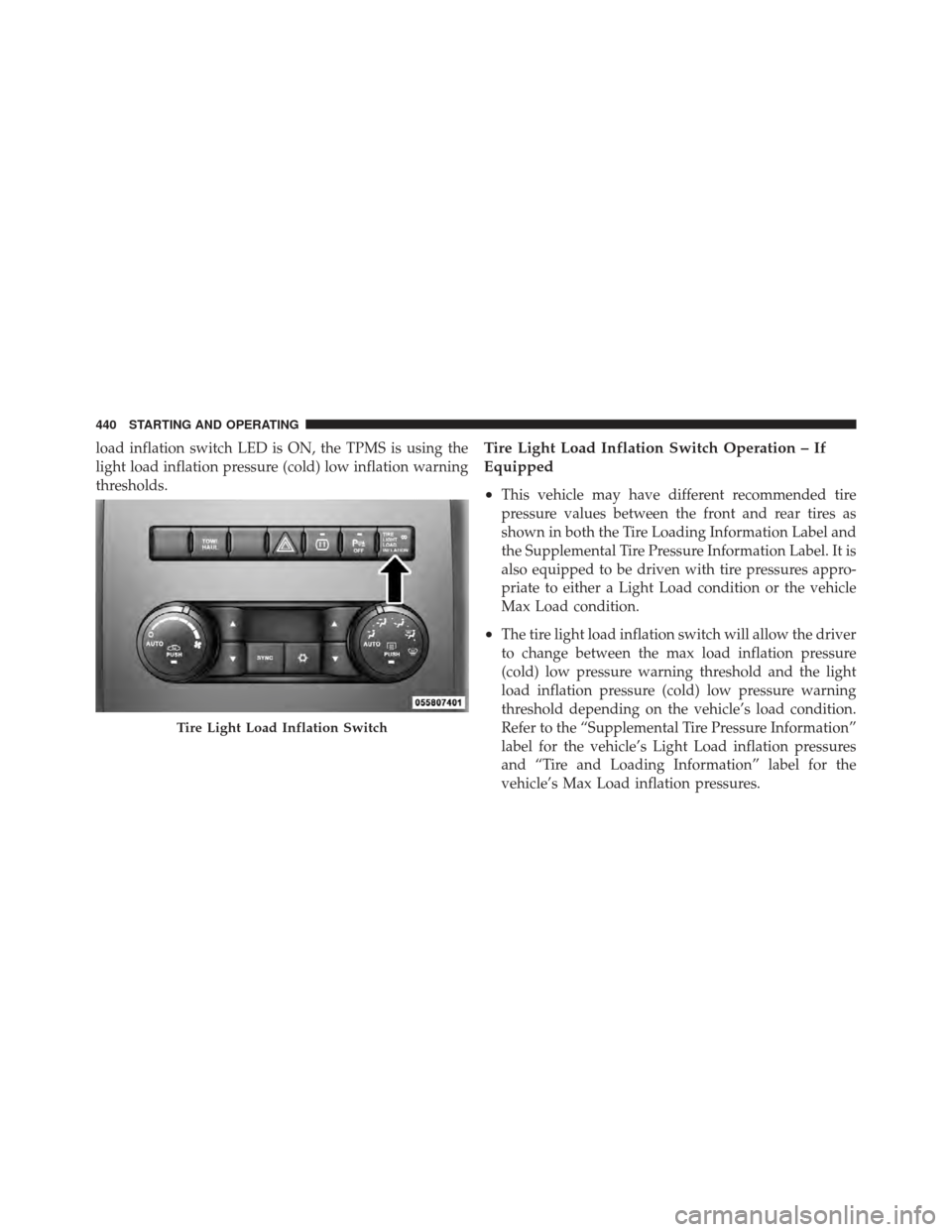
load inflation switch LED is ON, the TPMS is using the
light load inflation pressure (cold) low inflation warning
thresholds.Tire Light Load Inflation Switch Operation – If
Equipped
•
This vehicle may have different recommended tire
pressure values between the front and rear tires as
shown in both the Tire Loading Information Label and
the Supplemental Tire Pressure Information Label. It is
also equipped to be driven with tire pressures appro-
priate to either a Light Load condition or the vehicle
Max Load condition.
•The tire light load inflation switch will allow the driver
to change between the max load inflation pressure
(cold) low pressure warning threshold and the light
load inflation pressure (cold) low pressure warning
threshold depending on the vehicle’s load condition.
Refer to the “Supplemental Tire Pressure Information”
label for the vehicle’s Light Load inflation pressures
and “Tire and Loading Information” label for the
vehicle’s Max Load inflation pressures.
Tire Light Load Inflation Switch
440 STARTING AND OPERATING
Page 443 of 636
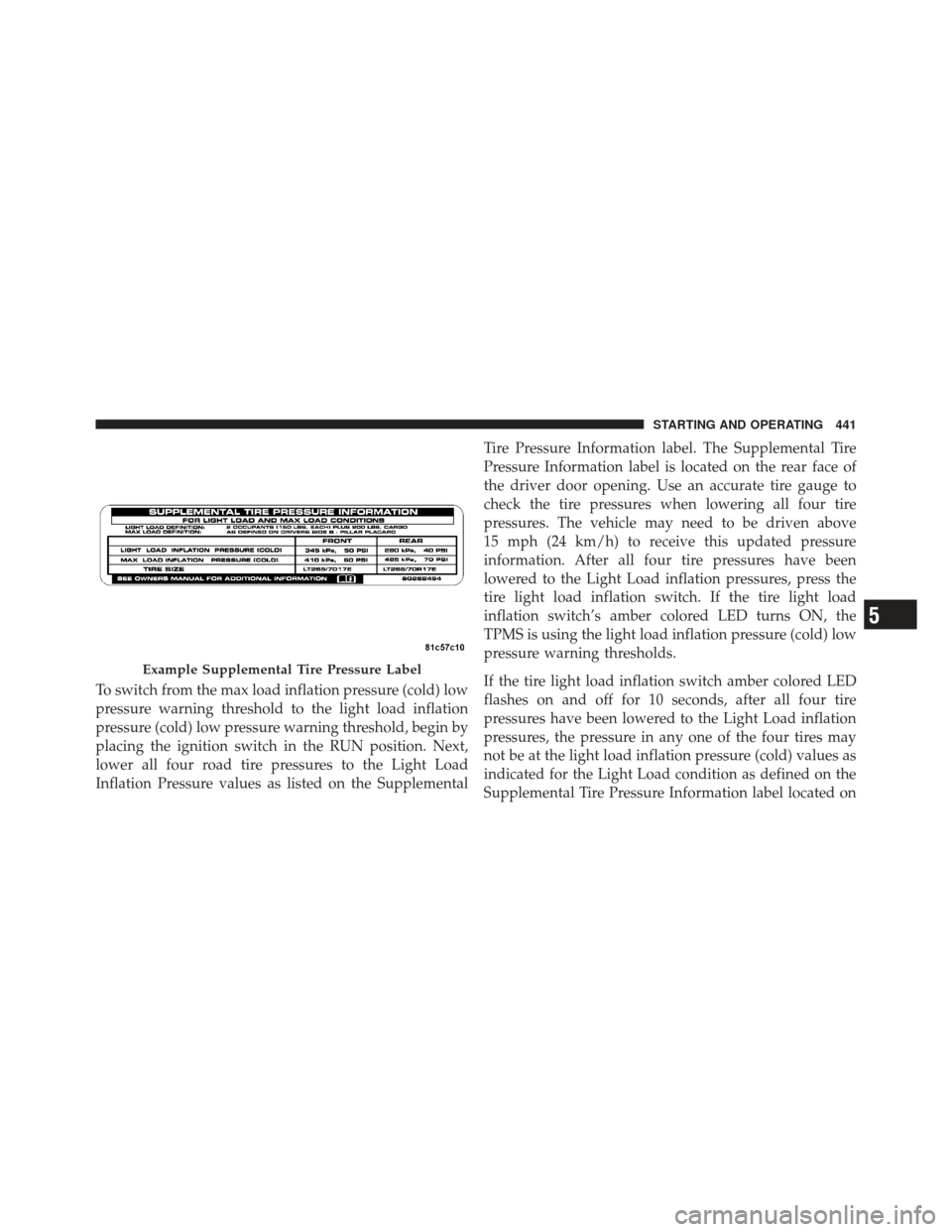
To switch from the max load inflation pressure (cold) low
pressure warning threshold to the light load inflation
pressure (cold) low pressure warning threshold, begin by
placing the ignition switch in the RUN position. Next,
lower all four road tire pressures to the Light Load
Inflation Pressure values as listed on the SupplementalTire Pressure Information label. The Supplemental Tire
Pressure Information label is located on the rear face of
the driver door opening. Use an accurate tire gauge to
check the tire pressures when lowering all four tire
pressures. The vehicle may need to be driven above
15 mph (24 km/h) to receive this updated pressure
information. After all four tire pressures have been
lowered to the Light Load inflation pressures, press the
tire light load inflation switch. If the tire light load
inflation switch’s amber colored LED turns ON, the
TPMS is using the light load inflation pressure (cold) low
pressure warning thresholds.
If the tire light load inflation switch amber colored LED
flashes on and off for 10 seconds, after all four tire
pressures have been lowered to the Light Load inflation
pressures, the pressure in any one of the four tires may
not be at the light load inflation pressure (cold) values as
indicated for the Light Load condition as defined on the
Supplemental Tire Pressure Information label located on
Example Supplemental Tire Pressure Label
5
STARTING AND OPERATING 441
Page 444 of 636
the rear face of the driver door. Using an accurate tire
pressure gauge, re-check the tire pressures for the light
load inflation pressure (cold) value.
WARNING!
It is the driver ’s responsibility to change to the max
load inflation pressure (cold) low pressure warning
threshold condition when not driving in the light
load condition as defined as two occupants (150 lbs
[68 kg] each) plus 200 lbs (91 kg) of cargo. The vehicle
“Light Load Definition” is found in the Supplemen-
tal Tire Pressure Information label located on the rear
face of the driver door. Failure to do so may cause you
to lose control resulting in a collision, causing seri-
ous or fatal injury.
To switch back to the max load inflation pressure (cold)
low pressure warning threshold, press the tire light load
inflation switch. It is not necessary to first fill the tires to the max load inflation pressure (cold) values to switch
the TPMS system to the max load inflation pressure
(cold) low pressure warning threshold. If after pressing
the tire light load inflation switch, and tire pressures are
below the max load inflation pressure (cold) low pressure
warning thresholds, the TPMS low pressure warning
telltale light (located in the instrument cluster) will turn
ON and a chime will sound. The tire pressures are now
required to be inflated to the max load inflation pressure
(cold) values described on the Tire and Loading Informa-
tion label. The Tire and Loading Information label is
located on the drivers side B-pillar. If the tire light load
inflation switch LED turns OFF, the TPMS has been reset
and the TPMS is using the max load inflation pressure
(cold) low pressure warning thresholds.
General Information
This device complies with Part 15 of the FCC rules and
RSS 210 of Industry Canada. Operation is subject to the
following conditions:
442 STARTING AND OPERATING
Page 457 of 636
Inflation Pressure
This is the cold tire inflation pressure for your vehicle for
all loading conditions up to full GAWR.
Curb Weight
The curb weight of a vehicle is defined as the total weight
of the vehicle with all fluids, including vehicle fuel, at full
capacity conditions, and with no occupants or cargo
loaded into the vehicle. The front and rear curb weight
values are determined by weighing your vehicle on a
commercial scale before any occupants or cargo are
added.
Loading
The actual total weight and the weight of the front and
rear of your vehicle at the ground can best be determined
by weighing it when it is loaded and ready for operation.The entire vehicle should first be weighed on a commer-
cial scale to insure that the GVWR has not been exceeded.
The weight on the front and rear of the vehicle should
then be determined separately to be sure that the load is
properly distributed over the front and rear axle. Weigh-
ing the vehicle may show that the GAWR of either the
front or rear axles has been exceeded but the total load is
within the specified GVWR. If so, weight must be shifted
from front to rear or rear to front as appropriate until the
specified weight limitations are met. Store the heavier
items down low and be sure that the weight is distributed
equally. Stow all loose items securely before driving.
Improper weight distributions can have an adverse effect
on the way your vehicle steers and handles and the way
the brakes operate.
5
STARTING AND OPERATING 455