TRANSMISSION SERVICE Ram 1500 2013 User Guide
[x] Cancel search | Manufacturer: RAM, Model Year: 2013, Model line: 1500, Model: Ram 1500 2013Pages: 734, PDF Size: 5.47 MB
Page 581 of 734
5. Turn the ignition OFF.Block both the front and rear of the
wheel diagonally opposite the jacking
position. For example, if the right front
wheel is being changed, block the left
rear wheel.
NOTE: Passengers should not remain in the vehicle
when the vehicle is being jacked.
Jack Instructions (1500 Series)
WARNING!
Carefully follow these tire changing warnings to help
prevent personal injury or damage to your vehicle:
(Continued)
WARNING! (Continued)
•Always park on a firm, level surface as far from the
edge of the roadway as possible before raising the
vehicle.
• Turn on the Hazard Warning flasher.
• Block the wheel diagonally opposite the wheel to
be raised.
• Set the parking brake firmly and set an automatic
transmission in PARK; a manual transmission in
REVERSE.
• Never start or run the engine with the vehicle on a
jack.
• Do not let anyone sit in the vehicle when it is on a
jack.
• Do not get under the vehicle when it is on a jack. If
you need to get under a raised vehicle, take it to a
service center where it can be raised on a lift.
(Continued)
6
WHAT TO DO IN EMERGENCIES 579
Page 600 of 734
Jack Instructions (2500, 3500 Series)
WARNING!
Carefully follow these tire changing warnings to help
prevent personal injury or damage to your vehicle:
•Always park on a firm, level surface as far from the
edge of the roadway as possible before raising the
vehicle.
• Turn on the Hazard Warning flasher.
• Block the wheel diagonally opposite the wheel to
be raised.
• Set the parking brake firmly and set an automatic
transmission in PARK; a manual transmission in
REVERSE.
• Never start or run the engine with the vehicle on a
jack.
(Continued)
WARNING! (Continued)
•Do not let anyone sit in the vehicle when it is on a
jack.
• Do not get under the vehicle when it is on a jack. If
you need to get under a raised vehicle, take it to a
service center where it can be raised on a lift.
• Only use the jack in the positions indicated and for
lifting this vehicle during a tire change.
• If working on or near a roadway, be extremely
careful of motor traffic.
• To assure that spare tires, flat or inflated, are
securely stowed, spares must be stowed with the
valve stem facing out.
598 WHAT TO DO IN EMERGENCIES
Page 635 of 734
ONBOARD DIAGNOSTIC SYSTEM (OBD II)
Your vehicle is equipped with a sophisticated onboard
diagnostic system called OBD II. This system monitors
the performance of the emissions, engine, and automatic
transmission control systems. When these systems are
operating properly, your vehicle will provide excellent
performance and fuel economy, as well as engine emis-
sions well within current government regulations.
If any of these systems require service, the OBD II system
will turn on the “Malfunction Indicator Light (MIL).” It
will also store diagnostic codes and other information to
assist your service technician in making repairs. Al-
though your vehicle will usually be drivable and not
need towing, see your authorized dealer for service as
soon as possible.
CAUTION!
•Prolonged driving with the MIL on could cause
further damage to the emission control system. It
could also affect fuel economy and drivability. The
vehicle must be serviced before any emissions tests
can be performed.
• If the MIL is flashing, while the engine is running,
severe catalytic converter damage and power loss
will soon occur. Immediate service is required.
Loose Fuel Filler Cap Message
If the vehicle diagnostic system determines
that the fuel filler cap is loose, improperly
installed, or damaged, a loose gascap indicator
will display in the EVIC telltale display area.
Refer to “Electronic Vehicle Information Center (EVIC) in7
MAINTAINING YOUR VEHICLE 633
Page 649 of 734
Under normal operating conditions, the catalytic converter
will not require maintenance. However, it is important to
keep the engine properly tuned to assure proper catalyst
operation and prevent possible catalyst damage.
NOTE:Intentional tampering with emissions control
systems can result in civil penalties being assessed
against you.
In unusual situations involving grossly malfunctioning
engine operation, a scorching odor may suggest severe
and abnormal catalyst overheating. If this occurs, stop
the vehicle, turn off the engine and allow it to cool.
Service, including a tune-up to manufacturer’s specifica-
tions, should be obtained immediately.
To minimize the possibility of catalytic converter dam-
age:
• Do not shut off the engine or interrupt the ignition,
when the transmission is in gear and the vehicle is in
motion. •
Do not try to start the engine by pushing or towing the
vehicle.
• Do not idle the engine with any spark plug wires
disconnected or removed, such as when diagnostic
testing, or for prolonged periods during very rough
idle or malfunctioning operating conditions.
Cooling System
WARNING!
You or others can be badly burned by hot engine
coolant (antifreeze) or steam from your radiator. If
you see or hear steam coming from under the hood,
do not open the hood until the radiator has had time
to cool. Never try to open a cooling system pressure
cap when the radiator is hot.
7
MAINTAINING YOUR VEHICLE 647
Page 663 of 734
NOTE:If it is necessary to check the transmission below
the operating temperature, the fluid level should be
between the two “COLD” (lower) holes on the dipstick
with the fluid at 60-70°F / 16-21°C. Only use the COLD
region of the dipstick as a rough reference when setting
the fluid level after a transmission service or fluid
change. Re-check the fluid level, and adjust as required,
once the transmission reaches normal operating tempera-
ture.
CAUTION!
If the fluid temperature is below 50°F (10°C) it may
not register on the dipstick. Do not add fluid until
the temperature is elevated enough to produce an
accurate reading. Run the engine at idle, in PARK, to
warm the fluid.
8. Check for leaks. Release the parking brake. NOTE:
To prevent dirt and water from entering the
transmission after checking or replenishing fluid, make
sure that the dipstick cap is properly reseated. It is
normal for the dipstick cap to spring back slightly from
its fully seated position, as long as its seal remains
engaged in the dipstick tube.
Fluid And Filter Changes
Refer to the “Maintenance Schedule” for the proper
maintenance intervals.
In addition, change the fluid and filter(s) if the transmis-
sion is disassembled for any reason.
Appearance Care And Protection From Corrosion
Protection Of Body And Paint From Corrosion
Vehicle body care requirements vary according to geo-
graphic locations and usage. Chemicals that make roads
passable in snow and ice and those that are sprayed on
trees and road surfaces during other seasons are highly
7
MAINTAINING YOUR VEHICLE 661
Page 698 of 734
MAINTENANCE SCHEDULE
Your vehicle is equipped with an automatic oil change
indicator system. The oil change indicator system will
remind you that it is time to take your vehicle in for
scheduled maintenance.
Based on engine operation conditions, the oil change
indicator message will illuminate. This means that ser-
vice is required for your vehicle. Operating conditions
such as frequent short-trips, trailer tow, extremely hot or
cold ambient temperatures, and E85 fuel usage will
influence when the “Oil Change Required” message is
displayed. Severe Operating Conditions can cause the
change oil message to illuminate as early as 3,500 miles
(5,600 km) since last reset. Have your vehicle serviced as
soon as possible, within the next 500 miles (805 km).
Your authorized dealer will reset the oil change indicator
message after completing the scheduled oil change. If a
scheduled oil change is performed by someone other thanyour authorized dealer, the message can be reset by refer-
ring to the steps described under “Electronic Vehicle Infor-
mation Center (EVIC)/Oil Change Required” in “Under-
standing Your Instrument Panel” for further information.
NOTE:
Under no circumstances should oil change inter-
vals exceed 10,000 miles (16,000 km) or twelve months,
whichever comes first.
Once A Month Or Before A Long Trip:
• Check engine oil level
• Check windshield washer fluid level
• Check the tire inflation pressures and look for unusual
wear or damage
• Check the fluid levels of the coolant reservoir, brake
master cylinder, power steering (2500/3500 Models
Only) and transmission as needed
• Check function of all interior and exterior lights
8
M
A I
N T
E
N
A
N
C E
S
C
H E
D
U L
E
S696 MAINTENANCE SCHEDULES
Page 725 of 734
Power Door............................36
Low Tire Pressure System ...................508
Lubrication, Body ........................ .643
Maintenance Free Battery ....................641
Maintenance Procedures ....................636
Maintenance Schedule ..................... .696
Malfunction Indicator Light (Check Engine) .......634
Manual, Service ......................... .710
Manual Transmission Fluid Level Check ...................... .658
Lubricant Selection ..................... .692
Memory Seat ........................... .156
Methanol .............................. .522
Mirrors ............................... .131
Electric Powered ....................... .136
Heated .............................. .137
Memory ............................. .156
Outside ............................. .133Rearview
............................ .131
Trailer Towing ........................ .139
Modifications/Alterations, Vehicle ...............7
Monitor, Tire Pressure System ................508
Mopar Parts ............................ .635
MTBE/ETBE ........................... .522
Multi-Function Control Lever .................171
Navigation System (Uconnect® gps) ............193
New Vehicle Break-In Period .................119
Occupant Restraints ........................47
Occupant Restraints (Sedan) ..................69
Octane Rating, Gasoline (Fuel) ................521
Off-Pavement Driving (Off-Road) ..............421
Off-Road Driving (Off-Pavement) ..............421
Oil, Engine ............................. .637
Capacity ............................ .689
Change Interval ....................... .638
10
INDEX 723
Page 729 of 734
Service Manuals......................... .710
Settings, Personal ........................ .285
Shifting ............................... .352
Automatic Transmission ..................355
Transfer Case ......................... .389
Transfer Case, Shifting into Transfer Case Neutral
(N) ................................ .564
Transfer Case, Shifting out of Transfer Case Neutral
(N) ................................ .567
Shift Lever Override ...................... .618
Shoulder Belts ............................51
Shoulder Belt Upper Anchorage ................59
Side Airbag ..............................75
Signals, Turn ........................... .124
Sliding Rear Window Power .............................. .226
SmartBeams ............................ .164
Snow Chains (Tire Chains) ...................504
Snow Plow ............................. .557Snow Tires
............................. .497
Spare Tire .............................. .498
Spark Plugs ............................ .691
Speed Control (Cruise Control) ................180
Speedometer ............................ .262
Stabilizer/Sway Bar System ..................419
Starting .................................31
Automatic Transmission ..................342
Cold Weather ......................... .345
Engine Fails to Start .....................345
Remote ...............................31
Starting Procedures (Gas Engines) .............342
Steering Power .............................. .465
Wheel, Heated ........................ .177
Wheel, Tilt ........................... .176
Steering Wheel Audio Controls ...............312
Steering Wheel Mounted Sound System Controls . . .312
Storage Compartment, Center Seat .............219
10
INDEX 727
Page 731 of 734
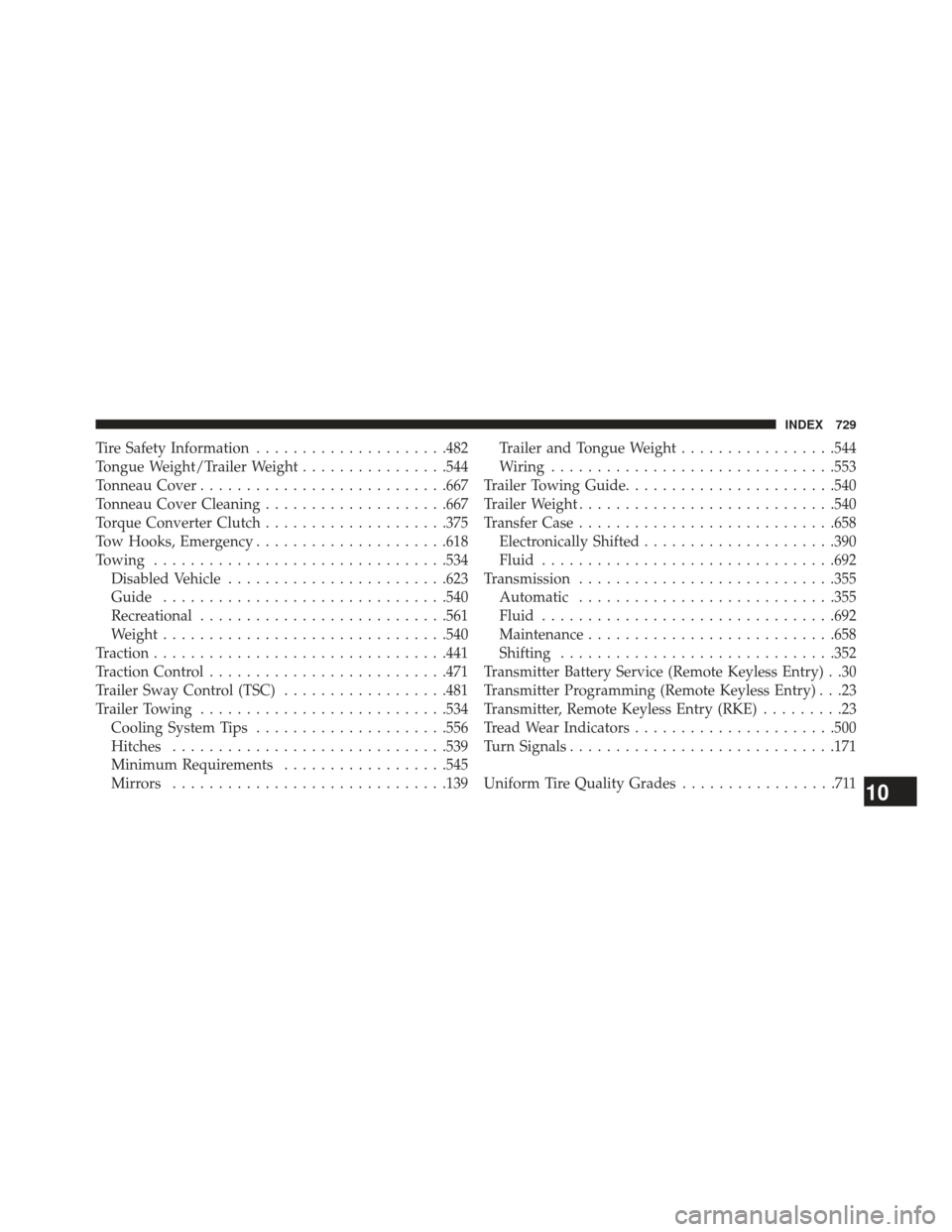
Tire Safety Information.....................482
Tongue Weight/Trailer Weight ................544
Tonneau Cover .......................... .667
Tonneau Cover Cleaning ....................667
Torque Converter Clutch ....................375
Tow Hooks, Emergency .....................618
Towing ............................... .534
Disabled Vehicle ....................... .623
Guide .............................. .540
Recreational .......................... .561
Weight .............................. .540
Traction ............................... .441
Traction Control ......................... .471
Trailer Sway Control (TSC) ..................481
Trailer Towing .......................... .534
Cooling System Tips .....................556
Hitches ............................. .539
Minimum Requirements ..................545
Mirrors ............................. .139Trailer and Tongue Weight
.................544
Wiring .............................. .553
Trailer Towing Guide ...................... .540
Trailer Weight ........................... .540
Transfer Case ........................... .658
Electronically Shifted .....................390
Fluid ............................... .692
Transmission ........................... .355
Automatic ........................... .355
Fluid ............................... .692
Maintenance .......................... .658
Shifting ............................. .352
Transmitter Battery Service (Remote Keyless Entry) . .30
Transmitter Programming (Remote Keyless Entry) . . .23
Transmitter, Remote Keyless Entry (RKE) .........23
Tread Wear Indicators ..................... .500
Turn Signals ............................ .171
Uniform Tire Quality Grades .................
71110
INDEX 729