key battery Ram 1500 2013 User Guide
[x] Cancel search | Manufacturer: RAM, Model Year: 2013, Model line: 1500, Model: Ram 1500 2013Pages: 734, PDF Size: 5.47 MB
Page 210 of 734
Sunroof Maintenance
Use only a nonabrasive cleaner and a soft cloth to clean
the glass panel.
Ignition Off Operation
For Vehicles Not Equipped With The Electronic Vehicle
Information Center (EVIC)
The power sunroof switch will remain active for 45
seconds after the ignition switch is turned to the LOCK
position. Opening either front door will cancel this
feature.
For Vehicles Equipped With The EVIC
The power sunroof switch will remain active for up to
approximately ten minutes after the ignition switch is
turned to the LOCK position. Opening either front door
will cancel this feature.
ELECTRICAL POWER OUTLETS
The auxiliary 12 Volt (13 Amp) power outlets can provide
power for in-cab accessories designed for use with the
standard “cigar lighter” plug. The 12 Volt power outlets
have a cap attached to the outlet indicating “12V DC”,
together with either a key symbol or a battery symbol.
A key symbol indicates that the key must be in the
ON/RUN or ACC positions for the outlet to provide
power. The battery symbol indicates that the outlet is
connected to the battery, and can provide power at all
times.
NOTE:To ensure proper operation a MOPAR® knob
and element must be used.
208 UNDERSTANDING THE FEATURES OF YOUR VEHICLE
Page 213 of 734
The key symbol indicates that this outlet can supply
power when the key is in the ON/RUN or ACC posi-
tions.All accessories connected to the outlet(s) should be
removed or turned off when the vehicle is not in use to
protect the battery against discharge.
WARNING!
To avoid serious injury or death:
•
Only devices designed for use in this type of outlet
should be inserted into any 12 Volt outlet.
• Do not touch with wet hands.
• Close the lid when not in use and while driving the
vehicle.
• If this outlet is mishandled, it may cause an electric
shock and failure.
Power Outlet — Rear Center Console
3
UNDERSTANDING THE FEATURES OF YOUR VEHICLE 211
Page 235 of 734
CAUTION!
Leaving the lid open for extended periods of time
could cause the vehicle battery to discharge. If the lid
is required to stay open for extended periods of time,
(Continued)
CAUTION!(Continued)
it is recommended that the bin lights be turned off
manually using the on/off switch.
Cargo bins feature two removable drain plugs (to allow
water to drain from bins). To remove plug, pull up on the
edge. To install push plug downward into drain hole.
NOTE: Provisions are provided in the bins for cargo
dividers and shelf supports. These accessories (in addi-
tion to other RamBox® accessories) are available from
MOPAR®.
Locking And Unlocking RamBox®
Press and release the LOCK or UNLOCK button on the
RKE transmitter to lock and unlock all doors, the tailgate
and the RamBox® (if equipped). Refer to “Remote Key-
less Entry” for further details.The RamBox® storage bins
can be locked using the vehicle key. To lock and unlock
RamBox® Light Switch
3
UNDERSTANDING THE FEATURES OF YOUR VEHICLE 233
Page 276 of 734
•Brake Fluid Low
• Service Electronic Braking System
• Engine Temperature Hot
• Battery Voltage Low
• Service Electronic Throttle Control
• Lights On
• Right Turn Signal Light Out
• Left Turn Signal Light Out
• Turn Signal On
• Vehicle Not in Park
• Key in Ignition
• Key in Ignition Lights On
• Remote Start Active Key to Run •
Remote Start Active Push Start Button
• Remote Start Aborted Fuel Low
• Remote Start Aborted Too Cold
• Remote Start Aborted Door Open
• Remote Start Aborted Hood Open
• Remote Start Aborted Trunk Open
• Remote Start Aborted Time Expired
• Remote Start Disabled Start to Reset
• Service Airbag System
• Service Airbag Warning Light
• Driver Seatbelt Unbuckled
• Passenger Seatbelt Unbuckled
• Front Seatbelts Unbuckled
274 UNDERSTANDING YOUR INSTRUMENT PANEL
Page 348 of 734
WARNING!(Continued)
•If the vehicle has a discharged battery, booster
cables may be used to obtain a start from a booster
battery or the battery in another vehicle. This type
of start can be dangerous if done improperly. Refer
to “Jump Starting” in “What To Do In Emergen-
cies” for further information.
If the engine has been flooded, it may start to run, but not
have enough power to continue running when the key
fob is released. If this occurs, continue cranking with the
accelerator pedal pushed all the way to the floor. Release
the accelerator pedal and the key fob once the engine is
running smoothly.
If the engine shows no sign of starting after two 15-
second periods of cranking with the accelerator pedal
held to the floor, the “Normal Starting” procedure should
be repeated.
After Starting
The idle speed is controlled automatically and it will
decrease as the engine warms up.
STOP/START SYSTEM — IF EQUIPPED
The Stop/Start function is developed to save fuel and
reduce emissions. The system will stop the engine auto-
matically during a vehicle stop if the required conditions
are met. Releasing the brake pedal will automatically
re-start the vehicle.
Automatic Mode
The Stop/Start feature is enabled after every normal
customer engine start. It will remain in STOP/START
NOT READY until you drive forward with a vehicle
speed greater than 5 mph (8 km/h). At that time, the
system will go into STOP/START READY and if all other
conditions are met, can go into an STOP/START AUTO
STOP ACTIVE “Autostop” mode.
346 STARTING AND OPERATING
Page 627 of 734
If you must use the accessories (wipers, defrosters, etc.)
while being towed, the ignition must be in the ON/RUN
position, not the ACC position.
If the key fob is unavailable or the vehicle’s battery is
discharged, see ”Manual Park Release” or “Shift Lever
Override” in “What To Do In Emergencies” for instruc-
tions on shifting the automatic transmission out of PARK
for towing.
CAUTION!
Do not use sling type equipment when towing.
When securing the vehicle to a flat bed truck, do not
attach to front or rear suspension components. Dam-
age to your vehicle may result from improper towing.
Two-Wheel Drive Models
The manufacturer recommends towing your vehicle with
all four wheelsOFFthe ground using a flatbed. If flatbed equipment is not available, and the transmis-
sion is operable, the vehicle may be towed (with rear
wheels on the ground) under the following conditions:
•
The transmission must be in NEUTRAL.
• The towing speed must not exceed 30 mph (48 km/h).
• The towing distance must not exceed 15 miles (24 km)
for 6-speed transmission, or 30 miles (48 km) for
8-speed transmission.
If the transmission is not operable, or the vehicle must be
towed faster than 30 mph (48 km/h) or farther than 15
miles (24 km), for 6-speed transmission, or 30 miles
(48 km) for 8-speed transmission, tow with the rear
wheels OFFthe ground. Acceptable methods are to tow
the vehicle on a flatbed, or with the front wheels raised
and the rear wheels on a towing dolly, or (when using a
suitable steering wheel stabilizer to hold the front wheels
6
WHAT TO DO IN EMERGENCIES 625
Page 636 of 734
“Understanding Your Instrument Panel” for further in-
formation. Tighten the fuel filler cap properly and press
the SELECT button to turn off the message. If the
problem continues, the message will appear the next time
the vehicle is started.
A loose, improperly installed, or damaged fuel filler cap
may also turn on the Malfunction Indicator Light (MIL).
EMISSIONS INSPECTION AND MAINTENANCE
PROGRAMS
In some localities, it may be a legal requirement to pass
an inspection of your vehicle’s emissions control system.
Failure to pass could prevent vehicle registration.For states that require an Inspection and Mainte-
nance (I/M), this check verifies the “Malfunction
Indicator Light (MIL)” is functioning and is not
on when the engine is running, and that the OBD II
system is ready for testing. Normally, the OBD II system will be ready. The OBD II
system may
notbe ready if your vehicle was recently
serviced, recently had a dead battery or a battery replace-
ment. If the OBD II system should be determined not
ready for the I/M test, your vehicle may fail the test.
Your vehicle has a simple ignition key-actuated test,
which you can use prior to going to the test station. To
check if your vehicle’s OBD II system is ready, you must
do the following:
1. Turn the ignition switch to the ON position, but do not crank or start the engine.
2. If you crank or start the engine, you will have to start this test over.
3. As soon as you turn the ignition switch to the ON position, you will see the MIL symbol come on as part
of a normal bulb check.
634 MAINTAINING YOUR VEHICLE
Page 675 of 734
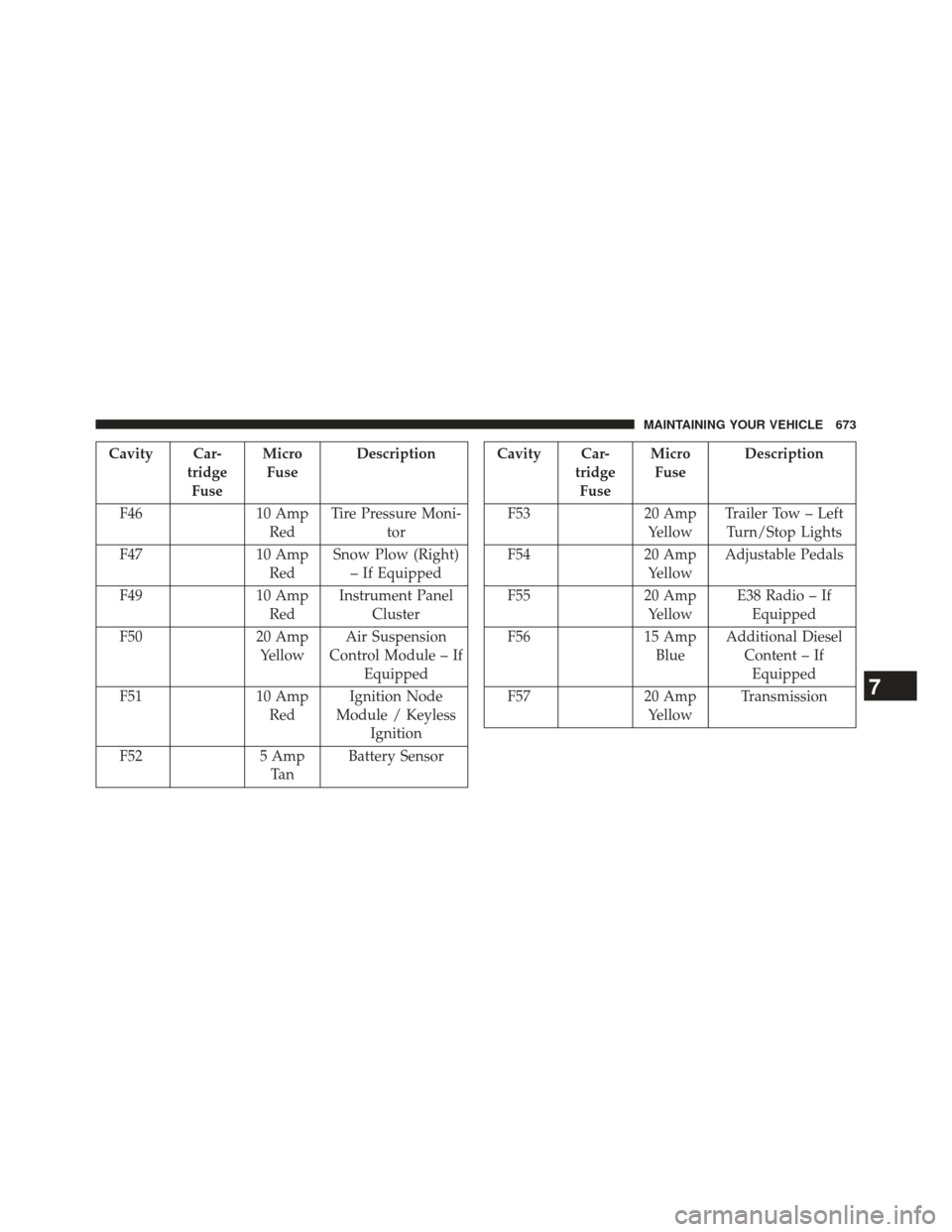
Cavity Car-tridgeFuse Micro
Fuse Description
F46 10 Amp
Red Tire Pressure Moni-
tor
F47 10 Amp
Red Snow Plow (Right)
– If Equipped
F49 10 Amp
Red Instrument Panel
Cluster
F50 20 Amp
Yellow Air Suspension
Control Module – If Equipped
F51 10 Amp
Red Ignition Node
Module / Keyless Ignition
F52 5 Amp
Ta n Battery SensorCavity Car-
tridgeFuse Micro
Fuse Description
F53 20 Amp
Yellow Trailer Tow – Left
Turn/Stop Lights
F54 20 Amp
Yellow Adjustable Pedals
F55 20 Amp
Yellow E38 Radio – If
Equipped
F56 15 Amp
Blue Additional Diesel
Content – IfEquipped
F57 20 Amp
Yellow Transmission
7
MAINTAINING YOUR VEHICLE 673
Page 717 of 734
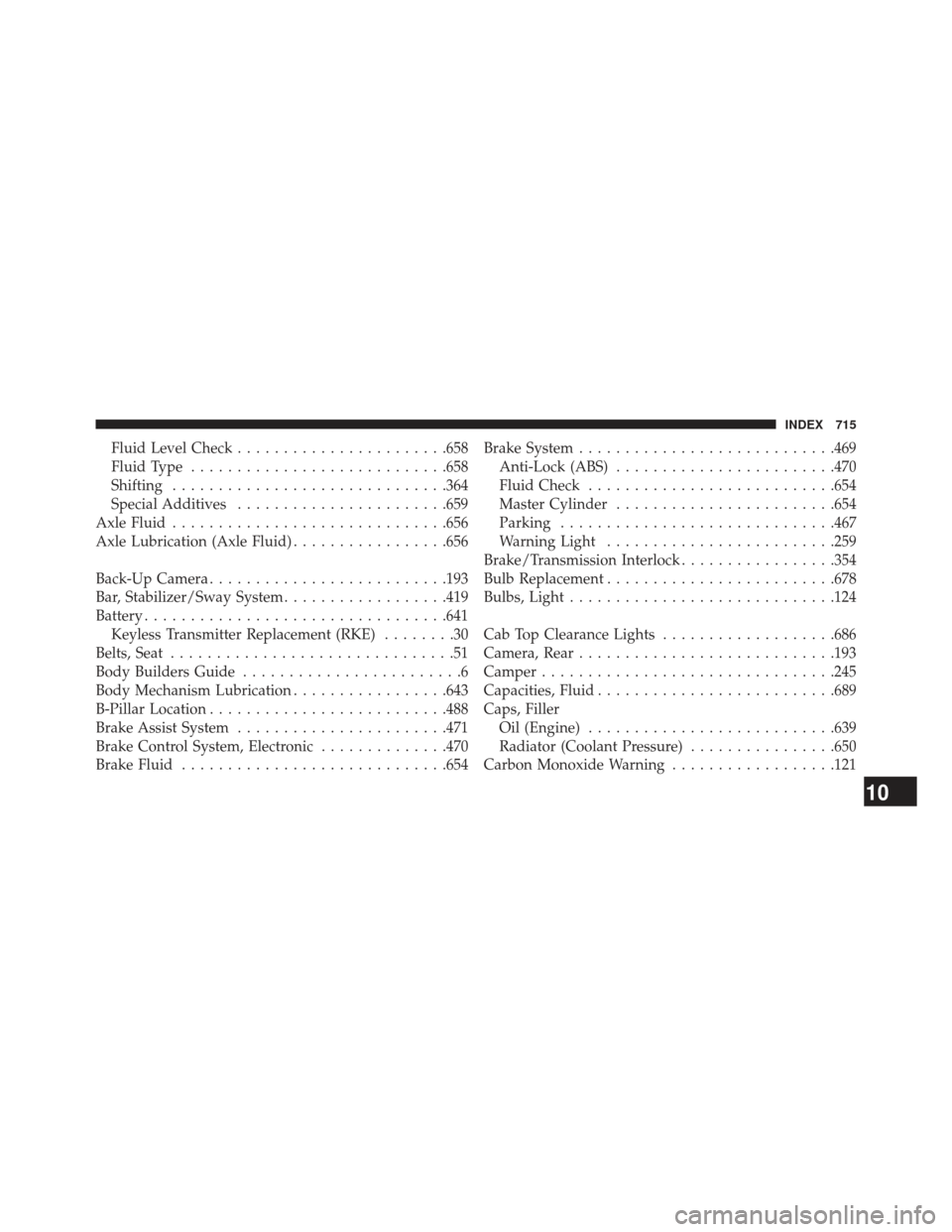
Fluid Level Check...................... .658
Fluid Type ........................... .658
Shifting ............................. .364
Special Additives ...................... .659
Axle Fluid ............................. .656
Axle Lubrication (Axle Fluid) .................656
Back-Up Camera ......................... .193
Bar, Stabilizer/Sway System ..................419
Battery ................................ .641
Keyless Transmitter Replacement (RKE) ........30
Belts, Seat ...............................51
Body Builders Guide ........................6
Body Mechanism Lubrication .................643
B-Pillar Location ......................... .488
Brake Assist System ...................... .471
Brake Control System, Electronic ..............470
Brake Fluid ............................ .654Brake System
........................... .469
Anti-Lock (ABS) ....................... .470
Fluid Check .......................... .654
Master Cylinder ....................... .654
Parking ............................. .467
Warning Light ........................ .259
Brake/Transmission Interlock .................354
Bulb Replacement ........................ .678
Bulbs, Light ............................ .124
Cab Top Clearance Lights ...................686
Camera, Rear ........................... .193
Camper ............................... .245
Capacities, Fluid ......................... .689
Caps, Filler Oil (Engine) .......................... .639
Radiator (Coolant Pressure) ................650
Carbon Monoxide Warning ..................121
10
INDEX 715
Page 731 of 734
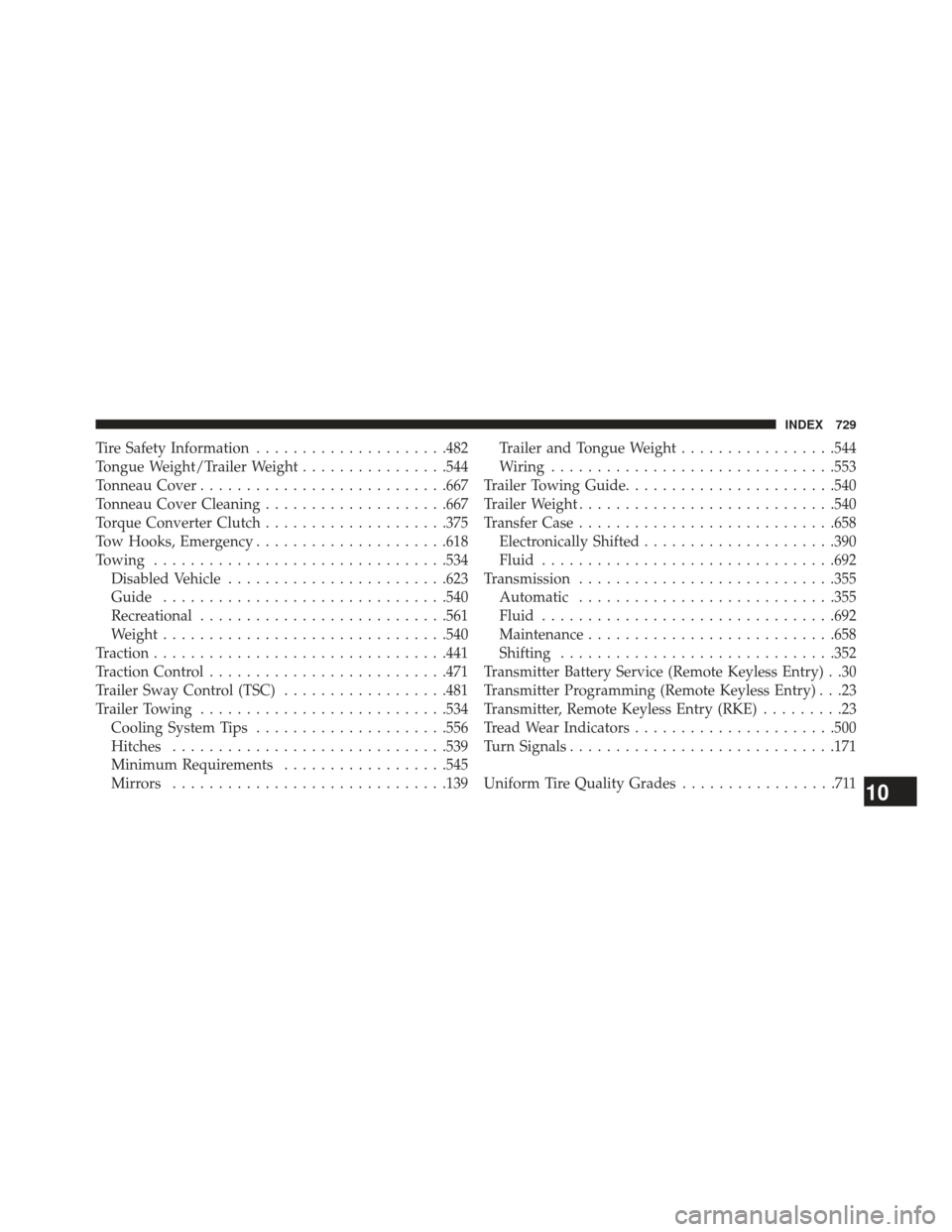
Tire Safety Information.....................482
Tongue Weight/Trailer Weight ................544
Tonneau Cover .......................... .667
Tonneau Cover Cleaning ....................667
Torque Converter Clutch ....................375
Tow Hooks, Emergency .....................618
Towing ............................... .534
Disabled Vehicle ....................... .623
Guide .............................. .540
Recreational .......................... .561
Weight .............................. .540
Traction ............................... .441
Traction Control ......................... .471
Trailer Sway Control (TSC) ..................481
Trailer Towing .......................... .534
Cooling System Tips .....................556
Hitches ............................. .539
Minimum Requirements ..................545
Mirrors ............................. .139Trailer and Tongue Weight
.................544
Wiring .............................. .553
Trailer Towing Guide ...................... .540
Trailer Weight ........................... .540
Transfer Case ........................... .658
Electronically Shifted .....................390
Fluid ............................... .692
Transmission ........................... .355
Automatic ........................... .355
Fluid ............................... .692
Maintenance .......................... .658
Shifting ............................. .352
Transmitter Battery Service (Remote Keyless Entry) . .30
Transmitter Programming (Remote Keyless Entry) . . .23
Transmitter, Remote Keyless Entry (RKE) .........23
Tread Wear Indicators ..................... .500
Turn Signals ............................ .171
Uniform Tire Quality Grades .................
71110
INDEX 729