manual evic Ram 1500 2013 User Guide
[x] Cancel search | Manufacturer: RAM, Model Year: 2013, Model line: 1500, Model: Ram 1500 2013Pages: 734, PDF Size: 5.47 MB
Page 553 of 734
Adjusting GAIN
NOTE:This should only be performed in a traffic free
environment at speeds of approximately 20–25 mph
(30–40 km/h).
1. Make sure the trailer brakes are in good working condition, functioning normally, and properly ad-
justed. See your trailer dealer if necessary.
2. Hook up the trailer and make the electrical connec- tions according to the trailer manufacturer’s instruc-
tions.
3. When a trailer with electric/EOH brakes is plugged in, the trailer connected message should appear in the
EVIC (if the connection is not recognized by the ITBM,
braking functions will not be available), the GAIN
setting will illuminate and the correct type of trailer
must be selected from the EVIC options. 4. Press the UP or DOWN button on the steering wheel
until “VEHICLE SETTINGS” appears on the screen.
5. Press the RIGHT arrow on the steering wheel to enter “VEHICLE SETTINGS”.
6. Press the UP or DOWN buttons until Trailer Brake Type appears on the screen.
NOTE:1500 Models Only– Light Electric and Heavy
Electric will only be available due to the tow capacities of
the vehicle.
7. Press the RIGHT arrow and then press the UP or DOWN buttons until the proper Trailer Brake Type
appears on the screen.
8. In a traffic-free environment, tow the trailer on a dry, level surface at a speed of 20–25 mph (30–40 km/h)
and squeeze the manual brake control lever com-
pletely.
5
STARTING AND OPERATING 551
Page 564 of 734
NOTE:Vehicles equipped with air suspension must be
lowered to the “Entry/Exit” (lowest) level, and have
automatic leveling disabled, before tying them down
(from the body) on a trailer or flatbed truck. Refer to “Air
Suspension – If Equipped” for more information. If the
vehicle cannot be lowered to the “Entry/Exit” level (for
example, engine will not run), tie-downs must be fas-
tened to the axles (not to the body). Failure to follow
these instructions may cause fault codes to be set and/or
cause loss of proper tie-down tension.
Recreational Towing – Two-Wheel Drive Models
DO NOT flat tow this vehicle. Damage to the drivetrain
will result.
Recreational towing (for two-wheel drive models) is
allowed ONLYif the rear wheels are OFFthe ground.
This may be accomplished using a tow dolly or vehicle
trailer. If using a tow dolly, follow this procedure: 1. Properly secure the dolly to the tow vehicle, following
the dolly manufacturer’s instructions.
2. Drive the rear wheels onto the tow dolly.
3. Firmly apply the parking brake. Place automatic trans- mission in PARK, manual transmission in gear (not in
NEUTRAL).
4. Properly secure the rear wheels to the dolly, following the dolly manufacturer’s instructions.
5. Remove the key fob from the ignition switch.
6. Install a suitable clamping device, designed for tow- ing, to secure the front wheels in the straight position.
562 STARTING AND OPERATING
Page 626 of 734
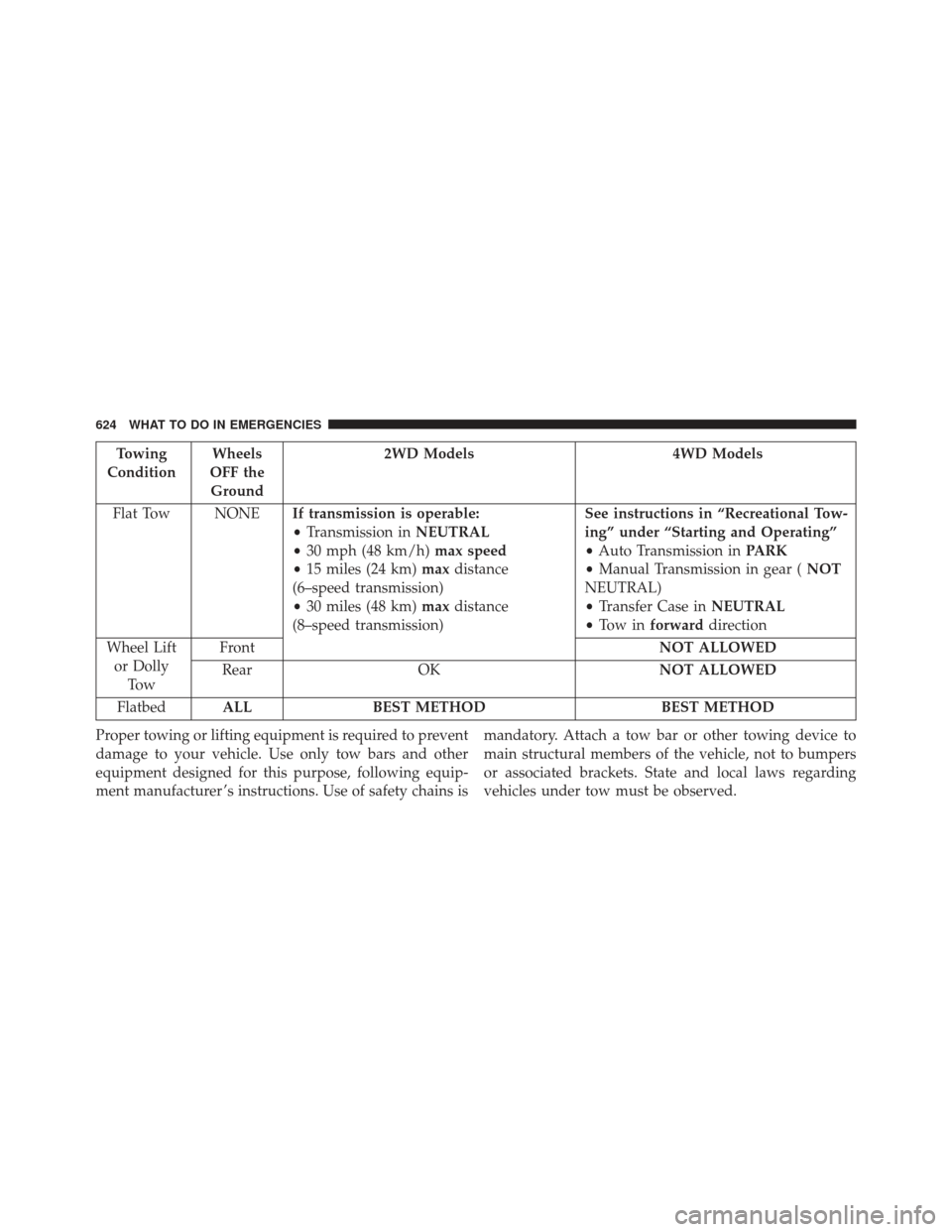
Towing
Condition Wheels
OFF the Ground 2WD Models 4WD Models
Flat Tow NONE If transmission is operable:
•Transmission in NEUTRAL
• 30 mph (48 km/h) max speed
• 15 miles (24 km) maxdistance
(6–speed transmission)
• 30 miles (48 km) maxdistance
(8–speed transmission) See instructions in “Recreational Tow-
ing” under “Starting and Operating”
•
Auto Transmission in PARK
• Manual Transmission in gear ( NOT
NEUTRAL)
• Transfer Case in NEUTRAL
• To w i n forward direction
Wheel Lift or Dolly To w Front
NOT ALLOWED
Rear OK NOT ALLOWED
Flatbed ALL BEST METHOD BEST METHOD
Proper towing or lifting equipment is required to prevent
damage to your vehicle. Use only tow bars and other
equipment designed for this purpose, following equip-
ment manufacturer ’s instructions. Use of safety chains is mandatory. Attach a tow bar or other towing device to
main structural members of the vehicle, not to bumpers
or associated brackets. State and local laws regarding
vehicles under tow must be observed.
624 WHAT TO DO IN EMERGENCIES