radiator Ram 1500 2013 User Guide
[x] Cancel search | Manufacturer: RAM, Model Year: 2013, Model line: 1500, Model: Ram 1500 2013Pages: 734, PDF Size: 5.47 MB
Page 650 of 734
Engine Coolant Checks
Check the engine coolant (antifreeze) protection every 12
months (before the onset of freezing weather, where
applicable). If the engine coolant (antifreeze) is dirty or
rusty in appearance, the system should be drained,
flushed and refilled with fresh coolant. Check the front of
the A/C condenser (if equipped) or radiator for any
accumulation of bugs, leaves, etc. If dirty, clean by gently
spraying water from a garden hose vertically down the
face of the A/C condenser (if equipped) or the back of the
radiator core.
Check the engine cooling system hoses for brittle rubber,
cracking , tears, cuts and tightness of the connection at
the coolant recovery bottle and radiator. Inspect the
entire system for leaks.
With the engine at normal operating temperature (but
not running), check the cooling system pressure cap for
proper vacuum sealing by draining a small amount of
engine coolant (antifreeze) from the radiator drain cock.The radiator drain cock is located in the lower radiator
tank. If the cap is sealing properly, the engine coolant
(antifreeze) will begin to drain from the coolant expan-
sion bottle. DO NOT REMOVE THE COOLANT PRES-
SURE CAP WHEN THE COOLING SYSTEM IS HOT.
Cooling System – Drain, Flush, And Refill
If the engine coolant (antifreeze) is dirty or contains a
considerable amount of sediment, clean and flush with a
reliable cooling system cleaner. Follow with a thorough
rinsing to remove all deposits and chemicals. Properly
dispose of old engine coolant (antifreeze).
Refer to the “Maintenance Schedule” for the proper
maintenance intervals.
Selection Of Coolant
Refer to “Fluids, Lubricants, and Genuine Parts” in
“Maintaining Your Vehicle” for further information.
648 MAINTAINING YOUR VEHICLE
Page 651 of 734
CAUTION!
•Mixing of engine coolant (antifreeze) other than
specified Organic Additive Technology (OAT) en-
gine coolant (antifreeze), may result in engine
damage and may decrease corrosion protection.
Organic Additive Technology (OAT) engine cool-
ant is different and should not be mixed with
Hybrid Organic Additive Technology (HOAT) en-
gine coolant (antifreeze) or any “globally compat-
ible” coolant (antifreeze). If a non-OAT engine
coolant (antifreeze) is introduced into the cooling
system in an emergency, it should be flushed with
OAT coolant and replaced with the specified OAT
engine coolant (antifreeze) as soon as possible.
(Continued)
CAUTION! (Continued)
•Do not use water alone or alcohol-based engine
coolant (antifreeze) products. Do not use additional
rust inhibitors or antirust products, as they may not
be compatible with the radiator engine coolant and
may plug the radiator.
• This vehicle has not been designed for use with
propylene glycol-based engine coolant (antifreeze).
Use of propylene glycol-based engine coolant (an-
tifreeze) is not recommended.
Adding Coolant
Your vehicle has been built with an improved engine
coolant (OAT coolant conforming to MS-12106) that
allows extended maintenance intervals. This engine cool-
ant (antifreeze) can be used up to ten years or 150,000
miles (240,000 km) before replacement. To prevent reduc-
ing this extended maintenance period, it is important that7
MAINTAINING YOUR VEHICLE 649
Page 652 of 734
you use the same engine coolant (OAT coolant conform-
ing to MS-12106) throughout the life of your vehicle.
Please review these recommendations for using Organic
Additive Technology (OAT) engine coolant (antifreeze)
that meets the requirements of Chrysler Material Stan-
dard MS-12106. When adding engine coolant (antifreeze):
•We recommend using MOPAR® Antifreeze/Coolant
10 Year/150,000 Mile Formula OAT (Organic Additive
Technology) that meets the requirements of Chrysler
Material Standard MS-12106.
• Mix a minimum solution of 50% OAT engine coolant
that meets the requirements of Chrysler Material Stan-
dard MS-12106 and distilled water. Use higher concen-
trations (not to exceed 70%) if temperatures below
34° F (37° C) are anticipated.
• Use only high purity water such as distilled or deion-
ized water when mixing the water/engine coolant (antifreeze) solution. The use of lower quality water
will reduce the amount of corrosion protection in the
engine cooling system.
Please note that it is the owner’s responsibility to main-
tain the proper level of protection against freezing ac-
cording to the temperatures occurring in the area where
the vehicle is operated.
NOTE: Mixing engine coolant (antifreeze) types is not
recommended and can result in cooling system damage.
Drain, flush, and refill as soon as possible to avoid
damage if coolant types are mixed in an emergency.
Cooling System Pressure Cap
The cap must be fully tightened to prevent loss of engine
coolant (antifreeze), and to ensure that the engine coolant
(antifreeze) will return to the radiator from the coolant
expansion bottle.
650 MAINTAINING YOUR VEHICLE
Page 654 of 734
To check the coolant level:
1. Open the coolant reservoir.
2. Lift and remove the plastic dipstick from the reservoirneck. 3. Check the coolant level on the dipstick.
The radiator normally remains completely full, so there is
no need to remove the radiator cap unless checking for
engine coolant (antifreeze) freeze point or replacing en-
gine coolant (antifreeze). Advise your service attendant
652 MAINTAINING YOUR VEHICLE
Page 655 of 734
of this. As long as the engine operating temperature is
satisfactory, the coolant bottle need only be checked once
a month.
When additional engine coolant (antifreeze) is needed to
maintain the proper level, it should be added to the
coolant bottle. Do not overfill.
Points To Remember
NOTE:When the vehicle is stopped after a few miles/
kilometers of operation, you may observe vapor coming
from the front of the engine compartment. This is nor-
mally a result of moisture from rain, snow, or high
humidity accumulating on the radiator and being vapor-
ized when the thermostat opens, allowing hot engine
coolant (antifreeze) to enter the radiator.
If an examination of your engine compartment shows no
evidence of radiator or hose leaks, the vehicle may be
safely driven. The vapor will soon dissipate. •
Do not overfill the coolant expansion bottle.
• Check the coolant freeze point in the radiator and in
the coolant expansion bottle. If engine coolant (anti-
freeze) needs to be added, the contents of the coolant
expansion bottle must also be protected against
freezing.
• If frequent engine coolant (antifreeze) additions are
required, the cooling system should be pressure tested
for leaks.
• Maintain engine coolant (antifreeze) concentration at a
minimum of 50% OAT coolant (conforming to MS-
12106) and distilled water for proper corrosion protec-
tion of your engine which contains aluminum
components.
• Make sure that the coolant expansion bottle overflow
hoses are not kinked or obstructed.
7
MAINTAINING YOUR VEHICLE 653
Page 656 of 734
•Keep the front of the radiator clean. If your vehicle is
equipped with air conditioning, keep the front of the
condenser clean.
• Do not change the thermostat for Summer or Winter
operation. If replacement is ever necessary, install
ONLY the correct type thermostat. Other designs may
result in unsatisfactory engine coolant (antifreeze)
performance, poor gas mileage, and increased
emissions.
Brake System
In order to assure brake system performance, all brake
system components should be inspected periodically.
Refer to the “Maintenance Schedule” for the proper
maintenance intervals.
WARNING!
Riding the brakes can lead to brake failure and
possibly a collision. Driving with your foot resting or
riding on the brake pedal can result in abnormally
high brake temperatures, excessive lining wear, and
possible brake damage. You would not have your full
braking capacity in an emergency.
Brake Fluid Level Check
The fluid level of the master cylinder should be checked
when performing under the hood service or immediately
if the brake system warning lamp indicates system
failure.
654 MAINTAINING YOUR VEHICLE
Page 682 of 734
Bulb Number
Side Marker Lamps
(Dual Rear Wheels) 194
Backup Lamp 921
Rear License Plate Lamp 194
BULB REPLACEMENT
Base Quad / Premium Bi-Halogen: Low Beam
Headlamp, High Beam Headlamp, Front Park And
Turn – If Equipped
1. Open the hood.
2. Disconnect and isolate the negative battery cable.
3. Remove the four plastic push-in fasteners that secure
the upper radiator seal to the grille support and both
fender ledges. 4. Remove the two plastic push-in rivets that secure the
upper radiator seal to the radiator.
5. Remove the upper radiator seal from the vehicle.
6.
Remove the two headlamp assembly attachment screws.
680 MAINTAINING YOUR VEHICLE
Page 717 of 734
Fluid Level Check...................... .658
Fluid Type ........................... .658
Shifting ............................. .364
Special Additives ...................... .659
Axle Fluid ............................. .656
Axle Lubrication (Axle Fluid) .................656
Back-Up Camera ......................... .193
Bar, Stabilizer/Sway System ..................419
Battery ................................ .641
Keyless Transmitter Replacement (RKE) ........30
Belts, Seat ...............................51
Body Builders Guide ........................6
Body Mechanism Lubrication .................643
B-Pillar Location ......................... .488
Brake Assist System ...................... .471
Brake Control System, Electronic ..............470
Brake Fluid ............................ .654Brake System
........................... .469
Anti-Lock (ABS) ....................... .470
Fluid Check .......................... .654
Master Cylinder ....................... .654
Parking ............................. .467
Warning Light ........................ .259
Brake/Transmission Interlock .................354
Bulb Replacement ........................ .678
Bulbs, Light ............................ .124
Cab Top Clearance Lights ...................686
Camera, Rear ........................... .193
Camper ............................... .245
Capacities, Fluid ......................... .689
Caps, Filler Oil (Engine) .......................... .639
Radiator (Coolant Pressure) ................650
Carbon Monoxide Warning ..................121
10
INDEX 715
Page 718 of 734
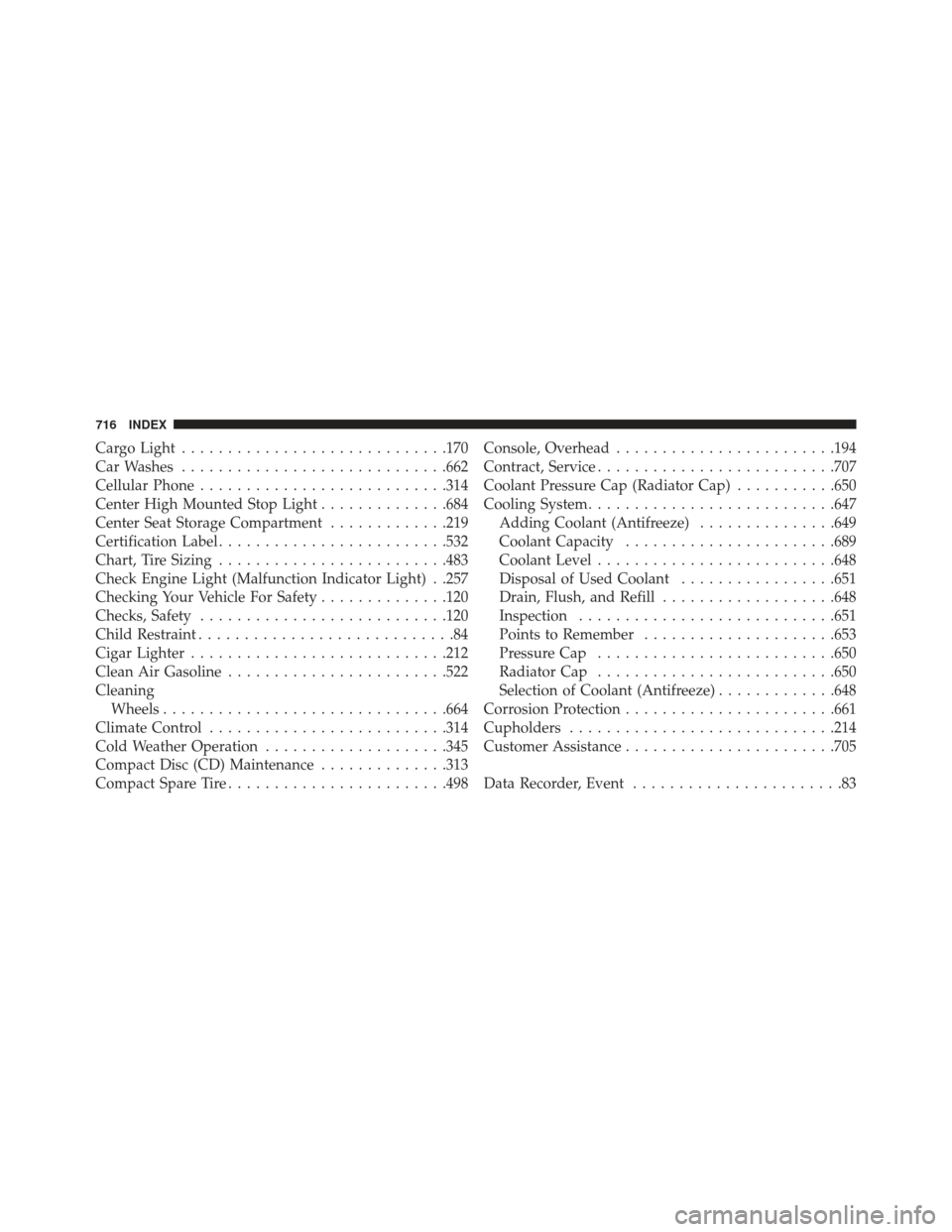
Cargo Light............................ .170
Car Washes ............................ .662
Cellular Phone .......................... .314
Center High Mounted Stop Light ..............684
Center Seat Storage Compartment .............219
Certification Label ........................ .532
Chart, Tire Sizing ........................ .483
Check Engine Light (Malfunction Indicator Light) . .257
Checking Your Vehicle For Safety ..............120
Checks, Safety .......................... .120
Child Restraint ............................84
Cigar Lighter ........................... .212
Clean Air Gasoline ....................... .522
Cleaning Wheels .............................. .664
Climate Control ......................... .314
Cold Weather Operation ....................345
Compact Disc (CD) Maintenance ..............313
Compact Spare Tire ....................... .498Console, Overhead
....................... .194
Contract, Service ......................... .707
Coolant Pressure Cap (Radiator Cap) ...........650
Cooling System .......................... .647
Adding Coolant (Antifreeze) ...............649
Coolant Capacity ...................... .689
Coolant Level ......................... .648
Disposal of Used Coolant .................651
Drain, Flush, and Refill ...................648
Inspection ........................... .651
Points to Remember .....................653
Pressure Cap ......................... .650
Radiator Cap ......................... .650
Selection of Coolant (Antifreeze) .............648
Corrosion Protection ...................... .661
Cupholders ............................ .214
Customer Assistance ...................... .705
Data
Recorder, Event .......................83
716 INDEX
Page 727 of 734
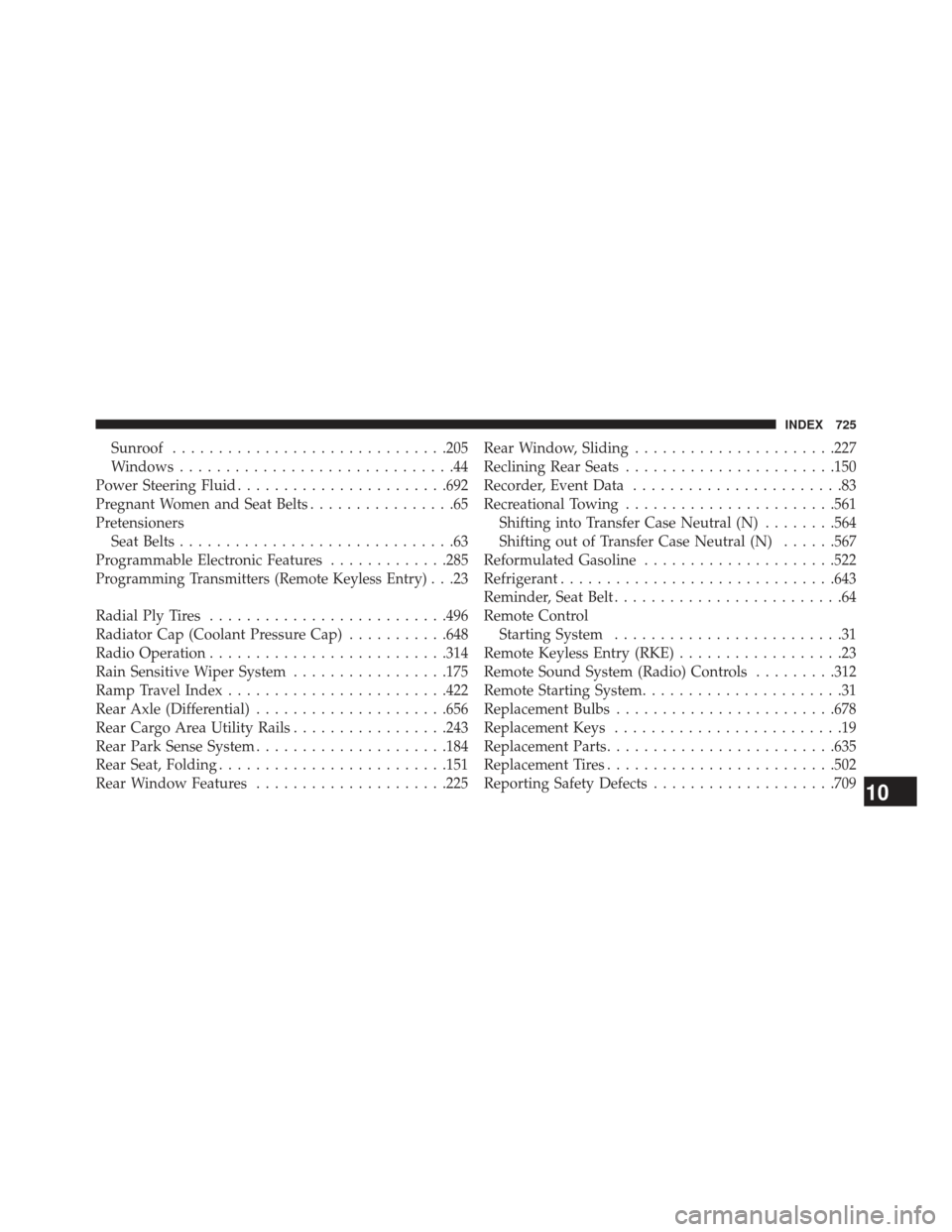
Sunroof............................. .205
Windows ..............................44
Power Steering Fluid ...................... .692
Pregnant Women and Seat Belts ................65
Pretensioners Seat Belts ..............................63
Programmable Electronic Features .............285
Programming Transmitters (Remote Keyless Entry). . .23
Radial Ply Tires ......................... .496
Radiator Cap (Coolant Pressure Cap) ...........648
Radio Operation ......................... .314
Rain Sensitive Wiper System .................175
Ramp Travel Index ....................... .422
Rear Axle (Differential) .....................656
Rear Cargo Area Utility Rails .................243
Rear Park Sense System .....................184
Rear Seat, Folding ........................ .151
Rear Window Features .....................225 Rear Window, Sliding
..................... .227
Reclining Rear Seats ...................... .150
Recorder, Event Data .......................83
Recreational Towing ...................... .561
Shifting into Transfer Case Neutral (N) ........564
Shifting out of Transfer Case Neutral (N) ......567
Reformulated Gasoline .....................522
Refrigerant ............................. .643
Reminder, Seat Belt .........................64
Remote Control Starting System .........................31
Remote Keyless Entry (RKE) ..................23
Remote Sound System (Radio) Controls .........312
Remote Starting System ......................31
Replacement Bulbs ....................... .678
Replacement Keys .........................19
Replacement Parts ........................ .635
Replacement Tires ........................ .502
Reporting Safety Defects ....................709
10
INDEX 725