tire type Ram 1500 2013 User Guide
[x] Cancel search | Manufacturer: RAM, Model Year: 2013, Model line: 1500, Model: Ram 1500 2013Pages: 734, PDF Size: 5.47 MB
Page 497 of 734
once a month. Use a good quality pocket-type gauge to
check tire pressure. Do not make a visual judgement
when determining proper inflation. Radial tires may look
properly inflated even when they are under-inflated.
CAUTION!
After inspecting or adjusting the tire pressure, al-
ways reinstall the valve stem cap. This will prevent
moisture and dirt from entering the valve stem,
which could damage the valve stem.
Inflation pressures specified on the placard are always
“cold tire inflation pressure.” Cold tire inflation pressure
is defined as the tire pressure after the vehicle has not
been driven for at least three hours or driven less than 1
mile (1.6 km) after a three hour period. The cold tire
inflation pressure must not exceed the maximum infla-
tion pressure molded into the tire sidewall. Check tire pressures more often if subject to a wide range
of outdoor temperatures as tire pressures vary with
temperature changes.
Tire pressures change by approximately 1 psi (7 kPa) per
12°F (7°C) of air temperature change. Keep this in mind
when checking tire pressure inside a garage, especially in
the Winter.
Example: If garage temperature = 68°F (20°C) and the
outside temperature = 32°F (0°C) then the cold tire
inflation pressure should be increased by 3 psi (21 kPa),
which equals 1 psi (7 kPa) for every 12°F (7°C) for this
outside temperature condition.
Tire pressure may increase from 2 to 6 psi (13 to 40 kPa)
during operation. Do not reduce this normal pressure
build up or your tire pressure will be too low.
5
STARTING AND OPERATING 495
Page 498 of 734
Tire Pressures For High Speed Operation
The manufacturer advocates driving at safe speeds and
within posted speed limits. Where speed limits or condi-
tions are such that the vehicle can be driven at high
speeds, maintaining correct tire inflation pressure is very
important. Increased tire pressure and reduced vehicle
loading may be required for high-speed vehicle opera-
tion. Refer to your authorized tire or original equipment
vehicle dealer for recommended safe operating speeds,
loading and cold tire inflation pressures.
WARNING!
High speed driving with your vehicle under maxi-
mum load is dangerous. The added strain on your
tires could cause them to fail. You could have a
serious collision. Do not drive a vehicle loaded to the
maximum capacity at continuous speeds above
75 mph (120 km/h).
Radial Ply Tires
WARNING!
Combining radial ply tires with other types of tires
on your vehicle will cause your vehicle to handle
poorly. The instability could cause a collision. Al-
ways use radial ply tires in sets of four (or six, in the
case of trucks with dual rear wheels). Never combine
them with other types of tires.
Cuts and punctures in radial tires are repairable only in
the tread area because of sidewall flexing. Consult your
authorized tire dealer for radial tire repairs.
All Season Tires – If Equipped
All Season tires provide traction for all seasons (spring,
summer, fall and winter). Traction levels may vary be-
tween different all season tires. All season tires can be
identified by the M+S, M&S, M/S or MS designation on
496 STARTING AND OPERATING
Page 499 of 734
the tire sidewall. Use all season tires only in sets of four;
failure to do so may adversely affect the safety and
handling of your vehicle.
Summer Or Three Season Tires – If Equipped
Summer tires provide traction in both wet and dry
conditions, and are not intended to be driven in snow or
on ice. Summer tires will not contain the all season
designation or mountain/snowflake symbol on the tire
sidewall. Use summer tires only in sets of four; failure to
do so may adversely affect the safety and handling of
your vehicle.
Snow Tires
Some areas of the country require the use of snow tires
during the winter. Snow tires can be identified by a
mountain/snowflake symbol on the tire sidewall.If you need snow tires, select tires equivalent in size and
type to the original equipment tires. Use snow tires only
in sets of four; failure to do so may adversely affect the
safety and handling of your vehicle.
Snow tires generally have lower speed ratings than what
was originally equipped with your vehicle and should
not be operated at sustained speeds over 75 mph
(120 km/h). For speeds above 75 mph (120 km/h) refer to
original equipment or an authorized tire dealer for
recommended safe operating speeds, loading and cold
tire inflation pressures.
While studded tires improve performance on ice, skid
and traction capability on wet or dry surfaces may be
poorer than that of non-studded tires. Some states pro-
hibit studded tires; therefore, local laws should be
checked before using these tire types.
5
STARTING AND OPERATING 497
Page 506 of 734
TIRE CHAINS
NOTE:Chains must be the proper size for the vehicle as
recommended by the chain manufacturer.
CAUTION!
To avoid damage to your vehicle or tires, observe the
following precautions:
• Because of restricted traction device clearance be-
tween tires and other suspension components, it is
important that only traction devices in good condi-
tion are used. Broken devices can cause serious
damage. Stop the vehicle immediately if noise
occurs that could indicate device breakage. Remove
the damaged parts of the device before further use.
• Install device as tightly as possible and then re-
tighten after driving about ½ mile (0.8 km).
• Do not exceed 30 mph (48 km/h).
(Continued)
CAUTION! (Continued)
•Drive cautiously and avoid severe turns and large
bumps, especially with a loaded vehicle.
• Do not drive for prolonged period on dry pave-
ment.
• Observe the traction device manufacturer ’s instruc-
tions on the method of installation, operating
speed, and conditions for use. Always use the
suggested operating speed of the device manufac-
turer ’s if it is less than 30 mph (48 km/h).
• Do not use traction devices on a compact spare tire.
WARNING!
Using tires of different size and type (M+S, Snow)
between front and rear axles can cause unpredictable
handling. You could lose control and have a collision.
504 STARTING AND OPERATING
Page 508 of 734
TIRE ROTATION RECOMMENDATIONS
Tires on the front and rear axles of vehicles operate at
different loads and perform different steering, driving,
and braking functions. For these reasons, they wear at
unequal rates.
These effects can be reduced by timely rotation of tires.
The benefits of rotation are especially worthwhile with
aggressive tread designs such as those on all season type
tires. Rotation will increase tread life, help to maintain
mud, snow and wet traction levels and contribute to a
smooth, quiet ride.
Refer to the “Maintenance Schedule” for the proper
maintenance intervals. More frequent rotation is permis-
sible if desired. The reasons for any rapid or unusual
wear should be corrected prior to rotation being per-
formed.The suggested rotation method is the “forward cross”
shown in the following diagram. This rotation pattern
does not apply to some directional tires that must not be
reversed.
Tire Rotation
506 STARTING AND OPERATING
Page 512 of 734
CAUTION!
•The TPMS has been optimized for the original
equipment tires and wheels. TPMS pressures and
warning have been established for the tire size
equipped on your vehicle. Undesirable system op-
eration or sensor damage may result when using
replacement equipment that is not of the same size,
type, and/or style. Aftermarket wheels can cause
sensor damage. Do not use aftermarket tire sealants
or balance beads if your vehicle is equipped with a
TPMS, as damage to the sensors may result.
• After inspecting or adjusting the tire pressure,
always reinstall the valve stem cap. This will
prevent moisture and dirt from entering the valve
stem, which could damage the TPM sensor. NOTE:
•
The TPMS is not intended to replace normal tire care
and maintenance or to provide warning of a tire failure
or condition.
• The TPMS should not be used as a tire pressure gauge
while adjusting your tire pressure.
• Driving on a significantly under-inflated tire causes
the tire to overheat and can lead to tire failure.
Under-inflation also reduces fuel efficiency and tire
tread life, and may affect the vehicle’s handling and
stopping ability.
• The TPMS is not a substitute for proper tire mainte-
nance, and it is the driver ’s responsibility to maintain
correct tire pressure using an accurate tire pressure
gauge, even if under-inflation has not reached the level
to trigger illumination of the “Tire Pressure Monitor-
ing Telltale Light.”
510 STARTING AND OPERATING
Page 554 of 734
9. If the trailer wheels lockup (indicated by squealingtires), reduce the GAIN setting; if the trailer wheels
turn freely, increase the GAIN setting.
Repeat Steps 8 and 9 until the GAIN setting is at a point
just below trailer wheel lockup. If towing a heavier trailer, trailer wheel lockup may not be attainable even
with the maximum GAIN setting of 10.
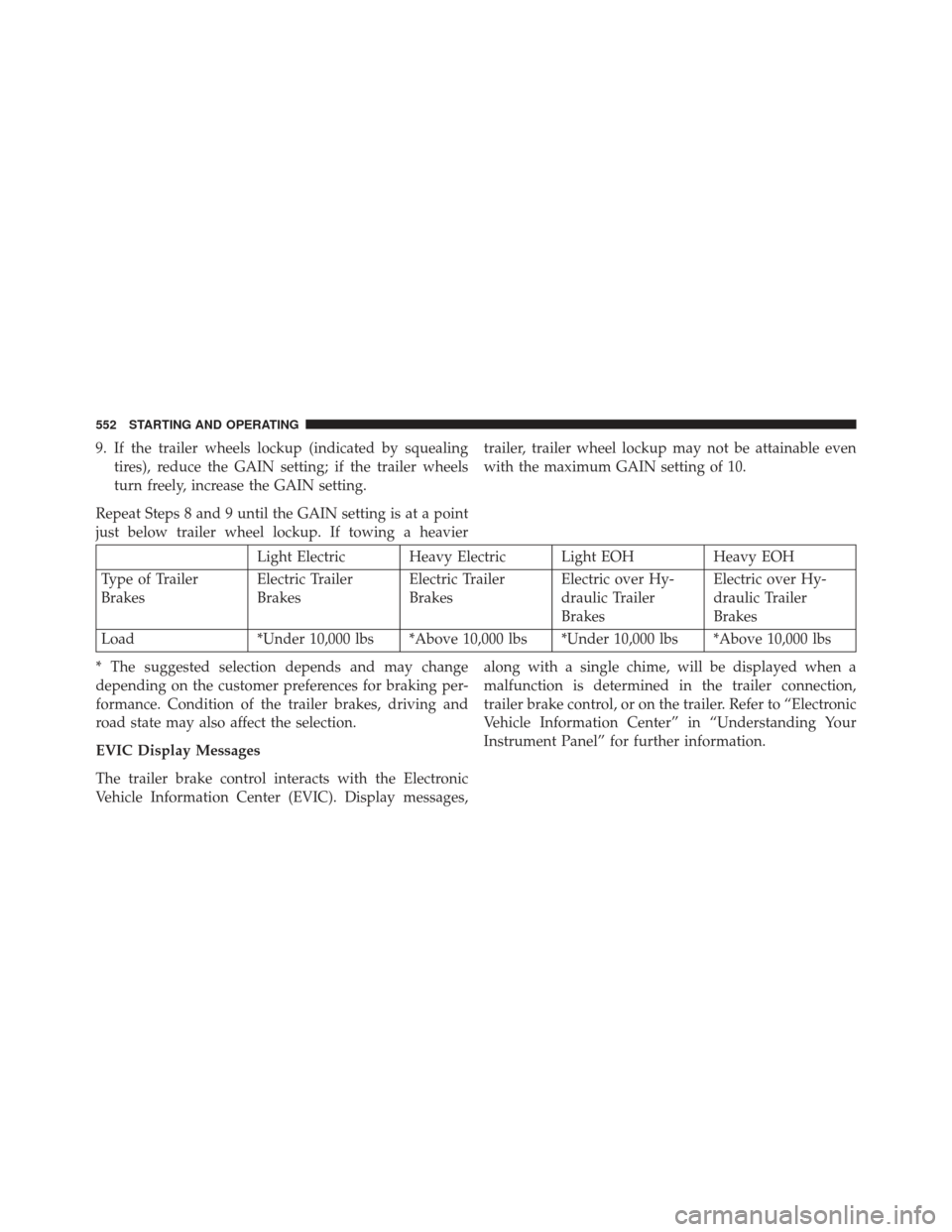
Light Electric Heavy Electric Light EOH
Heavy EOH
Type of Trailer
Brakes Electric Trailer
BrakesElectric Trailer
BrakesElectric over Hy-
draulic Trailer
BrakesElectric over Hy-
draulic Trailer
Brakes
Load *Under 10,000 lbs *Above 10,000 lbs *Under 10,000 lbs *Above 10,000 lbs
* The suggested selection depends and may change
depending on the customer preferences for braking per-
formance. Condition of the trailer brakes, driving and
road state may also affect the selection.
EVIC Display Messages
The trailer brake control interacts with the Electronic
Vehicle Information Center (EVIC). Display messages, along with a single chime, will be displayed when a
malfunction is determined in the trailer connection,
trailer brake control, or on the trailer. Refer to “Electronic
Vehicle Information Center” in “Understanding Your
Instrument Panel” for further information.
552 STARTING AND OPERATING
Page 586 of 734
5. Remove the wheel nuts and pull the wheel off. Installthe spare wheel and wheel nuts with the cone shaped
end of the wheel nuts toward the wheel. To avoid the
risk of forcing the vehicle off the jack, do not fully
tighten the wheel nuts until the vehicle has been
lowered.
6. Using the lug wrench, finish tightening the wheel nuts using a crisscross pattern. The correct wheel nut
tightness for a cone type wheel nut is 120–140 ft lbs
(160–190 N·m) torque, for a flanged type wheel nut is
130–160 ft lbs (175–215 N·m) torque. If in doubt about
the correct tightness, have them checked with a torque
wrench by your authorized dealer or at a service
station.WARNING!
A loose tire or jack thrown forward in a collision or
hard stop could injure someone in the vehicle. Al-
ways stow the jack parts and the extra tire and wheel
in the places provided.
7. Install the wheel center cap and remove the wheel blocks. Do not install chrome or aluminum wheel
center caps on the spare wheel. This may result in cap
damage.
8. Lower the jack to its fully closed position. If the bottle jack will not lower by turning the dial (thumbwheel)
by hand, it may be necessary to use the jack drive tube
in order to lower the jack. Stow the replaced tire, jack,
and tools as previously described.
9. Adjust the tire pressure when possible.
584 WHAT TO DO IN EMERGENCIES
Page 593 of 734
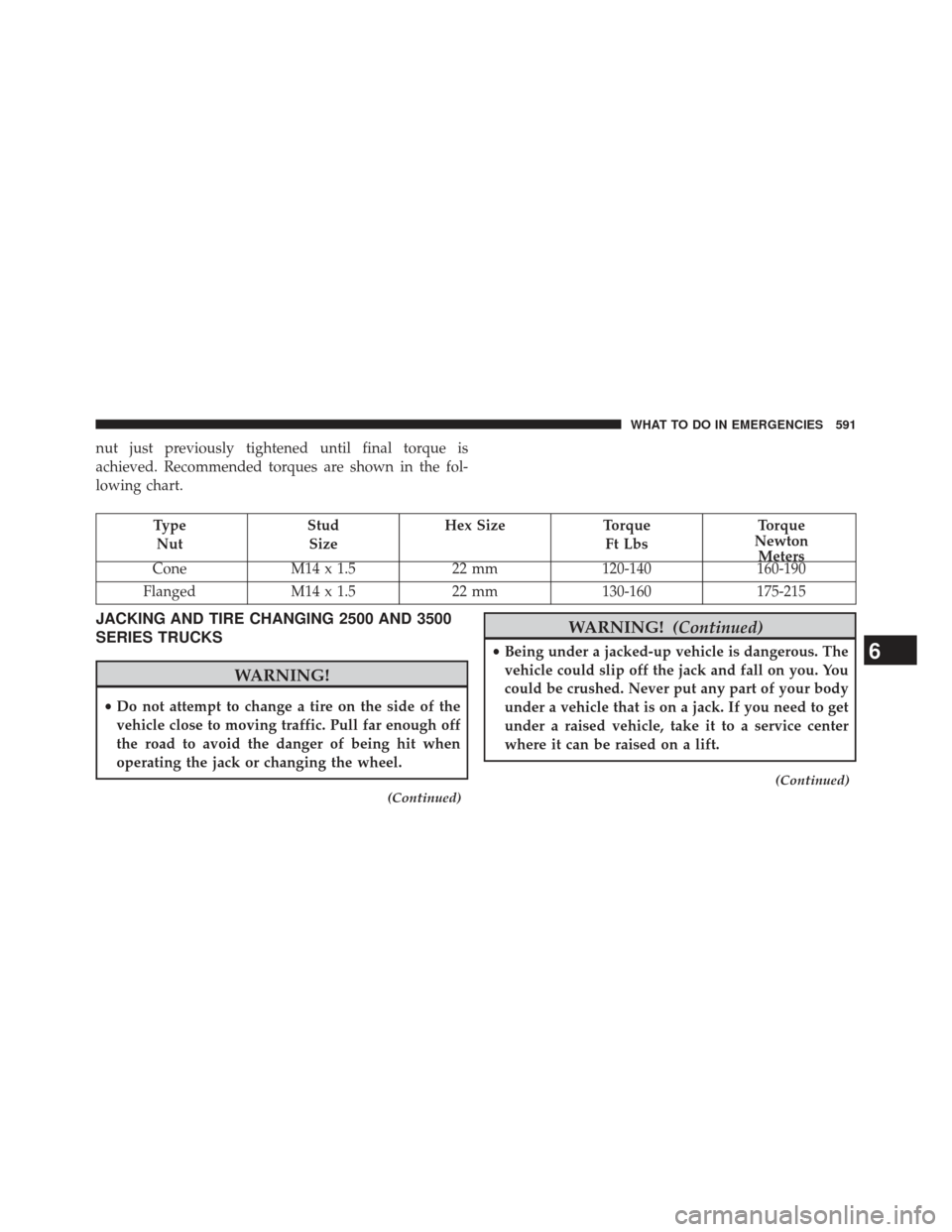
nut just previously tightened until final torque is
achieved. Recommended torques are shown in the fol-
lowing chart.
TypeNut Stud
Size Hex Size Torque
Ft LbsTorque
Newton Meters
Cone M14 x 1.5 22 mm120-140 160-190
Flanged M14 x 1.5 22 mm130-160 175-215
JACKING AND TIRE CHANGING 2500 AND 3500
SERIES TRUCKS
WARNING!
•Do not attempt to change a tire on the side of the
vehicle close to moving traffic. Pull far enough off
the road to avoid the danger of being hit when
operating the jack or changing the wheel.
(Continued)
WARNING! (Continued)
•Being under a jacked-up vehicle is dangerous. The
vehicle could slip off the jack and fall on you. You
could be crushed. Never put any part of your body
under a vehicle that is on a jack. If you need to get
under a raised vehicle, take it to a service center
where it can be raised on a lift.
(Continued)
6
WHAT TO DO IN EMERGENCIES 591
Page 604 of 734
CAUTION!
Before raising the wheel off the ground, make sure
that the jack will not damage surrounding truck parts
and adjust the jack position as required.
NOTE: If the bottle jack will not lower by turning the
dial (thumbwheel) by hand, it may be necessary to use
the jack drive tube in order to lower the jack.
4. By rotating the wheel wrench clockwise, raise the vehicle until the wheel just clears the surface.
WARNING!
Raising the vehicle higher than necessary can make
the vehicle unstable and cause a collision. It could
slip off the jack and hurt someone near it. Raise the
vehicle only enough to remove the tire. 5. Remove the wheel nuts and pull the wheel off. On
single rear-wheel (SRW) trucks, install the spare wheel
and wheel nuts with the cone shaped end of the wheel
nuts toward the wheel. On 3500 dual rear-wheel
models (DRW) the wheel nuts are a two-piece assem-
bly with a flat face. Lightly tighten the wheel nuts. To
avoid the risk of forcing the vehicle off the jack, do not
fully tighten the wheel nuts until the vehicle has been
lowered.
6. Using the lug wrench, finish tightening the wheel nuts using a crisscross pattern. The correct wheel nut
tightness for a cone type wheel nut is 120–140 ft lbs
(160–190 N·m) torque, for a flanged type wheel nut is
130–160 ft lbs (175–215 N·m) torque. If in doubt about
the correct tightness, have them checked with a torque
wrench by your authorized dealer or at a service
station.
602 WHAT TO DO IN EMERGENCIES