wheel torque Ram 1500 2013 User Guide
[x] Cancel search | Manufacturer: RAM, Model Year: 2013, Model line: 1500, Model: Ram 1500 2013Pages: 734, PDF Size: 5.47 MB
Page 611 of 734
nut bolt circle and strike the high side down with a
rubber mallet. Be sure that the hub caps and wheel skins
are firmly seated around the wheel.
Wheel Nuts
All wheel nuts should be tightened occasionally to elimi-
nate the possibility of wheel studs being sheared or the
bolt holes in the wheels becoming elongated. This is
especially important during the first few hundred miles/
kilometers of operation to allow the wheel nuts tobecome properly set. All wheel nuts should first be firmly
seated against the wheel. The wheel nuts should then be
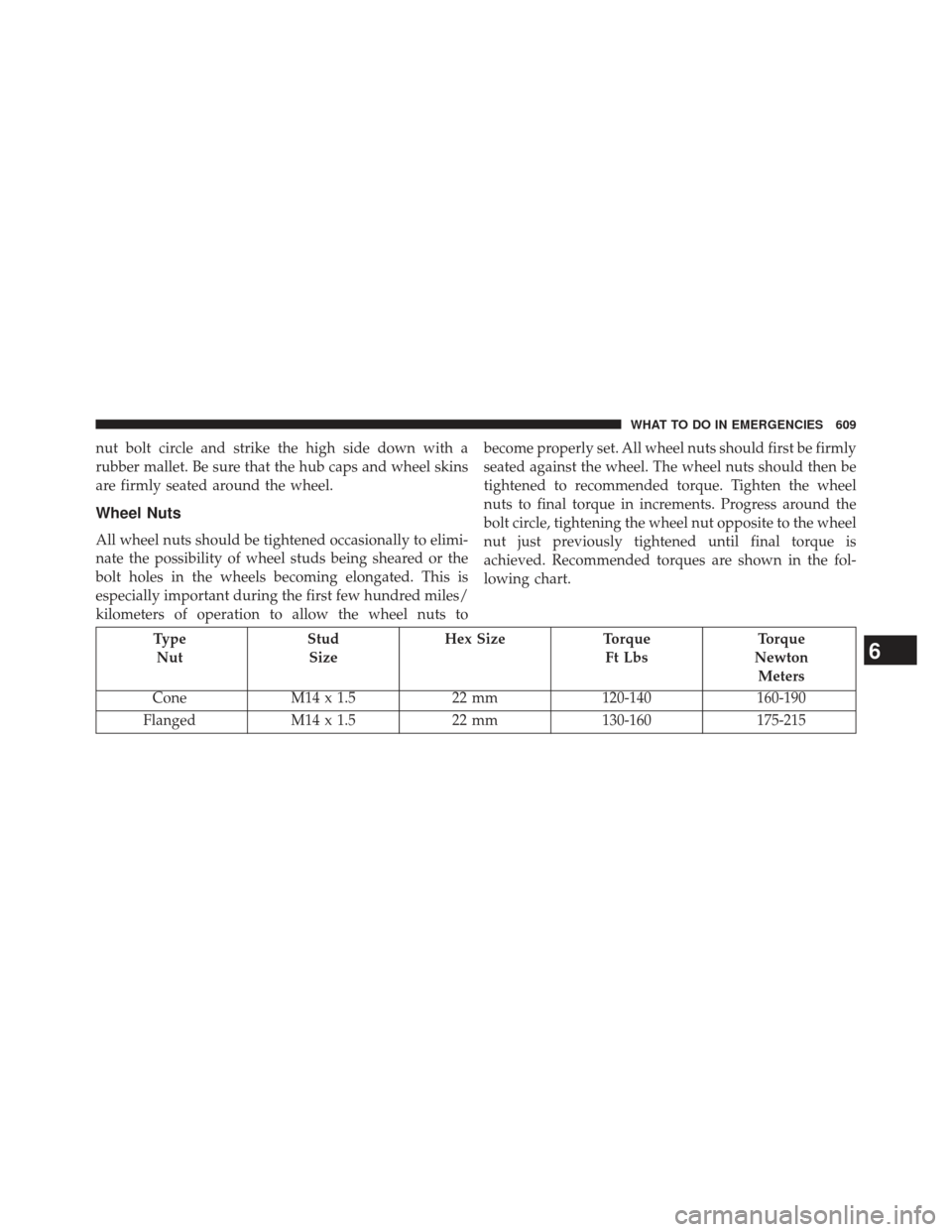
tightened to recommended torque. Tighten the wheel
nuts to final torque in increments. Progress around the
bolt circle, tightening the wheel nut opposite to the wheel
nut just previously tightened until final torque is
achieved. Recommended torques are shown in the fol-
lowing chart.
Type
Nut Stud
Size Hex Size Torque
Ft LbsTorque
Newton Meters
Cone M14 x 1.5 22 mm120-140 160-190
Flanged M14 x 1.5 22 mm130-160 175-215
6
WHAT TO DO IN EMERGENCIES 609
Page 613 of 734
These dual rear wheels should be tightened as follows:
1. Tighten the wheel nuts in the numbered sequence to asnug fit.
2. Retighten the wheel nuts in the same sequence to the torques listed in the table. Go through the sequence a second time to verify that specific torque has been
achieved. Retighten to specifications at 100 miles
(160 km) and after 500 miles (800 km).
It is recommended that wheel stud nuts be kept torqued
to specifications at all times. Torque wheel stud nuts to
specifications at each lubrication interval.
HOISTING
A conventional floor jack may be used at the jacking
locations. Refer to the graphics that show jacking loca-
tions. However, a floor jack or frame hoist must never be
used on any other parts of the underbody.
CAUTION!
Never use a floor jack directly under the differential
housing of a loaded truck or damage to your vehicle
may result.
Tightening Pattern
6
WHAT TO DO IN EMERGENCIES 611
Page 732 of 734
Unleaded Gasoline....................... .521
Untwisting Procedure, Seat Belt ................59
Utility Rails, Rear Cargo Area ................243
Vehicle Identification Number (VIN) .............6
Vehicle Loading ......................... .489
Vehicle Modifications/Alterations ...............7
Vehicle Storage .......................... .332
Warning Lights (Instrument Cluster Description) . . .257
Warnings and Cautions .......................6
Warranty Information ..................... .708
Washers, Windshield ...................... .173
Washing Vehicle ......................... .662
Water Driving Through ....................... .442
Wheel and Wheel Trim .....................664
Wheel and Wheel Trim Care .................664
Wheel Cover ........................... .590Wheel Nut Torque
........................ .590
Winch ................................ .445
Accessories ........................... .449
Operation ............................ .450
Rigging Techniques ..................... .463
Usage .............................. .445
Wind Buffeting ............................47
Window Fogging ........................ .332
Windows ................................44
Power ................................44
Rear Sliding .......................... .227
Windshield Defroster ...................... .122
Windshield Washers ...................... .172
Fluid ............................... .172
Windshield Wiper Blades ....................644
Windshield Wipers ....................... .172
Wiper Blade Replacement ...................644
Wipers, Intermittent ...................... .173
Wipers, Rain Sensitive ..................... .175
730 INDEX