battery Ram 1500 2015 Diesel Supplement
[x] Cancel search | Manufacturer: RAM, Model Year: 2015, Model line: 1500, Model: Ram 1500 2015Pages: 347, PDF Size: 2.02 MB
Page 191 of 347
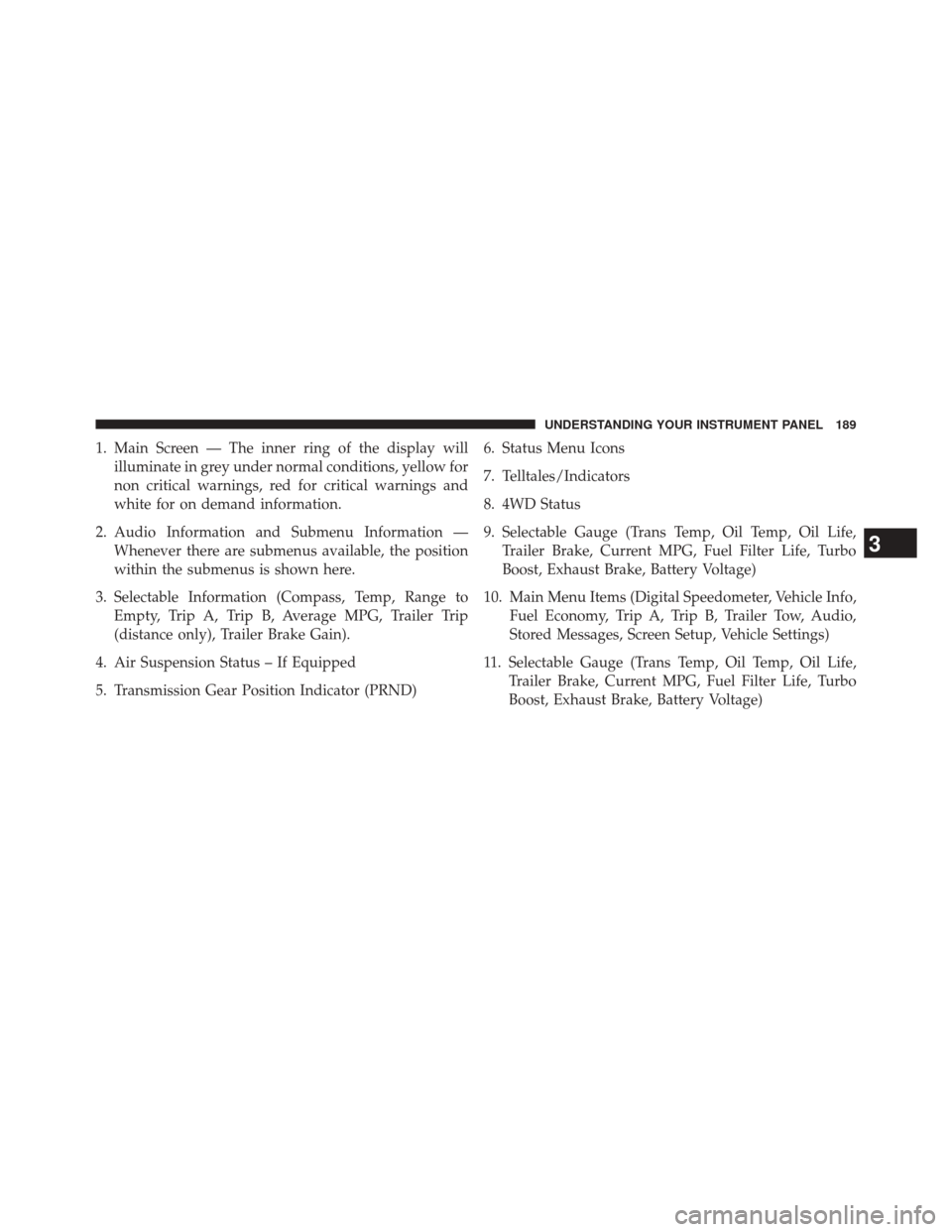
1. Main Screen — The inner ring of the display willilluminate in grey under normal conditions, yellow for
non critical warnings, red for critical warnings and
white for on demand information.
2. Audio Information and Submenu Information — Whenever there are submenus available, the position
within the submenus is shown here.
3. Selectable Information (Compass, Temp, Range to Empty, Trip A, Trip B, Average MPG, Trailer Trip
(distance only), Trailer Brake Gain).
4. Air Suspension Status – If Equipped
5. Transmission Gear Position Indicator (PRND) 6. Status Menu Icons
7. Telltales/Indicators
8. 4WD Status
9. Selectable Gauge (Trans Temp, Oil Temp, Oil Life,
Trailer Brake, Current MPG, Fuel Filter Life, Turbo
Boost, Exhaust Brake, Battery Voltage)
10. Main Menu Items (Digital Speedometer, Vehicle Info, Fuel Economy, Trip A, Trip B, Trailer Tow, Audio,
Stored Messages, Screen Setup, Vehicle Settings)
11. Selectable Gauge (Trans Temp, Oil Temp, Oil Life, Trailer Brake, Current MPG, Fuel Filter Life, Turbo
Boost, Exhaust Brake, Battery Voltage)
3
UNDERSTANDING YOUR INSTRUMENT PANEL 189
Page 217 of 347
•Automatic equipped vehicles with optional Keyless
Enter-N-Go™ – If the start button is pushed once
while in park with the ignition off and driver ’s foot on
the brake pedal, the vehicle will automatically crank
and start after the Wait to Start time has elapsed. If it is
desired to abort the start process before it completes,
the driver ’s foot should be fully removed from the
brake pedal prior to pushing the start button again in
order for the ignition to move directly to off.
• If the engine stalls, or if the ignition switch is left ON
for more than two minutes after the “Wait To Start”
telltale goes out, reset the grid heaters by turning the
ignition switch to the OFF position for at least five
seconds and then back ON. Repeat steps 1 through 5 of
“Starting Procedure – Engine Manifold Air Tempera-
ture Below 66°F (19°C).”Starting Procedure — Engine Manifold Air
Temperature Below 0°F (-18°C)
In extremely cold weather below 0°F (-18°C) it may be
beneficial to cycle the manifold heaters twice before
attempting to start the engine. This can be accomplished
by turning the ignition OFF for at least five seconds and
then back ON after the “Wait To Start” telltale has turned
off, but before the engine is started. However, excessive
cycling of the manifold heaters will result in damage to
the heater elements or reduced battery voltage.
NOTE:If multiple pre-heat cycles are used before start-
ing, additional engine run time may be required to
maintain battery state of charge at a satisfactory level.
1. If the engine stalls after the initial start, the ignition must be turned to the OFF position for at least five
seconds and then to the ON position to recycle the
manifold heaters.
4
STARTING AND OPERATING 215
Page 222 of 347
diesel engine. However, if seasonably adjusted fuel is
not available and you are operating below 20°F (-6°C),
Mopar® Premium Diesel Fuel Treatment (or equiva-
lent) may be beneficial to avoid fuel gelling.
Engine Oil Usage
Refer to “Maintenance Procedures” in “Maintaining Your
Vehicle” for the correct engine oil viscosity.
Winter Front Usage
A winter front or cold weather cover is to be used in
ambient temperatures below 32°F (0°C), especially dur-
ing extended idle conditions to reduce condensation
build-up within engine crankcase. If a winter front or
cold weather cover is to be used, a percentage of the total
grille opening area must be left uncovered to provide
sufficient air flow to the charge air cooler and automatic
transmission oil cooler. The percentage of opening must
be increased with the increasing ambient air temperature
and/or engine load. If the cooling fan can be heardcycling frequently, increase the size of the opening in the
winter front. A suitable cold weather cover is available
from your MOPAR® dealer.
Battery Blanket Usage
A battery loses 60% of its cranking power as the battery
temperature decreases to 0°F (-18°C). For the same de-
crease in temperature, the engine requires twice as much
power to crank at the same RPM. The use of 120 VAC
powered battery blankets will greatly increase starting
capability at low temperatures. Suitable battery blankets
are available from your authorized MOPAR® dealer.
Engine Warm-Up
Avoid full throttle operation when the engine is cold.
When starting a cold engine, bring the engine up to
operating speed slowly to allow the oil pressure to
stabilize as the engine warms up.
220 STARTING AND OPERATING
Page 250 of 347
To shift out of REVERSE bring the vehicle to a complete
stop and press the clutch. Shifting out of REVERSE prior
to a complete stop may cause high shift effort.
AUXILIARY SWITCHES — IF EQUIPPED
There can be up to five auxiliary switches located in the
lower switch bank of the instrument panel which can be
used to power various electronic devices and PTO
(Power Take Off) – If Equipped. Connections to the
switches are found under the hood in the connectors
attached to the auxiliary Power Distribution Center.
You have the ability to configure the functionality of the
auxiliary switches via the Electronic Vehicle Information
Center (EVIC) or Driver Information Display (DID). All
switches can now be configured for ignition or battery
power, saving or not saving state across a key cycle, and
momentary or latching switch operation.For further information on using the auxiliary switches,
please refer to the Ram Body Builders Guide by accessing
www.rambodybuilder.comand choosing the appropri-
ate links.
POWER TAKE OFF OPERATION — IF EQUIPPED
(CHASSIS CAB ONLY)
This vehicle when equipped with PTO Prep and either
the AS69RC automatic six-speed or G-56 manual six-
speed transmissions, will allow for an aftermarket upfit
with a transmission driven PTO (power take off). The
customer will have the ability to operate the PTO in
either a “stationary” or “mobile” mode. The vehicles will
be factory set to the “stationary” mode. To select ’mobile
mode’ You will need to enter the commercial vehicle
menu on the EVIC/DID screen and select mobile PTO
mode. Details of the PTO selection modes and further
PTO information is available at the Ram Truck Body-
builders web site. www.rambodybuilder.com
248 STARTING AND OPERATING
Page 272 of 347
JUMP STARTING
WARNING!
•To prevent personal injury or damage to clothing,
do not allow battery fluid to contact eyes, skin or
fabrics. Do not lean over a battery when connecting
jumper cables or allow cable clamps to touch each
other. Keep open flames or sparks away from
battery vent holes. Always wear eye protection
when working with batteries.
• Do not use a booster battery or any other booster
source that has a greater than 12 Volt system, i.e., do
not use a 24 Volt power source.
NOTE: Replacement batteries should both be of equal
size to prevent damage to the vehicle’s charging system.
Your vehicle is equipped with two 12 Volt batteries. If it
becomes necessary to use a booster battery with jumper cables to start a vehicle’s engine because its batteries are
discharged, the following procedure should be used:
Set the parking brake and place an automatic transmis-
sion in PARK (or NEUTRAL for a manual transmission).
Turn off lights, heater and other electrical loads. Observe
charge indicator (if equipped) in both batteries. If the
indicator (if equipped) is light or yellow on either battery,
replace that battery.
CAUTION!
Use the jump start procedure only when the charge
indicator (if equipped) in both batteries is dark in the
center. Do not attempt jump starting when either
battery charge indicator (if equipped) is bright or
yellow. If the charge indicator (if equipped) has a
green dot in the center, failure to start is not due to a
discharged battery and cranking system should be
checked.
270 WHAT TO DO IN EMERGENCIES
Page 273 of 347
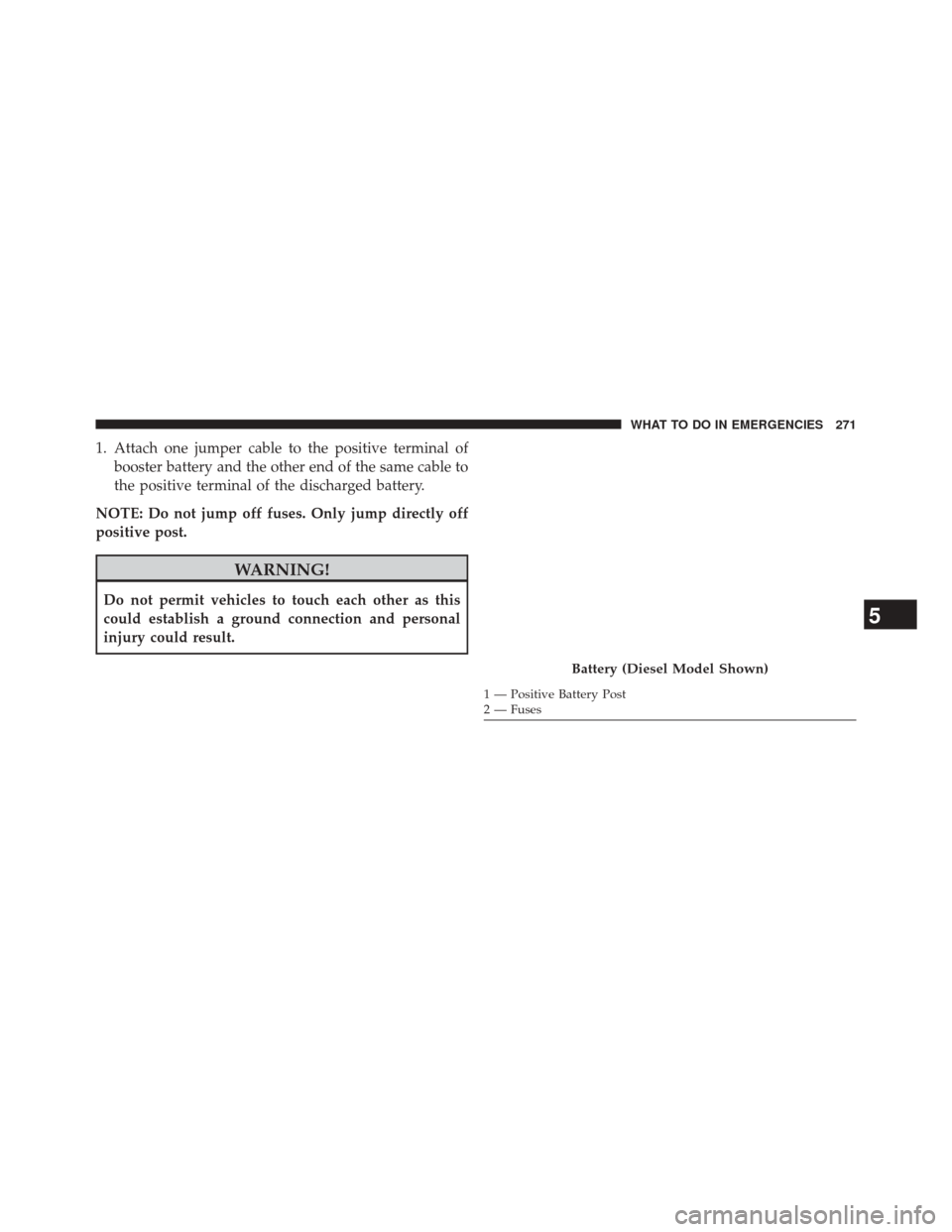
1. Attach one jumper cable to the positive terminal ofbooster battery and the other end of the same cable to
the positive terminal of the discharged battery.
NOTE: Do not jump off fuses. Only jump directly off
positive post.
WARNING!
Do not permit vehicles to touch each other as this
could establish a ground connection and personal
injury could result.
Battery (Diesel Model Shown)
1 — Positive Battery Post
2 — Fuses
5
WHAT TO DO IN EMERGENCIES 271
Page 274 of 347
2. Connect one end of the other jumper cable to negative(-) post of booster battery. Connect the other end of the
jumper cable to a good ground on the engine block of
the vehicle with the discharged battery. Make sure a
good connection is made, free of dirt and grease.
WARNING!
•Do not connect the cable to the negative post of the
discharge battery. The resulting electrical spark
could cause the battery to explode.
• During cold weather when temperatures are below
freezing point, electrolyte in a discharged battery
may freeze. Do not attempt jump starting because
the battery could rupture or explode. The battery
temperature must be brought up above freezing
point before attempting to jump start. 3. Take care that the clamps from one cable do not
inadvertently touch clamps from the other cable. Do
not lean over the battery when making connection.
The negative connection must provide good electrical
conductivity and current carrying capacity.
4. After the engine is started or if the engine fails to start, cables must be disconnected in the following order:
• Disconnect the negative cable at the engine ground.
• Disconnect the negative cable at the negative post on
booster battery.
• Disconnect the cable from the positive post of both
batteries.
272 WHAT TO DO IN EMERGENCIES
Page 275 of 347
WARNING!
Any procedure other than above could result in:
•Personal injury caused by electrolyte squirting out
the battery vent.
• Personal injury or property damage due to battery
explosion.
• Damage to charging system of booster vehicle or of
immobilized vehicle.
With Portable Starting Unit
There are many types of these units available. Follow the
manufacturer’s instructions for necessary precautions
and operation.
CAUTION!
It is very important that the starting unit operating
voltage does not exceed 12 Volts DC or damage to
battery, starter motor, alternator, or electrical system
may occur.
5
WHAT TO DO IN EMERGENCIES 273
Page 279 of 347
ENGINE COMPARTMENT — 6.7L DIESEL — SIX-SPEED 68RFE (2500/3500 Models)
1 — Battery7 — Washer Fluid Reservoir
2 — Engine Coolant Reservoir 8 — Power Steering Fluid Reservoir
3 — Automatic Transmission Dipstick 9 — Power Distribution Center
4 — Brake Fluid Reservoir 10 — Engine Oil Dipstick
5 — Battery 11 — Engine Oil Fill
6 — Aux Power Distribution Center 12 — Air Cleaner Filter
6
MAINTAINING YOUR VEHICLE 277
Page 280 of 347
ENGINE COMPARTMENT — 6.7L DIESEL — SIX-SPEED AS69RC HD (3500/CHASSIS CAB MODELS)
1 — Battery7 — Washer Fluid Reservoir
2 — Engine Coolant Reservoir 8 — Power Steering Fluid Reservoir
3 — Automatic Transmission Dipstick 9 — Power Distribution Center
4 — Brake Fluid Reservoir 10 — Engine Oil Dipstick
5 — Battery 11 — Engine Oil Fill
6 — Aux Power Distribution Center 12 — Air Cleaner Filter
278 MAINTAINING YOUR VEHICLE