electronic Ram 1500 2015 Owner's Manual
[x] Cancel search | Manufacturer: RAM, Model Year: 2015, Model line: 1500, Model: Ram 1500 2015Pages: 871, PDF Size: 24.83 MB
Page 589 of 871
WARNING!(Continued)
•HSA is not a parking brake. If you stop the vehicle
on a hill without putting the transmission in PARK
or using the parking brake, it will roll down the
incline and could collide with another vehicle,
object or person, and cause serious or fatal injury.
Always remember to use the parking brake while
parking on a hill and that the driver is responsible
for braking the vehicle.
HSA Off
HSA is a Customer Programmable Feature in the EVIC/
DID. If you wish to turn off the HSA feature, refer to
“Electronic Vehicle Information Center (EVIC)/Driver
Information Display (DID)” in “Understanding Your
Instrument Panel” for further information.
Electronic Stability Control (ESC)
The ESC system enhances directional control and stabil-
ity of the vehicle under various driving conditions. ESC
corrects for oversteering or understeering of the vehicle
by applying the brake of the appropriate wheel to assist
in counteracting the oversteer or understeer condition.
Engine power may also be reduced to help the vehicle
maintain the desired path.
ESC uses sensors in the vehicle to determine the vehicle
path intended by the driver and compares it to the actual
path of the vehicle. When the actual path does not match
the intended path, ESC applies the brake of the appro-
priate wheel to assist in counteracting the oversteer or
understeer condition.
•Oversteer - when the vehicle is turning more than
appropriate for the steering wheel position.
•Understeer - when the vehicle is turning less than
appropriate for the steering wheel position.
5
STARTING AND OPERATING 587
Page 590 of 871
WARNING!
Electronic Stability Control (ESC) cannot prevent the
natural laws of physics from acting on the vehicle,
nor can it increase the traction afforded by prevailing
road conditions. ESC cannot prevent accidents, in-
cluding those resulting from excessive speed in
turns, driving on very slippery surfaces, or hydro-
planing. ESC also cannot prevent accidents resulting
from loss of vehicle control due to inappropriate
driver input for the conditions. Only a safe, attentive,
and skillful driver can prevent accidents. The capa-
bilities of an ESC equipped vehicle must never be
exploited in a reckless or dangerous manner which
could jeopardize the user ’s safety or the safety of
others.
All Two-Wheel Drive Vehicles And Four-Wheel
Drive Vehicles In 2WD, 4WD AUTO, Or 4WD
LOCK Modes Can Choose The Following ESC
Operating Modes:
ESC On
This is the normal operating mode for ESC in 2WD/4WD
AUTO/4WD LOCK modes and in 2WD vehicles. When-
ever the vehicle is started or the transfer case (if
equipped) is shifted from 4WD LOW or Neutral, back to
4WD LOCK or 4WD AUTO, the ESC system will be in
this mode. This mode should be used for almost all
driving situations. ESC should only be turned to#ESC
Partial Off#or “ESC Full Off” for specific reasons as noted
below.
ESC Partial Off
This mode is entered by momentarily pressing the “ESC
Partial Off” switch. When in#Partial Off#mode, the TCS
588 STARTING AND OPERATING
Page 594 of 871
NOTE:
•The “ESC Activation/Malfunction Indicator Light”
and the “ESC OFF Indicator Light” come on momen-
tarily each time the ignition switch is turned ON.
•Each time the ignition is turned ON, the ESC system
will be ON even if it was turned off previously. Except
for when the vehicle is started while in 4WD Low
Range.
•The ESC system will make buzzing or clicking sounds
when it is active. This is normal; the sounds will stop
when ESC becomes inactive following the maneuver
that caused the ESC activation.
The “ESC OFF Indicator Light” indicates the
Electronic Stability Control (ESC) is in#ESC
Partial Off#or#ESC Full Off#.
Trailer Sway Control (TSC)
The TSC system uses sensors in the vehicle to recognize
an excessively swaying trailer and will take the appro-
priate actions to attempt to stop the sway. The system
may reduce engine power and apply the brake of the
appropriate wheel(s) to counteract the sway of the trailer.
TSC will become active automatically once an excessively
swaying trailer is recognized. No driver action is re-
quired to activate. Note that TSC cannot stop all trailers
from swaying. Always use caution when towing a trailer
and follow the trailer tongue weight recommendations.
Refer to “Trailer Towing” in “Starting and Operating” for
further information. When TSC is functioning, the “ESC
Activation/Malfunction Indicator Light” will flash, the
engine power may be reduced and you may feel the
brakes being applied to individual wheels to attempt to
stop the trailer from swaying. TSC is disabled when the
ESC system is in the “ESC Partial Off” or “ESC Full Off”
modes.
592 STARTING AND OPERATING
Page 596 of 871
Activating HDC
Once HDC is enabled it will activate automatically if
driven down a grade of sufficient magnitude (greater
than approximately 8%). The set speed for HDC is
selectable by the driver, and can be adjusted by using the
Electronic range switches located on steering column
shifter. The following summarizes the HDC set speed:
GearApproximate HDC Set Speed
PNo set speed. HDC may be en-
abled but will not activate
R0.6 mph (1 km/h)
N1.2 mph (2 km/h)
1st0.6 mph (1 km/h)
2nd1.2 mph (2 km/h)
GearApproximate HDC Set Speed
3rd1.8 mph (3 km/h)
4th2.5 mph (4 km/h)
5th3.1 mph (5 km/h)
6th3.7 mph (6 km/h)
7th4.3 mph (7 km/h)
8th5.0 mph (8 km/h)
9th5.6 mph (9 km/h)
NOTE:During HDC the ERS +/- shifter input is used for
HDC target speed selection but will not affect the gear
chosen by the transmission. During HDC the transmis-
sion will shift appropriately for the driver-selected set
speed and corresponding driving conditions.
594 STARTING AND OPERATING
Page 631 of 871
•Seasonal temperature changes will affect tire pressure,
and the TPMS will monitor the actual tire pressure in
the tire.
Premium System
The Tire Pressure Monitor System (TPMS) uses wireless
technology with wheel rim mounted electronic sensors to
monitor tire pressure levels. Sensors mounted to each
wheel as part of the valve stem transmit tire pressure
readings to the receiver module.
NOTE:It is particularly important for you to check the
tire pressure in all of the tires on your vehicle monthly
and to maintain the proper pressure.
The TPMS consists of the following components:
•Receiver module
•Four TPM sensors
•Various TPMS messages, which display in the Elec-
tronic Vehicle Information Center (EVIC)/Driver In-
formation Display (DID)
•TPM Telltale Light
The matching full size spare wheel and tire assembly (if
equipped) has a TPM sensor. The full size spare can be
used in place of any of the four road tires. A spare with a
pressure below the low-pressure limit will not cause the
“Tire Pressure Monitoring Telltale Light” to illuminate or
the chime to sound while it is stored in the spare tire
location.
Tire Pressure Monitoring Low Pressure Warnings
The “Tire Pressure Monitoring Telltale Light” will
illuminate in the instrument cluster and a chime
will sound when tire pressure is low in one or more of the
four active road tires. In addition, the EVIC/DID will
display a “LOW TIRE” message and a graphic showing
5
STARTING AND OPERATING 629
Page 633 of 871
If the ignition switch is cycled, this sequence will repeat,
providing the system fault still exists. If the system fault
no longer exists, the “Tire Pressure Monitoring Telltale
Light” will no longer flash, and the#SERVICE TPM
SYSTEM#message will no longer display, and a pressure
value will display in place of the dashes. A system fault
can occur due to any of the following:
1. Signal interference due to electronic devices or driving
next to facilities emitting the same radio frequencies as
the TPM sensors.
2. Installing aftermarket window tinting that contains
materials that may block radio wave signals.
3. Accumulation of snow or ice around the wheels or
wheel housings.
4. Using tire chains on the vehicle.
5. Using wheels/tires not equipped with TPM sensors.
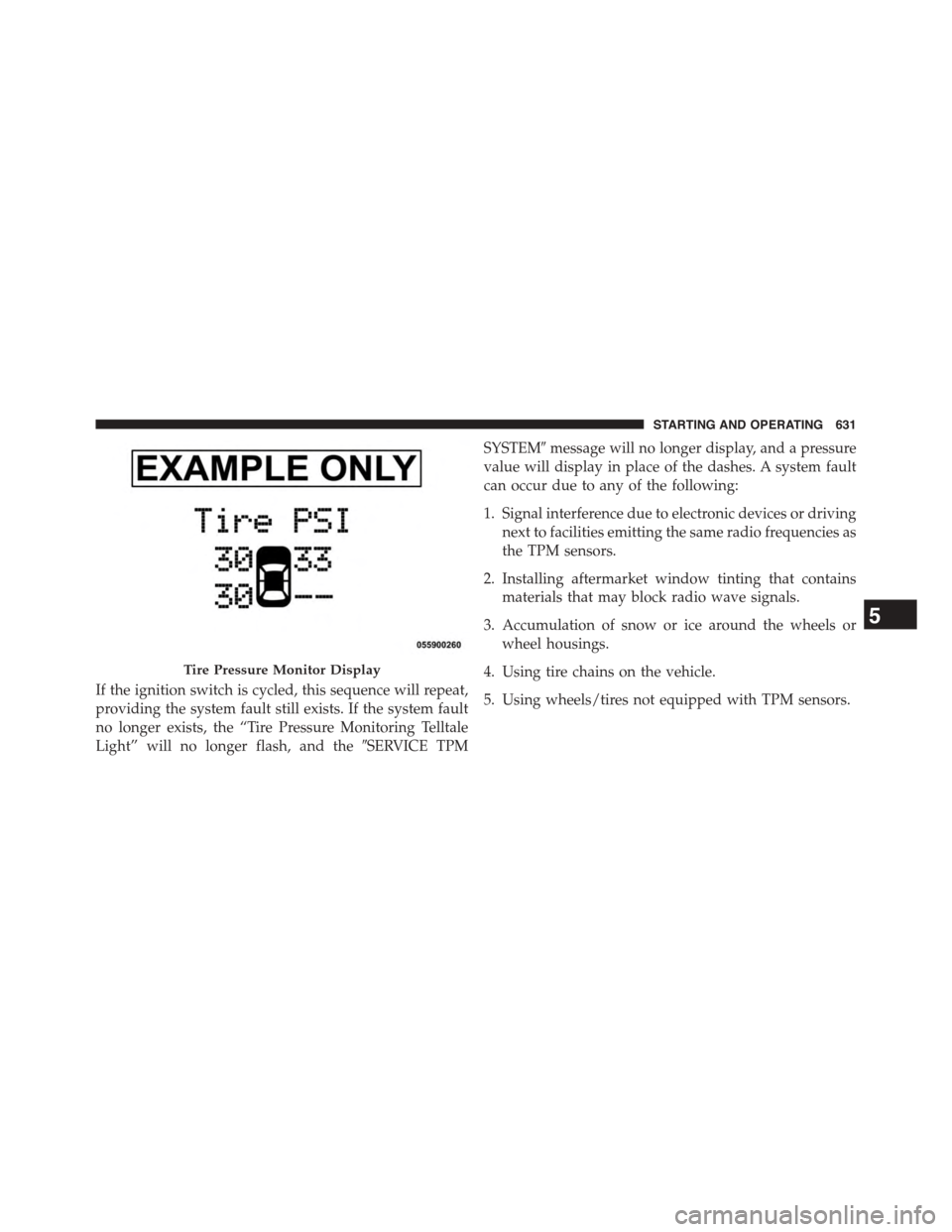
Tire Pressure Monitor Display
5
STARTING AND OPERATING 631
Page 634 of 871
Vehicles With Full Size Spare
1. The matching full size spare wheel and tire assembly
has a TPM sensor that can be monitored by the TPMS.
2. If you install the full size spare in place of a road tire
that has a pressure below the low-pressure warning
limit, upon the next ignition switch cycle, a chime will
sound and the “Tire Pressure Monitoring Telltale
Light” will turn ON. In addition, the EVIC/DID will
display a “LOW TIRE” message and a graphic show-
ing the low tire pressure value in a different color. An
#Inflate to XX#message will also be displayed.
3. After driving the vehicle for up to 20 minutes above
15 mph (25 km/h) the “Tire Pressure Monitoring
Telltale Light” will turn OFF and the pressure value
will be updated and return to it’s original color, as
long as no tire pressure is below the low-pressure
warning limit in any of the four active road tires.
Tire Pressure Information System (TPIS) 3500
Series Trucks
Your vehicle may be equipped with a Tire Pressure
Information System (TPIS).
The Tire Pressure Information System (TPIS) uses wire-
less technology with wheel rim mounted electronic sen-
sors to transmit tire pressure levels. Sensors mounted to
each wheel as part of the valve stem transmit tire
pressure readings to the receiver module.
NOTE:It is particularly important for you to check the
tire pressure in all of the tires on your vehicle monthly
and to maintain the proper pressure.
The TPIS consists of the following components:
•Receiver module
•Four TPM sensors (Single Rear Wheel (SRW) applica-
tions)
632 STARTING AND OPERATING
Page 635 of 871
•Six TPM sensors (Dual Rear Wheel (DRW) applica-
tions)
•Pressure display in the Electronic Vehicle Information
Center (EVIC)/Driver Information Display (DID)
The TPIS system will display all four (Single Rear Wheel
(SRW) applications) or six (Dual Rear Wheel (DRW)
applications) tire pressure values in the EVIC/DID dis-
play.
If a system fault is detected, the EVIC/DID will display a
#SERVICE TPM SYSTEM#message for a minimum of five
seconds and then display dashes (- -) in place of the
pressure value to indicate which sensor is not being
received.
If the ignition switch is cycled, this sequence will repeat,
providing the system fault still exists. If the system fault
no longer exists, the#SERVICE TPM SYSTEM#message
will no longer be displayed, and a pressure value will
display in place of the dashes. A system fault can occur
due to any of the following:
•Signal interference due to electronic devices or driving
next to facilities emitting the same radio frequencies as
the TPM sensors.
•Installing aftermarket window tinting that contains
materials that may block radio wave signals.
•Accumulation of snow or ice around the wheels or
wheel housings.
•Using tire chains on the vehicle.
•Using wheels/tires not equipped with TPM sensors.
5
STARTING AND OPERATING 633
Page 647 of 871
WARNING!
Static electricity can cause an ignition of flammable
liquid, vapor or gas in any vehicle or trailer. To
reduce risk of serious injury or death when filling
containers:
•Always place container on the ground before fill-
ing.
•Keep the pump nozzle in contact with the container
when you are filling it.
•Use only approved containers for flammable liq-
uid.
•Do not leave container unattended while filling.
•A static electric charge could cause a spark and fire
hazard.
Loose Fuel Filler Cap Message
If the vehicle diagnostic system determines
that the fuel filler cap is loose, improperly
installed, or damaged, a loose gascap indicator
will display in the EVIC/DID telltale display
area. Refer to “Electronic Vehicle Information Center
(EVIC)/Driver Information Display (DID) in “Under-
standing Your Instrument Panel” for further information.
Tighten the fuel filler cap properly and press the SELECT
button to turn off the message. If the problem continues,
the message will appear the next time the vehicle is
started.
5
STARTING AND OPERATING 645
Page 652 of 871
Frontal Area
The frontal area is the maximum height multiplied by the
maximum width of the front of a trailer.
Trailer Sway Control
The trailer sway control can be a mechanical telescoping
link that can be installed between the hitch receiver and
the trailer tongue that typically provides adjustable fric-
tion associated with the telescoping motion to dampen
any unwanted trailer swaying motions while traveling.
If equipped, the electronic Trailer Sway Control (TSC)
recognizes a swaying trailer and automatically applies
individual wheel brakes and/or reduces engine power to
attempt to eliminate the trailer sway.
Weight-Carrying Hitch
A weight-carrying hitch supports the trailer tongue weight,
just as if it were luggage located at a hitch ball or some other
connecting point of the vehicle. These kinds of hitches are
the most popular on the market today and they are com-
monly used to tow small and medium sized trailers.
Weight-Distributing Hitch
A weight-distributing system works by applying lever-
age through spring (load) bars. They are typically used
for heavier loads to distribute trailer tongue weight to the
tow vehicle’s front axle and the trailer axle(s). When used
in accordance with the manufacturer’s directions, it pro-
vides for a more level ride, offering more consistent
steering and brake control, thereby enhancing towing
safety. The addition of a friction/hydraulic sway control
also dampens sway caused by traffic and crosswinds and
contributes positively to tow vehicle and trailer stability.
Trailer sway control and a weight distributing (load
equalizing) hitch are recommended for heavier Tongue
Weights (TW) and may be required depending on vehicle
and trailer configuration/loading to comply with GAWR
requirements.
650 STARTING AND OPERATING