brake Ram 1500 2015 Owner's Manual
[x] Cancel search | Manufacturer: RAM, Model Year: 2015, Model line: 1500, Model: Ram 1500 2015Pages: 871, PDF Size: 24.83 MB
Page 740 of 871
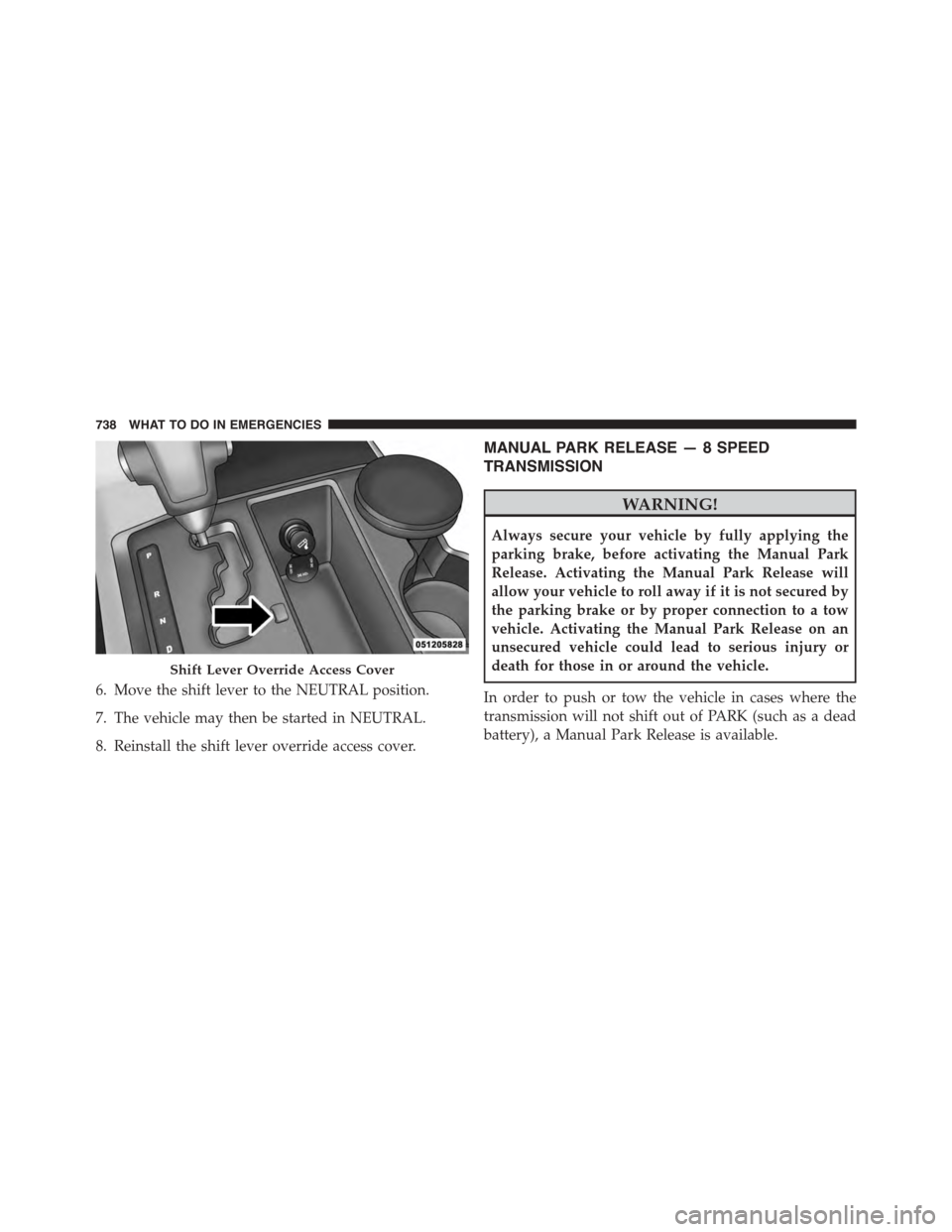
6. Move the shift lever to the NEUTRAL position.
7. The vehicle may then be started in NEUTRAL.
8. Reinstall the shift lever override access cover.
MANUAL PARK RELEASE — 8 SPEED
TRANSMISSION
WARNING!
Always secure your vehicle by fully applying the
parking brake, before activating the Manual Park
Release. Activating the Manual Park Release will
allow your vehicle to roll away if it is not secured by
the parking brake or by proper connection to a tow
vehicle. Activating the Manual Park Release on an
unsecured vehicle could lead to serious injury or
death for those in or around the vehicle.
In order to push or tow the vehicle in cases where the
transmission will not shift out of PARK (such as a dead
battery), a Manual Park Release is available.
Shift Lever Override Access Cover
738 WHAT TO DO IN EMERGENCIES
Page 741 of 871
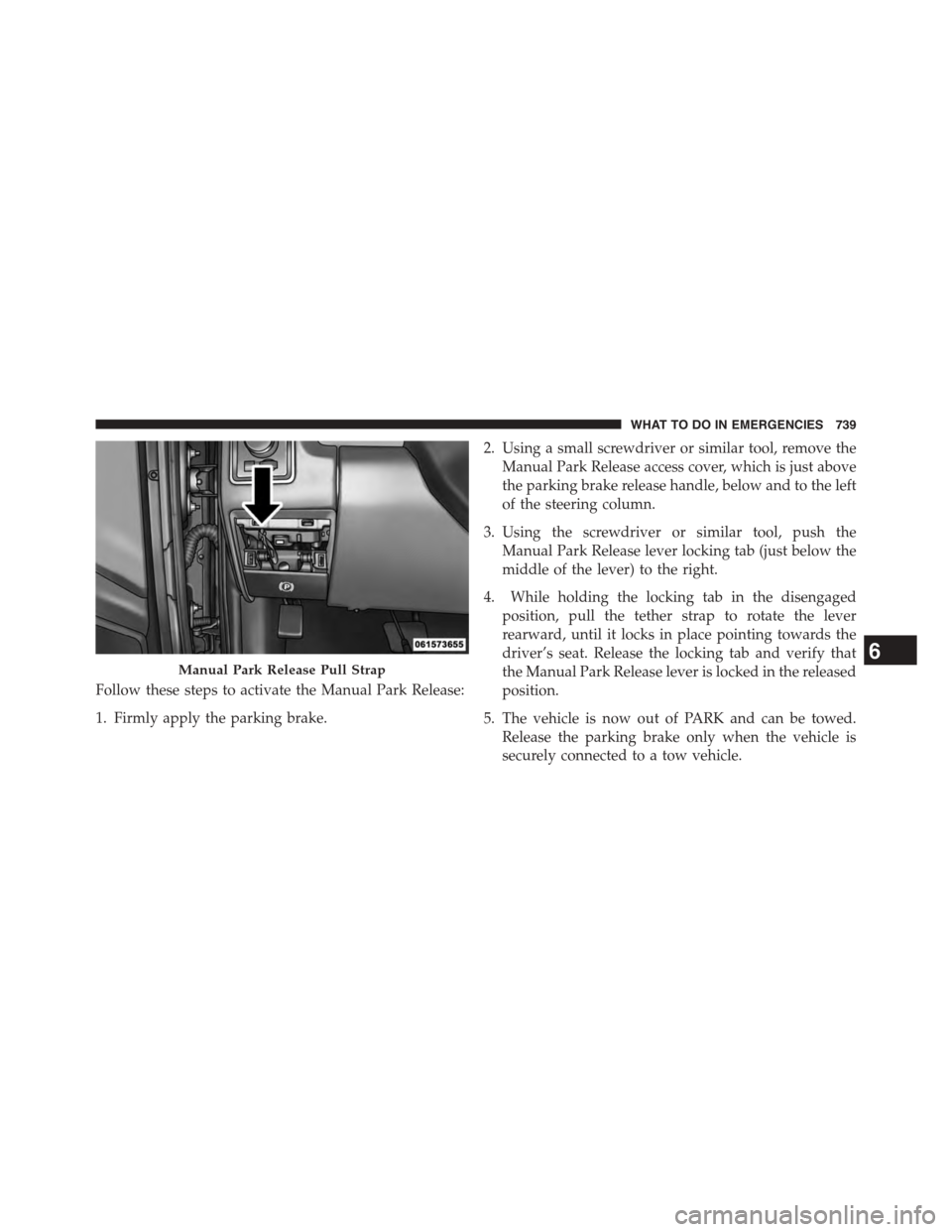
Follow these steps to activate the Manual Park Release:
1. Firmly apply the parking brake.
2. Using a small screwdriver or similar tool, remove the
Manual Park Release access cover, which is just above
the parking brake release handle, below and to the left
of the steering column.
3. Using the screwdriver or similar tool, push the
Manual Park Release lever locking tab (just below the
middle of the lever) to the right.
4. While holding the locking tab in the disengaged
position, pull the tether strap to rotate the lever
rearward, until it locks in place pointing towards the
driver’s seat. Release the locking tab and verify that
the Manual Park Release lever is locked in the released
position.
5. The vehicle is now out of PARK and can be towed.
Release the parking brake only when the vehicle is
securely connected to a tow vehicle.
Manual Park Release Pull Strap6
WHAT TO DO IN EMERGENCIES 739
Page 748 of 871
▫Adding Washer Fluid..................771
▫Exhaust System......................772
▫Cooling System......................774
▫Brake System........................782
▫Rear Axle And 4x4 Front Driving Axle Fluid
Level..............................784
▫Transfer Case........................785
▫Automatic Transmission................786
▫Appearance Care And Protection From
Corrosion...........................790
!FUSES..............................797
▫Power Distribution Center...............798
!VEHICLE STORAGE....................807
!REPLACEMENT BULBS.................808
!BULB REPLACEMENT..................809
▫Base Quad / Premium Bi-Halogen: Low Beam
Headlamp, High Beam Headlamp, Front Park
And Turn — If Equipped...............810
▫Fog Lamps — If Equipped..............812
▫Rear Tail/Stop, Turn Signal And Backup Lamps
..................................812
▫Center High-Mounted Stoplamp (CHMSL) With
Cargo Lamp.........................814
▫Cab Top Clearance Lamps — If Equipped . . . .816
▫Rear Lamp Bar ID Marker (Dual Rear Wheels) —
If Equipped..........................817
▫Side Marker Lamps (Dual Rear Wheels) —
If Equipped.........................818
746 MAINTAINING YOUR VEHICLE
Page 750 of 871
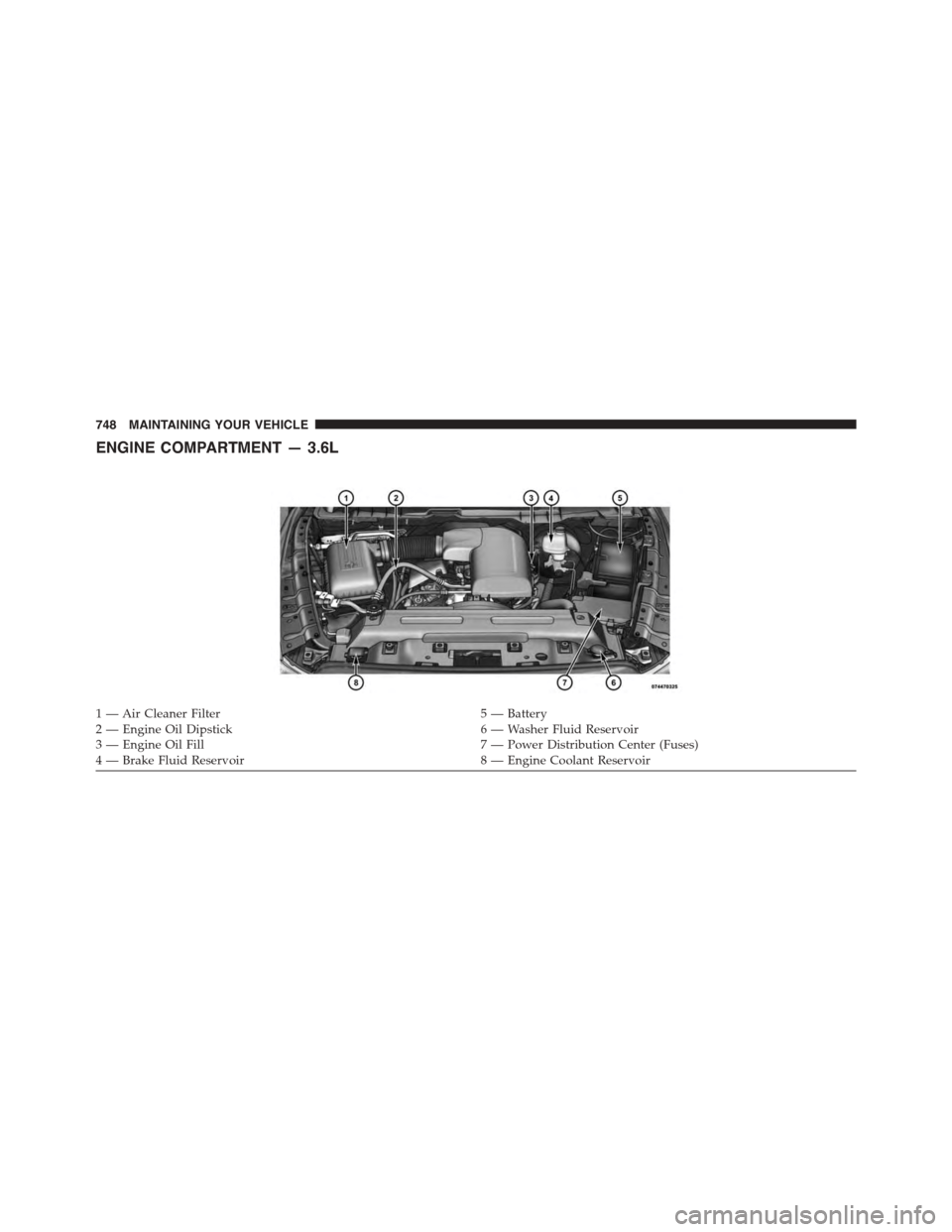
ENGINE COMPARTMENT — 3.6L
1 — Air Cleaner Filter5 — Battery2 — Engine Oil Dipstick6 — Washer Fluid Reservoir3 — Engine Oil Fill7 — Power Distribution Center (Fuses)4—BrakeFluidReservoir8—EngineCoolantReservoir
748 MAINTAINING YOUR VEHICLE
Page 751 of 871
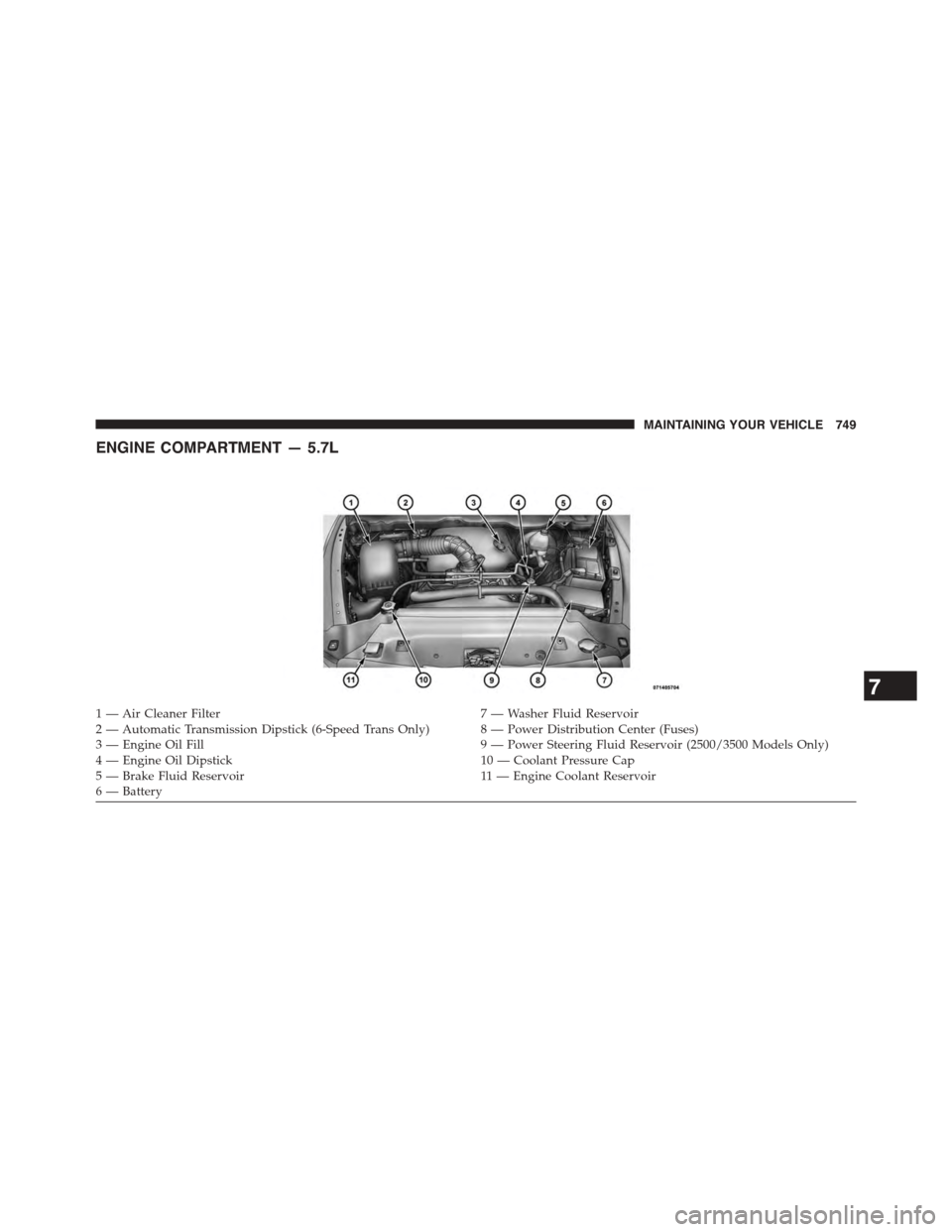
ENGINE COMPARTMENT — 5.7L
1 — Air Cleaner Filter7 — Washer Fluid Reservoir2 — Automatic Transmission Dipstick (6-Speed Trans Only) 8 — Power Distribution Center (Fuses)3 — Engine Oil Fill9 — Power Steering Fluid Reservoir (2500/3500 Models Only)4 — Engine Oil Dipstick10 — Coolant Pressure Cap5 — Brake Fluid Reservoir11 — Engine Coolant Reservoir6 — Battery
7
MAINTAINING YOUR VEHICLE 749
Page 752 of 871
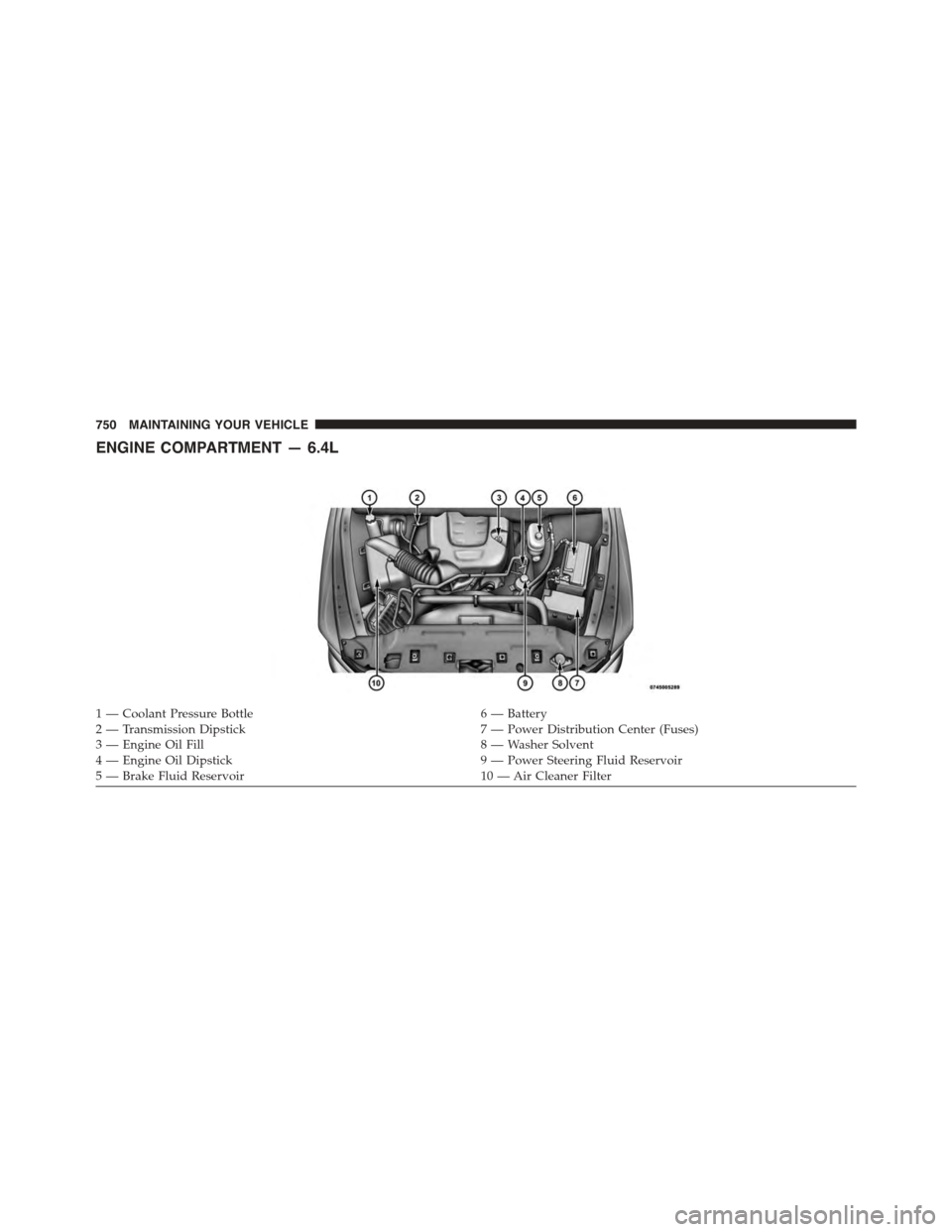
ENGINE COMPARTMENT — 6.4L
1 — Coolant Pressure Bottle6 — Battery2 — Transmission Dipstick7 — Power Distribution Center (Fuses)3—EngineOilFill8—WasherSolvent4 — Engine Oil Dipstick9 — Power Steering Fluid Reservoir5 — Brake Fluid Reservoir10 — Air Cleaner Filter
750 MAINTAINING YOUR VEHICLE
Page 784 of 871
Brake System
In order to assure brake system performance, all brake
system components should be inspected periodically.
Refer to the “Maintenance Schedule” for the proper
maintenance intervals.
WARNING!
Riding the brakes can lead to brake failure and
possibly a collision. Driving with your foot resting or
riding on the brake pedal can result in abnormally
high brake temperatures, excessive lining wear, and
possible brake damage. You would not have your full
braking capacity in an emergency.
Brake Fluid Level Check
The fluid level of the master cylinder should be checked
when performing under the hood service or immediately
if the brake system warning lamp indicates system
failure.
The brake master cylinder has a translucent plastic
reservoir. On the outboard side of the reservoir, there is a
“MAX” dot and an “MIN” dot. The fluid level must be
kept within these two dots. Do not add fluid above the
MAX mark because leakage may occur at the cap.
With disc brakes the fluid level can be expected to fall as
the brake linings wear. However, an unexpected drop in
fluid level may be caused by a leak and a system check
should be conducted.
Use only the manufacturer’s recommended brake fluid.
Refer to “Fluids, Lubricants, and Genuine Parts” in
“Maintaining Your Vehicle” for further information.
782 MAINTAINING YOUR VEHICLE
Page 785 of 871
WARNING!
•Use only manufacturer’s recommended brake
fluid. Refer to “Fluids, Lubricants, and Genuine
Parts” in “Maintaining Your Vehicle” for further
information. Using the wrong type of brake fluid
can severely damage your brake system and/or
impair its performance. The proper type of brake
fluid for your vehicle is also identified on the
original factory installed hydraulic master cylinder
reservoir.
(Continued)
WARNING!(Continued)
•To avoid contamination from foreign matter or
moisture, use only new brake fluid or fluid that has
been in a tightly closed container. Keep the master
cylinder reservoir cap secured at all times. Brake
fluid in a open container absorbs moisture from the
air resulting in a lower boiling point. This may
cause it to boil unexpectedly during hard or pro-
longed braking, resulting in sudden brake failure.
This could result in a collision.
•Overfilling the brake fluid reservoir can result in
spilling brake fluid on hot engine parts, causing
the brake fluid to catch fire. Brake fluid can also
damage painted and vinyl surfaces, care should be
taken to avoid its contact with these surfaces.
(Continued)
7
MAINTAINING YOUR VEHICLE 783
Page 786 of 871
WARNING!(Continued)
•Do not allow petroleum based fluid to contaminate
the brake fluid. Brake seal components could be
damaged, causing partial or complete brake failure.
This could result in a collision.
Rear Axle And 4x4 Front Driving Axle Fluid Level
For normal service, periodic fluid level checks are not
required. When the vehicle is serviced for other reasons
the exterior surfaces of the axle assembly should be
inspected. If gear oil leakage is suspected inspect the
fluid level. Refer to “Fluids, Lubricants, and Genuine
Parts” in “Maintaining Your Vehicle” for further informa-
tion. This inspection should be made with the vehicle in
a level position.
For 1500 Model axles, the fluid level should be even with
the bottom of the fill hole (within 1/4 in (6.4 mm) of edge
of hole) for the FDU215 HD front axle and C235FE rear
axle.
For all 2500/3500 Model axles, the fluid level should be
1/4 in ± 1/4 in (6.4 mm ± 6.4 mm) below the fill hole on
the 9.25 in front and 3/4 in ± 1/4 in (19 mm ± 6.4 mm) on
10.5 in rear axles. The 11.5 in rear axle level should be
1/4 in ± 1/4 in (6.4 mm ± 6.4 mm) below the fill hole.
Drain And Refill
Refer to the “Maintenance Schedule” for the proper
maintenance intervals.
Lubricant Selection
Refer to “Fluids, Lubricants, and Genuine Parts” in
“Maintaining Your Vehicle” for further information.
784 MAINTAINING YOUR VEHICLE
Page 790 of 871

Use the following procedure to check the transmission
fluid level properly:
1. Monitor the transmission temperature using the
EVIC/DID screen, and operate the vehicle as required
to reach the normal operating temperature. If the
transmission is not functioning properly, or the vehicle
cannot be driven, see the NOTE and CAUTION below
about checking the fluid level at colder temperatures.
2. Park the vehicle on level ground.
3. Run the engine at normal idle speed for at least 60
seconds, and leave the engine running for the rest of
this procedure.
4. Fully apply the parking brake, and press the brake
pedal.
5.Place the shift lever momentarily into each gear position
(allowing time for the transmission to fully engage in
each position), ending with the transmission in PARK.
6. Remove the dipstick, wipe it clean and reinsert it until
seated.
7. Remove the dipstick again and note the fluid level on
both sides. The fluid level reading is only valid if there
is a solid coating of oil on both sides of the dipstick.
Note that the holes in the dipstick will be full of fluid
if the actual level is at or above the hole. The fluid level
should be between the “HOT” (upper) reference holes
on the dipstick at normal operating temperature. If the
fluid level is low, add fluid through the dipstick tube
to bring it to the proper level.Do not overfill.Use
ONLY the specified fluid (see#Fluids, Lubricants, and
Genuine Parts#for fluid specifications). After adding
any quantity of oil through the dipstick tube, wait a
minimum of two minutes for the oil to fully drain into
the transmission before rechecking the fluid level.
788 MAINTAINING YOUR VEHICLE