clutch Ram 1500 2015 User Guide
[x] Cancel search | Manufacturer: RAM, Model Year: 2015, Model line: 1500, Model: Ram 1500 2015Pages: 871, PDF Size: 24.83 MB
Page 561 of 871
1.Motor:The winch motor is powered by the vehicle
charging system and features a thermal protection
switch that automatically stops motor function in the
power-in direction if the motor gets too hot.
2.Remote Socket:The remote socket allows the remote
control to be attached to the control pack to allow the
winch to function.
3.Winch Drum With Integral Brake:The winch drum
allows the wire rope to be stored on the winch and
transmits force to the wire rope. The winch is
equipped with an integral brake that will stop rotation
of the winch drum if the winch motor is stopped.
4.3-Stage Planetary Gear Set:Provides balance between
speed and pulling power.
5.Wire Rope:The wire rope allows the winch to be
connected to an anchor to provide a pulling force.
6.Clutch Lever:The clutch lever allows the winch drum
to be disconnected from the winch motor to allow the
wire rope to be pulled from the winch by hand.
7.Remote Control:The remote control provides the
interface between the winch operator and the winch.
The remote control provides the ability to power the
winch in, out, and stop the winch. To operate the
winch, the toggle switch is pressed down to power the
winch in and up to power the winch out. The winch
will stop if the switch is left in the neutral (center)
position.
CAUTION!
If not installed, the hook strap must be placed on the
hook.
Fairlead:The fairlead acts as a guide for the wire rope
and minimizes damage to the rope.
5
STARTING AND OPERATING 559
Page 563 of 871
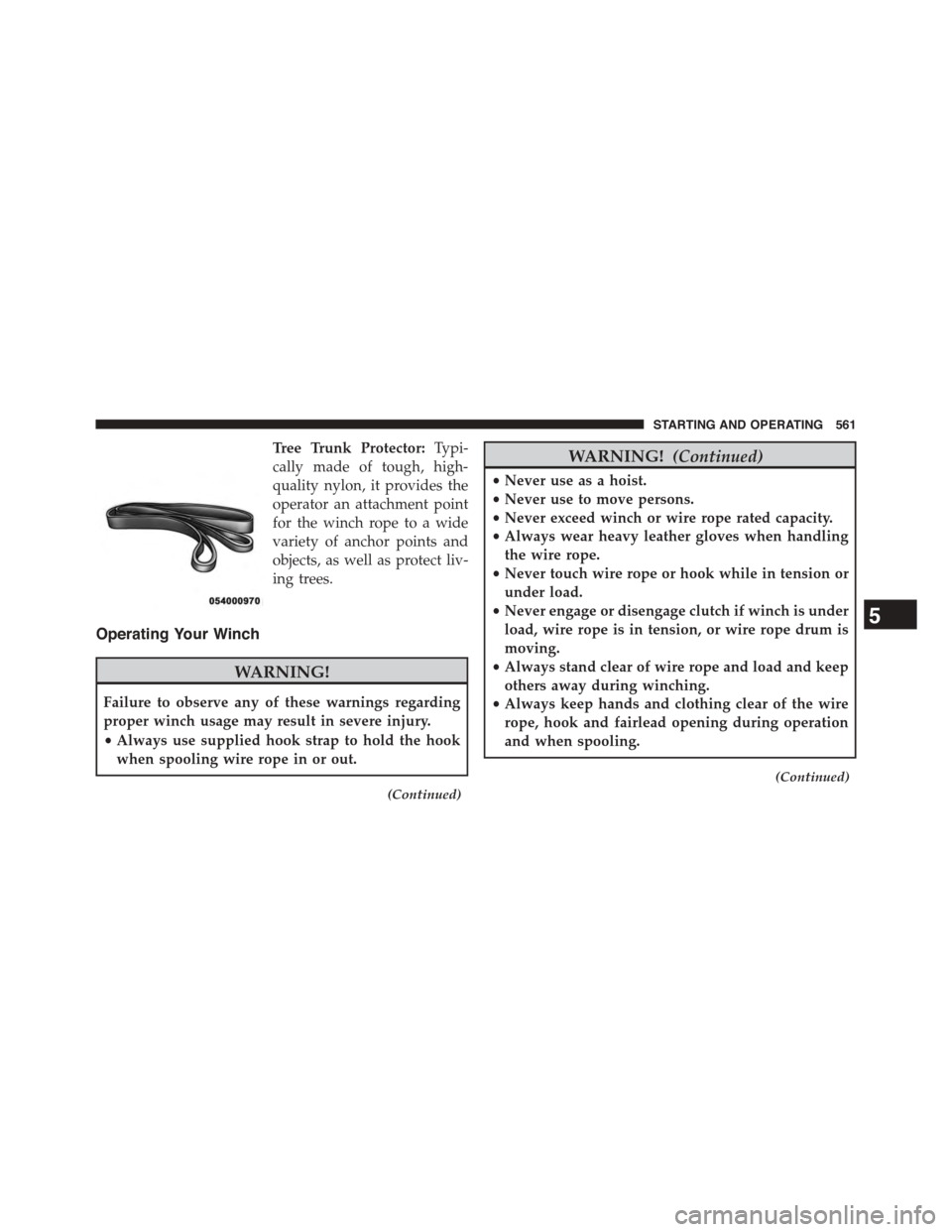
Tree Trunk Protector:Typi-
cally made of tough, high-
quality nylon, it provides the
operator an attachment point
for the winch rope to a wide
variety of anchor points and
objects, as well as protect liv-
ing trees.
Operating Your Winch
WARNING!
Failure to observe any of these warnings regarding
proper winch usage may result in severe injury.
•Always use supplied hook strap to hold the hook
when spooling wire rope in or out.
(Continued)
WARNING!(Continued)
•Never use as a hoist.
•Never use to move persons.
•Never exceed winch or wire rope rated capacity.
•Always wear heavy leather gloves when handling
the wire rope.
•Never touch wire rope or hook while in tension or
under load.
•Never engage or disengage clutch if winch is under
load, wire rope is in tension, or wire rope drum is
moving.
•Always stand clear of wire rope and load and keep
others away during winching.
•Always keep hands and clothing clear of the wire
rope, hook and fairlead opening during operation
and when spooling.
(Continued)
5
STARTING AND OPERATING 561
Page 566 of 871
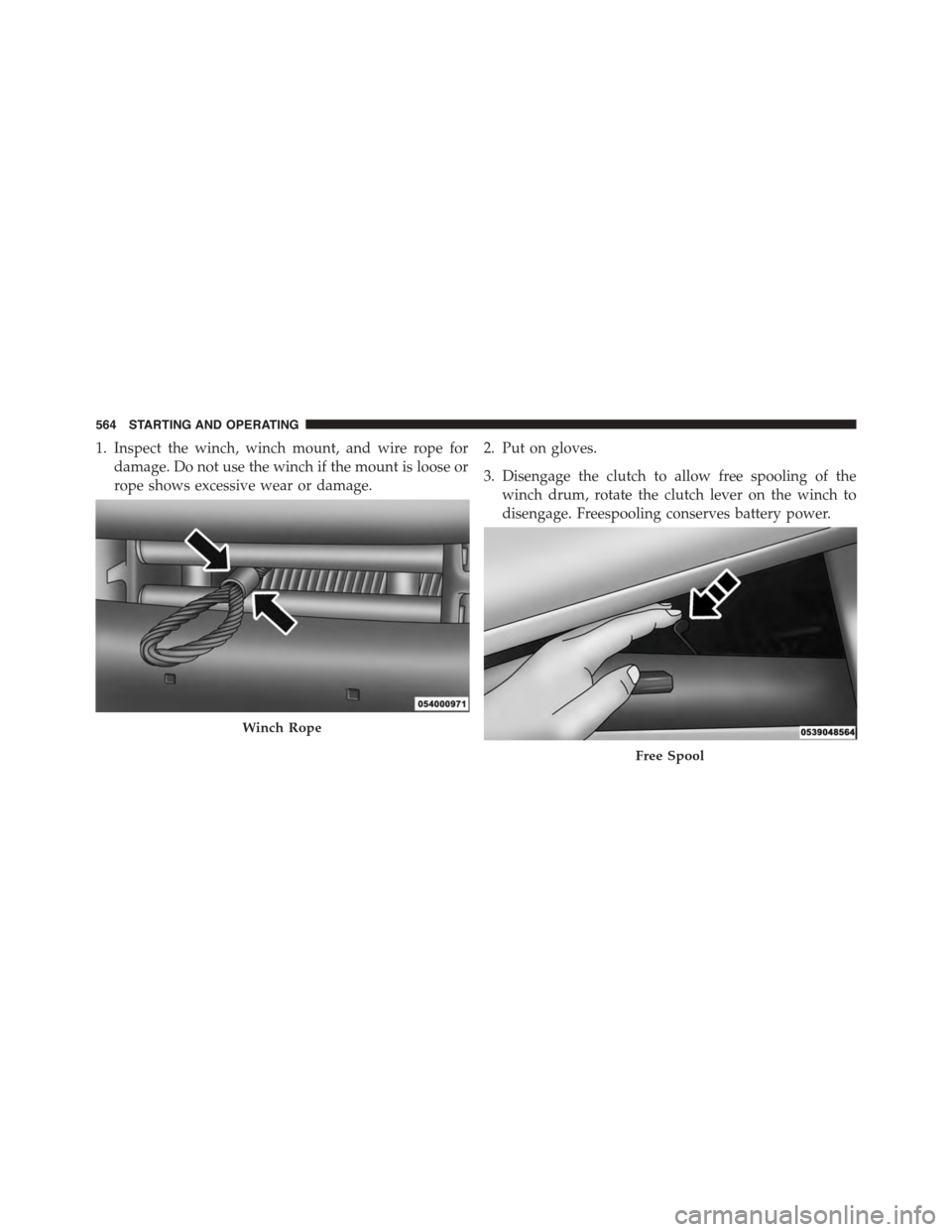
1. Inspect the winch, winch mount, and wire rope for
damage. Do not use the winch if the mount is loose or
rope shows excessive wear or damage.
2. Put on gloves.
3. Disengage the clutch to allow free spooling of the
winch drum, rotate the clutch lever on the winch to
disengage. Freespooling conserves battery power.
Winch Rope
Free Spool
564 STARTING AND OPERATING
Page 569 of 871
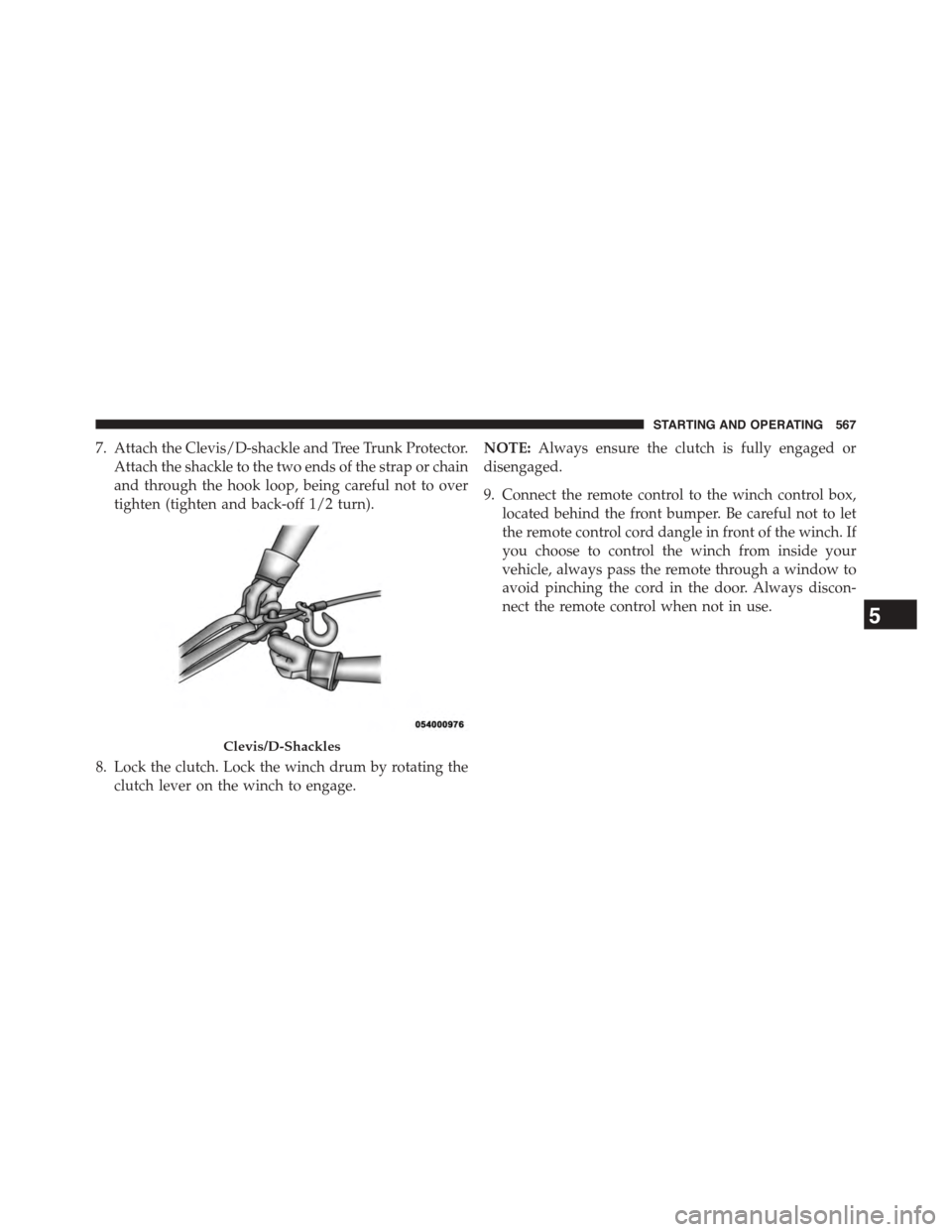
7. Attach the Clevis/D-shackle and Tree Trunk Protector.
Attach the shackle to the two ends of the strap or chain
and through the hook loop, being careful not to over
tighten (tighten and back-off 1/2 turn).
8. Lock the clutch. Lock the winch drum by rotating the
clutch lever on the winch to engage.
NOTE:Always ensure the clutch is fully engaged or
disengaged.
9. Connect the remote control to the winch control box,
located behind the front bumper. Be careful not to let
the remote control cord dangle in front of the winch. If
you choose to control the winch from inside your
vehicle, always pass the remote through a window to
avoid pinching the cord in the door. Always discon-
nect the remote control when not in use.
Clevis/D-Shackles
5
STARTING AND OPERATING 567
Page 577 of 871
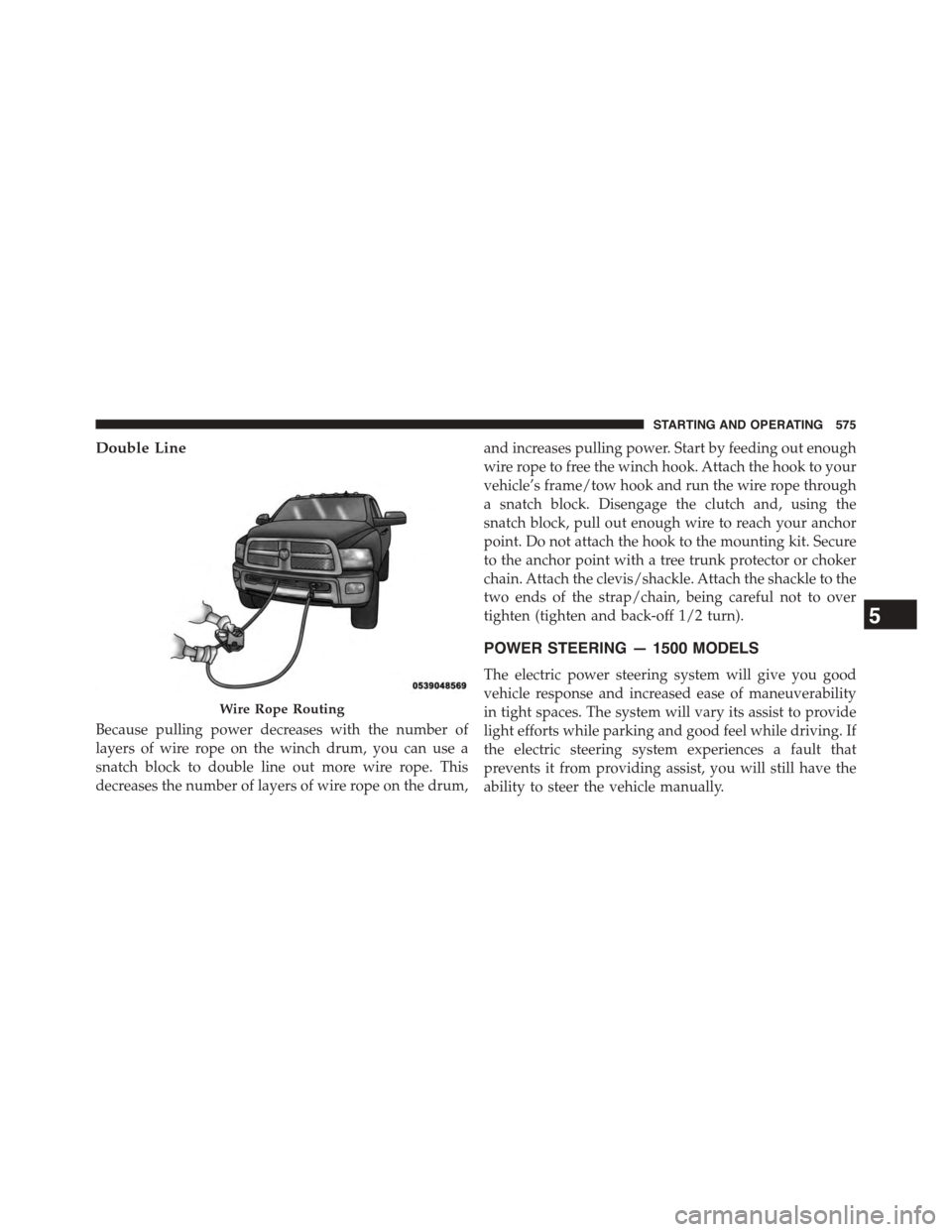
Double Line
Because pulling power decreases with the number of
layers of wire rope on the winch drum, you can use a
snatch block to double line out more wire rope. This
decreases the number of layers of wire rope on the drum,
and increases pulling power. Start by feeding out enough
wire rope to free the winch hook. Attach the hook to your
vehicle’s frame/tow hook and run the wire rope through
a snatch block. Disengage the clutch and, using the
snatch block, pull out enough wire to reach your anchor
point. Do not attach the hook to the mounting kit. Secure
to the anchor point with a tree trunk protector or choker
chain. Attach the clevis/shackle. Attach the shackle to the
two ends of the strap/chain, being careful not to over
tighten (tighten and back-off 1/2 turn).
POWER STEERING — 1500 MODELS
The electric power steering system will give you good
vehicle response and increased ease of maneuverability
in tight spaces. The system will vary its assist to provide
light efforts while parking and good feel while driving. If
the electric steering system experiences a fault that
prevents it from providing assist, you will still have the
ability to steer the vehicle manually.
Wire Rope Routing
5
STARTING AND OPERATING 575
Page 679 of 871

WARNING!(Continued)
the parking brake. The transfer case NEUTRAL (N)
position disengages both the front and rear drive-
shafts from the powertrain and will allow the vehicle
to roll, even if the transmission is in PARK. The
parking brake should always be applied when the
driver is not in the vehicle.
CAUTION!
It is necessary to follow these steps to be certain that
the transfer case is fully in NEUTRAL (N) before
recreational towing to prevent damage to internal
parts.
1. Bring the vehicle to a complete stop, with the engine
running. Firmly apply the parking brake.
2. Shift the transmission to NEUTRAL.
NOTE:If vehicle is equipped with air suspension, ensure
the vehicle is set to Normal Ride Height.
3. Press and hold the brake pedal.
4. Depress the clutch pedal on a manual transmission.
•With manual shift transfer case, shift the transfer
case lever into NEUTRAL (N).
•With electronic shift transfer case, press and hold the
transfer case NEUTRAL (N) button. Some models
have a small, recessed#N#button (at the center of the
transfer case switches) that must be pressed using a
ballpoint pen or similar object. Other models have a
rectangular NEUTRAL switch, below the rotary
transfer case control knob. The NEUTRAL (N) indi-
cator light will blink while the shift is in progress.
The light will stop blinking (stay on solid) when the
shift to NEUTRAL (N) is complete. After the shift is
completed and the NEUTRAL (N) light stays on,
release the NEUTRAL (N) button.
5
STARTING AND OPERATING 677
Page 680 of 871
5. Release the parking brake.
6. Shift the transmission into REVERSE.
7. Release the brake pedal (and clutch pedal on manual
transmissions) for five seconds and ensure that there is
no vehicle movement.
8. Repeat steps 7 and 8 with automatic transmission in
DRIVE or manual transmission in first gear.
9. Shift the transmission to NEUTRAL. Firmly apply the
parking brake. Turn OFF the engine. For vehicles with
Keyless Enter-N-Go™, press and hold the ENGINE
START/STOP button until the engine shuts off.
10. Shift the transmission into PARK or place manual
transmission in gear (NOT in Neutral). On 8-speed
transmissions the shifter will automatically select
PARK when the engine is turned off.
11. Turn the ignition switch to the OFF position, then
cycle the key or the Keyless Enter-N-Go™ button to
the RUN position and back to the OFF position.
12. Attach the vehicle to the tow vehicle using a suitable
tow bar.
13. Release the parking brake.
NOTE:With electronic shift transfer case:
•Steps 2 through 4 are requirements that must be met
before pressing the NEUTRAL (N) button, and must
continue to be met until the shift has been completed.
If any of these requirements are not met before press-
ing the NEUTRAL (N) button or are no longer met
during the shift, the NEUTRAL (N) indicator light will
flash continuously until all requirements are met or
until the NEUTRAL (N) button is released.
678 STARTING AND OPERATING
Page 681 of 871

•The ignition switch must be in the ON/RUN position
for a shift to take place and for the position indicator
lights to be operable. If the ignition switch is not in the
ON/RUN position, the shift will not take place and no
position indicator lights will be on or flashing.
•A flashing NEUTRAL (N) position indicator light
indicates that shift requirements have not been met.
•If the vehicle is equipped with air suspension, the
engine should be started and left running for a mini-
mum of 60 seconds (with all the doors closed) at least
once every 24 hours. This process allows the air
suspension to adjust the vehicle’s ride height to com-
pensate for temperature effects.
Shifting Out Of NEUTRAL (N)
Use the following procedure to prepare your vehicle for
normal usage.
1. Bring the vehicle to a complete stop, leaving it con-
nected to the tow vehicle.
2. Firmly apply the parking brake.
3. Press and hold the brake pedal.
4. Start the engine. Shift the transmission into NEU-
TRAL. Depress the clutch pedal on a manual trans-
mission.
•With manual shift transfer case, shift the transfer
case lever to the desired position.
•With electronic shift transfer case with rotary selector
switch, press and hold the transfer case NEUTRAL (N)
button until the NEUTRAL (N) indicator light turns
off. After the NEUTRAL (N) indicator light turns off,
release the NEUTRAL (N) button. After the NEUTRAL
5
STARTING AND OPERATING 679
Page 682 of 871

(N) button has been released, the transfer case will
shift to the position indicated by the selector switch.
•With electronic shift transfer case with pushbutton
selector switch, press and hold the switch for the
desired transfer case position, until the NEUTRAL
(N) indicator light turns off and the desired position
indicator light turns on.
NOTE:When shifting out of transfer case NEUTRAL (N),
turning the engine OFF is not required, but may be
helpful to avoid gear clash. With the 8-speed automatic
transmission, the engine must remain running, since
turning the engine OFF will shift the transmission to
PARK (and the transmission must be in NEUTRAL for
the transfer case to shift out of NEUTRAL).
5. Turn the engine OFF. Shift automatic transmission into
PARK. On 8-speed transmissions the shifter will auto-
matically select PARK when the engine is turned off.
6. Release the brake pedal (and clutch pedal on a manual
transmission).
7. Disconnect vehicle from the tow vehicle.
8. Start the engine.
9. Press and hold the brake pedal.
10. Release the parking brake.
11. Shift the transmission into gear, release the brake
pedal (and clutch pedal on manual transmissions),
and check that the vehicle operates normally.
NOTE:With electronic shift transfer case:
•Steps 3 and 4 are requirements that must be met before
pressing the button to shift out of NEUTRAL (N), and
must continue to be met until the shift has been
completed. If any of these requirements are not met
before pressing the button or are no longer met during
680 STARTING AND OPERATING
Page 805 of 871

Cavity Cartridge Fuse Micro FuseDescription
F525 Amp TanBattery Sensor
F5320 Amp YellowTrailer Tow – Left Turn/Stop Lights
F5420 Amp YellowAdjustable Pedals
F5615 Amp Blue Additional Diesel Content – If Equipped
F5720 Amp YellowTransmission
F5820 Amp YellowSpare Fuse
F5910 Amp RedSCR Relay – If Equipped
F6015 Amp BlueUnderhood Lamp
F6110 Amp Red (1500
LD Diesel & Cum-
mins Diesel)
PM Sensor – If Equipped
F6210 Amp RedAir Conditioning Clutch
F6320 Amp Yellow Ignition Coils (Gas), Urea Heater (Cummins
Diesel)
F6425 Amp ClearFuel Injectors / Powertrain
7
MAINTAINING YOUR VEHICLE 803