radio Ram 1500 2015 Workshop Manual
[x] Cancel search | Manufacturer: RAM, Model Year: 2015, Model line: 1500, Model: Ram 1500 2015Pages: 871, PDF Size: 24.83 MB
Page 528 of 871
WARNING!
The air suspension system uses a high pressure
volume of air to operate the system. To avoid per-
sonal injury or damage to the system, see your
authorized dealer for service.
Air Suspension Modes
The Air Suspension system has multiple modes to protect
the system in unique situations:
Tire/Jack Mode
To assist with changing a spare tire, the air suspension
system has a feature which allows the automatic leveling to
be disabled. This mode is intended to be used with engine
running. Refer to “Electronic Vehicle Information Center
(EVIC) or Driver Information Display (DID)” in “Under-
standing Your Instrument Panel” or “Uconnect® Settings”
in “Understanding Your Instrument Panel” if equipped
with a touch screen radio for further information.
NOTE:This mode is intended to be enabled with engine
running.
Transport Mode
To assist with flat bed towing, the air suspension system
has a feature which will put the vehicle below Normal
Ride Height (NRH) and disable the automatic load
leveling system. This mode is intended to be used with
engine running. Refer to “Electronic Vehicle Information
Center (EVIC) or Driver Information Display (DID)” in
“Understanding Your Instrument Panel” or “Uconnect®
Settings” in “Understanding Your Instrument Panel” if
equipped with a touch screen radio for further informa-
tion.
NOTE:This mode is intended to be enabled with engine
running.
526 STARTING AND OPERATING
Page 529 of 871
Wheel Alignment Mode
Before performing a wheel alignment this mode must be
enabled. Refer to “Electronic Vehicle Information Center
(EVIC) or Driver Information Display (DID)” in “Under-
standing Your Instrument Panel” or “Uconnect® Set-
tings” in “Understanding Your Instrument Panel” if
equipped with a touch screen radio for further informa-
tion.
NOTE:This mode is intended to be enabled with engine
running.
Protection Mode
In order to “protect” the air suspension system, the
vehicle will enter Protection Mode when load leveling
cannot be achieved. Some driving may be required to
clear the protection mode telltale in the EVIC/DID. Refer
to “Electronic Vehicle Information Center (EVIC) or
Driver Information Display (DID)” in “Understanding
Your Instrument Panel” or “Uconnect® Settings” in “Un-
derstanding Your Instrument Panel” if equipped with a
touch screen radio for further information.
NOTE:If equipped with a touch screen radio all
enabling/disabling of air suspension features must be
done through the radio. Refer to “Uconnect® Settings” in
“Understanding Your Instrument Panel” for further in-
formation.
Electronic Vehicle Information Center
(EVIC)/Driver Information Display (DID) Display
Messages
When the appropriate conditions exist, a message will
appear in the EVIC/DID display. Refer to “Electronic
Vehicle Information Center (EVIC) or Driver Information
Display (DID)” in “Understanding Your Instrument
Panel” for further information.
An audible chime will be heard whenever a system error
has been detected.
5
STARTING AND OPERATING 527
Page 633 of 871
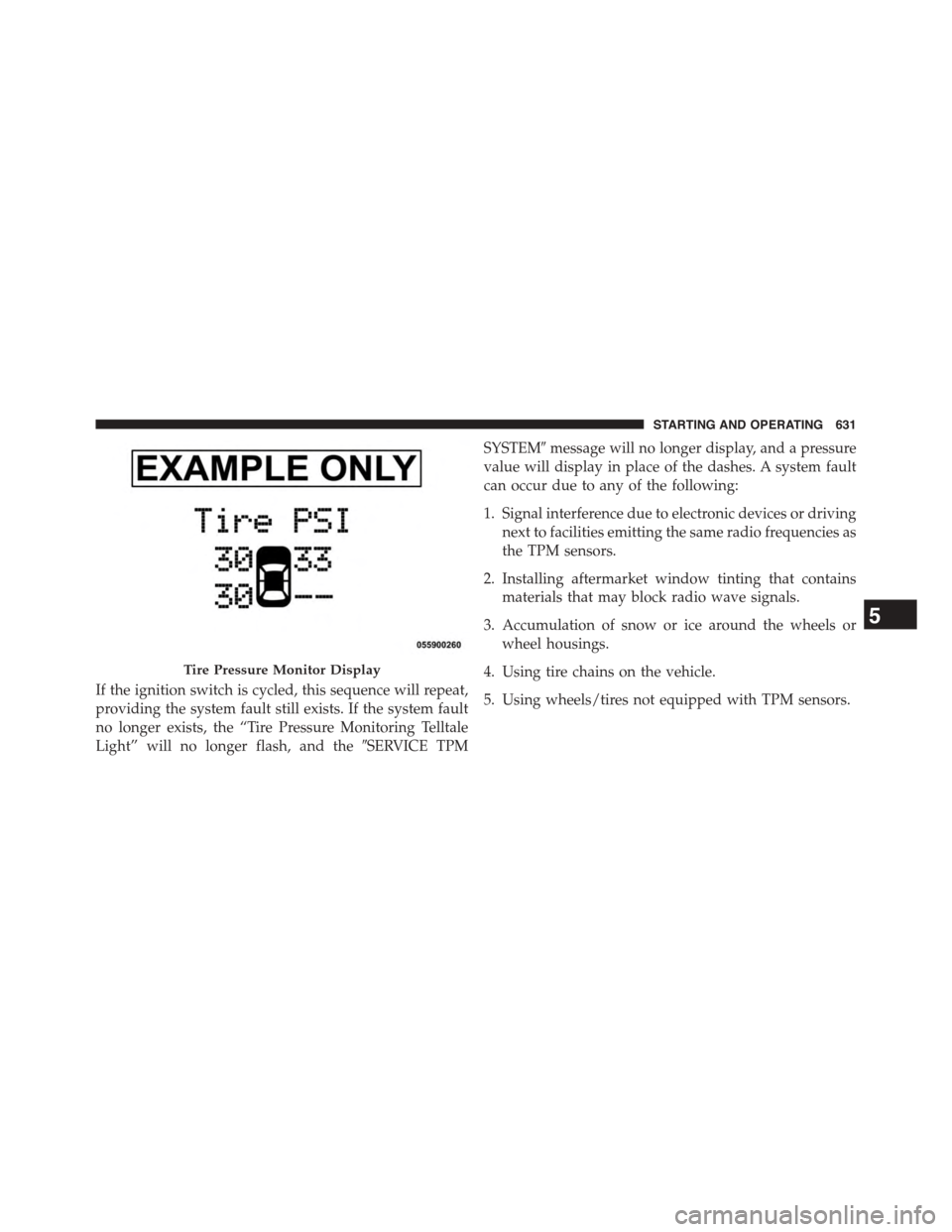
If the ignition switch is cycled, this sequence will repeat,
providing the system fault still exists. If the system fault
no longer exists, the “Tire Pressure Monitoring Telltale
Light” will no longer flash, and the#SERVICE TPM
SYSTEM#message will no longer display, and a pressure
value will display in place of the dashes. A system fault
can occur due to any of the following:
1. Signal interference due to electronic devices or driving
next to facilities emitting the same radio frequencies as
the TPM sensors.
2. Installing aftermarket window tinting that contains
materials that may block radio wave signals.
3. Accumulation of snow or ice around the wheels or
wheel housings.
4. Using tire chains on the vehicle.
5. Using wheels/tires not equipped with TPM sensors.
Tire Pressure Monitor Display
5
STARTING AND OPERATING 631
Page 635 of 871
•Six TPM sensors (Dual Rear Wheel (DRW) applica-
tions)
•Pressure display in the Electronic Vehicle Information
Center (EVIC)/Driver Information Display (DID)
The TPIS system will display all four (Single Rear Wheel
(SRW) applications) or six (Dual Rear Wheel (DRW)
applications) tire pressure values in the EVIC/DID dis-
play.
If a system fault is detected, the EVIC/DID will display a
#SERVICE TPM SYSTEM#message for a minimum of five
seconds and then display dashes (- -) in place of the
pressure value to indicate which sensor is not being
received.
If the ignition switch is cycled, this sequence will repeat,
providing the system fault still exists. If the system fault
no longer exists, the#SERVICE TPM SYSTEM#message
will no longer be displayed, and a pressure value will
display in place of the dashes. A system fault can occur
due to any of the following:
•Signal interference due to electronic devices or driving
next to facilities emitting the same radio frequencies as
the TPM sensors.
•Installing aftermarket window tinting that contains
materials that may block radio wave signals.
•Accumulation of snow or ice around the wheels or
wheel housings.
•Using tire chains on the vehicle.
•Using wheels/tires not equipped with TPM sensors.
5
STARTING AND OPERATING 633
Page 655 of 871
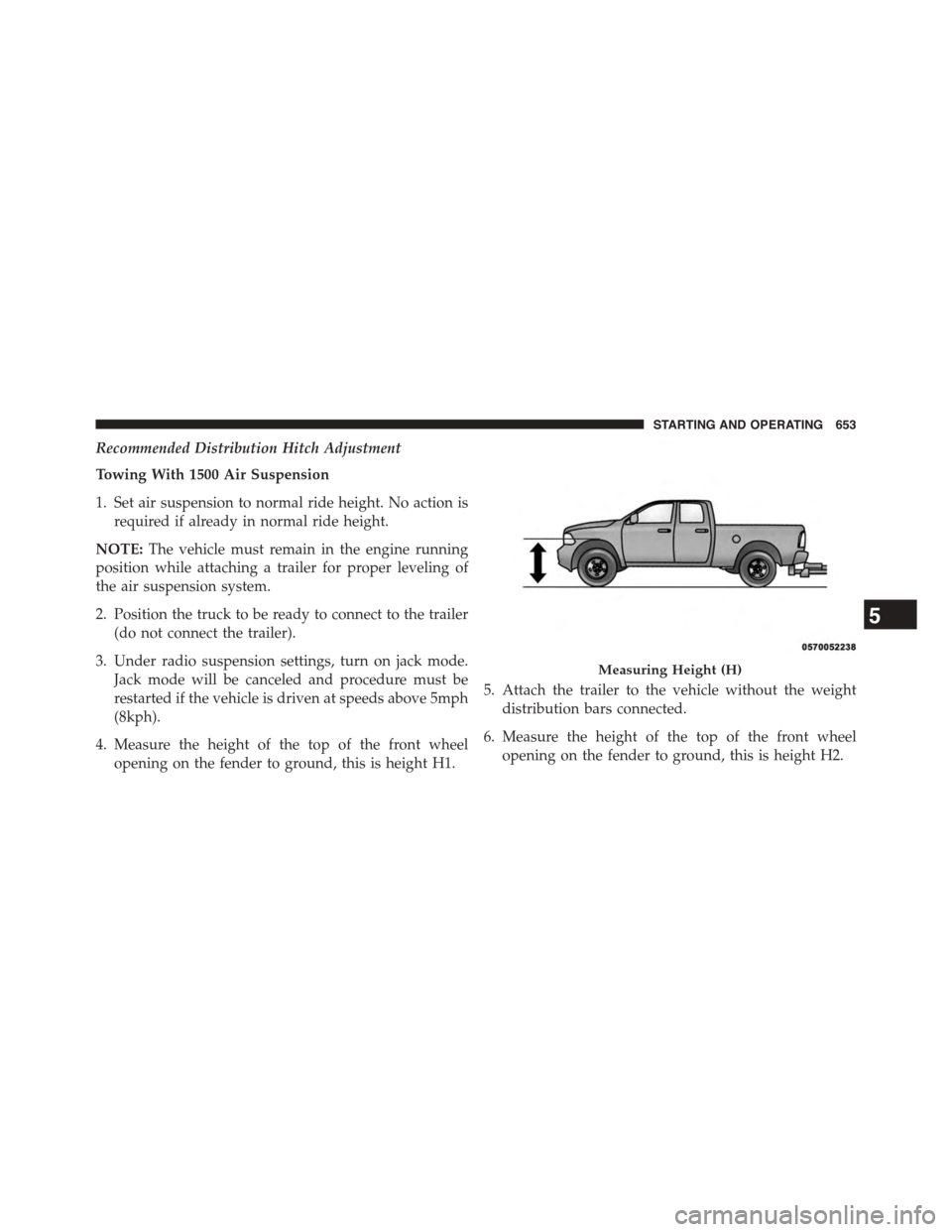
Recommended Distribution Hitch Adjustment
Towing With 1500 Air Suspension
1. Set air suspension to normal ride height. No action is
required if already in normal ride height.
NOTE:The vehicle must remain in the engine running
position while attaching a trailer for proper leveling of
the air suspension system.
2. Position the truck to be ready to connect to the trailer
(do not connect the trailer).
3. Under radio suspension settings, turn on jack mode.
Jack mode will be canceled and procedure must be
restarted if the vehicle is driven at speeds above 5mph
(8kph).
4. Measure the height of the top of the front wheel
opening on the fender to ground, this is height H1.
5. Attach the trailer to the vehicle without the weight
distribution bars connected.
6. Measure the height of the top of the front wheel
opening on the fender to ground, this is height H2.
Measuring Height (H)
5
STARTING AND OPERATING 653
Page 687 of 871
HAZARD WARNING FLASHERS
The Hazard Warning flasher switch is located on the
upper switch bank just below the radio.
Press the switch to turn on the Hazard Warning
flasher. When the switch is activated, all direc-
tional turn signals will flash on and off to warn oncoming
traffic of an emergency. Press the switch a second time to
turn off the Hazard Warning flashers.
This is an emergency warning system and it should not
be used when the vehicle is in motion. Use it when your
vehicle is disabled and it is creating a safety hazard for
other motorists.
When you must leave the vehicle to seek assistance, the
Hazard Warning flashers will continue to operate even
though the ignition is placed in the OFF position.
NOTE:With extended use the Hazard Warning flashers
may wear down your battery.
IF YOUR ENGINE OVERHEATS
In any of the following situations, you can reduce the
potential for overheating by taking the appropriate action.
•On the highways — slow down.
•In city traffic — while stopped, place the transmission
in NEUTRAL, but do not increase the engine idle
speed.
NOTE:There are steps that you can take to slow down
an impending overheat condition:
•If your air conditioner (A/C) is on, turn it off. The A/C
system adds heat to the engine cooling system and
turning the A/C off can help remove this heat.
•You can also turn the temperature control to maximum
heat, the mode control to floor and the blower control to
high. This allows the heater core to act as a supplement
to the radiator and aids in removing heat from the
engine cooling system.
6
WHAT TO DO IN EMERGENCIES 685
Page 733 of 871
WARNING!
•Take care to avoid the radiator cooling fan when-
ever the hood is raised. It can start anytime the
ignition switch is ON. You can be injured by
moving fan blades.
•Remove any metal jewelry such as rings, watch
bands and bracelets that could make an inadvertent
electrical contact. You could be seriously injured.
•Batteries contain sulfuric acid that can burn your
skin or eyes and generate hydrogen gas which is
flammable and explosive. Keep open flames or
sparks away from the battery.
1. Set the parking brake, shift the automatic transmission
into PARK and turn the ignition to LOCK.
2. Turn off the heater, radio, and all unnecessary electri-
cal accessories.
3. If using another vehicle to jump-start the battery, park
the vehicle within the jumper cables reach, set the
parking brake and make sure the ignition is OFF.
WARNING!
Do not allow vehicles to touch each other as this
could establish a ground connection and personal
injury could result.
Jump-Starting Procedure
WARNING!
Failure to follow this jump-starting procedure could
result in personal injury or property damage due to
battery explosion.
6
WHAT TO DO IN EMERGENCIES 731
Page 797 of 871
cleaner. Use caution when cleaning the inside rear win-
dow equipped with electric defrosters or the right rear
quarter window equipped with the radio antenna. Do
not use scrapers or other sharp instrument that may
scratch the elements.
When cleaning the rear view mirror, spray cleaner on the
towel or rag that you are using. Do not spray cleaner
directly on the mirror.
Cleaning Plastic Instrument Cluster Lenses
The lenses in front of the instruments in this vehicle are
molded in clear plastic. When cleaning the lenses, care
must be taken to avoid scratching the plastic.
1. Clean with a wet soft rag. A mild soap solution may be
used, but do not use high alcohol content or abrasive
cleaners. If soap is used, wipe clean with a clean damp
rag.
2. Dry with a soft cloth.
Seat Belt Maintenance
Do not bleach, dye or clean the belts with chemical
solvents or abrasive cleaners. This will weaken the fabric.
Sun damage can also weaken the fabric.
If the belts need cleaning, use a mild soap solution or
lukewarm water. Do not remove the belts from the car to
wash them. Dry with a soft cloth.
Replace the belts if they appear frayed or worn or if the
buckles do not work properly.
WARNING!
A frayed or torn belt could rip apart in a collision and
leave you with no protection. Inspect the belt system
periodically, checking for cuts, frays, or loose parts.
Damaged parts must be replaced immediately. Do
not disassemble or modify the system. Seat belt
(Continued)
7
MAINTAINING YOUR VEHICLE 795
Page 862 of 871
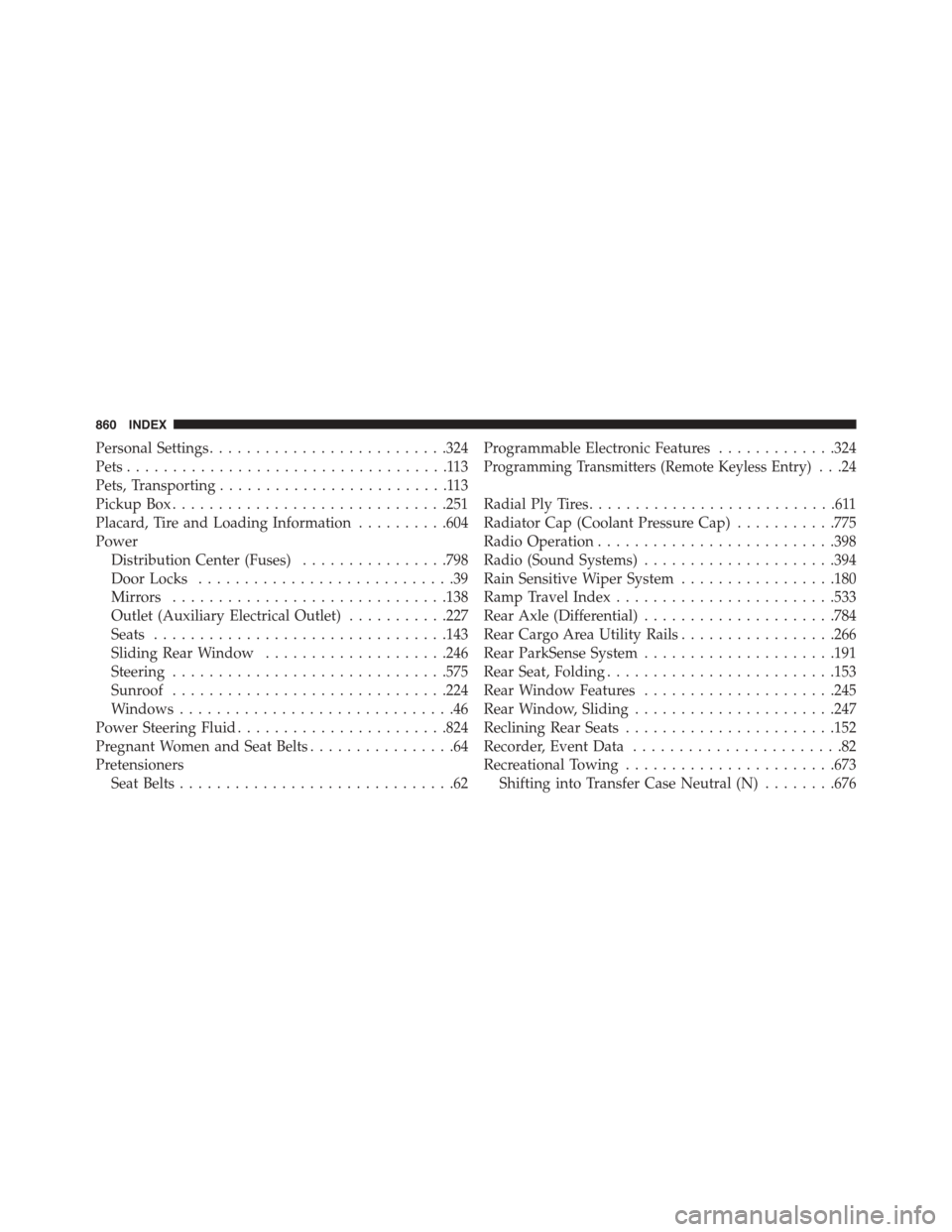
Personal Settings..........................324
Pets...................................113
Pets, Transporting.........................113
Pickup Box..............................251
Placard, Tire and Loading Information..........604
Power
Distribution Center (Fuses)................798
Door Locks............................39
Mirrors..............................138
Outlet (Auxiliary Electrical Outlet)...........227
Seats................................143
Sliding Rear Window....................246
Steering..............................575
Sunroof..............................224
Windows..............................46
Power Steering Fluid.......................824
Pregnant Women and Seat Belts................64
Pretensioners
Seat Belts..............................62
Programmable Electronic Features.............324
Programming Transmitters (Remote Keyless Entry). . .24
Radial Ply Tires...........................611
Radiator Cap (Coolant Pressure Cap)...........775
Radio Operation..........................398
Radio (Sound Systems).....................394
Rain Sensitive Wiper System.................180
Ramp Travel Index........................533
Rear Axle (Differential).....................784
Rear Cargo Area Utility Rails.................266
Rear ParkSense System.....................191
Rear Seat, Folding.........................153
Rear Window Features.....................245
Rear Window, Sliding......................247
Reclining Rear Seats.......................152
Recorder, Event Data.......................82
Recreational Towing.......................673
Shifting into Transfer Case Neutral (N)........676
860 INDEX
Page 863 of 871
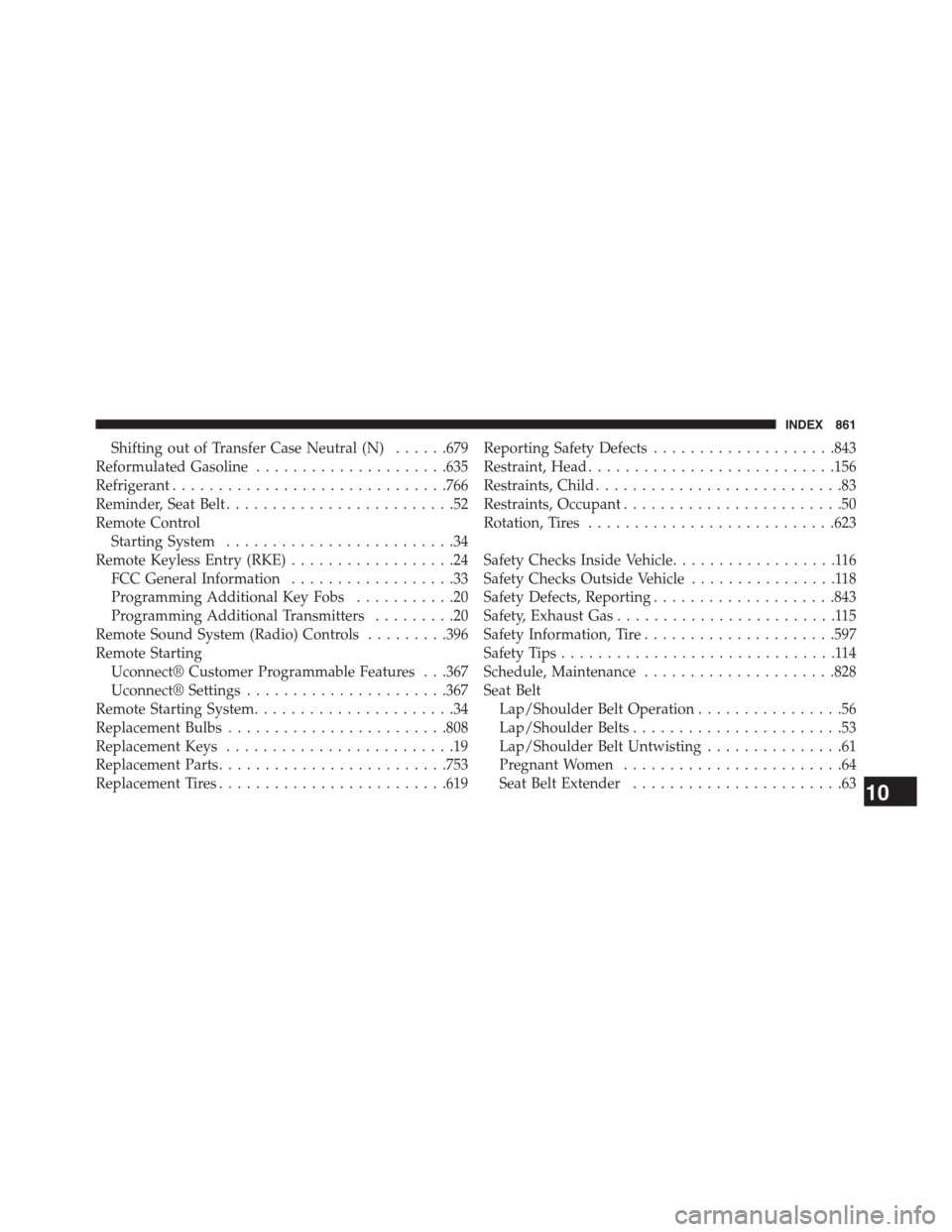
Shifting out of Transfer Case Neutral (N)......679
Reformulated Gasoline.....................635
Refrigerant..............................766
Reminder, Seat Belt.........................52
Remote Control
Starting System.........................34
Remote Keyless Entry (RKE)..................24
FCC General Information..................33
Programming Additional Key Fobs...........20
Programming Additional Transmitters.........20
Remote Sound System (Radio) Controls.........396
Remote Starting
Uconnect® Customer Programmable Features . . .367
Uconnect® Settings......................367
Remote Starting System......................34
Replacement Bulbs........................808
Replacement Keys.........................19
Replacement Parts.........................753
Replacement Tires.........................619
Reporting Safety Defects....................843
Restraint, Head...........................156
Restraints, Child...........................83
Restraints, Occupant........................50
Rotation, Tires...........................623
Safety Checks Inside Vehicle..................116
Safety Checks Outside Vehicle................118
Safety Defects, Reporting....................843
Safety, Exhaust Gas........................115
Safety Information, Tire.....................597
Safety Tips..............................114
Schedule, Maintenance.....................828
Seat Belt
Lap/Shoulder Belt Operation................56
Lap/Shoulder Belts.......................53
Lap/Shoulder Belt Untwisting...............61
Pregnant Women........................64
Seat Belt Extender.......................6310
INDEX 861