Jack Ram 1500 2016 User Guide
[x] Cancel search | Manufacturer: RAM, Model Year: 2016, Model line: 1500, Model: Ram 1500 2016Pages: 916, PDF Size: 7.55 MB
Page 551 of 916
After the engine is turned off, it may be noticed that the
air suspension system operates briefly, this is normal. The
system is correcting the position of the vehicle to ensure
a proper appearance.
To assist with changing a spare tire, the air suspension
system has a feature which allows the automatic leveling
to be disabled. Refer to “Electronic Vehicle Information
Center (EVIC) or Driver Information Display (DID)” in
“Understanding Your Instrument Panel” for further in-
formation.
NOTE:If equipped with a touch screen radio all
enabling/disabling of air suspension features must be
done through the radio. Refer to “Uconnect Settings” in
“Understanding Your Instrument Panel” for further in-
formation.WARNING!
The air suspension system uses a high pressure
volume of air to operate the system. To avoid per-
sonal injury or damage to the system, see your
authorized dealer for service.
Air Suspension Modes
The Air Suspension system has multiple modes to protect
the system in unique situations:
Tire/Jack Mode
To assist with changing a spare tire, the air suspension
system has a feature which allows the automatic leveling
to be disabled. Refer to “Electronic Vehicle Information
Center (EVIC) or Driver Information Display (DID)” in
“Understanding Your Instrument Panel” or “Uconnect
5
STARTING AND OPERATING 549
Page 555 of 916
•Entry/Exit Mode – Indicator lamp 3 will be illumi-
nated when the vehicle is in Entry Exit Mode. Entry/
Exit mode can be requested up to 33 mph (53 km/h).
If vehicle speed is reduced to, and kept below, 15 mph
(24 km/h) indicator lamp 4 will flash and indicator
lamp 3 will remain solid until Entry/Exit Mode is
achieved at which point indicator lamp 4 will turn off.
•Transport Mode – No indicator lamps will be illumi-
nated. Transport Mode is disabled by driving the
vehicle.
•Tire/Jack Mode – Indicator lamps 3 and 6 will be
illuminated. Tire/Jack Mode is disabled by driving the
vehicle.
•Wheel Alignment Mode – Indicator lamps 3 and 4 will
be illuminated. Wheel Alignment Mode is disabled by
driving the vehicle.AIR SUSPENSION SYSTEM (2500/3500 MODELS)
— IF EQUIPPED
Description
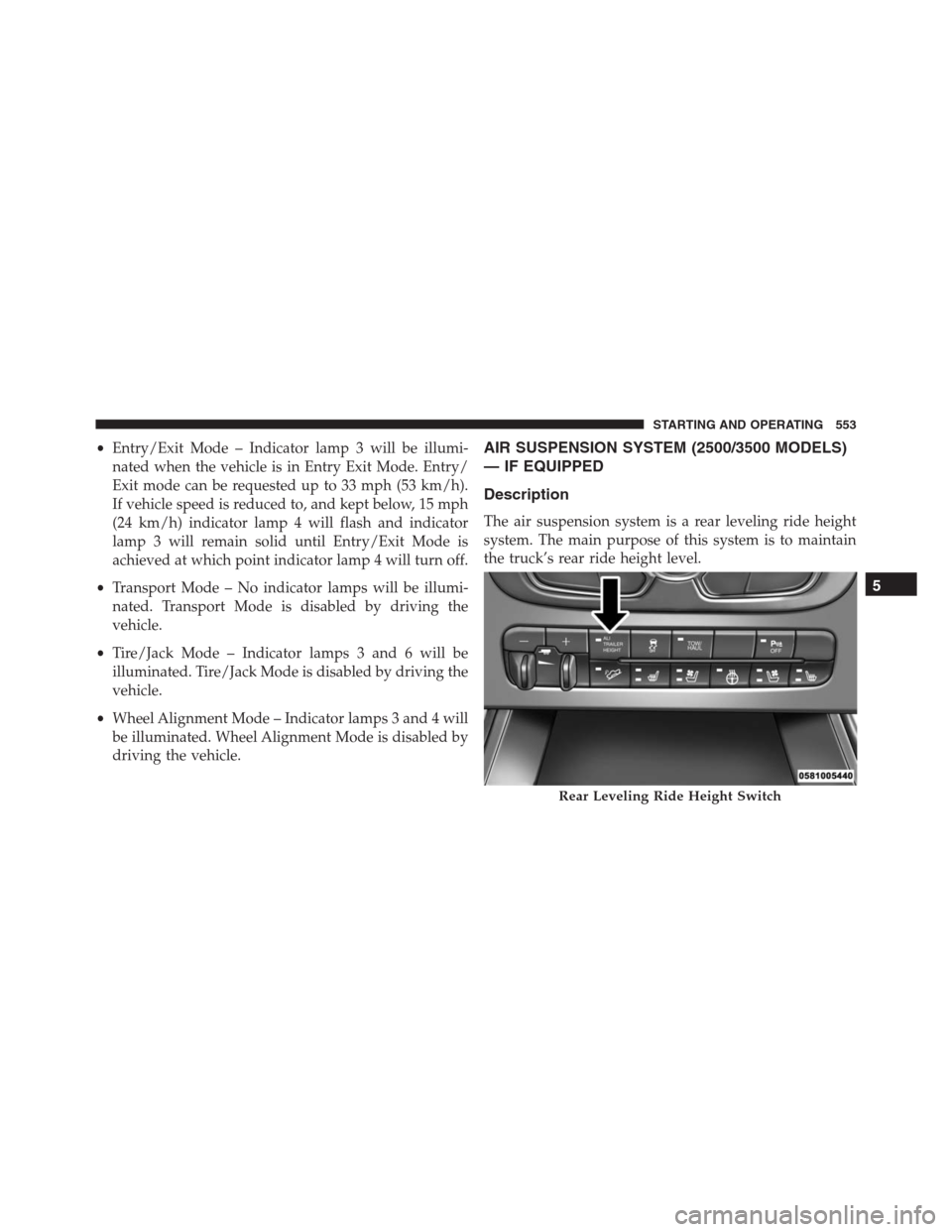
The air suspension system is a rear leveling ride height
system. The main purpose of this system is to maintain
the truck’s rear ride height level.
Rear Leveling Ride Height Switch
5
STARTING AND OPERATING 553
Page 556 of 916
Normal Ride Height (NRH)– This is the standard
position of the suspension and is meant for normal
driving.
Trailer Mode (Lowers the vehicle approximately 1 in (25
mm)– This position will lower the rear suspension and
provide load leveling for all loading conditions including
towing a trailer. After the “ALT TRAILER HEIGHT”
button has been pushed, it will blink continuously until
the trailer height has been achieved.
The system requires that the ignition be in ON/RUN
position or the engine running with zero vehicle speed
for all user requested changes.
After the engine is turned off, it may be noticed that the
air suspension system operates briefly, this is normal. The
system is correcting the position of the vehicle to ensure
a proper appearance.NOTE:If equipped with a touch screen radio all
enabling/disabling of air suspension features must be
done through the radio. Refer to “Uconnect Settings” in
“Understanding Your Instrument Panel” for further in-
formation.
WARNING!
The air suspension system uses a high pressure
volume of air to operate the system. To avoid per-
sonal injury or damage to the system, see your
authorized dealer for service.
Air Suspension Modes
The Air Suspension system has multiple modes to protect
the system in unique situations:
Tire/Jack Mode
To assist with changing a spare tire, the air suspension
system has a feature which allows the automatic leveling
554 STARTING AND OPERATING
Page 559 of 916
•Transport Mode – No indicator lamps will be illumi-
nated. Transport Mode is disabled by driving the
vehicle.
•Tire/Jack Mode – No indicator lamps will be illumi-
nated. Tire/Jack Mode is disabled by driving the
vehicle.
•Wheel Alignment Mode – No indicator lamps will be
illuminated. Wheel Alignment Mode is disabled by
driving the vehicle.
AIR SUSPENSION SYSTEM (REBEL MODELS
ONLY) — IF EQUIPPED
Description
The air suspension system provides full time load level-
ing capability along with the benefit of being able to
adjust vehicle height by the push of a button.
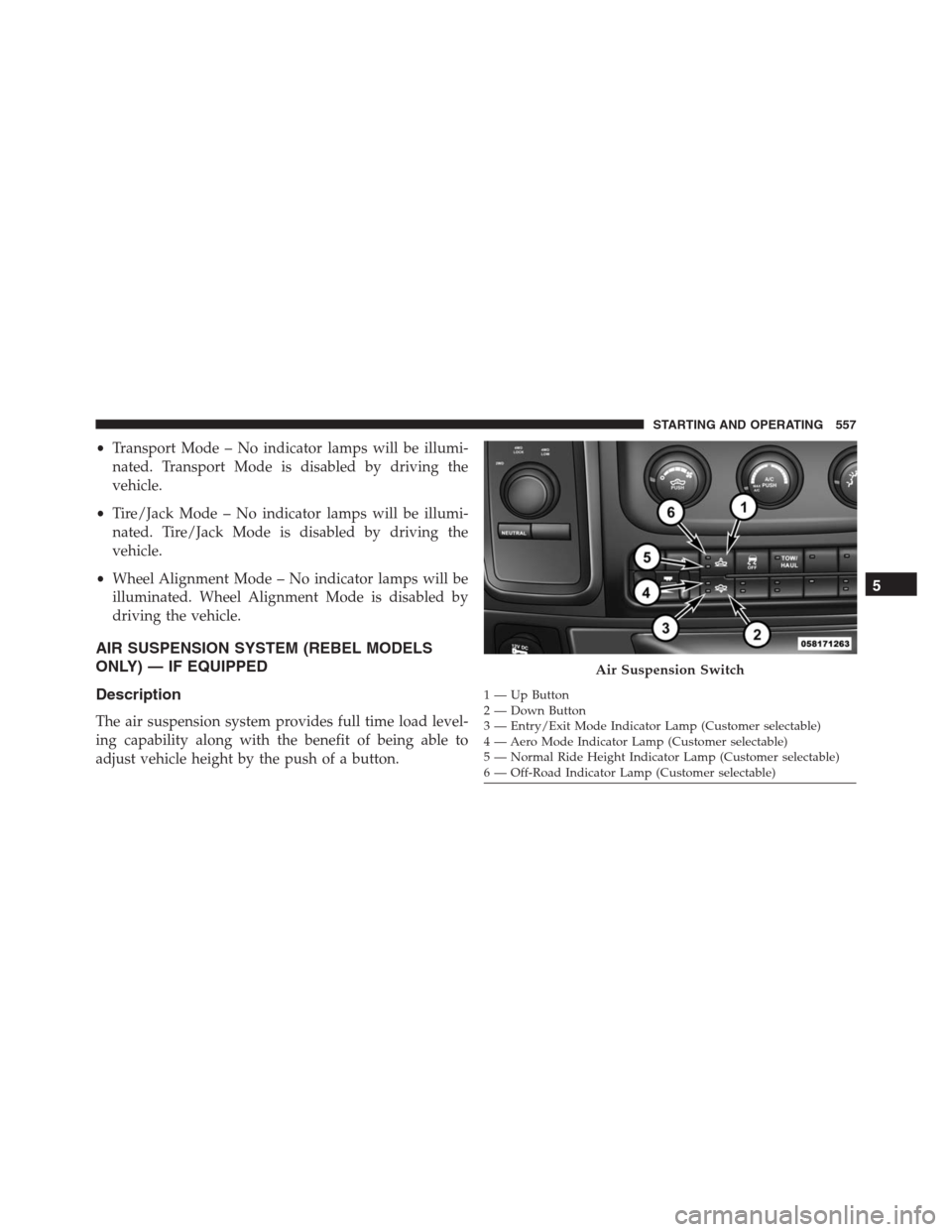
Air Suspension Switch
1 — Up Button
2 — Down Button
3 — Entry/Exit Mode Indicator Lamp (Customer selectable)
4 — Aero Mode Indicator Lamp (Customer selectable)
5 — Normal Ride Height Indicator Lamp (Customer selectable)
6 — Off-Road Indicator Lamp (Customer selectable)
5
STARTING AND OPERATING 557
Page 563 of 916
NOTE:If equipped with a touch screen radio all
enabling/disabling of air suspension features must be
done through the radio. Refer to “Uconnect Settings” in
“Understanding Your Instrument Panel” for further in-
formation.
WARNING!
The air suspension system uses a high pressure
volume of air to operate the system. To avoid per-
sonal injury or damage to the system, see your
authorized dealer for service.
Air Suspension Modes
The Air Suspension system has multiple modes to protect
the system in unique situations:
Tire/Jack Mode
To assist with changing a spare tire, the air suspension
system has a feature which allows the automatic levelingto be disabled. Refer to “Electronic Vehicle Information
Center (EVIC) or Driver Information Display (DID)” in
“Understanding Your Instrument Panel” for further in-
formation.
NOTE:This mode is intended to be enabled with engine
running.
Transport Mode
To assist with flat bed towing, the air suspension system
has a feature which will put the vehicle into Entry/Exit
height and disable the automatic load leveling system.
Refer to “Electronic Vehicle Information Center (EVIC) or
Driver Information Display (DID)” in “Understanding
Your Instrument Panel” for further information.
NOTE:This mode is intended to be enabled with engine
running and all doors closed.
5
STARTING AND OPERATING 561
Page 566 of 916
•Entry/Exit Mode – Indicator lamp 3 will be illumi-
nated when the vehicle is in Entry Exit Mode. Entry/
Exit mode can be requested up to 33 mph (53 km/h).
If vehicle speed is reduced to, and kept below, 15 mph
(24 km/h) indicator lamp 3 will flash and indicator
lamp 4 will remain solid until Entry/Exit Mode is
achieved at which point indicator lamp 4 will turn off.
•Transport Mode – No indicator lamps will be illumi-
nated. Transport Mode is disabled by driving the
vehicle.
•Tire/Jack Mode – indicator lamps 3 and 6 will be
illuminated. Tire/Jack Mode is disabled by driving the
vehicle.
•Wheel Alignment Mode – indicator lamps 3, 4 and 5
will be illuminated. Wheel Alignment Mode is dis-
abled by driving the vehicle.AXLE LOCKER SYSTEM — POWER WAGON
MODELS ONLY (IF EQUIPPED)
This vehicle is equipped with electronically locking front
and rear differentials. These differentials, when engaged,
mechanically lock together the axle shafts forcing the
wheels to spin at an equal rate. This allows the vehicle to
maintain its momentum and prevents it from becoming
stuck. The locking front and rear differentials should only
be engaged during low-speed, extreme off-road situa-
tions where one wheel is likely to not be in contact with
the ground. It is not recommended to drive the vehicle
with the differentials locked on pavement due to the
reduced ability to turn and speed limitations.
CAUTION!
•Do not lock the front or rear axle on hard surfaced
roads. The ability to steer the vehicle is reduced
(Continued)
564 STARTING AND OPERATING
Page 578 of 916
what is the best direction to recover the vehicle. Depend-
ing on what you are in contact with, jack the vehicle up
and place a few rocks under the tires so the weight is off
of the high point when you let the vehicle down. You can
also try rocking the vehicle or winching the vehicle off
the object.
CAUTION!
Winching or rocking the vehicle off hard objects
increases the risk of underbody damage.
Hill Climbing
Hill climbing requires good judgment and a good under-
standing of your abilities and your vehicle’s limitations.
Hills can cause serious problems. Some are just too steep
to climb and should not be attempted. You should alwaysfeel confident with the vehicle and your abilities. You
should always climb hills straight up and down. Never
attempt to climb a hill on an angle.
•Before Climbing A Steep Hill– As you approach a
hill consider its grade or steepness. Determine if it is
too steep. Look to see what the traction is on the hill
side trail. Is the trail straight up and down? What is on
top and the other side? Are there ruts, rocks, branches
or other obstacles on the path? Can you safely recover
the vehicle if something goes wrong? If everything
looks good and you feel confident, then change trans-
mission into a lower gear, shift the transfer case into 4L
(Low) and proceed with caution. You should use first
gear and 4L (Low Range) for very steep hills.
•Driving Up Hill– Once you have determined your
ability to proceed and have shifted into the appropri-
ate gear, line your vehicle up for the straightest pos-
sible run. Accelerate with an easy constant throttle and
576 STARTING AND OPERATING
Page 585 of 916
high risk of vehicle damage during the recovery process?
Answering these questions will help you determine the
best method of recovery. If you can still move the vehicle
slightly and the only issue is slick ground, then rock
cycling your vehicle would be the first choice. If you have
ample room, an additional vehicle and there is low risk of
vehicle impingement on the surroundings, then using a
tow strap to the vehicle tow hooks would be fast and
easy. If the vehicle is severely hung up or in a situation
where great care needs to be taken during the recovery,
then nothing can do the job better than a winch. If you are
severely hung up on something you should jack the
vehicle up and stack something under the wheels to
allow the vehicle to roll off the object without causing
further damage. This should be tried before attempting
any recovery method.CAUTION!
Pulling the vehicle off an obstacle, without first
clearing the object, may result in additional under-
body damage.
•Rock Cycling Your Vehicle– Rock cycling your ve-
hicle is one of the easiest, fastest and most commonly
used methods. This simply involves shifting your
vehicle from DRIVE to REVERSE, while applying
throttle after each shift. During this process, for addi-
tional traction, try turning your steering wheel quickly
left and right no more than a ¼ turn. If you are stuck
in mud, sand, or snow try spinning your tires during
this process to clean the debris from the tread and
improve the traction. You want to create a rocking
motion with the vehicle. This helps build vehicle
momentum, which hopefully gets you out. Remember
to ease off and on the accelerator before and after the
5
STARTING AND OPERATING 583
Page 695 of 916
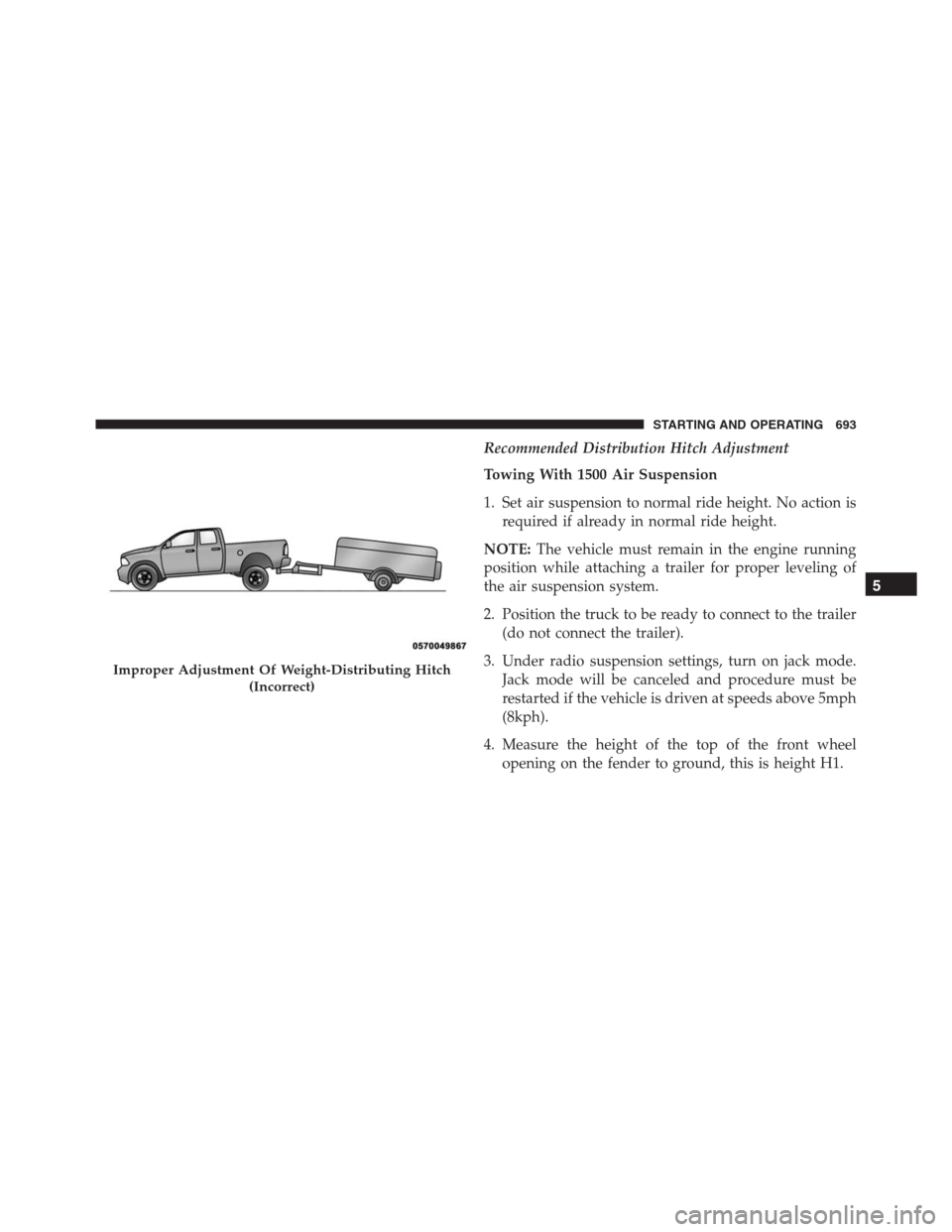
Recommended Distribution Hitch Adjustment
Towing With 1500 Air Suspension
1. Set air suspension to normal ride height. No action is
required if already in normal ride height.
NOTE:The vehicle must remain in the engine running
position while attaching a trailer for proper leveling of
the air suspension system.
2. Position the truck to be ready to connect to the trailer
(do not connect the trailer).
3. Under radio suspension settings, turn on jack mode.
Jack mode will be canceled and procedure must be
restarted if the vehicle is driven at speeds above 5mph
(8kph).
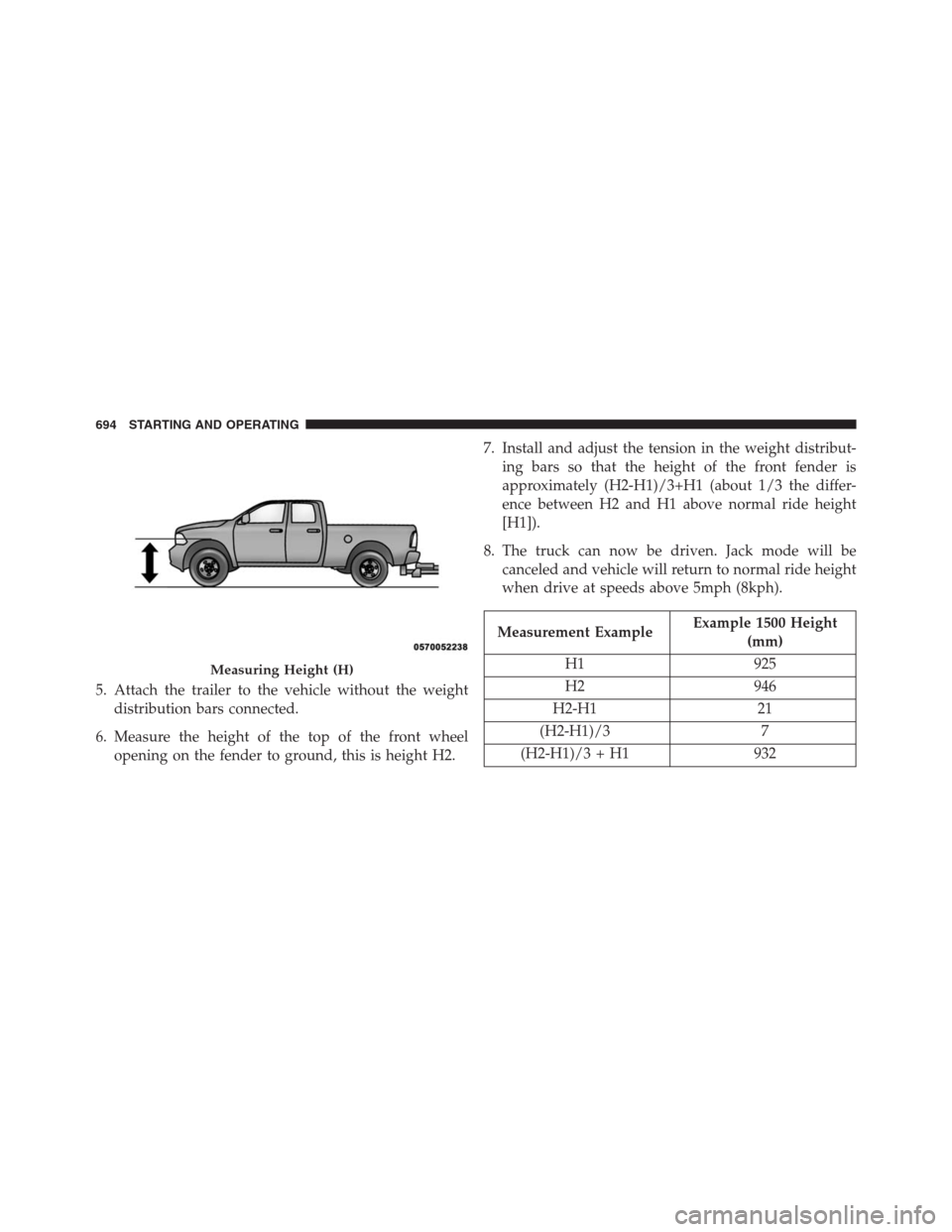
4. Measure the height of the top of the front wheel
opening on the fender to ground, this is height H1.
Improper Adjustment Of Weight-Distributing Hitch
(Incorrect)
5
STARTING AND OPERATING 693
Page 696 of 916
5. Attach the trailer to the vehicle without the weight
distribution bars connected.
6. Measure the height of the top of the front wheel
opening on the fender to ground, this is height H2.7. Install and adjust the tension in the weight distribut-
ing bars so that the height of the front fender is
approximately (H2-H1)/3+H1 (about 1/3 the differ-
ence between H2 and H1 above normal ride height
[H1]).
8. The truck can now be driven. Jack mode will be
canceled and vehicle will return to normal ride height
when drive at speeds above 5mph (8kph).
Measurement ExampleExample 1500 Height
(mm)
H1 925
H2 946
H2-H1 21
(H2-H1)/3 7
(H2-H1)/3 + H1 932
Measuring Height (H)
694 STARTING AND OPERATING