air condition Ram 1500 2016 Owner's Guide
[x] Cancel search | Manufacturer: RAM, Model Year: 2016, Model line: 1500, Model: Ram 1500 2016Pages: 916, PDF Size: 7.55 MB
Page 444 of 916
Winter Operation
To ensure the best possible heater and defroster perfor-
mance, make sure the engine cooling system is function-
ing properly and the proper amount, type, and concen-
tration of coolant is used. Refer to “Maintenance
Procedures” in “Maintaining Your Vehicle” for proper
coolant selection. Use of the air Recirculation mode
during Winter months is not recommended because it
may cause window fogging.
Vacation/Storage
Any time you store your vehicle or keep it out of service
(i.e., vacation) for two weeks or more, run the air
conditioning system at idle for about five minutes in
fresh air with the blower setting in high. This will ensure
adequate system lubrication to minimize the possibility
of compressor damage when the system is started again.
Window Fogging and Frosting
Vehicle windows tend to fog on the inside of the glass in
mild, rainy and/or humid weather. Windows may frost
on the inside of the glass in very cold weather. To clear
the windows, select Defrost or Mix mode and increase
the front blower speed. Do not use the Recirculation
mode without A/C for long periods, as fogging may
occur.
NOTE:Automatic Temperature Controls (ATC) will au-
tomatically adjust the climate control settings to reduce
or eliminate window fogging on the front windshield.
When this occurs, recirculation will be unavailable.
442 UNDERSTANDING YOUR INSTRUMENT PANEL
Page 484 of 916

Automatic Mode
The Stop/Start feature is enabled after every normal
customer engine start. It will remain in STOP/START
NOT READY until you drive forward with a vehicle
speed greater than 5 mph (8 km/h). At that time, the
system will go into STOP/START READY and if all other
conditions are met, can go into an STOP/START AUTO
STOP ACTIVE “Autostop” mode.
To Activate The Autostop Mode, The Following Must
Occur:
1. The system must be in STOP/START READY state. A
STOP/START READY message will be displayed in
the Electronic Vehicle Information Center (EVIC)/
Driver Information Display (DID) within the Stop/
Start section. Refer to “Electronic Vehicle Information
Center (EVIC) or Driver Information Display (DID)”
in “Electronics” for further information.
2. The vehicle must be completely stopped.3. The transmission Gear Selector must be in DRIVE and
the brake pedal depressed.
The engine will shut down, the tachometer will move to
the zero position and the stop/start telltale will illumi-
nate indicating you are in an Autostop. While in an
Autostop, the Climate Controls system may automati-
cally adjust airflow to maintain cabin comfort. Customer
settings will be maintained upon return to an engine
running condition.
Possible Reasons The Engine Does Not Autostop
Prior to engine shut down, the system will check many
safety and comfort conditions to see if they are fulfilled.
In following situations the engine will not stop:
•Driver ’s seat belt is not buckled.
•Driver ’s door is not closed.
•Outside temperature is less than 1°F (–17°C) or greater
than 104°F (40°C).
482 STARTING AND OPERATING
Page 553 of 916
Your Instrument Panel” or “Uconnect Settings” in “Un-
derstanding Your Instrument Panel” if equipped with a
touch screen radio for further information.
NOTE:If equipped with a touch screen radio all
enabling/disabling of air suspension features must be
done through the radio. Refer to “Uconnect Settings” in
“Understanding Your Instrument Panel” for further in-
formation.
Electronic Vehicle Information Center
(EVIC)/Driver Information Display (DID) Display
Messages
When the appropriate conditions exist, a message will
appear in the EVIC/DID display. Refer to “Electronic
Vehicle Information Center (EVIC) or Driver Information
Display (DID)” in “Understanding Your Instrument
Panel” for further information.
An audible chime will be heard whenever a system error
has been detected.
Operation
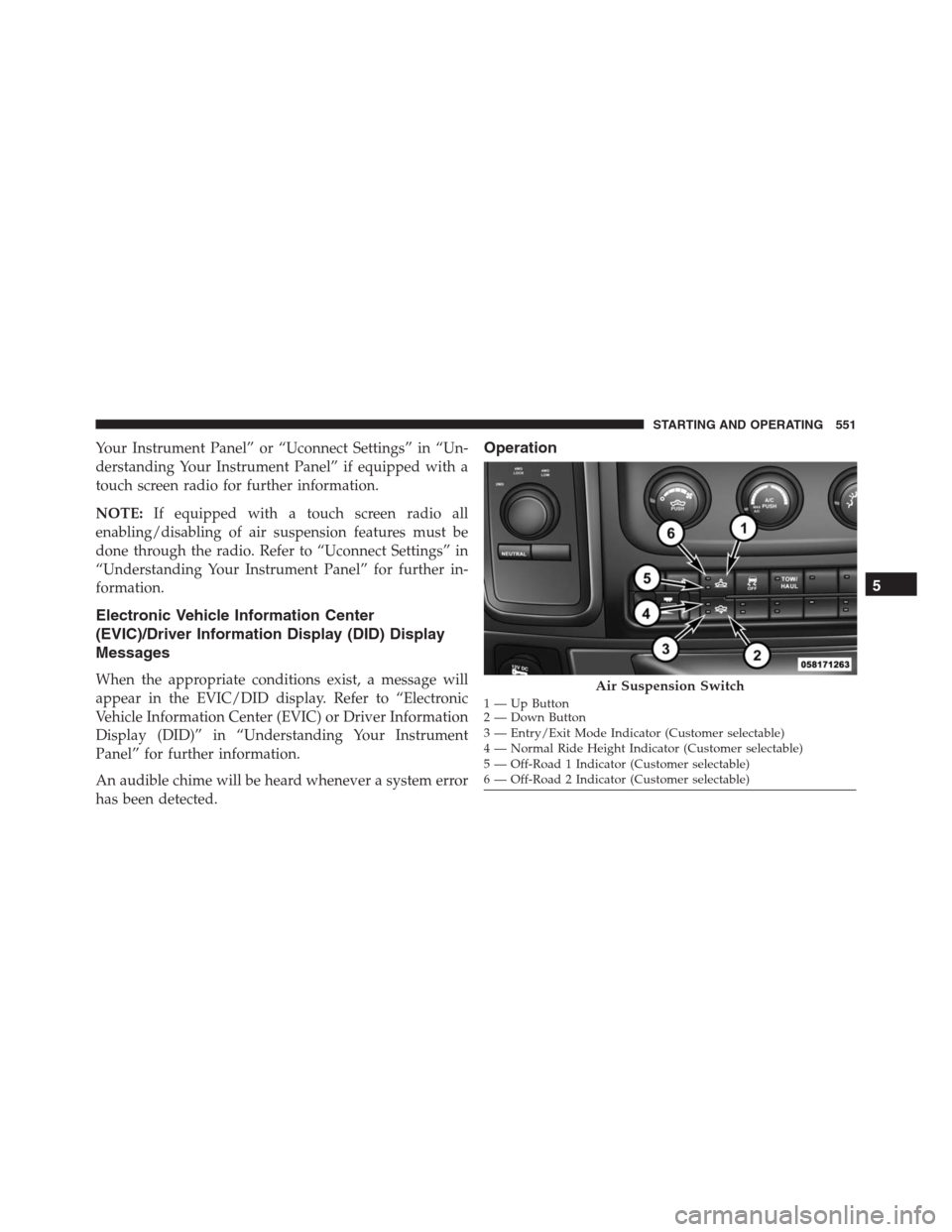
1 — Up Button
2 — Down Button
3 — Entry/Exit Mode Indicator (Customer selectable)
4 — Normal Ride Height Indicator (Customer selectable)
5 — Off-Road 1 Indicator (Customer selectable)
6 — Off-Road 2 Indicator (Customer selectable)
Air Suspension Switch
5
STARTING AND OPERATING 551
Page 556 of 916
Normal Ride Height (NRH)– This is the standard
position of the suspension and is meant for normal
driving.
Trailer Mode (Lowers the vehicle approximately 1 in (25
mm)– This position will lower the rear suspension and
provide load leveling for all loading conditions including
towing a trailer. After the “ALT TRAILER HEIGHT”
button has been pushed, it will blink continuously until
the trailer height has been achieved.
The system requires that the ignition be in ON/RUN
position or the engine running with zero vehicle speed
for all user requested changes.
After the engine is turned off, it may be noticed that the
air suspension system operates briefly, this is normal. The
system is correcting the position of the vehicle to ensure
a proper appearance.NOTE:If equipped with a touch screen radio all
enabling/disabling of air suspension features must be
done through the radio. Refer to “Uconnect Settings” in
“Understanding Your Instrument Panel” for further in-
formation.
WARNING!
The air suspension system uses a high pressure
volume of air to operate the system. To avoid per-
sonal injury or damage to the system, see your
authorized dealer for service.
Air Suspension Modes
The Air Suspension system has multiple modes to protect
the system in unique situations:
Tire/Jack Mode
To assist with changing a spare tire, the air suspension
system has a feature which allows the automatic leveling
554 STARTING AND OPERATING
Page 558 of 916
cannot be achieved. Some driving may be required to
clear the protection mode telltale in the EVIC/DID. Refer
to “Electronic Vehicle Information Center (EVIC) or
Driver Information Display (DID)” in “Understanding
Your Instrument Panel” or “Uconnect Settings” in “Un-
derstanding Your Instrument Panel” if equipped with a
touch screen radio for further information.
NOTE:If equipped with a touch screen radio all
enabling/disabling of air suspension features must be
done through the radio. Refer to “Uconnect Settings” in
“Understanding Your Instrument Panel” for further in-
formation.
Electronic Vehicle Information Center
(EVIC)/Driver Information Display (DID) Display
Messages
When the appropriate conditions exist, a message will
appear in the EVIC/DID display. Refer to “ElectronicVehicle Information Center (EVIC) or Driver Information
Display (DID)” in “Understanding Your Instrument
Panel” for further information.
An audible chime will be heard whenever a system error
has been detected.
Operation
Pushing the Trailer Mode button once, while at Normal
Ride Height (NRH) will lower the vehicle to trailer level.
NOTE:The LED will continuously blink until vehicle
trailer level that been achieved.
Pushing the Trailer Mode again will raise the vehicle to
Normal Ride Height (NRH).
NOTE:The LED will continuously blink until Normal
Ride Height (NRH) has been achieved.
556 STARTING AND OPERATING
Page 564 of 916
Wheel Alignment Mode
Before performing a wheel alignment this mode must be
enabled. Refer to “Electronic Vehicle Information Center
(EVIC) or Driver Information Display (DID)” in “Under-
standing Your Instrument Panel” for further information.
NOTE:This mode is intended to be enabled with engine
running and all doors closed.
Protection Mode
In order to “protect” the air suspension system, the
vehicle will enter Protection Mode when load leveling
cannot be achieved. Some driving may be required to
clear the protection mode telltale in the EVIC/DID. Refer
to “Electronic Vehicle Information Center (EVIC) or
Driver Information Display (DID)” in “Understanding
Your Instrument Panel” for further information.NOTE:If equipped with a touch screen radio all
enabling/disabling of air suspension features must be
done through the radio. Refer to “Uconnect Settings” in
“Understanding Your Instrument Panel” for further in-
formation.
Electronic Vehicle Information Center
(EVIC)/Driver Infromation Display (DID) Display
Messages
When the appropriate conditions exist, a message will
appear in the EVIC/DID display. Refer to “Electronic
Vehicle Information Center (EVIC) or Driver Information
Display (DID)” in “Understanding Your Instrument
Panel” for further information.
An audible chime will be heard whenever a system error
has been detected.
562 STARTING AND OPERATING
Page 572 of 916
ramp without lifting any other wheel off the ground. This
distance up the ramp divided by the wheelbase of the
vehicle and multiplied by 1,000 is the RTI. This vehicle
has an RTI of 510, which means you can articulate one
front wheel 26 inches (66 cm) in the air while the other
three wheels remain in contact with the ground.
Water Fording Characteristics
Water fording characteristic is the vehicle’s ability to
cross a body of still water, where the powertrain and
drivetrain are safe from water ingestion. This vehicle has
high water fording characteristics with the ability to cross
a pool of water, without stopping, 24 inches (60 cm) deep
at a maximum speed of 10 mph (16 km/h) and a pool of
water 30 inches (76 cm) deep at a maximum speed of
5 mph (8 km/h), both with an entrance ramp angle of 1.3
degrees.
CAUTION!
The door sill height is 25 inches (63.5 cm). Water may
intrude into the interior of the vehicle at greater
depths.
Simultaneous Brake And Throttle Operation
Many off-road driving conditions require the simultane-
ous use of the brake and throttle (two footed driving).
When climbing rocks, logs, or other stepped objects,
using light brake pressure with light throttle will keep the
vehicle from jerking or lurching. This technique is also
used when you need to stop and restart a vehicle on a
steep incline.
The Basics Of Off-Road Driving
You will encounter many types of terrain driving off-
road. You should be familiar with the terrain and area
before proceeding. There are many types of surface
570 STARTING AND OPERATING
Page 583 of 916
CAUTION!
Muddy waters can reduce the cooling system effec-
tiveness by depositing debris onto the radiator.
•Crossing Ditches, Streams, Shallow Rivers Or Other
Flowing Water– Flowing water can be extremely
dangerous. Never attempt to cross a fast running
stream or river even in shallow water. Fast moving
water can easily push your vehicle downstream
sweeping it out of control. Even in very shallow water,
a high current can still wash the dirt out from around
your tires putting you and your vehicle in jeopardy.
There is still a high risk of personal injury and vehicle
damage with slower water currents in depths greater
than the vehicle’s running ground clearance. You
should never attempt to cross flowing water which is
deeper than the vehicle’s running ground clearance.
Even the slowest current can push the heaviest vehicledownstream out of control if the water is deep enough
to push on the large surface area of the vehicle’s body.
Before you proceed determine the speed of the current,
the water’s depth, approach angle, bottom condition
and if there are any obstacles, then cross at an angle
heading slightly upstream using the low and slow
technique.
WARNING!
Never drive through fast moving deep water. It can
push your vehicle downstream, sweeping it out of
control. This could put you and your passengers at
risk of injury or drowning.
Airing Down For Off-Road Driving
Running lower tire pressure off-road can improve your
ride comfort and vehicle traction. Reducing the tire air
5
STARTING AND OPERATING 581
Page 584 of 916
pressure allows the tire to bulge slightly, improving its
surface area for better flotation and ability to mold or
form to the ground contour. Different terrain, tires, and
vehicles require different tire pressure. Hard surfaces like
rock and heavier vehicles require higher pressures than
softer surfaces such as sand and lighter vehicles. You will
need to experiment to determine what is right for your
situation. It is easier and faster to let air out than it is to
replace it so, start high and lower it as required. Remem-
ber you must return the tires to normal air pressure
before driving on road or at highway conditions. Be sure
you have a way to return the tires to their normal on road
air pressure.
CAUTION!
Reduced tire pressure increases the risk of tire dam-
age and may cause tire unseating with total loss of air
(Continued)
CAUTION!(Continued)
pressure. To reduce the risk of tire unseating, while at
a reduced tire pressure, drive at slower speeds and
avoid sharp turns or abrupt maneuvers.
Vehicle Recovery
If you drive off-road, you may encounter a situation
where you will need to recover your vehicle. Vehicle
recovery should always be given consideration before
attempting a questionable obstacle. You should never go
off-road driving without the ability to recover your
vehicle from a situation. Having another vehicle with
you usually works best for most situations. The first
thing to do is assess the situation. Why are you stuck?
Are you hung up on something? Would it be easier to go
forward or to go backward? Can you still move the
vehicle? Is there an anchor point to winch to? Are you
alone or do you have another vehicle to help? Is there
582 STARTING AND OPERATING
Page 622 of 916
come on when the ignition switch is turned to the ON
position, have the light repaired as soon as possible.
Anti-Lock Brake System (ABS)
The Anti-Lock Brake System (ABS) provides increased
vehicle stability and brake performance under most
braking conditions. The system automatically prevents
wheel lock, and enhances vehicle control during braking.
The ABS performs a self-check cycle to ensure that the
ABS is working properly each time the vehicle is started
and driven. During this self-check you may hear a slight
clicking sound as well as some related motor noises.
ABS is activated during braking when the system detects
one or more wheels begins to lock. Road conditions such
as ice, snow, gravel, bumps, railroad tracks, loose debris,
or panic stops may increase the likelihood of ABS activa-
tion(s).You also may experience the following when ABS acti-
vates:
•The ABS motor noise (it may continue to run for a
short time after the stop).
•The clicking sound of solenoid valves.
•Brake pedal pulsations.
•A slight drop of the brake pedal at the end of the stop.
These are all normal characteristics of ABS.
WARNING!
•The ABS contains sophisticated electronic equip-
ment that may be susceptible to interference
caused by improperly installed or high output
radio transmitting equipment. This interference
(Continued)
620 STARTING AND OPERATING